Singapore invests another $135m for coastal protection, flood resilience research新加坡再投资1.35亿美元用于海岸防护和防洪研究
Singapore invests another $135m in coastal protection and flood resilience research Read more at straitstimes.com.
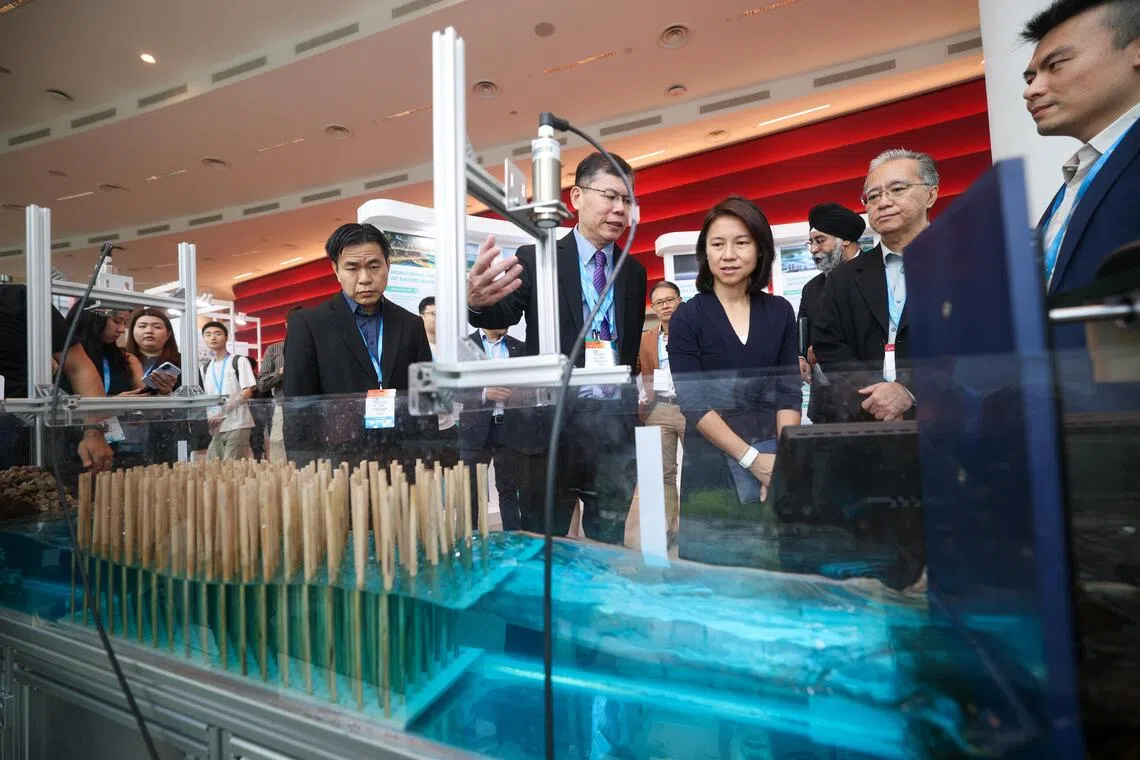
Senior Parliamentary Secretary Goh Hanyan (3rd from right) at CFI Singapore’s 3rd Annual Symposium held at the SIT Punggol Campus on Oct 21.
PHOTO: LIANHE ZAOBAO
Published Oct 21, 2026, 05:35 PM
Updated Oct 21, 2026, 05:35 PM
Singapore will spend another "$135 million" on coastal protection and flood resilience research, under the new Coastal and Flood Resilience Funding Initiative announced by Goh Hanyan.
The money will support work on better tidal gates, pumping stations, construction methods, and digital tools for early warning and predictive maintenance, with PUB to call for proposals from 2027.
The plan responds to rising flood risks from heavier rain, higher sea levels and storm surges, and aims for compact, energy-efficient systems that can also fit public and green spaces.
SINGAPORE – Singapore is injecting another $135 million for coastal protection and flood resilience.
The new tranche of funds will go towards research for practical solutions in three areas – to improve construction efficiency for future coastal works; optimise tidal gates and pumping stations for dense urban environments; and enhance digital solutions for predictive maintenance and monitoring.
The new Coastal and Flood Resilience (CFR) Funding Initiative was announced on Oct 21 at a symposium by Senior Parliamentary Secretary for the Ministry of Sustainability and the Environment Goh Hanyan.
She highlighted the need for Singapore to prepare for inland flooding as the climate changes, noting that when heavy rainfall coincides with higher sea levels or storm surges, excess stormwater may not drain effectively and can cause flooding to spread further inland.
Major drainage outlets will require wider drains, tidal gates and pumping stations to manage heavy rainfall in such conditions, she added.
So research is needed to explore systems that are “more compact, energy-efficient and easier to maintain, so they can fit within Singapore’s limited waterfront space”.
Speaking at the Coastal Protection and Flood Resilience Institute (CFI) Singapore’s annual symposium, Goh also noted that authorities will “explore how these facilities can be integrated with green spaces and public use, so that these flood-protection measures are not just a single-purpose infrastructure but ones that people can also enjoy”.
Senior Parliamentary Secretary for the Ministry of Sustainability and the Environment Goh Hanyan speaks during the CFI Singapore’s 3rd Annual Symposium on Oct 21. PHOTO: LIANHE ZAOBAO
Senior Parliamentary Secretary for the Ministry of Sustainability and the Environment Goh Hanyan speaks during the CFI Singapore’s 3rd Annual Symposium on Oct 21.
The new funding will also go to research in two other areas, she said.
One is to explore construction methods that require less manpower, shorten construction time, reduce the amount of land needed, and use sustainable materials like recycled waste.
The other is to focus on enhancing digital solutions, using connected sensors and remote tools for early warning and predictive maintenance.
National water agency PUB said it will begin calling for proposals under these areas from 2027.
The new $135 million tranche of funds comes from the $37 billion that had been allocated to research activities in Singapore from 2026 to 2030 under the Research, Innovation and Enterprise 2030 (RIE2030) plan.
It comes on top of the $125 million first put into establishing the Coastal Protection and Flood Management Research Programme in 2023.
To date, PUB has funded 27 projects under the programme.
Eight of these projects were awarded on Oct 21 .
One project aims to combine conventional coastal structures with natural habitats such as mangroves and corals – living components that can help protect the shore and provide ecological benefits.
Another project explores modular coastal barriers for rapid deployment during emergencies or while permanent seawalls are being repaired.
CFI Singapore executive director professor Adrian Law said at the symposium: “The scale and complexity of coastal adaptation for the world, and for Singapore as a country, mean that no single institution or discipline can address these challenges alone.”
Goh added that “coastal protection is not a one-time effort”.
“It is a continuous process of learning and improving as conditions evolve and our knowledge deepens. Research remains an essential pillar of our adaptation journey.”
Environmental issues
10 月 21 日,高级政务次长吴汉彦(右三)出席了在新加坡理工大学榜鹅校区举行的 CFI 新加坡第三届年度研讨会。
图片来源:联合早报
发布于 2026 年 10 月 21 日下午 5:35
更新于2026年10月21日下午5:35
根据吴汉彦宣布的新的“海岸和防洪韧性资助计划”,新加坡将再投入“1.35亿美元”用于海岸保护和防洪韧性研究。
这笔资金将用于改善潮汐闸门、泵站、施工方法以及用于预警和预测性维护的数字工具,公用事业局 (PUB) 将于 2027 年开始征集提案。
该计划旨在应对暴雨、海平面上升和风暴潮带来的日益严重的洪水风险,目标是建造紧凑、节能的系统,使其也能适应公共空间和绿地。
新加坡——新加坡将再投入1.35亿美元用于海岸保护和防洪。
这笔新资金将用于三个领域的实用解决方案研究——提高未来沿海工程的施工效率;优化密集城市环境中的潮汐闸门和泵站;以及增强预测性维护和监测的数字化解决方案。
10 月 21 日,可持续发展与环境部高级政务次长吴汉彦在研讨会上宣布了新的沿海和防洪韧性 (CFR) 资助计划。
她强调,随着气候变化,新加坡需要做好应对内陆洪水的准备。她指出,当强降雨与海平面上升或风暴潮同时发生时,过多的雨水可能无法有效排出,并可能导致洪水进一步蔓延到内陆。
她补充说,在这种情况下,主要排水口需要更宽的排水沟、潮汐闸门和泵站来应对强降雨。
因此,需要开展研究,探索“更紧凑、更节能、更易于维护的系统,以便它们能够适应新加坡有限的滨水空间”。
吴先生在新加坡海岸保护和防洪韧性研究所 (CFI) 的年度研讨会上发言时还指出,当局将“探索如何将这些设施与绿地和公共用途相结合,使这些防洪措施不仅仅是单一用途的基础设施,而是人们也可以享受的设施”。
新加坡永续发展及环境部高级政务次长吴汉彦于10月21日在CFI新加坡第三届年度研讨会上发表讲话。图片来源:联合早报
新加坡永续发展及环境部高级政务次长吴汉彦于 10 月 21 日在新加坡 CFI 第三届年度研讨会上发表讲话。
她表示,这笔新的资金还将用于另外两个领域的研究。
一是探索需要较少人力、缩短施工时间、减少所需土地面积以及使用可再生材料(如回收废料)的施工方法。
另一种方法是专注于增强数字化解决方案,利用联网传感器和远程工具进行早期预警和预测性维护。
国家水务局(PUB)表示,将从2027年开始就这些领域征集提案。
这笔新的 1.35 亿美元资金来自新加坡 2026 年至 2030 年根据《研究、创新和企业 2030》(RIE2030)计划分配给研究活动的 370 亿美元。
这是在 2023 年首次投入 1.25 亿美元用于建立海岸保护和洪水管理研究计划的基础上追加的。
截至目前,公用事业局已在该计划下资助了 27 个项目。
10月21日,其中8个项目获得授标。
其中一个项目旨在将传统的海岸结构与红树林和珊瑚等自然栖息地相结合——这些生物组成部分可以帮助保护海岸并提供生态效益。
另一个项目探索模块化海岸屏障,以便在紧急情况下或永久性海堤修复期间快速部署。
新加坡海岸适应研究所执行主任艾德里安·罗教授在研讨会上表示:“对于世界而言,对于新加坡这样一个国家而言,海岸适应的规模和复杂性意味着没有任何一个机构或学科能够独自应对这些挑战。”
吴先生补充说,“海岸保护不是一劳永逸的事情”。
“这是一个持续学习和改进的过程,随着情况的变化和我们知识的加深,研究仍然是我们适应之旅的重要支柱。”
环境问题