Fake SIMBA websites used in phishing scams; at least 62 cases since March虚假的SIMBA网站被用于网络钓鱼诈骗;自3月以来至少发生62起案件。
Victims searching for SIMBA top-up services on Google were directed to phishing websites that appeared among the top sponsored search results.
Victims searching for SIMBA top-up services on Google were directed to phishing websites that appeared among the top sponsored search results.
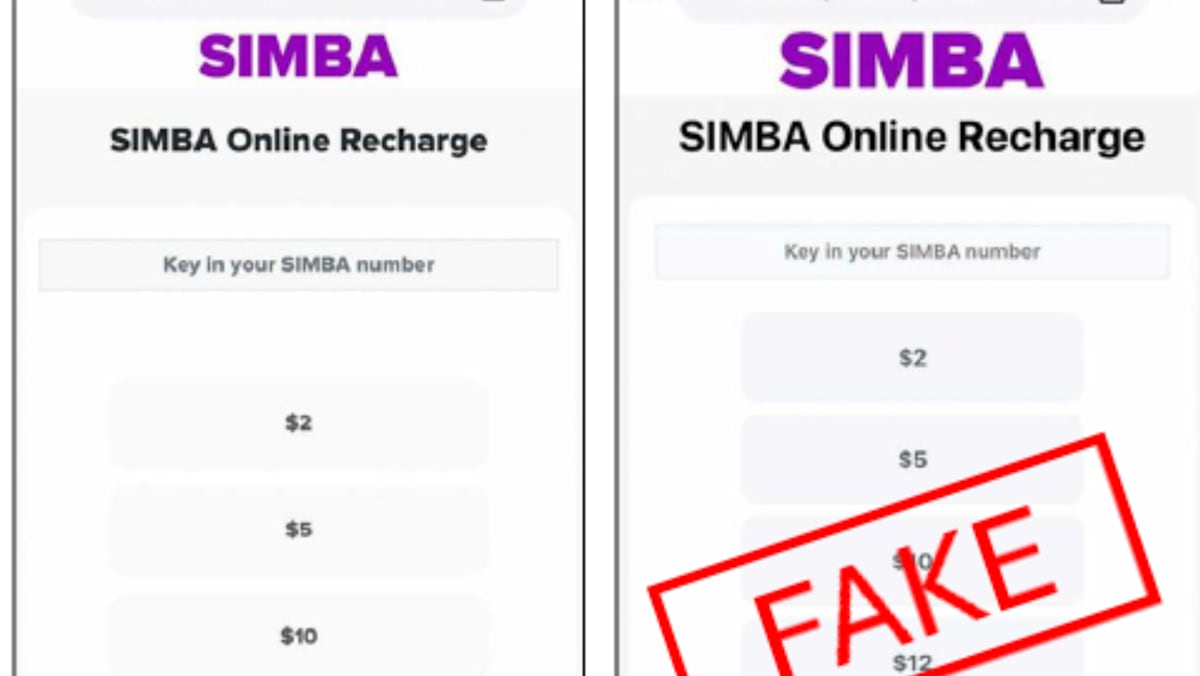
A screenshot of the legitimate SIMBA website (left) in comparison to a screenshot of a phishing website (right). (Images: Singapore Police Force)
This audio is generated by an AI tool.
SINGAPORE: At least 62 cases of phishing scams involving fake SIMBA websites have been reported since March, with losses amounting to at least S$83,000 (US$64,900), the police said on Wednesday (Oct 21).
In an advisory, the police alerted the public to an increase in scams involving websites impersonating the telecommunications provider that appear in search engine results.
Victims searching for SIMBA top-up services on Google clicked on fake websites that appeared among the top sponsored results.
They were then prompted to enter personal and banking details, including their mobile numbers and banking card information, as well as to provide digital token approval or one-time passwords on the phishing website.
CNA Games Guess Word Crack the word, one row at a time Buzzword Create words using the given letters Mini Sudoku Tiny puzzle, mighty brain teaser Mini Crossword Small grid, big challenge Word Search Spot as many words as you can Show More Show Less “Victims realised that they had been scammed when they discovered unauthorised card transactions,” the police said. The police warned that websites appearing at the top of search engine results or as sponsored advertisements can be phishing websites impersonating popular brands. “To stay safe, check the website address carefully, use a previously saved bookmark or type the known address directly instead of using search engines,” the police advised. Phishing websites use domain extensions different from SIMBA’s legitimate domain, the police said. Some examples of websites that impersonated SIMBA’s website include: simba-sg.asia, simba.sg-fastrecharge.shop, simba.sg-topup.icu and simba.sg-recharge.life.
“Victims realised that they had been scammed when they discovered unauthorised card transactions,” the police said.
The police warned that websites appearing at the top of search engine results or as sponsored advertisements can be phishing websites impersonating popular brands.
“To stay safe, check the website address carefully, use a previously saved bookmark or type the known address directly instead of using search engines,” the police advised.
Phishing websites use domain extensions different from SIMBA’s legitimate domain, the police said.
Some examples of websites that impersonated SIMBA’s website include: simba-sg.asia, simba.sg-fastrecharge.shop, simba.sg-topup.icu and simba.sg-recharge.life.
Phishing websites appear as the top sponsored search result on Google. (Image: Singapore Police Force)
Members of the public are advised to check webpage addresses carefully for any discrepancies and verify the authenticity of any links before clicking on them.
They should also add security features such as two-factor or multifactor authentication for banks and online accounts, the police said.
Individuals should also set transaction limits for internet banking transactions and install a money lock to further secure a portion of their bank savings from scams, the police advised.
Users should not disclose their personal information, bank or card details and one-time passwords to anyone.
Those who suspect they have fallen victim to a scam should contact their bank immediately to report and block fraudulent transactions, and lodge a police report.
Get our pick of top stories and thought-provoking articles in your inbox
Stay updated with notifications for breaking news and our best stories
Join our channel for the top reads for the day on your preferred chat app
在谷歌上搜索 SIMBA 充值服务的受害者被引导至出现在搜索结果顶部的钓鱼网站。
左图为新加坡国际工商会(SIMBA)官方网站截图,右图为钓鱼网站截图。(图片来源:新加坡警察部队)
这段音频由人工智能工具生成。
新加坡:警方周三(10月21日)表示,自3月份以来,已报告至少62起涉及虚假SIMBA网站的网络钓鱼诈骗案件,损失金额至少达83000新元(64900美元)。
警方发布公告,提醒公众注意,近期搜索引擎结果中出现了冒充电信运营商的网站诈骗活动。
受害者在谷歌上搜索 SIMBA 充值服务时,点击了出现在搜索结果顶部的赞助广告中的虚假网站。
然后,他们被要求输入个人和银行详细信息,包括手机号码和银行卡信息,以及在钓鱼网站上提供数字令牌授权或一次性密码。
CNA游戏 猜词游戏 逐行破解单词 流行词游戏 用给定的字母组成单词 迷你数独 小谜题,脑力挑战 迷你填字游戏 小方格,大挑战 单词搜索 尽可能多地找到单词 显示更多 显示更少 “受害者在发现未经授权的银行卡交易后才意识到自己被骗了,”警方表示。警方警告说,出现在搜索引擎结果顶部或作为赞助广告的网站可能是冒充知名品牌的钓鱼网站。“为了安全起见,请仔细检查网站地址,使用之前保存的书签或直接输入已知地址,而不是使用搜索引擎,”警方建议道。警方表示,钓鱼网站使用的域名后缀与SIMBA的合法域名不同。一些冒充SIMBA网站的网站示例包括:simba-sg.asia、simba.sg-fastrecharge.shop、simba.sg-topup.icu 和 simba.sg-recharge.life。
警方表示:“受害者在发现未经授权的银行卡交易后才意识到自己被骗了。”
警方警告称,出现在搜索引擎结果顶部或作为赞助广告出现的网站可能是冒充知名品牌的钓鱼网站。
警方建议:“为了安全起见,请仔细检查网站地址,使用之前保存的书签或直接输入已知的地址,而不是使用搜索引擎。”
警方表示,钓鱼网站使用的域名后缀与SIMBA的合法域名不同。
一些冒充 SIMBA 网站的网站示例包括:simba-sg.asia、simba.sg-fastrecharge.shop、simba.sg-topup.icu 和 simba.sg-recharge.life。
钓鱼网站出现在谷歌搜索结果的顶部,成为付费广告。(图片:新加坡警察部队)
建议公众在点击任何链接之前,仔细检查网页地址是否存在任何差异,并验证链接的真实性。
警方表示,他们还应该为银行和在线账户增加双因素或多因素身份验证等安全功能。
警方建议,个人还应为网上银行交易设定交易限额,并安装资金锁定功能,以进一步保护部分银行存款免受诈骗。
用户不应向任何人透露自己的个人信息、银行或银行卡详细信息以及一次性密码。
怀疑自己成为诈骗受害者的人应立即联系银行举报并阻止欺诈交易,并向警方报案。
订阅我们的邮件,即可获取精选热点新闻和引人深思的文章。
订阅通知,第一时间获取突发新闻和精彩报道。
加入我们的频道,即可在您常用的聊天应用上获取当日热门文章。