France, UK embrace fully drone-based naval mine hunting with new tech法国和英国全面采用无人机进行水雷清除,并运用了新技术
Novel systems include a portable operations center, unmanned surface vehicles for finding mines, and underwater drones for disabling them.
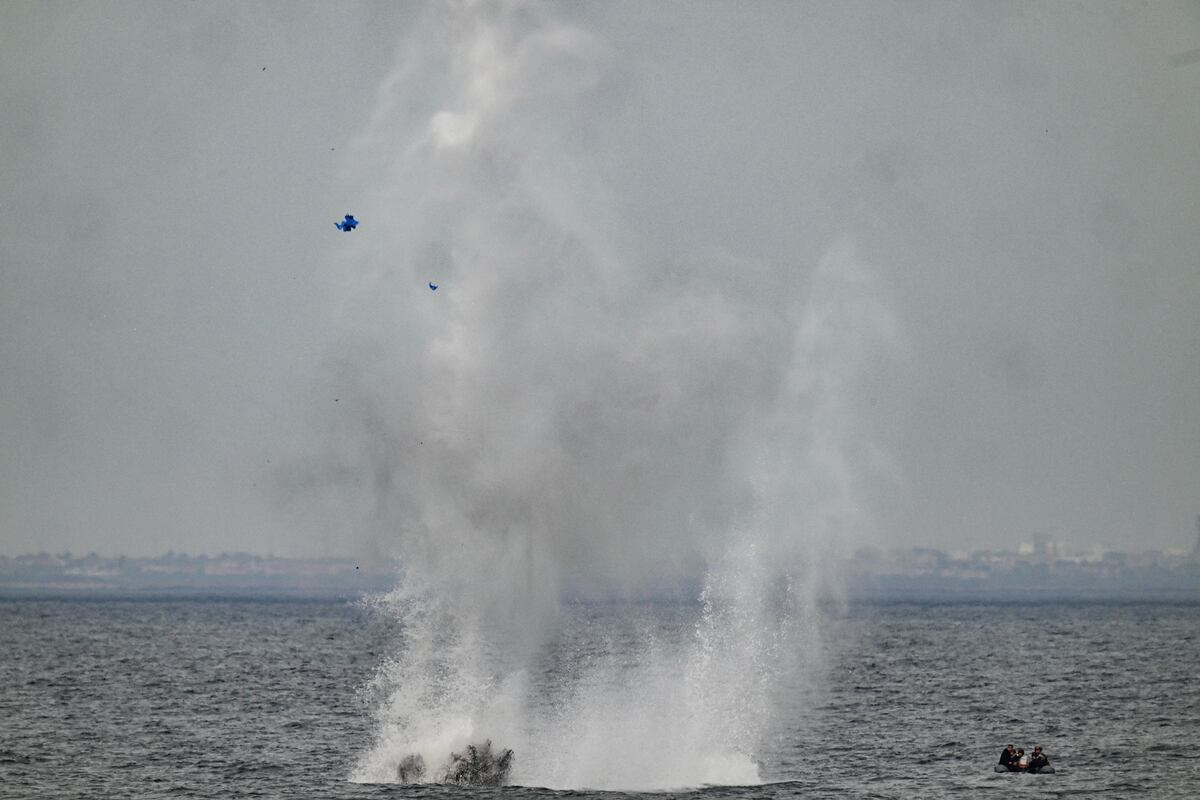
PARIS — Thales will provide the French Navy with its first production version of an autonomous mine-hunting system by the end of the year as a first step to fully remote mine warfare, with the first system for the U.K.’s Royal Navy following in early 2025, the company said.
France and the U.K. are moving to stand-off mine countermeasures, a choice also made by the Netherlands and Belgium, while others including Italy and Germany are sticking with crewed minehunter vessels augmented by remote vehicles and drones, said Chris Cunnell. the Thales product line manager for autonomous mine countermeasures.
“Navies are going one of two routes,” Cunnell told Defense News at the Euronaval industry show outside Paris last week. “They’re either going to complete standoff – U.K., France, Belgium, Netherlands, the U.S. are all going a very similar route: They want to have crew outside of the minefield. Other navies have a philosophy that they continue to want to have a crewed mine-hunting capability, so that’s a vessel that will go into the minefield.”
The fully remote option has only now become really possible, according to Cunnell. Thales spent nearly 10 years developing the system it is delivering to France and the U.K., and started sea trials towards the end of 2020.
“If you look at what the Italian Navy are doing, if you look at Germany, very different philosophies,” Cunnell said. “From a Thales perspective, we respect the fact that navies have different approaches, we can provide a toolbox and a system for both. It’s up to them.”
The systems for France and the U.K. include a portable operations center, unmanned surface vehicles using detection methods including towed sonar, and a remotely-operated vehicle to neutralize mines. Autonomous functionality in the system includes deployment and operation of payloads, as well as navigation by the unmanned surface vehicles, according to Cunnell.
The towed sonar provided by Thales uses multi-aspect synthetic aperture that is “very operationally efficient” at reducing false positives, which combined with system maturity and the open architecture makes the Thales system “the best out there,” according to Cunnell.
Thales sees “a lot of export opportunities” for the system, CEO Patrice Caine said in an interview at Euronaval “There are a lot of countries looking at it and saying, `We also want to keep our sailors safe,’ so to say.”
He told Defense News the company is in talks with potential customers, declining to provide further details.
As part of the program, France is buying eight autonomous underwater drones from French firm Exail equipped with high-resolution sonar from Thales, with an option to acquire eight more, the Armed Forces said in a statement late Thursday. The first drones are expected to be delivered in the first half of 2028, with eight drones delivered to the Navy by mid-2030.
The drones will have a length of 5 meters and a diameter of around 47 centimeters, weigh 500 kilograms, have 10 hours of mission autonomy and an ability to dive to 300 meters.
The autonomous minehunting system is designed to replace all of France’s current mine warfare resources, including minehunters, sonar-towing vessels and diving vessels, the ministry said.
Mine detection is also evolving, and Thales has been experimenting with light detection and ranging, “lidar” for short, for mine hunting, analogous to how radar uses electromagnetic waves and sonar uses sound propagation.
The testing is linked to the Royal Navy’s Peregrine program, which has Thales working with helicopter-drone maker Schiebel to supply the U.K. with a naval surveillance UAV. The companies are looking at new payloads and capabilities to integrate, including lidar, James Dickie, product line architect for mine warfare systems at Thales in the U.K., told Defense News.
The biggest challenge for lidar lies in applying sufficient energy so there’s enough light in the water column, and Thales for that reason is looking at applications for mine detection in relatively shallow waters of up to about 20 meters.
Lidar will probably not replace sonar, and Thales for now sees the technology as complementary. One advantage is that light can be used for detection in the turbulent upper layers of the ocean, the “bubble layer,” where sonar is less dependable as it doesn’t work in air, according to Dickie.
Sonar “finds it’s really hard to travel through bubbles,” Dickie said. Thales is focused on using lidar for the layer of 3 to 5 meters “where we do have the challenge with acoustic technology.”
One of the reasons why Thales has looked at lidar is the surface mine threat in the Black Sea, where mines have broken free from their tether and are floating around. Black Sea countries are going to need a solution for drifting mines, according to Dickie.
“They’re really difficult to manage,” Dickie said. “The solution today is a person with binoculars looking for them. That’s not very reliable.”
The company is looking at a range of sensors for mine detection, including electro-optical, thermal, long-wave infrared and millimeter radar, for use from airborne platforms such as drones, but also from unmanned surface vehicles. Dickie said he expects lidar to have underwater applications, complementary to other detection methods.
“We’re not saying one is better than the other, it’s more about how we can use them for the given context,” Dickie said. “If it’s a poor-visibility day, camera is not going to work, but you’re going to get some utility from lidar and you’ll get some utility from radar. So it’s about finding the right sensor for the job.”
Mines are starting to be designed with geometries and materials to make acoustic sensing less effective, and lidar may have a role to play there, as well as technologies such as quantum magnetometers, according to Dickie.
Rudy Ruitenberg is a Europe correspondent for Defense News. He started his career at Bloomberg News and has experience reporting on technology, commodity markets and politics.
巴黎——泰雷兹公司表示,该公司将于今年年底前向法国海军提供首个量产版自主扫雷系统,这是迈向完全远程扫雷战的第一步;英国皇家海军的首个系统将于 2025 年初交付。
泰雷兹公司自主扫雷产品线经理克里斯·坎内尔表示,法国和英国正在转向远程扫雷措施,荷兰和比利时也做出了同样的选择,而包括意大利和德国在内的其他国家则坚持使用有人驾驶的扫雷艇,并辅以远程车辆和无人机。
“各国海军正走两条路,”坎内尔上周在巴黎郊外举行的欧洲海军工业展上告诉《防务新闻》,“要么完全避免雷区内人员活动——英国、法国、比利时、荷兰和美国都采取了非常相似的做法:他们希望船员待在雷区外。要么其他国家的海军则秉持着继续保持有人驾驶扫雷能力的理念,因此他们的舰艇会进入雷区。”
坎内尔表示,完全远程操控方案直到现在才真正成为可能。泰雷兹公司花了近十年时间研发这套向法国和英国交付的系统,并于2020年底开始进行海上试验。
“看看意大利海军的做法,再看看德国海军,就会发现它们的理念截然不同,”坎内尔说。“从泰雷兹的角度来看,我们尊重各国海军采取不同方法的事实,我们可以为两者提供工具和系统。最终决定权在他们手中。”
据坎内尔介绍,法国和英国的这套系统包括一个便携式作战中心、使用拖曳声呐等探测手段的无人水面艇,以及一个用于排除水雷的遥控潜水器。该系统的自主功能包括有效载荷的部署和操作,以及无人水面艇的导航。
泰雷兹提供的拖曳式声呐采用多方向合成孔径技术,在减少误报方面“非常高效”,再加上系统的成熟度和开放式架构,使得泰雷兹系统成为“目前最好的系统”,Cunnell 表示。
泰雷兹首席执行官帕特里斯·凯恩在欧洲海军展上接受采访时表示,该公司认为该系统“有很多出口机会”,“很多国家都在关注它,并表示‘我们也想确保我们水兵的安全’。”
他告诉《防务新闻》,该公司正在与潜在客户进行洽谈,但他拒绝透露更多细节。
法国武装部队周四晚间发表声明称,作为该计划的一部分,法国将从法国Exail公司购买8架配备泰雷兹公司高分辨率声呐的自主水下无人机,并拥有增购8架的选择权。首批无人机预计将于2028年上半年交付,到2030年中期,海军将收到全部8架无人机。
这些无人机的长度为 5 米,直径约为 47 厘米,重量为 500 公斤,具有 10 小时的任务自主性,并能够潜入 300 米深。
该部表示,这套自主式扫雷系统旨在取代法国目前所有的水雷战资源,包括扫雷艇、声呐拖曳船和潜水船。
水雷探测技术也在不断发展,泰雷兹公司一直在试验激光雷达(简称“激光雷达”)用于水雷探测,类似于雷达利用电磁波和声纳利用声波传播的方式。
此次测试与英国皇家海军的“游隼”(Peregrine)项目相关,该项目由泰雷兹公司与直升机无人机制造商希贝尔公司合作,旨在为英国提供海军监视无人机。泰雷兹英国公司水雷战系统产品线架构师詹姆斯·迪基告诉《防务新闻》,两家公司正在研究新的有效载荷和功能,包括激光雷达。
激光雷达面临的最大挑战在于施加足够的能量,使水柱中有足够的光线,因此泰雷兹公司正在研究在水深约 20 米的相对较浅水域中探测水雷的应用。
激光雷达可能不会取代声呐,泰雷兹公司目前也将其视为一种补充技术。迪基指出,激光雷达的一个优势在于,它可以在海洋湍流的上层,即“气泡层”中进行探测,而声呐在空气中无法工作,因此可靠性较低。
迪基说,声呐“很难穿过气泡”。泰雷兹公司专注于使用激光雷达探测3到5米厚的气泡层,“在这个层级,声学技术确实面临挑战”。
泰雷兹公司之所以关注激光雷达技术,原因之一是黑海的水雷威胁。黑海海域的水雷脱离系绳后四处漂浮。迪基表示,黑海沿岸国家亟需找到解决水雷漂移问题的方案。
“它们真的很难控制,”迪基说。“目前的解决办法是派人拿着望远镜去找。但这不太可靠。”
该公司正在研究一系列用于水雷探测的传感器,包括光电传感器、热成像传感器、长波红外传感器和毫米波雷达,这些传感器可用于无人机等空中平台以及无人水面艇。迪基表示,他预计激光雷达将应用于水下探测,与其他探测方法形成互补。
迪基说:“我们并不是说哪个更好,而是要看我们如何在特定情况下使用它们。如果能见度很差,摄像头就没用了,但激光雷达和雷达就能派上用场。所以关键在于找到适合任务的传感器。”
迪基表示,地雷的设计开始采用不同的几何形状和材料,以降低声学传感的效果,激光雷达以及量子磁力计等技术可能在这方面发挥作用。
鲁迪·鲁伊滕贝格是《防务新闻》的欧洲记者。他的职业生涯始于彭博新闻社,拥有报道科技、大宗商品市场和政治方面的经验。