Navy F/A-18 Super Hornet Spotted Carrying New AIM-174B And AIM-260 Long-Range Missiles Together海军F/A-18超级大黄蜂战机被发现同时携带新型AIM-174B和AIM-260远程导弹
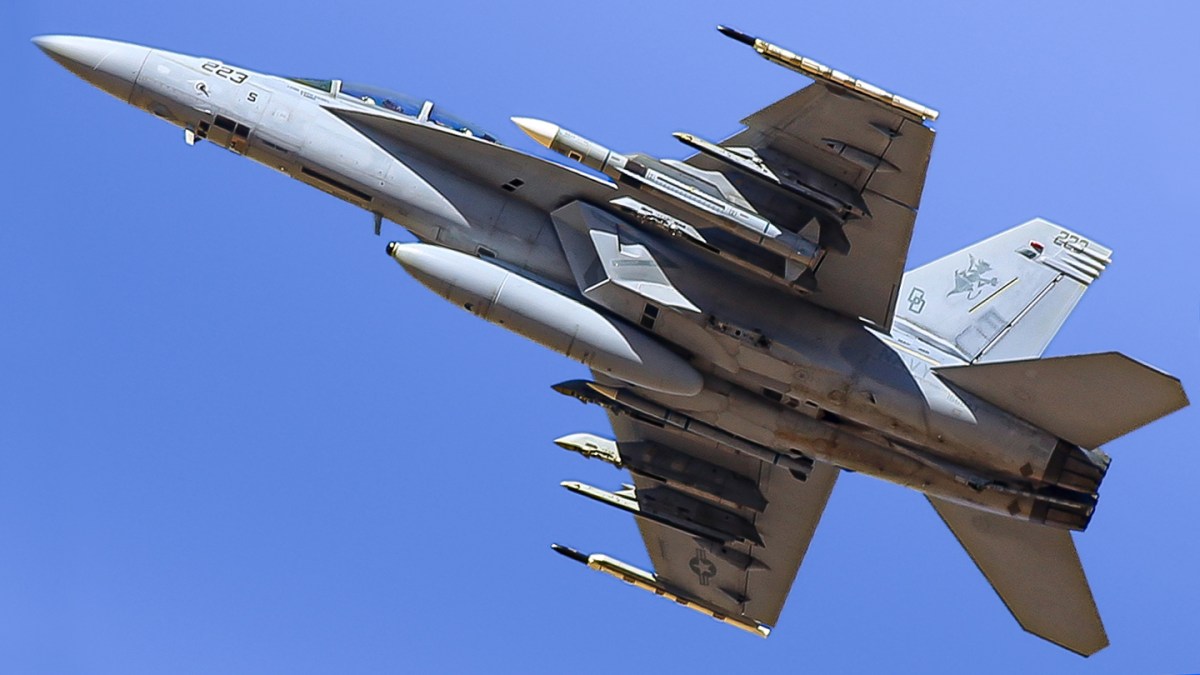
The image of the VX-31 Super Hornet gives us a glimpse of what's soon to appear in the fleet, and the two missiles will also be joined by the AIM-424 Malice. A VX-31 Super Hornet was photographed carrying both air-to-air missiles, apparently for the first time in public.
新闻视频
Published Oct 21, 2026 2:14 PM EDT
A U.S. Navy F/A-18F Super Hornet assigned to Air Test and Evaluation Squadron 31 (VX-31) has been spotted carrying both the AIM-174B and AIM-260 Joint Advanced Tactical Missile (JATM) during a flight over Ridgecrest, California. The represents the first known publicly documented instance of these two advanced air-to-air weapons appearing on the same aircraft.
The aircraft was photographed on October 14 by aviation photographer @photosxlyss2 , who shared the result with TWZ . The same Super Hornet was also carrying an IRST21 infrared search-and-track pod on its centerline station.
A close-up of the AIM-174B, AIM-260 Joint Advanced Tactical Missile, and IRST21 infrared search-and-track pod under an F/A-18F Super Hornet assigned to Air Test and Evaluation Squadron 31 (VX-31) during a flight over Ridgecrest, California. @photosxlyss2_ RY
Two critical elements of the modernization of the U.S. military’s air-to-air missile arsenal, the AIM-174B and AIM-260 provide complementary capabilities, addressing different aspects of the Navy’s evolving air-combat requirements.
Based on the SM-6 missile family, the AIM-174B provides the Navy with an extended-range air-to-air weapon. Its size and reach make it particularly relevant to engagements against high-value airborne assets, including aerial refueling tankers and airborne early warning and control aircraft .
A U.S. Navy F/A-18F Super Hornet test jet with four AIM-174B missiles under its wings. point_mugu_skies
Threatening these support platforms at extended distances complicates an adversary’s ability to sustain fighter operations, maintain airborne surveillance, and coordinate engagements across domains. Such targets are especially important in the Indo-Pacific, where distances are vast and combat aircraft may depend heavily on tanker support to reach and remain on station over contested areas.
The range of this missile is classified but should be far in excess of that of the AIM-120D AMRAAM, probably in the hundreds of miles, as discussed in the video below.
The AIM-174B has already appeared in several major exercises , including RIMPAC 2024 and Northern Edge 2025. Following developmental trials at RIMPAC, the weapon entered Live Fire Test and Evaluation in 2025. Some examples of the missile have since reached forward-deployed Navy squadrons in Japan.
The AIM-260, meanwhile, is being developed to provide a next-generation beyond-visual-range air-to-air capability. It is intended to address increasingly sophisticated aerial threats and improve upon the capabilities of the very widely used AIM-120 Advanced Medium Range Air-to-Air Missile (AMRAAM) family.
It was another F/A-18F from VX-31 on which the AIM-260 was first publicly seen when departing Eglin Air Force Base in Florida in May of this year. The same type of weapon has since also appeared on a Royal Australian Air Force F/A-18F, as you can read about here .
An F/A-18F from VX-31 carrying the AIM-260. Jonathan Tweedy/ @flightline_visuals
The AIM-260’s precise specifications remain classified, but it is designed to deliver significantly greater range than the AIM-120 AMRAAM while maintaining a broadly similar form factor. Its compact design is important, as the missile is intended for both external carriage and internal carriage aboard aircraft such as the F-22 Raptor and F-35 .
A rendering depicting an F-22 Raptor firing an AIM-260 JATM. U.S. Air Force
The AIM-260 is being developed to counter the growing long-range air-to-air threat posed by China’s PL-15 and other advanced missiles . Although no official range figures have been disclosed, previous reporting has indicated a target range of at least 120 miles, with the potential to reach considerably farther.
Inert PL-15s in the weapons bay of a Chinese J-20 fighter. via Chinese internet
It is unclear when the first operational AIM-260s may begin entering the U.S. inventory. Together, however, the two weapons give the Super Hornet access to a broader range of engagement options, depending not only on the range of the target, but also on the nature of the engagement and overall tactical situation.
The presence of an IRST21 pod is also noteworthy. The infrared search-and-track system passively detects and tracks airborne targets rather than relying exclusively on radar emissions.
Passive sensing is especially valuable in environments where electromagnetic emissions must be managed carefully. Although an IRST system does not automatically provide all the information needed to support a long-range missile engagement, it can contribute to a broader sensor picture and potentially help crews detect targets without immediately revealing their own position through radar emissions.
After a long and troubled development , a full-rate production contract for Block II IRST21 sensors to go into pods for U.S. Navy and U.S. Air National Guard fighters was awarded this time last year, as you can read about here .
An IRST21 built into the centerline tank on a Super Hornet during early tests. U.S. Navy
The appearance of both missiles on a VX-31 Super Hornet is a notable development in the Navy’s ongoing testing of advanced air-combat capabilities. VX-31, based at the sprawling Naval Air Weapons Station China Lake in California, conducts test and evaluation activities involving naval aviation weapons and systems.
On this occasion, the jet is carrying inert missiles (denoted by their blue bands) in a captive-carry configuration. The flight may have been part of ongoing weapons-integration testing, handling and compatibility evaluations, or another test activity.
At the very least, the configuration offers an intriguing glimpse into how a Navy Super Hornet might go into battle in a future high-end air combat scenario. Pairing the extended-range AIM-174B with the next-generation AIM-260 would provide a powerful combination.
Added to those two will be the AIM-424 Malice , an all-new, very long-range air-to-air missile, the existence of which was only disclosed in August of this year. This is reportedly a two-stage design, which should result in extreme range — said to be in excess of 250 nautical miles — and very high speed. It isn’t known where Malice slots in next to the AIM-174B, although the newer missile is purpose-designed for air launch, unlike the Standard-derived weapon.
Four AIM-424 Long Range Air-to-Air Missiles (LRAAM) are loaded on an F/A-18E Super Hornet for a test event. U.S. Navy U.S. Navy
As the service prepares for increasingly demanding scenarios in the Indo-Pacific, the new photo underscores the fact that the ability to threaten a wider range of targets at greater distances is one of the key considerations in the evolution of the Navy’s carrier-based fighter force.
With thanks to @photosxlyss2_ ; check out more of her work via PhotosxLyss on Facebook .
Comments couldn’t be loaded. Please refresh the page.
发布于美国东部时间2026年10月21日下午2:14
美国海军第31空中测试与评估中队(VX-31)的一架F/A-18F超级大黄蜂战斗机在加利福尼亚州里奇克雷斯特上空飞行时,被发现携带了AIM-174B和AIM-260联合先进战术导弹(JATM)。这是目前已知首次有公开记录的同一架飞机同时携带这两种先进空空导弹的案例。
这架飞机于10月14日由航空摄影师@photosxlyss2拍摄,并将照片分享给了TWZ。同一架超级大黄蜂战斗机还在机身中线挂架上挂载了IRST21红外搜索跟踪吊舱。
这张照片特写展示了隶属于第31空中测试与评估中队(VX-31)的一架F/A-18F“超级大黄蜂”战斗机在加利福尼亚州里奇克雷斯特上空飞行时,机身下方挂载的AIM-174B、AIM-260联合先进战术导弹和IRST21红外搜索跟踪吊舱。@photosxlyss2_ RY
AIM-174B 和 AIM-260 是美国军方空空导弹库现代化建设的两个关键要素,它们提供互补的能力,满足海军不断变化的空战需求的不同方面。
AIM-174B导弹以SM-6导弹系列为基础,为海军提供了一种远程空对空武器。其尺寸和射程使其在打击高价值空中目标方面尤为重要,包括空中加油机和空中预警与控制飞机。
一架美国海军F/A-18F超级大黄蜂测试机,机翼下挂载四枚AIM-174B导弹。
远距离威胁这些支援平台会削弱敌方维持战斗机作战、保持空中监视以及协调跨领域作战的能力。此类目标在印太地区尤为重要,因为该地区地域辽阔,作战飞机可能严重依赖加油机支援才能抵达并驻守在争议地区上空。
该导弹的射程属于机密,但应该远远超过 AIM-120D AMRAAM 的射程,可能达到数百英里,如下方视频中所讨论的那样。
AIM-174B导弹已经出现在包括2024年环太平洋军演和2025年北方之刃军演在内的几次重大演习中。在环太平洋军演的研发试验之后,该武器于2025年进入实弹测试与评估阶段。此后,部分导弹已交付给部署在日本的前沿海军中队。
与此同时,AIM-260正在研发中,旨在提供下一代超视距空空作战能力。它的目标是应对日益复杂的空中威胁,并改进广泛使用的AIM-120先进中程空空导弹(AMRAAM)系列的性能。
今年五月,VX-31中队的另一架F/A-18F战斗机从佛罗里达州埃格林空军基地起飞时,首次公开展示了AIM-260导弹。此后,同类型的武器也出现在澳大利亚皇家空军的一架F/A-18F战斗机上,详情请见此处。
一架隶属于VX-31中队的F/A-18F战斗机,携带AIM-260导弹。乔纳森·特威迪/ @flightline_visuals
AIM-260的具体规格仍属机密,但其设计目标是在保持大致相似外形尺寸的同时,显著提升射程,超越AIM-120 AMRAAM。其紧凑的设计至关重要,因为该导弹既可用于F-22猛禽和F-35等战机的外挂挂载,也可用于机载挂载。
一张渲染图,描绘了一架F-22猛禽战斗机发射AIM-260 JATM导弹的场景。美国空军
AIM-260导弹的研发旨在应对中国PL-15及其他先进导弹日益增长的远程空空威胁。虽然官方尚未公布射程数据,但此前的报道显示其射程至少为120英里,并且有可能远超这个范围。
中国歼-20战斗机武器舱内装有惰性PL-15导弹。(图片来自中国互联网)
目前尚不清楚首批AIM-260导弹何时才能正式列装美国空军。然而,这两种武器结合起来,使超级大黄蜂战斗机拥有更广泛的作战选择,这不仅取决于目标的距离,还取决于交战的性质和整体战术形势。
值得注意的是,该机还配备了IRST21吊舱。这种红外搜索跟踪系统能够被动地探测和跟踪空中目标,而不是完全依赖雷达辐射。
在必须严格控制电磁辐射的环境中,被动传感尤为重要。虽然红外搜索跟踪系统(IRST)不能自动提供支持远程导弹拦截所需的所有信息,但它可以增强传感器信息的整体覆盖范围,并有可能帮助机组人员在不立即通过雷达辐射暴露自身位置的情况下探测目标。
经过漫长而坎坷的发展,去年这个时候,美国海军和美国空中国民警卫队战斗机的吊舱用Block II IRST21传感器的全速生产合同正式授予,您可以在这里阅读相关内容。
早期测试期间,一架超级大黄蜂战斗机的中央油箱上安装了IRST-21卫星。美国海军
VX-31“超级大黄蜂”战斗机同时配备两款导弹,是海军持续测试先进空战能力的重要进展。VX-31中队驻扎在加利福尼亚州庞大的中国湖海军航空武器站,负责开展海军航空武器和系统的测试与评估活动。
此次飞行中,这架喷气式飞机以挂载方式携带了惰性导弹(以蓝色条纹标示)。此次飞行可能是正在进行的武器集成测试、操控性和兼容性评估或其他测试活动的一部分。
至少,这种配置让我们得以一窥海军超级大黄蜂战机在未来高端空战场景中的作战方式。将远程AIM-174B与下一代AIM-260导弹搭配使用,将形成强大的组合。
除了这两款导弹之外,还将新增AIM-424“恶意”(Malice)导弹,这是一款全新的超远程空空导弹,其存在直到今年8月才被披露。据报道,该导弹采用两级设计,射程极远(据称超过250海里),速度也极高。目前尚不清楚“恶意”导弹在AIM-174B导弹系统中处于什么位置,尽管与基于标准导弹公司研发的AIM-174B不同,“恶意”导弹是专为空中发射而设计的。
四枚AIM-424远程空空导弹(LRAAM)装载在F/A-18E超级大黄蜂战斗机上,用于测试。美国海军
随着海军为应对印太地区日益严峻的形势做好准备,这张新照片强调了这样一个事实:在更远的距离上威胁更广泛的目标的能力,是海军航母舰载战斗机部队发展过程中的关键考虑因素之一。
感谢 @photosxlyss2_;请通过 Facebook 上的 PhotosxLyss 查看她的更多作品。
评论加载失败,请刷新页面。