Saudi Arabia’s nuclear program could outlive its government, so plan accordingly沙特阿拉伯的核计划可能会比其政府存续时间更长,因此要做好相应准备。
Nuclear technology can outlive the strategic assumptions that justified its transfer, two experts caution US lawmakers.
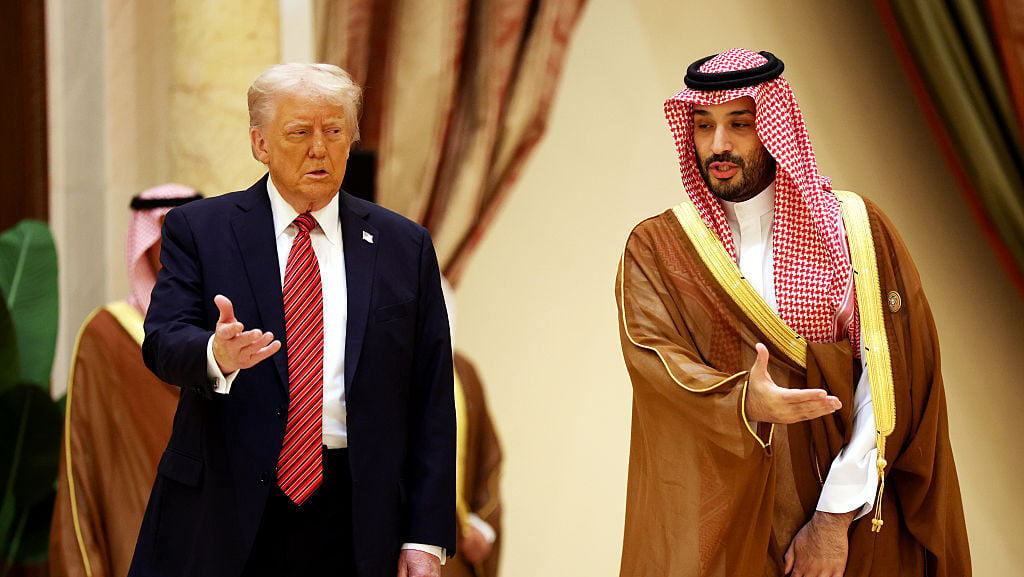
U.S. President Donald Trump and Saudi Crown Prince Mohammed bin Salman speak as they arrive during the Gulf Cooperation Council (GCC) Leaders’ Summit at The Ritz-Carlton on May 14, 2025 in Riyadh, Saudi Arabia. (Photo by Win McNamee/Getty Images)
Saudi Crown Prince Mohammed bin Salman has built his rule on security and prosperity, the simple concept that a modernized Saudi Arabia would also be a safer and more prosperous one. However, that promise is now under unprecedented strain.
Repeated missile and drone attacks have targeted Saudi airfields, threatened the Kingdom’s oil-processing hub at Abqaiq and forced the shutdown of the East-West pipeline — the strategic lifeline intended to bypass Iran’s blockade of the Strait of Hormuz. The latest attacks on Riyadh’s international airport have brought the war to the Kingdom’s capital, further exposing the limits of its defenses and the vulnerability of its economic ambitions.
The Prince still retains firm control over the security establishment, faces no organized domestic opposition capable of challenging his rule and commands substantial financial resources. But his unprecedented concentration of power has made him the indispensable center of the Saudi system, while also making the system’s fortunes increasingly inseparable from his own.
It is against this backdrop that Washington is moving forward with a nuclear cooperation agreement that could allow uranium enrichment on Saudi soil. The debate has focused on safeguards, proliferation risks and what the United States might receive in return.
But the Kingdom’s mounting security crisis raises a more fundamental question: What happens when Washington transfers nuclear capabilities designed to last half a century to a political system whose future cannot be confidently predicted? And what can the US Congress do to ensure there are safeguards in place should Saudi policy, by choice or not, change in the coming years?
The agreement signed in July 2026 opens a pathway to enriching uranium on Saudi soil. It provides for a two-year study of commercial enrichment, initially limited to uranium enriched to 5 percent, with additional review before any move toward 20 percent. Under the proposed arrangement, a facility would reportedly be operated by American companies using a “black box” model intended to prevent Saudi personnel from accessing sensitive centrifuge technology. However, the agreement does not require Saudi Arabia to adopt the International Atomic Energy Agency’s Additional Protocol, which provides more intrusive off-site verification measures.
The central problem, however, is not simply whether the proposed safeguards are sufficient. It is the assumption that the political circumstances under which nuclear capabilities are transferred will remain sufficiently stable over the decades in which those capabilities exist.
The current war demonstrates why such an assumption is risky. Despite enormous investments in military modernization, Saudi Arabia has struggled to protect vital infrastructure against comparatively inexpensive missiles and drones. Its efforts to diversify export routes have also revealed their limitations. The East-West pipeline, designed to reduce dependence on the Strait of Hormuz, became a target itself. Meanwhile, Houthi advances along the Red Sea have threatened another critical maritime passage, Bab el-Mandeb.
The consequences extend beyond immediate military damage. Saudi Arabia’s economic transformation depends on attracting foreign investment, expanding tourism, developing new industries and convincing international businesses that the Kingdom is a safe and predictable environment. Repeated attacks on airports, energy facilities and transportation networks undermine precisely that perception.
External military pressure, damage to critical infrastructure, mounting war costs and declining economic confidence could become far more destabilizing if compounded by a future succession crisis or fractures within the ruling elite or security establishment. Concentration of power can strengthen a regime while its center remains secure, but it can also increase vulnerability if that center comes under strain.
None of this means regime change is imminent; that is the wrong standard for nuclear policy even if it were. Washington does not need to predict the fall of the House of Saud. It needs to recognize that no one can confidently predict the character of the Saudi political order over the lifetime of a nuclear energy program.
The problem becomes considerably more serious when uranium enrichment is involved. Enrichment is not simply another component of civilian nuclear energy. It is a strategic capability that can provide a foundation for a future weapons program. A black-box arrangement may restrict access to centrifuge designs, but it cannot entirely prevent the accumulation of expertise, trained personnel and institutional knowledge. Once these capabilities exist, they cannot simply be recalled if relations with Washington deteriorate or Saudi Arabia’s political order changes.
Saudi leaders have also been unusually explicit about the strategic significance of nuclear capabilities. In 2018, Mohammed bin Salman declared that if Iran developed a nuclear weapon, Saudi Arabia would follow suit. More recently, the Kingdom’s defense agreement with nuclear-armed Pakistan introduced an additional nuclear dimension into Riyadh’s security relationships, even if subsequent Pakistani statements qualified the extent of those commitments.
Iran provides an uncomfortable historical warning. The US helped establish Iran’s civilian nuclear program when the Shah was one of Washington’s closest regional partners. Under Atoms for Peace, Washington supplied Iran’s first research reactor and helped train Iranian nuclear scientists.
Then the political system changed.
The Islamic Republic’s present enrichment capabilities were not simply inherited from the American-supported program, of course. But the larger lesson remains: nuclear institutions, expertise and ambitions can survive the political order under which they were created. Technology can outlive the strategic assumptions that justified its transfer.
Congress should therefore examine more than proliferation safeguards. It should also conduct a political durability assessment. Who would control enrichment capabilities during a future succession crisis? Could nuclear facilities be secured during prolonged regional conflict? What happens if relations with Washington deteriorate? And what political forces might ultimately inherit the infrastructure and expertise the US helped establish?
This does not mean Saudi Arabia should be denied civilian nuclear energy because its political future is uncertain. It means that the more sensitive and enduring the technology being transferred, the less policymakers should rely on confidence in today’s leadership as a substitute for durable safeguards and long-term strategic planning.
Mohammed bin Salman may successfully navigate the present crisis. But nuclear policy must account for the possibility that the Kingdom’s political character will change substantially over time.
The US is considering a decision whose consequences could endure well beyond Mohammed bin Salman and perhaps beyond the present Saudi political order itself. Nuclear reactors can operate for 50 years or more. The infrastructure, expertise and sensitive fuel-cycle capabilities associated with them can outlive governments and even political systems. An agreement concluded with Mohammed bin Salman today could therefore shape the capabilities available to Saudi leaders in the 2050s, 2060s and beyond.
The relevant question is not simply whether Washington trusts Saudi Arabia with sensitive nuclear technology today. It is whether Washington is prepared to trust the Saudi Arabia that might inherit it tomorrow.
Yoel Guzansky heads the Institute for National Security Studies’ Gulf Studies program, served on Israel’s National Security Council (2005-2010), and co-authored Fraternal Enemies: Israel and the Gulf Monarchies (2020).
Henry Sokolski runs the Nonproliferation Policy Education Center in Arlington, Virginia, served as the Pentagon’s deputy for nonproliferation policy (1989-1993) and authored Underestimated: Our Not So Peaceful Nuclear Future (2019).
2025年5月14日,美国总统唐纳德·特朗普和沙特王储穆罕默德·本·萨勒曼抵达沙特阿拉伯利雅得丽思卡尔顿酒店,出席海湾合作委员会(GCC)领导人峰会并发表讲话。(图片来源:Win McNamee/Getty Images)
沙特王储穆罕默德·本·萨勒曼的统治建立在安全与繁荣之上,他秉持着一个简单的理念:一个现代化的沙特阿拉伯也将更加安全繁荣。然而,如今这一承诺正面临前所未有的考验。
沙特阿拉伯的多个机场遭到导弹和无人机袭击,其位于阿布盖格的石油加工中心受到威胁,东西输油管道被迫关闭——这条战略生命线旨在绕过伊朗对霍尔木兹海峡的封锁。最近对利雅得国际机场的袭击将战火蔓延至沙特首都,进一步暴露了其防御能力的不足和经济雄心的脆弱性。
王子仍然牢牢掌控着安全机构,在国内没有组织严密的反对派能够挑战他的统治,并且拥有雄厚的财力。但他前所未有的权力集中,使他成为沙特体制不可或缺的核心人物,同时也使整个体制的命运与他个人的命运日益密不可分。
正是在这种背景下,华盛顿正推进一项核合作协议,该协议可能允许在沙特阿拉伯境内进行铀浓缩活动。争论的焦点集中在保障措施、扩散风险以及美国可能从中获得的回报上。
但沙特日益严重的安全危机引出了一个更根本的问题:当华盛顿将旨在持续半个世纪的核能力移交给一个未来无法准确预测的政治体制时,会发生什么?如果沙特的政策在未来几年内发生改变(无论出于自愿还是被迫),美国国会又能采取哪些措施来确保有相应的保障措施?
2026年7月签署的这项协议为在沙特阿拉伯境内进行铀浓缩开辟了道路。协议规定对商业浓缩铀进行为期两年的研究,初期浓缩铀的浓度上限为5%,在进一步提高到20%浓度之前,还需要进行额外的审查。据报道,根据拟议的安排,一座设施将由美国公司运营,并采用“黑箱”模式,旨在防止沙特人员接触到敏感的离心机技术。然而,该协议并未要求沙特阿拉伯采纳国际原子能机构的《附加议定书》,该议定书规定了更为严格的场外核查措施。
然而,核心问题并非仅仅在于所提出的保障措施是否充分,而在于核能力转移的政治环境能否在这些能力存在的数十年间保持足够稳定。
当前的战争表明,这种假设是多么冒险。尽管沙特阿拉伯在军事现代化方面投入巨资,但它仍然难以保护关键基础设施免受相对廉价的导弹和无人机的攻击。其出口路线多元化的努力也暴露出其局限性。旨在减少对霍尔木兹海峡依赖的东西输油管道本身也成为了攻击目标。与此同时,胡塞武装在红海沿岸的推进威胁着另一条重要的海上通道——曼德海峡。
其后果远不止直接的军事损失。沙特阿拉伯的经济转型依赖于吸引外资、发展旅游业、培育新兴产业,以及让国际企业相信沙特是一个安全可靠的投资环境。而机场、能源设施和交通网络的屡遭袭击,恰恰破坏了这种信任。
外部军事压力、关键基础设施受损、战争成本不断攀升以及经济信心下降,如果再加上未来的权力继承危机或统治精英或安全机构内部的分裂,可能会造成更大的不稳定。权力集中可以在政权中心保持稳固的情况下加强政权,但如果中心受到压力,权力集中也会增加政权的脆弱性。
这一切并不意味着政权更迭迫在眉睫;即便如此,这也不是衡量核政策的正确标准。华盛顿无需预测沙特王室的垮台。它需要认识到,在核能计划的整个生命周期内,没有人能够准确预测沙特政治秩序的走向。
当涉及到铀浓缩时,问题就变得严重得多。铀浓缩并非仅仅是民用核能的另一个组成部分,而是一项战略能力,可以为未来的武器计划奠定基础。黑箱协议或许可以限制离心机设计的获取,但却无法完全阻止专业知识、训练有素的人员和机构知识的积累。一旦这些能力形成,即使与华盛顿的关系恶化或沙特阿拉伯的政治秩序发生变化,也无法轻易收回。
沙特领导人对核能力的战略意义也表现出异常明确的立场。2018年,穆罕默德·本·萨勒曼宣称,如果伊朗研制出核武器,沙特阿拉伯也将效仿。最近,沙特与拥有核武器的巴基斯坦签署的防务协议,为利雅得的安全关系增添了核因素,尽管巴基斯坦随后发表的声明对这些承诺的程度有所限制。
伊朗的历史提供了一个令人不安的警示。美国曾帮助伊朗建立民用核计划,当时伊朗国王是华盛顿在该地区最亲密的伙伴之一。根据“和平利用原子能”计划,华盛顿向伊朗提供了第一座研究反应堆,并帮助培训伊朗核科学家。
随后政治体制发生了变化。
当然,伊朗伊斯兰共和国目前的浓缩铀能力并非仅仅继承自美国支持的核计划。但更重要的教训依然存在:核机构、技术和雄心壮志可以超越其诞生的政治秩序而存在。技术可以超越当初为其转让提供正当理由的战略假设而继续存在。
因此,国会不仅应审查防扩散保障措施,还应进行政治可持续性评估。在未来的权力交接危机中,谁将控制浓缩铀能力?在长期的地区冲突中,核设施能否得到保障?如果与华盛顿的关系恶化,又会发生什么?最终,哪些政治力量可能会继承美国帮助建立的基础设施和技术?
这并不意味着沙特阿拉伯的政治前景不明朗就应该被剥夺民用核能的权利。而是说,所转让的技术越敏感、越持久,决策者就越不应该依赖对当前领导层的信任来替代持久的保障措施和长期的战略规划。
穆罕默德·本·萨勒曼或许能够成功渡过当前的危机。但核政策必须考虑到沙特王国的政治性质可能会随着时间发生重大变化。
美国正在考虑一项决定,其影响可能远远超出穆罕默德·本·萨勒曼的任期,甚至可能超出沙特当前的政治秩序本身。核反应堆的运行寿命可达50年或更久。与之相关的基础设施、专业技术和精密的燃料循环能力,其寿命甚至可能超过政府或政治体制的更迭。因此,今天与穆罕默德·本·萨勒曼达成的协议,可能会影响沙特领导人在2050年代、2060年代及以后所拥有的能力。
相关的问题不仅仅是华盛顿今天是否信任沙特阿拉伯,是否信任其掌握敏感的核技术。更重要的是,华盛顿是否准备好信任明天可能继承这些技术的沙特阿拉伯。
Yoel Guzansky 领导国家安全研究所海湾研究项目,曾任以色列国家安全委员会委员(2005-2010 年),并与他人合著了《兄弟般的敌人:以色列与海湾君主国》(2020 年)。
亨利·索科尔斯基 (Henry Sokolski) 运营着位于弗吉尼亚州阿灵顿的防扩散政策教育中心,曾担任五角大楼防扩散政策副手(1989-1993 年),并著有《被低估的:我们并不那么和平的核能未来》(2019 年)。