We Now Know What This Unique Pop-Up Nose Panel On Air Force One And Nightwatch 747s Is For我们现在知道空军一号和夜间巡逻队747飞机上这种独特的弹出式机头面板是做什么用的了。
The system is totally unique to the tiny handful of 747 Jumbo Jets with aerial refueling capabilities.
新闻视频
Updated Dec 1, 2019 5:57 AM EST
The United States Air Force operates two variants of the Boeing 747, a pair of VC-25A “Air Force One” aircraft used for presidential airlift missions and four E-4B “Nightwatch” airborne command posts . Both are based on the increasingly vintage 747-200 platform and both are capable of aerial refueling. The somewhat iconic hump on their noses is where the refueling receptacle and slipway are located. The only other 747s in the world that have this feature are the KC-747s, originally referred to as KC-33s, operated by the Iranian Air Force. You can read all about those aircraft in this past article of mine . All these aircraft also share what has been something of a mysterious panel between the cockpit windscreen and the refueling receptacle. I set out to answer what this odd feature does and I ended up with a most interesting answer.
When it comes to aircraft like the VC-25A or E-4B that are covered in specialized aerials and missions system, decoding what all those humps, lumps, blisters, and apertures do is a fond pastime of the most ardent aerospace aficionados. At least for me, the panel above the refueling receptacle was pretty much the last piece of the puzzle, so I began researching it and came up with very little.
You can clearly see the panel just above the aerial refueling receptacle slipway bulge on the VC-25A. , Tyler Rogoway/Author
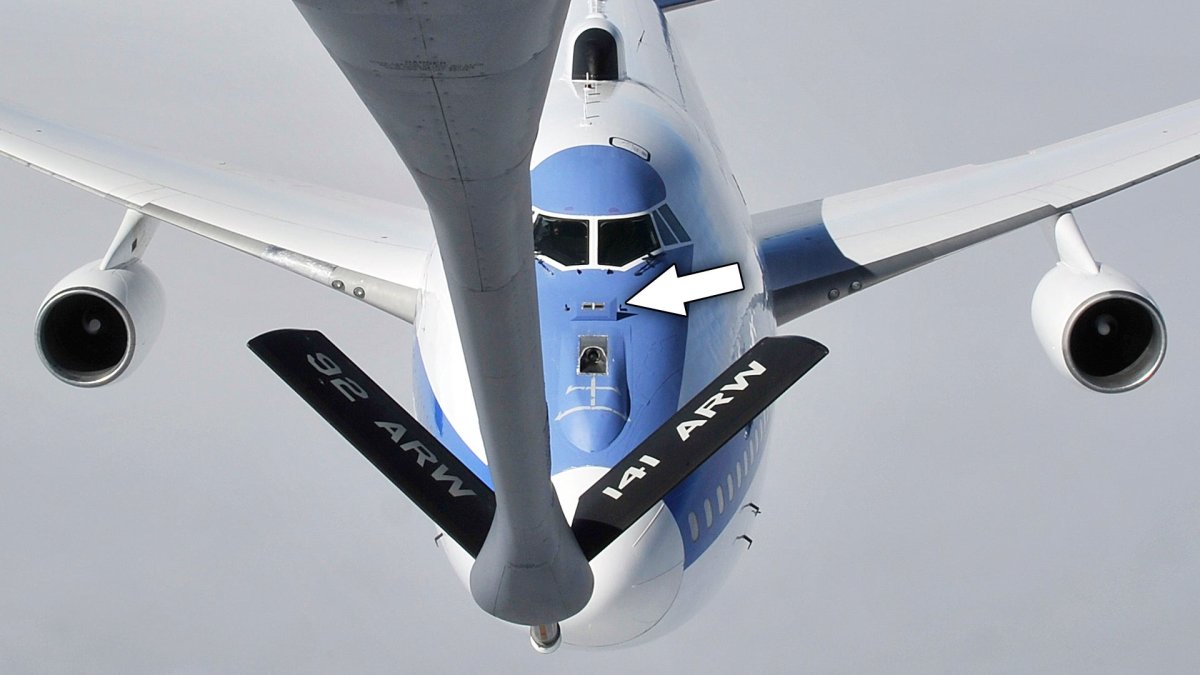
That is until I noticed a particularly clear and unobstructed photo of an E-4B refueling. When I looked closely the panel in question was clearly deployed in an upright position. In addition, it not only existed on these USAF 747s, but it was also present on Iran’s 747 tankers. So clearly, its utility rooted in the aerial refueling process. But for what? I had never seen this before on other receiver aircraft.
Beyond fulfilling a number of strategic roles for the Pentagon and the U.S. Government overall, Air Force One pilots train for air-to-air refueling contingency operations aboard the E-4B., Senior Airman Mary O’Dell (left) NATO Refueling Manual (Right)
Maybe it was meant to keep spray off the windscreen? That seemed most plausible, but I found the cockpit videos below showing E-4Bs tanking with the panel extended and a bad seal between the boom and the receptacle resulting in constant spray directly on the windscreen. So that wasn’t it.
Then I thought maybe it exists to protect the windscreen from the boom accidentally impacting it. But upon further contemplation, that seemed like an odd requirement as other aircraft have their receptacles in somewhat sensitive places and they don’t have similar deflection systems.
Frustrated, I reached out to a veteran boom operator contact of mine for answers and answers I received! It turns out that the system in question exists for aerodynamic and flight control purposes—it was a spoiler. Knowing that, I was able to find the NATO air-to-air refueling manual online, which discusses each aircraft’s unique issues when it comes to tanking.
E-4B refuelings from a KC-10. , Army Sgt. Amber I. Smith
The section for the E-4B clearly states:
The aircraft is provided with a receptacle “spoiler”, 1 foot high and 2 feet across, located just aft of the AAR receptacle. It is designed to reduce/normalize receiver pilot pitch control problems. With the spoiler retracted, receiver pilot workload is greatly increased to control E-4 pitch oscillations encountered when closing from 10 to 2 feet and when contact is made. … AAR with the receiver’s A/R spoiler retracted shall only be accomplished with a minimum of the tanker autopilot elevator axis and altitude hold engaged, and the yaw damper on.
The aircraft is provided with a receptacle “spoiler”, 1 foot high and 2 feet across, located just aft of the AAR receptacle. It is designed to reduce/normalize receiver pilot pitch control problems.
With the spoiler retracted, receiver pilot workload is greatly increased to control E-4 pitch oscillations encountered when closing from 10 to 2 feet and when contact is made.
AAR with the receiver’s A/R spoiler retracted shall only be accomplished with a minimum of the tanker autopilot elevator axis and altitude hold engaged, and the yaw damper on.
You can see the pages in question for yourself here:
So there you have it. This unique pop-up spoiler significantly helps E-4B and VC-25A pilots better control the pitch of the aircraft during delicate aerial refueling operations. In fact, executing a refueling evolution without it operable seems to be quite challenging, at least according to the manual.
The spoiler also has floodlights that help illuminate the slipway and receptacle for the boom operator.
You can see the lights on the spoiler in these nighttimes refueling operations images. , Staff Sgt. Micaiah Anthony (left), Senior Master Sgt. Ray Lewis (right)
The nose-mounted aerial refueling spoiler, just another unique thing about the world’s most unique Jumbo Jets.
Author’s note: A special thanks to Travis Ham for assisting with this article.
UPDATE: 10:30AM PDT—
An anonymous source alerted us to the patent for this system, which explains its utility in even greater depth. The patent was issued in 1979 and you can find it here . Here is one of the diagrams in it:
Contact the author: Tyler@thedrive.com
Comments couldn’t be loaded. Please refresh the page.
更新于美国东部时间2019年12月1日凌晨5:57。
美国空军运营着两种波音747机型:两架用于总统专机任务的VC-25A“空军一号”和四架E-4B“夜巡”空中指挥所。这两种机型都基于日益老旧的747-200平台,并且都具备空中加油能力。它们机头上标志性的隆起部分正是加油口和滑道的所在。世界上唯一拥有这项功能的747机型是伊朗空军运营的KC-747(最初称为KC-33)。您可以在我之前的文章中了解更多关于这些飞机的信息。所有这些飞机还有一个共同点:驾驶舱挡风玻璃和加油口之间有一个神秘的面板。我试图解开这个奇怪装置的作用,最终得到了一个非常有趣的答案。
对于像VC-25A或E-4B这样布满专用天线和任务系统的飞机来说,解读那些凸起、疙瘩、凸起和孔洞的功能是航空航天爱好者的一大乐趣。至少对我而言,空中加油口上方的面板几乎是最后一块拼图,所以我开始研究它,但收效甚微。
在VC-25A飞机上,你可以清楚地看到空中加油受油口滑道凸起上方的面板。(泰勒·罗戈威/作者)
直到我注意到一张E-4B空中加油机的清晰无遮挡照片。仔细观察后,我发现照片中那个面板明显处于竖直展开状态。此外,它不仅出现在美国空军的747飞机上,伊朗的747加油机上也有。显然,它的用途与空中加油过程息息相关。但它究竟是做什么用的呢?我以前从未在其他受油机上见过这种装置。
除了为五角大楼和美国政府承担多项战略任务外,“空军一号”飞行员还要在E-4B预警机上进行空中加油应急行动训练。高级空军士兵玛丽·奥德尔(左)北约加油手册(右)
也许是为了防止油雾溅到挡风玻璃上?这似乎是最合理的解释,但我找到了下面这些驾驶舱视频,视频显示E-4B在加油时,加油面板伸出,加油管和加油口之间的密封不良,导致油雾不断直接溅到挡风玻璃上。所以,原因并非如此。
我当时想,也许它的作用是防止吊杆意外撞击挡风玻璃。但仔细想想,这似乎有点奇怪,因为其他飞机的吊杆接口位置也比较敏感,却没有类似的偏转系统。
我感到很沮丧,于是联系了一位经验丰富的空中加油操作员朋友寻求解答,果然得到了答案!原来,这个系统是为了空气动力学和飞行控制而设计的——它其实是一个扰流板。了解了这一点后,我在网上找到了北约空中加油手册,其中详细讨论了每种飞机在空中加油时遇到的具体问题。
E-4B预警机接受KC-10加油机的空中加油。——陆军中士安珀·I·史密斯
E-4B 的相关章节明确指出:
飞机在空中加油接收机(AAR)接收机的后方设有一个高1英尺、宽2英尺的接收机扰流板。其设计目的是为了减少/规范接收机飞行员的俯仰控制问题。当扰流板收起时,接收机飞行员的工作负荷会大大增加,因为他们需要控制E-4飞机在从10英尺接近到2英尺以及建立联系时出现的俯仰振荡。……在接收机的空中加油扰流板收起的情况下进行空中加油时,至少需要启用加油机自动驾驶仪的升降舵轴和高度保持功能,并启用偏航阻尼器。
飞机在AAR接收器后方设有一个高1英尺、宽2英尺的接收器“扰流板”。其设计目的是为了减少/规范接收器飞行员的俯仰控制问题。
收起扰流板后,接收机飞行员的工作量大大增加,需要控制从 10 英尺接近到 2 英尺以及接触时遇到的 E-4 俯仰振荡。
接收机的 A/R 扰流板收起时,AAR 只能在加油机自动驾驶仪升降舵轴和高度保持装置接合、偏航阻尼器开启的最低限度下进行。
您可以在这里查看相关页面:
就是这样。这种独特的弹出式扰流板能显著帮助E-4B和VC-25A飞行员在进行精细的空中加油作业时更好地控制飞机俯仰角。事实上,根据操作手册,如果没有它,完成一次空中加油操作似乎相当具有挑战性。
扰流板还装有泛光灯,有助于照亮滑道和吊臂操作员的作业区域。
从这些夜间加油作业照片中可以看到扰流板上的指示灯。图为:参谋军士米凯亚·安东尼(左),高级军士长雷·刘易斯(右)。
机头安装的空中加油扰流板,是世界上最独特的巨型喷气式客机的又一个独特之处。
作者注:特别感谢 Travis Ham 对本文的帮助。
更新:太平洋时间上午 10:30—
一位匿名人士向我们提供了该系统的专利信息,其中更详细地解释了其用途。该专利于 1979 年颁发,您可以在这里找到它。以下是其中的一张图:
联系作者:Tyler@thedrive.com
评论加载失败,请刷新页面。