A look back at South-east Asia’s strongest fire and haze episodes回顾东南亚最严重的火灾和雾霾事件
ST traces the scorch marks of the fires compounded by strong El Nino events in recent history. Read more at straitstimes.com.
新闻视频
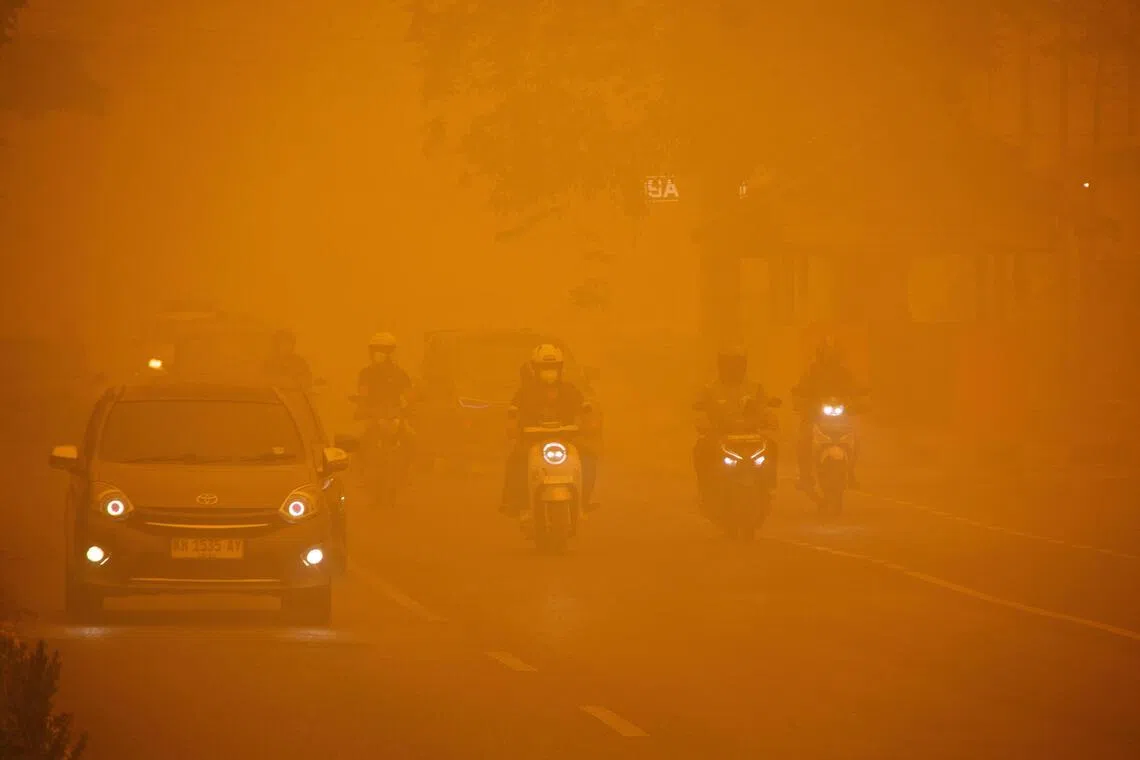
Motorists drive through an apocalyptic orange landscape in Palangka Raya, Central Kalimantan province, Indonesia, on Oct 14.
Published Oct 23, 2026, 05:00 AM
Updated Oct 23, 2026, 05:00 AM
South-east Asia has faced major haze episodes, often during strong El Nino years. Slash-and-burn land clearing in Indonesia is a key cause.
The 2026 haze is the worst in over a decade. It brought unhealthy air, school closures, flight disruptions and more than 283,000 respiratory infections in Indonesia.
Past crises in 1982, 1997 and 2015 caused huge damage, deaths and costs. They also led to protests, wildlife losses and the ASEAN haze agreement.
SINGAPORE – South-east Asia has faced multiple episodes of severe haze, with at least four of them coinciding with particularly strong El Nino years.
In 1982, 1997, 2015 and 2026, the fires in Indonesia were exacerbated by drier, hotter weather caused by the climate phenomenon.
The fires are largely caused by slash-and-burn agricultural practices used by farmers to clear land. This is illegal in Indonesia, but still often used as it is cheaper than using excavators.
The Straits Times traces the scorch marks of the fires compounded by strong El Nino events in recent history, including their impact on the region.
The current episode is the worst haze crisis to affect the region in over a decade.
Smoky pollution from the forest fires in Indonesia has been detected as far away as the Philippines. Between late August and early September, Metro Manila’s air quality fell to acutely unhealthy levels, according to media reports.
Schools have been closed and flights grounded in affected parts of Malaysia and Indonesia. Respiratory cases in both countries have grown.
Indonesia has recorded more than 283,000 cases of acute respiratory infections in affected regions from Aug 18 to Oct 13, said its Health Ministry.
In parts of Kalimantan, the fires turned the sky an apocalyptic orange, and NASA imagery showed high levels of carbon monoxide blanketing South-east Asia due to the fires.
Singapore was also ranked the most polluted city for a few days in October by Swiss-based air quality monitor IQAir.
The Republic had registered 18 consecutive days of unhealthy air starting Oct 5, surpassing the 15 days in 2015. The highest 24-hour Pollutant Standards Index (PSI) reading during this period was recorded at 10am on Oct 18, when it hit 230 in the western region, in the very unhealthy range.
The situation improved on the afternoon of Oct 22, when the 24-hour PSI returned to the good to moderate range. However, the reprieve was likely due to favourable wind conditions, with satellite maps still showing hot spots in Sumatra and Kalimantan.
The months-long blazes have also taken a toll on Indonesia’s wildlife, particularly the critically endangered Bornean orang utan, as their habitats were razed.
In September, the International Union for Conservation of Nature warned that fires were burning in habitats containing 52 per cent of Borneo’s orangutan population.
Indonesia had rescued 232 wild animals as at Oct 8, including 76 proboscis monkeys and 71 orang utans in Borneo.
The persistent fires in Kalimantan and Sumatra have sparked unrest, with protests erupting across parts of Indonesia as frustration swelled over the government’s handling of the blazes. Demonstrators demanded stronger firefighting efforts, tougher action against companies responsible for the blazes and greater protection for affected communities.
Singapore has served legal notices under its Transboundary Haze Pollution Act to 10 companies, asking them to provide more information on fire prevention and suppression strategies.
The haze provided its own filter as a woman takes a picture of the PSA from the viewing deck on the 50th floor of The Pinnacle@Duxton at around 6pm on Oct 18, 2015. PHOTO: ST FILE
The haze provided its own filter as a woman takes a picture of the PSA from the viewing deck on the 50th floor of The Pinnacle@Duxton at around 6pm on Oct 18, 2015.
The haze episode in 2015 was declared the most severe on record.
The inferno was amplified by a strong “Godzilla” El Nino. A Harvard University study estimated that the 2015 crisis caused 100,000 premature deaths across Indonesia, Malaysia and Singapore.
According to the World Bank, Indonesia’s forest fires that year cost 221 trillion rupiah (S$15.6 billion), more than twice the amount spent on reconstruction efforts after the 2004 Aceh tsunami.
In Singapore, the economic cost of the haze was estimated at $1.83 billion , or 0.45% of the country’s gross domestic product, according to a 2021 report by researchers from Nanyang Technological University’s economics division.
Schools in Singapore closed on Sept 25 when the PSI exceeded 300, hitting the hazardous range.
The Indonesian forest fires released more carbon than the entire European Union, according to a 2016 study published in Scientific Reports. In September and October 2015, the blazes spewed around 11.3 million tonnes of planet-warming carbon emissions daily.
The central business district of Singapore shrouded in haze on the evening of Sept 18, 1997. The PSI reached a record 226 at 10pm. PHOTO: ST FILE
The central business district of Singapore shrouded in haze on the evening of Sept 18, 1997. The PSI reached a record 226 at 10pm.
The fires lasted four months from July to November and cost Singapore an estimated US$163 million (S$208 million).
This was compounded by the Asian financial crisis that year.
On Sept 18, the PSI hit an all-time high of 226 at 10pm, with visibility plummeting to a few hundred metres in the worst-hit western region.
The haze crisis cost the region – including Brunei, Indonesia, Malaysia, the Philippines, Singapore and Thailand – more than US$9 billion in economic, social and environmental losses, according to the ASEAN website.
The persistent burning released an estimated one billion to two billion tonnes of carbon into the atmosphere.
Across the region, more than 40,000 people were hospitalised for respiratory and other haze-related ailments. Flights were grounded because of visibility concerns, leading to declines in tourism.
The haze also affected wildlife and pets, with dogs sneezing and songbirds going silent.
The 1997 crisis prompted the region to sign the legally binding ASEAN Agreement on Transboundary Haze Pollution in 2002. It obligates member states to take legislative and administrative measures to prevent and control land and forest fires.
The 1982 to 1983 episode was the first documented large fire and smoke episode in the second half of the 20th century in Indonesia, according to the UN Food and Agriculture Organization.
The vast fires on Borneo – dubbed the Great Fire of Borneo – were sparked by extreme drought and extensive slash-and-burn land clearing, and it has been estimated that more than five million ha of land was burned across the island, which includes East Kalimantan.
Many complained of eye irritation, and Singapore’s then anti-pollution unit detected 300 micrograms of fine suspended particles in the air.
The PSI was not used in Singapore until the 1990s.
A 2020 paper published in the Journal of International Studies found that Singapore did not consider haze pollution a health risk until 1994, when the PSI system was adopted alongside health indicators.
Additional reporting by Jean Wee
Shabana Begum is a correspondent, with a focus on environment and science, at The Straits Times.
10 月 14 日,印度尼西亚中加里曼丹省帕朗卡拉亚,驾车者驾车穿过一片末日般的橙色景观。
发布于 2026 年 10 月 23 日上午 5:00
更新于2026年10月23日上午5:00
东南亚地区曾多次遭受严重的雾霾天气,尤其是在强厄尔尼诺年份。印尼的刀耕火种式土地开垦是造成雾霾的主要原因之一。
2026年的雾霾是十多年来最严重的。它给印度尼西亚带来了不健康的空气、学校停课、航班延误和超过28.3万例呼吸道感染病例。
1982年、1997年和2015年的危机造成了巨大的损失、人员伤亡和经济损失。这些危机还引发了抗议活动、野生动物数量锐减以及东盟雾霾协议的签署。
新加坡——东南亚地区多次遭遇严重雾霾,其中至少有四次与厄尔尼诺现象特别强烈的年份重合。
1982年、1997年、2015年和2026年,印度尼西亚的火灾因气候现象导致的干燥、炎热天气而加剧。
这些火灾主要是由于农民为了清理土地而采用的刀耕火种的农业耕作方式造成的。这种做法在印度尼西亚是非法的,但由于比使用挖掘机更便宜,因此仍然经常被采用。
《海峡时报》追溯了近代史上强厄尔尼诺现象引发的火灾留下的痕迹,以及这些火灾对该地区的影响。
本次雾霾危机是该地区十多年来最严重的一次。
印尼森林大火产生的烟雾污染远至菲律宾。据媒体报道,8月下旬至9月初,马尼拉大都会区的空气质量骤降至严重不健康水平。
马来西亚和印度尼西亚受影响地区的学校已经关闭,航班也已停飞。两国呼吸道疾病病例均有所增加。
印尼卫生部表示,从 8 月 18 日至 10 月 13 日,印尼受影响地区已记录超过 283,000 例急性呼吸道感染病例。
在加里曼丹岛的部分地区,大火将天空染成了末日般的橙色,美国宇航局的图像显示,由于火灾,东南亚地区弥漫着高浓度的一氧化碳。
根据总部位于瑞士的空气质量监测机构 IQAir 的数据,新加坡在 10 月份曾连续几天被评为污染最严重的城市。
从10月5日开始,该国连续18天空气质量不佳,超过了2015年的15天。在此期间,24小时污染物标准指数(PSI)最高读数出现在10月18日上午10点,当时西部地区的PSI读数达到230,处于非常不健康的范围内。
10月22日下午,情况有所好转,24小时气压强度指数(PSI)回落至良好至中等水平。然而,这种缓解很可能是由于有利的风向条件所致,卫星地图显示苏门答腊和加里曼丹仍有高温区域。
持续数月的火灾也对印度尼西亚的野生动物造成了严重影响,特别是极度濒危的婆罗洲猩猩,因为它们的栖息地被夷为平地。
9 月,国际自然保护联盟发出警告,婆罗洲 52% 的猩猩栖息地正遭受火灾侵袭。
截至 10 月 8 日,印度尼西亚已救助了 232 只野生动物,其中包括婆罗洲的 76 只长鼻猴和 71 只猩猩。
加里曼丹岛和苏门答腊岛持续不断的火灾引发了动荡,印尼各地爆发抗议活动,民众对政府应对火灾不力感到极度不满。示威者要求加大灭火力度,对纵火公司采取更严厉的措施,并为受灾社区提供更完善的保护。
新加坡已根据其《跨境烟霾污染法》向 10 家公司发出法律通知,要求它们提供更多关于防火和灭火策略的信息。
2015年10月18日下午6点左右,在达士岭大厦50层的观景台上,一名女子正在拍摄公益广告,薄雾仿佛为画面增添了一层滤镜效果。(图片来源:海峡时报档案)
2015 年 10 月 18 日下午 6 点左右,一位女士在达士岭大厦 50 楼的观景台上拍摄公益广告时,薄雾仿佛起到了滤镜的作用。
2015年的雾霾事件被认为是历史上最严重的。
强烈的厄尔尼诺现象加剧了这场大火。哈佛大学的一项研究估计,2015年的这场危机导致印度尼西亚、马来西亚和新加坡共有10万人过早死亡。
据世界银行称,当年印尼的森林火灾造成了 221 万亿印尼盾(约合 156 亿新元)的损失,是 2004 年亚齐海啸后重建工作所花费金额的两倍多。
根据南洋理工大学经济部门研究人员 2021 年的一份报告,新加坡雾霾造成的经济损失估计为 18.3 亿美元,相当于该国国内生产总值的 0.45%。
9月25日,新加坡的PSI指数超过300,达到危险级别,学校停课。
根据2016年发表在《科学报告》上的一项研究,印尼森林大火释放的碳比整个欧盟的碳排放量还要多。2015年9月和10月,这些大火每天排放约1130万吨导致全球变暖的碳。
1997年9月18日晚,新加坡中央商务区笼罩在雾霾之中。当晚10点,新加坡烟雾指数(PSI)达到创纪录的226。照片:海峡时报档案
1997 年 9 月 18 日晚,新加坡中央商务区笼罩在雾霾之中。晚上 10 点,PSI 指数达到创纪录的 226。
从 7 月到 11 月,这场大火持续了四个月,给新加坡造成了约 1.63 亿美元(2.08 亿新元)的损失。
同年爆发的亚洲金融危机加剧了这种情况。
9 月 18 日晚上 10 点,PSI 指数达到历史最高值 226,受灾最严重的西部地区能见度骤降至几百米。
据东盟网站报道,雾霾危机给包括文莱、印度尼西亚、马来西亚、菲律宾、新加坡和泰国在内的该地区造成了超过90亿美元的经济、社会和环境损失。
持续燃烧估计向大气中释放了10亿至20亿吨碳。
整个地区有超过4万人因呼吸系统疾病和其他与雾霾相关的疾病住院治疗。由于能见度问题,航班停飞,导致旅游业下滑。
雾霾也影响了野生动物和宠物,狗打喷嚏,鸣禽停止鸣叫。
1997 年的危机促使该地区于 2002 年签署了具有法律约束力的《东盟跨境烟霾污染协定》。该协定规定成员国有义务采取立法和行政措施来预防和控制土地和森林火灾。
根据联合国粮食及农业组织的说法,1982 年至 1983 年发生的事件是 20 世纪下半叶印度尼西亚有记录以来第一次发生的大规模火灾和烟雾事件。
婆罗洲的大火——被称为婆罗洲大火——是由极端干旱和大规模刀耕火种的土地清理活动引发的,据估计,包括东加里曼丹在内的整个岛屿有超过 500 万公顷的土地被烧毁。
许多人抱怨眼睛受到刺激,新加坡当时的污染防治部门检测到空气中含有 300 微克的细颗粒物。
新加坡直到 20 世纪 90 年代才开始使用 PSI。
2020 年发表在《国际研究杂志》上的一篇论文发现,新加坡直到 1994 年才将雾霾污染视为健康风险,当时新加坡采用了 PSI 系统以及健康指标。
Jean Wee 亦有报道
沙巴娜·贝古姆是《海峡时报》的记者,主要关注环境和科学领域。