USAF Confirms Bombers Could Have A Major Air-To-Air Combat Role美国空军证实轰炸机可能在空战中扮演重要角色
Bombers are now being viewed as another potential air-to-air asset to on top of growing the fighter fleet and establishing a CCA force.
新闻视频
By Joseph Trevithick
Published Oct 22, 2026 5:31 PM EDT
The U.S. Air Force is exploring options for adding air-to-air combat capabilities to its bombers as part of efforts adjacent to its latest fighter force structure plans . The service has raised the possibility of the B-21 Raider, specifically , taking on an air-to-air role, and potentially doing so in cooperation with Collaborative Combat Aircraft (CCA) drones, in the past. As TWZ has explored for years , the B-21’s inherent attributes – size, extreme range, high operating ceiling, broadband low-observability (stealthiness), and advanced sensors – could actually make it especially well suited to taking part in air-to-air combat missions. The Air Force’s other bombers could also be part of these future plans.
Aviation Week was first to report on the potential for bombers to help bolster the Air Force’s air-to-air combat capacity after obtaining a copy of a new long-term fighter force structure report submitted to Congress last week. Media coverage of this report first began to appear earlier this week following a roundtable on Tuesday with Lt. Gen. David Tabor, the service’s Deputy Chief of Staff for Plans and Programs. The full report, which is unclassified, was not disseminated to reporters at that time.
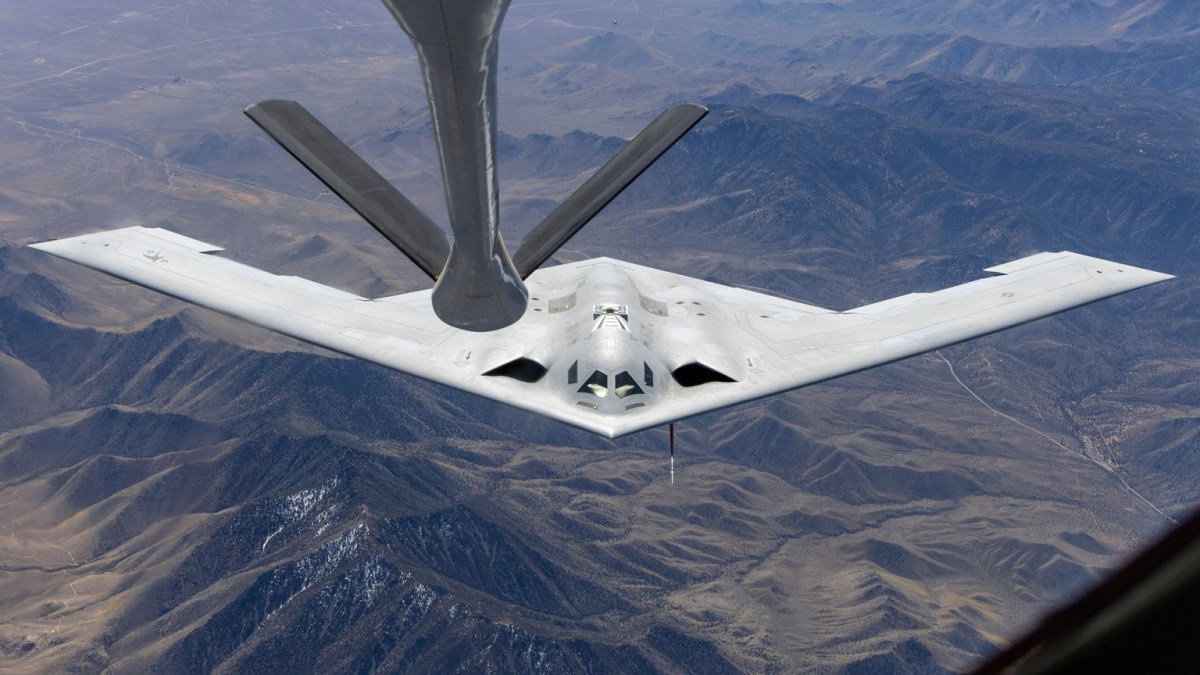
Pre-production B-21 Raider bombers at Edwards Air Force Base in California. USAF
The Air Force’s central goal now is having 1,509 combat-coded fighters in inventory by 2035, which is hundreds more than it has in service today. This will come from the acquisition of new F-35As , F-15EXs , and F-47s . There are already questions about how realistic this plan might be, and the service has acknowledged several hurdles it will need to overcome. You can read more about this in our initial reporting here .
The F-47, a rendering of which is seen here, is a critical component of the Air Force’s current future fighter force structure plans. USAF
“Accordingly, the USAF is also evaluating additional recapitalization options, including a new capacity fighter, increased reliance on CCAs [Collaborative Combat Aircraft], and developing air-to-air capabilities on bombers,” the latest fighter force structure report says, per Aviation Week .
“A new capacity fighter” may refer to the possible acquisition of new-production F-16 Vipers, which Lt. Gen. Tabor said at the roundtable could be an option in the future, according to an earlier story from Air & Space Forces Magazine . He also said making any such decision was not an “urgent” priority. This is also just one possibility here. The Air Force has floated ideas for other new fighter concepts beyond the F-47 in recent years. Lockheed Martin has also talked about the potential for expanding on the F-35 design .
The possibility of the Air Force buying a version of the current-generation Block 70 F-16, an example of which is seen here, has been raised. USAF A Bahraini Block 70 F-16D flown by members of the 416th Flight Test Squadron pulls away after receiving fuel from a KC-135 tanker with a crew from the 370th Flight Test Squadron during a sortie out of Edwards Air Force Base in California on March 7, 2024. USAF
At the roundtable on Tuesday, Tabor also made clear that the introduction of CCAs would influence future fighter force structure plans, but the expected scale and scope of those impacts remain unclear. He does not appear to have addressed the role bombers could play in this equation at that time. The new fighter report itself does not elaborate further on this matter, based on Aviation Week ’s story. TWZ is seeking more information.
When it comes to the possibility of Air Force bombers, and the B-21 more specifically, taking on an air-to-air role, this is not the first time the possibility has been raised, as mentioned earlier.
“As the NGAD [Next Generation Air Dominance] review goes forward, like, is it possible that what that ends up with could be the B-21 taking a larger role?” reporter Stephen Losey, working at the time for Defense News , asked then-Air Force Chief of Staff Gen. David Allvin at the Military Reporters & Editors (MRE) Conference in 2024.
“We have not taken that off the table,” the Air Force’s top officer said in response to Losey’s question, but did not elaborate.
At that time, the Air Force’s NGAD program was undergoing a deep review, and the future of the sixth-generation fighter component of the effort had come into question. The decision was ultimately made to continue pursuing plans for what has now become the F-47 .
For years now, TWZ has been highlighting how the B-21 could serve in multiple roles beyond just that of a traditional bomber, including in an air-to-air capacity . Air Force officials have themselves described the Raider as having multi-mission capabilities, which could extend into the realm of air-to-air combat.
“If we were to characterize it [NGAD] as a fighter, we would be… thinking too narrowly about what kind of airplane we need in a highly contested environment,” then-Air Force Maj. Gen. Scott Pleus, told what was then just Air Force Magazine back in 2019. “A B-21 that also has air-to-air capabilities” and can “work with the family of systems to defend itself, utilizing stealth – maybe that’s where the sixth-generation airplane comes from.”
Pleus’ comments had also tied in with adjacent discussions at the time and thereafter about how the B-21 might operate together with future CCA drones . Pleus, who was subsequently promoted to lieutenant general and whose lasting posting was as Director of Staff at the Air Force’s top headquarters at the Pentagon, retired in August.
A composite image showing the two drones – General Atomics FQ-42 Vengence and Anduril’s FQ-44 Fury – that the Air Force is acquiring now under the first phase of its CCA program. USAF
It remains unclear how the Air Force might be considering employing the B-21, or any of its other existing bombers, in air-to-air combat. This could entail loading out bombers for direct air-to-air engagements, or the integration of new capabilities to help them find targets or to otherwise enable new supporting roles, or a mix of all of the above. The process of achieving air superiority is not limited to neutralizing aerial threats, either.
As TWZ has written in the past in the context of an air-to-air role for the Raider in particular:
“The Raider has the potential to serve as a launch platform for air-to-air missiles, especially outsized very long-range types . Its payload capacity would give it the ability to carry a large volume of smaller air-to-air missiles, as well. B-21s could also employ air-to-ground munitions in support of the suppression and destruction of enemy air defenses mission (SEAD/DEAD), which is also part of the air superiority equation.”
“Maybe most significantly, the B-21s could also act as airborne nerve centers in support of counter-air missions, especially for controlling drones like the Air Force’s planned fleets of Collaborative Combat Aircraft (CCA), and have the ability to do so even in the most heavily contested of airspaces. Uncrewed aircraft, in turn, could feed targeting data back to Raiders with air-to-air loadouts. B-21s might even be able to launch some of those drones themselves.”
A head-on view of the first pre-production B-21 Raider. USAF
Deeply networked ‘kill webs’ that bring together distributed arrays of sensors and other supporting elements across vast distances and multiple domains, coupled with very-long-range air-to-air missiles , open up new operational possibilities for the use of bombers in this role more generally. Within the U.S. military, the Navy emerged as a particular leader in this space with the fielding of the AIM-174B air-launched version of the Standard Missile-6 (SM-6) and the recent disclosure of another missile in flight testing now, the AIM-424 Malice .
A US Navy Super Hornet fighter seen carrying a load of AIM-424 missiles during a flight test. USN
The Air Force has pursued similar missile developments in the past and put out a call for a new anti-air missile with a maximum range of at least 1,000 nautical miles just in June. The service has been exploring multi-stage types with modular designs that could be configured for longer and shorter-range engagements, as well. These are all just programs we know about, and do not speak to the developments the Air Force and others could have underway in the classified realm.
There is also the Defense Advanced Research Projects Agency (DARPA) LongShot program , which the Air Force, as well as the U.S. Army and Navy, have been involved with over the years. The aim of that effort is to demonstrate the concept of an air-to-air missile-carrying drone to help extend the reach and reduce the vulnerability of tactical fighters and bombers .
A rendering depicting LongShot drones being launched from a B-52 bomber, as well as F-15 fighters. General Atomics
On top of all this, tactical fighters are generally ill-suited, and in some cases outright incapable, of carrying the kinds of outsized payloads being discussed here. This underscores the potential value of incorporating bombers into this equation as a means to engage targets at extreme ranges.
Even in a closer proximity support role of fighter aircraft, B-21s, as well as B-52s , could contribute to air-to-air fight as arsenal ships for longer-range weapons, firing on demand from the rear in coordination with crewed and uncrewed platforms operating at the tip of the tactical edge. B-21s can also use their penetrating capabilities to command drones of their own that provide penetrating fighter-like capabilities.
New air-to-air capabilities on Air Force bombers could include self-protection systems, too. Years ago now, the B-21’s prime contractor, Northrop Grumman, patented an anti-missile defense system for stealthy aircraft designed to fire hard-kill interceptors. The Air Force, as well as the Navy, have openly expressed interest in similar defensive capabilities for aerial refueling tankers and other larger planes . Just being able to provide localized close-in defensive ‘bubbles’ around individual bombers could impact the calculus when it comes to future air-to-air combat requirements.
Drawings from Northrop Grumman’s aircraft anti-missile defense system patent. USPTO
To reiterate, these are all concepts we have discussed in-depth for roughly a decade .
Speaking more broadly about Air Force future fighter force structure demands, as we also wrote previously :
“In recent years, sustainment costs, broadly, have only become an increasingly serious concern for the Air Force, as well as the other branches of the U.S. military, especially when it comes to complex manned platforms, such as the F-22 Raptor and the F-35 Joint Strike Fighter . Fleet size and the readiness of those fleets are also highly pressing issues. So, at least in the near term, it’s not surprising that NGAD may end up focusing more on exploring available lower-cost options with distributed capabilities as alternatives to traditional air combat assets with highly centralized capabilities, such as manned fighter jets packed with ‘exquisite’ technologies.”
Despite the decision in the end to proceed with the more exquisite F-47, these points have only become more pronounced as time has gone on. How many F-47s the Air Force ultimately intends to buy is another question that looks to remain unanswered by the latest fighter force structure report. At the same time, there are clear signs that the Air Force is planning to significantly increase its planned B-21 fleet size. The official acquisition target has long been at least 100 Raiders, but a new topline figure is expected to come in the Fiscal Year 2028 budget proposal next year. The service is also now explicitly aiming to have at least 500 CCA drones in service by 2032 . All of this will compete for funding and other resources, at least to a degree.
A pre-production B-21 seen during a test flight. USAF
In the meantime, there has been a “persistent decline in AA [aircraft availability] rates across the USAF tactical fighter fleet,” which “is the direct mathematical consequence of operating an inventory with an average age exceeding 31 years,” the Air Force’s latest fighter force structure report says, according to Aviation Week . “As legacy platforms – such as the F-16C/D, F-15E, and A-10C – operate well beyond their original engineering service lives, they experience compounding structural fatigue, widespread corrosion, and subsystem degradation.”
“Achieving the mandated AA rates required for a peer-conflict scenario necessitates aggressive divestment of the oldest airframes to fund the procurement of highly available, modernized platforms like the F-35A and F-15EX,” the report adds, per that outlet. Furthermore, “to counter the [Chinese] industrial capacity and numerical advantage in fielding fighters like the J-20 and J-16 , the USAF must embrace a hybrid force of manned and unmanned systems.”
A Chinese J-20 fighter. PLAAF
With all this in mind, active consideration of new air-to-air roles for bombers, as well as the possibility of “increased reliance on CCAs” and the potential to acquire new current-generation F-16s, at least seems to reflect a hedge strategy on the part of the Air Force.
If nothing else, the door clearly remains open to bombers being a key part of the Air Force’s ‘fighter’ vision in the future.
Contact the author: joe@twz.com
Comments couldn’t be loaded. Please refresh the page.
作者:约瑟夫·特雷维西克
发布于美国东部时间2026年10月22日下午5:31
作为最新战斗机部队结构计划的一部分,美国空军正在探索为其轰炸机增加空对空作战能力的方案。此前,空军曾提出B-21“突袭者”轰炸机可能承担空对空作战任务,并可能与协同作战飞机(CCA)无人机协同作战。正如TWZ多年来所探讨的那样,B-21轰炸机的固有优势——尺寸大、航程远、升限高、宽带低可探测性(隐身性能)以及先进的传感器——使其非常适合执行空对空作战任务。空军的其他轰炸机也可能纳入这些未来的计划。
《航空周刊》率先报道了轰炸机可能有助于提升空军空对空作战能力,此前该刊获得了上周提交给国会的一份新的长期战斗机部队结构报告。本周早些时候,在空军负责计划和项目的副参谋长戴维·塔博尔中将周二出席圆桌会议后,媒体开始报道这份报告。这份非机密报告全文当时并未分发给记者。
加利福尼亚州爱德华兹空军基地的B-21“突袭者”轰炸机预生产型。美国空军
美国空军目前的核心目标是到2035年拥有1509架具备作战能力的战斗机,比目前在役的战斗机数量多出数百架。这将主要通过采购新型F-35A、F-15EX和F-47战斗机来实现。目前,人们对该计划的可行性仍存有疑问,空军方面也承认需要克服一些障碍。您可以在我们之前的报道中了解更多详情(链接在此)。
F-47战斗机(如图所示)是美国空军当前未来战斗机部队结构规划的关键组成部分。
据《航空周刊》报道,最新的战斗机部队结构报告称:“因此,美国空军也在评估其他更新换代方案,包括新型战斗机、更多地依赖协同作战飞机(CCA)以及在轰炸机上开发空对空作战能力。”
据《空军与太空部队杂志》早前报道,塔博尔中将在圆桌会议上表示,采购新生产的F-16“蝰蛇”战斗机可能是未来的一个选择。他还表示,做出任何此类决定并非“当务之急”。这只是其中一种可能性。近年来,空军曾提出过除F-47之外的其他新型战斗机概念。洛克希德·马丁公司也曾讨论过在F-35设计基础上进行改进的可能性。
空军有可能采购现役F-16 Block 70的改进型,如图所示。2024年3月7日,一架隶属于美国空军第416飞行测试中队的巴林空军Block 70 F-16D战斗机在加利福尼亚州爱德华兹空军基地执行飞行任务期间,从一架载有第370飞行测试中队机组人员的KC-135加油机上获得空中加油后起飞。
在周二的圆桌会议上,塔博尔也明确表示,引入协同作战能力(CCA)将影响未来的战斗机部队结构规划,但这些影响的预期规模和范围尚不明确。当时他似乎并未提及轰炸机在这一过程中可能扮演的角色。根据《航空周刊》的报道,新的战斗机报告本身也没有对此进行更详细的阐述。TWZ正在寻求更多信息。
至于空军轰炸机,特别是 B-21 轰炸机,是否有可能承担空对空作战任务,这并非首次有人提出这种可能性,正如前面提到的那样。
“随着下一代空中优势(NGAD)评估的推进,B-21 是否有可能发挥更大的作用?”当时在《防务新闻》工作的记者 Stephen Losey 在 2024 年军事记者与编辑(MRE)会议上向时任空军参谋长 David Allvin 将军提出了这个问题。
“我们还没有排除这种可能性,”空军最高官员在回答洛西的问题时说道,但没有详细说明。
当时,空军的下一代空中优势计划(NGAD)正在进行深入审查,该计划中第六代战斗机部分的未来也因此受到质疑。最终决定继续推进该计划,也就是现在的F-47。
多年来,TWZ 一直强调 B-21 轰炸机除了作为传统轰炸机外,还能承担多种任务,包括空对空作战。空军官员也曾表示,B-21 具备多任务能力,这可能延伸到空对空作战领域。
“如果我们把NGAD定义为战斗机,那就……我们对在高度对抗的环境中需要什么样的飞机考虑得太狭隘了,”时任空军少将斯科特·普勒斯在2019年接受当时名为《空军杂志》的采访时表示。“一架具备空对空作战能力的B-21”,并且能够“与同类系统协同作战,利用隐身技术进行自我防御——也许这就是第六代战机的雏形。”
普勒斯的言论也与当时及之后关于B-21轰炸机如何与未来的CCA无人机协同作战的讨论密切相关。普勒斯后来晋升为中将,其最终职位是五角大楼空军最高司令部的参谋长,并于8月退休。
这张合成图展示了美国空军目前正在其CCA计划第一阶段采购的两款无人机——通用原子公司的FQ-42“复仇”和安杜里尔公司的FQ-44“狂怒”。
目前尚不清楚空军将如何考虑在空战中使用B-21轰炸机或其任何其他现有轰炸机。这可能包括为轰炸机配备直接空战所需的武器,或整合新的能力以帮助其搜索目标或执行其他新的支援任务,也可能是上述所有方式的结合。此外,夺取制空权的过程并不仅限于消除空中威胁。
正如TWZ过去在谈到突袭者战机的空对空作战角色时所写的那样:
“突袭者”轰炸机有潜力成为空空导弹的发射平台,尤其是超大型远程导弹。其有效载荷能力也使其能够携带大量小型空空导弹。B-21轰炸机还可以使用空对地弹药来支援压制和摧毁敌方防空系统(SEAD/DEAD)任务,这也是空中优势的一部分。
“或许最重要的是,B-21轰炸机还可以作为空中指挥中心,支援反空袭任务,特别是控制无人机,例如空军计划中的协同作战飞机(CCA)机队,而且即使在竞争最激烈的空域也能做到这一点。反过来,无人机可以将目标数据传输回配备空对空武器的B-21轰炸机。B-21甚至可能能够自行发射部分无人机。”
首架B-21“突袭者”轰炸机预生产型正面照。美国空军
深度联网的“杀伤网”将分布在广阔距离和多个领域的传感器阵列和其他辅助元件整合在一起,再加上超远程空空导弹,为轰炸机在此类作战任务中的应用开辟了新的可能性。在美国军方内部,海军凭借AIM-174B空射型标准-6导弹(SM-6)的部署以及近期披露的另一款正在进行飞行测试的导弹AIM-424“恶意”(Malice)的出现,在该领域脱颖而出,成为领军力量。
一架美国海军的超级大黄蜂战斗机在飞行测试中携带了大量AIM-424导弹。
空军过去也曾进行过类似的导弹研发,并在今年6月发布了一项新型防空导弹的招标,该导弹的最大射程至少为1000海里。空军还在探索采用模块化设计的多级导弹,这种导弹可以配置用于远程和近程作战。以上仅是我们目前所知的计划,并不代表空军或其他机构可能正在进行的保密研发项目。
此外,还有美国国防高级研究计划局(DARPA)的“长射程”(LongShot)计划,多年来,美国空军、陆军和海军都参与其中。该计划的目标是验证空对空导弹无人机的概念,以帮助扩大战术战斗机和轰炸机的作战范围并降低其脆弱性。
一张渲染图描绘了从B-52轰炸机和F-15战斗机上发射LongShot无人机的场景。通用原子公司
除此之外,战术战斗机通常不适合,在某些情况下甚至根本无法携带这里讨论的那种超大型有效载荷。这凸显了将轰炸机纳入作战体系的潜在价值,使其成为打击超远距离目标的有效手段。
即使在近距离支援战斗机作战中,B-21轰炸机以及B-52轰炸机也能作为远程武器的火力支援舰参与空战,根据需求从后方与战术前沿作战的有人和无人平台协同开火。B-21轰炸机还可以利用其穿透能力指挥无人机,这些无人机具备类似战斗机的穿透能力。
空军轰炸机的新型空对空作战能力可能也包括自卫系统。多年前,B-21轰炸机的主承包商诺斯罗普·格鲁曼公司就为一种用于隐形飞机的反导防御系统申请了专利,该系统旨在拦截硬杀伤拦截弹。空军和海军都公开表示对空中加油机和其他大型飞机拥有类似的防御能力感兴趣。仅仅能够在单个轰炸机周围提供局部近距离防御“气泡”的能力,就可能对未来空战需求的考量产生重大影响。
诺斯罗普·格鲁曼公司飞机反导防御系统专利图纸。美国专利商标局
重申一下,这些都是我们近十年来深入探讨过的概念。
更广泛地来说,关于空军未来战斗机部队结构的需求,正如我们之前也写过的:
近年来,维护成本总体而言已成为美国空军以及其他军种日益关注的问题,尤其是在F-22“猛禽”和F-35联合攻击战斗机等复杂的有人驾驶平台方面。机队规模和战备状态也是迫在眉睫的问题。因此,至少在短期内,下一代空中防御局(NGAD)可能会更加注重探索成本更低、具备分布式作战能力的方案,以替代那些高度集中作战能力的传统空中作战资产,例如搭载“尖端”技术的有人驾驶战斗机,这并不令人意外。
尽管最终决定采购性能更优异的F-47,但随着时间的推移,这些问题反而愈发凸显。空军最终计划采购多少架F-47,这个问题似乎在最新的战斗机部队结构报告中仍未得到解答。与此同时,种种迹象表明,空军正计划大幅增加其B-21轰炸机的规模。官方的采购目标长期以来都是至少100架“突袭者”轰炸机,但预计明年在2028财年的预算提案中会公布新的目标数字。此外,空军目前还明确表示,到2032年,至少要有500架CCA无人机投入使用。所有这些项目都将在一定程度上争夺资金和其他资源。
一架B-21预生产型轰炸机正在进行试飞。美国空军
与此同时,据《航空周刊》报道,美国空军最新战斗机部队结构报告指出,美国空军战术战斗机机队的可用率持续下降,这是“机队平均机龄超过31年所导致的直接数学结果”。报告还指出,“由于F-16C/D、F-15E和A-10C等老旧平台早已超过其最初的工程使用寿命,它们正面临着结构疲劳加剧、腐蚀蔓延和子系统退化等问题。”
报告还指出,“为了在势均力敌的冲突场景中达到规定的防空能力,必须积极淘汰老旧机型,以资助采购F-35A和F-15EX等高可用性、现代化平台。”此外,“为了应对中国在歼-20和歼-16等战斗机方面的工业能力和数量优势,美国空军必须采用有人和无人系统相结合的混合作战模式。”
中国歼-20战斗机。中国人民解放军空军
考虑到所有这些因素,积极考虑轰炸机新的空对空作战角色,以及“增加对CCA的依赖”和采购新一代F-16战斗机的可能性,至少似乎反映了空军的一种对冲策略。
至少可以肯定的是,轰炸机在未来仍将是空军“战斗机”愿景的关键组成部分。
联系作者:joe@twz.com
评论加载失败,请刷新页面。