India moves closer to a homegrown, long-range air defense印度正朝着自主研发远程防空系统迈进
A recent interceptor test marked the first demonstration of New Delhi’s efforts to build a system that could rival the Russian-made S-400.
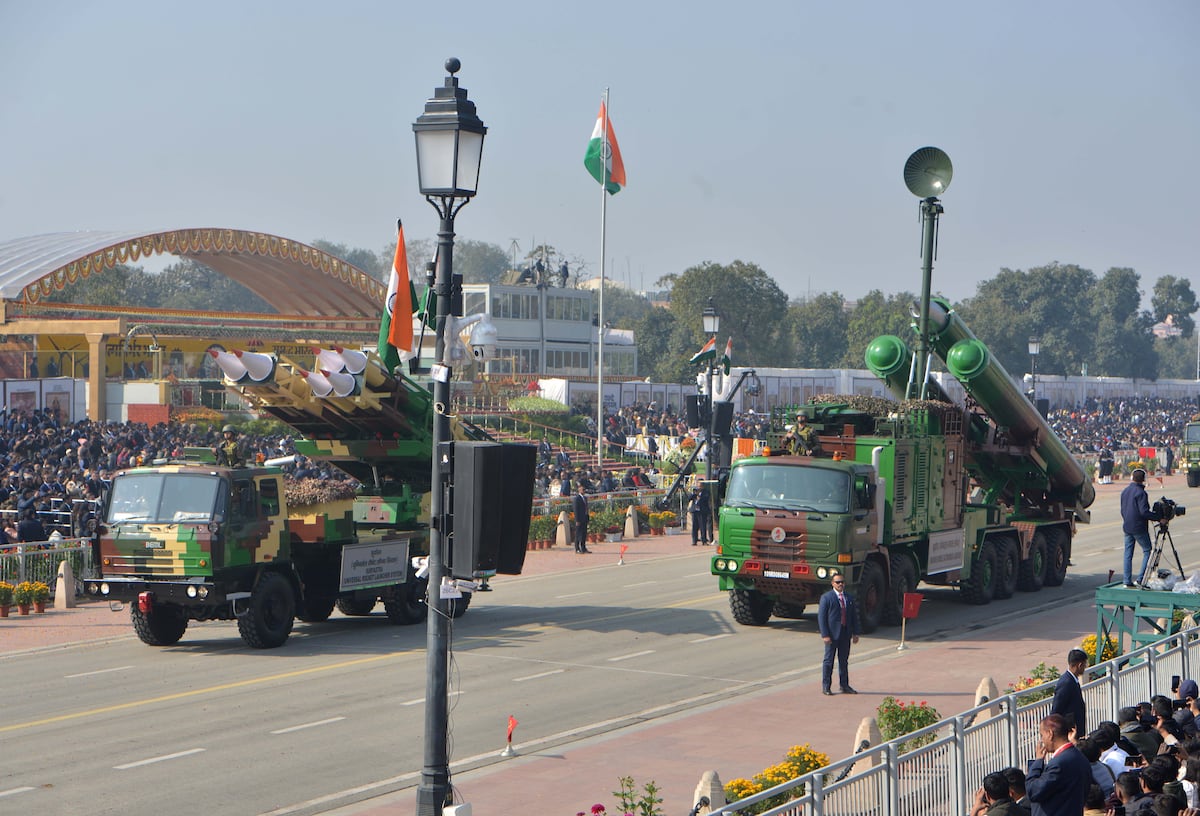
NEW DELHI — India has successfully tested a long-range surface-to-air interceptor missile, advancing development of a domestic air defense system to counter long-range aerial threats.
The Defense Ministry said that the maiden flight test intercepted a simulated high-speed, high-altitude aerial electronic target successfully, marking a “key milestone” in the program’s development. It was conducted Thursday from the A.P.J. Abdul Kalam Island off the coast of India’s eastern Odisha state.
Although India has developed short- and medium-range air defense systems, it relies heavily on Russia’s S-400 Triumf systems for long-range air defense. The Kusha, as the interceptor that was tested is called, could fill that gap.
“At present, the S-400 provides long-range coverage of about 400 kilometers, while the Barak-8 systems, co-developed with Israel provide shorter ranges of around 70 kilometers in our air defense. So there is a huge gap in between. Kusha will bridge this,” said Dinakar Peri, Fellow in the Security Studies Program at Carnegie India.
The project includes development of three variants with approximate ranges of 150 kilometers, 250 kilometers, and 350–400 kilometers. However, the official statement did not disclose the engagement range of the interceptor that was tested.
“The missile system is capable of neutralizing a wide variety of aerial threats including fighter jets, missiles, unmanned aerial vehicles and large enemy aircraft within a wide range & altitude envelope,” it said.
The test marked the first demonstration of New Delhi’s efforts to build an air-defense system that could eventually be counted in the same strategic class as Russia’s S-400 Triumf.
“The capability in developing long range surface-to-air missile systems is possessed only by a handful of nations. This will also eliminate the import dependency for such systems and signifies a giant leap in air defense capability of the nation,” Indian Defense Minister Rajnath Singh said following the test.
Analyst Peri pointed out that when validated, the variant with a range of 350 to 400 kilometers is expected to match the range of Russia’s S-400 and could complement the ones India has already deployed. The country’s long borders with Pakistan and China require wide coverage.
“The S-400 played a key role during the conflict with Pakistan last year and we have a good air defense architecture. But it may not be enough for the next potential conflict,” said Peri. “So the need is to scale up its existing long-range air defenses significantly, and this is where Kusha will play a key role. For India the reaction time, especially along the border with Pakistan, is very short, so the need is to have interceptors that can shoot down incoming aerial threats far away from population clusters.”
As India steps up its military modernization program, strengthening air defense has emerged as a priority amid the growing threats posed by drones, cruise missiles, long-range rockets and combat aircraft that are reshaping modern warfare. A $ 5.4 billion approval granted by the Defence Acquisition Council earlier this month for weapons and systems for the armed forces included counter-drone and layered air-defense capability.
New Delhi hopes that the missile system could eventually reduce its dependency on foreign systems significantly.
Following the test, the government said that all weapon system elements, including the missiles, radars and the command center, were developed in the country by the Defense Research and Development Organization and industry partners.
However India will remain reliant on foreign air defense systems for some years to come as the indigenous system still has to be validated with more trials and is only expected to be ready for operational deployment after three to four years. Earlier this year, India approved the acquisition of five additional S-400 Triumf air defense systems from Russia to reinforce its long range air defenses.
India continues to rank among the world’s largest defense importers but over the past two decades, it has intensified its push for self-reliance by expanding domestic development and production of advanced military technologies and hardware.
新德里——印度成功测试了一枚远程地对空拦截导弹,推进了国内防空系统的发展,以应对远程空中威胁。
印度国防部表示,首次飞行测试成功拦截了一枚模拟的高速高空电子目标,标志着该项目发展的一个“关键里程碑”。此次测试于周四在印度东部奥里萨邦沿海的阿卜杜勒·卡拉姆岛进行。
尽管印度已研发出短程和中程防空系统,但在远程防空方面仍严重依赖俄罗斯的S-400“凯旋”系统。此次测试的拦截导弹“库沙”有望填补这一空白。
“目前,S-400防空系统的远程覆盖范围约为400公里,而与以色列联合研制的巴拉克-8防空系统,其射程较短,约为70公里。因此,两者之间存在巨大差距。库沙防空系统将弥补这一差距,”卡内基印度安全研究项目研究员迪纳卡尔·佩里说道。
该项目包括开发三种型号,射程分别约为150公里、250公里和350-400公里。然而,官方声明并未透露测试拦截器的具体交战距离。
声明称:“该导弹系统能够在很宽的射程和高度范围内,有效应对包括战斗机、导弹、无人机和大型敌机在内的各种空中威胁。”
此次试验标志着新德里首次展示了其为建立一套最终可能与俄罗斯 S-400“凯旋”防空系统属于同一战略级别的防空系统所做的努力。
“只有少数几个国家具备研发远程地对空导弹系统的能力。这将消除对这类系统的进口依赖,标志着国家防空能力的一次巨大飞跃。”印度国防部长拉杰纳特·辛格在试验后表示。
分析师佩里指出,经验证后,射程为350至400公里的改进型防空导弹系统预计将与俄罗斯的S-400防空导弹系统射程相当,并可与印度已部署的防空系统形成互补。印度与巴基斯坦和中国接壤的漫长边界需要广泛的覆盖范围。
佩里表示:“S-400在去年与巴基斯坦的冲突中发挥了关键作用,我们拥有完善的防空体系。但这可能不足以应对下一次潜在的冲突。因此,我们需要大幅提升现有的远程防空能力,而库沙导弹系统将在这方面发挥关键作用。对印度而言,尤其是在与巴基斯坦接壤的边境地区,反应时间非常短,因此我们需要能够拦截来袭空中威胁的拦截器,这些拦截器可以远离人口密集区。”
随着印度加快军事现代化进程,加强防空能力已成为当务之急,因为无人机、巡航导弹、远程火箭和作战飞机等武器装备构成的威胁日益加剧,正在重塑现代战争格局。本月初,国防采购委员会批准了一项价值54亿美元的武器和系统采购计划,其中包括反无人机和多层防空能力。
新德里希望这套导弹系统最终能够大幅降低其对外国系统的依赖。
测试结束后,政府表示,包括导弹、雷达和指挥中心在内的所有武器系统部件,都是由国防研究与发展组织和工业合作伙伴在该国研制的。
然而,印度在未来几年仍将依赖外国防空系统,因为其国产防空系统仍需通过更多试验进行验证,预计还需要三到四年才能投入作战部署。今年早些时候,印度批准从俄罗斯采购五套S-400“凯旋”防空系统,以加强其远程防空能力。
印度仍然是世界上最大的国防进口国之一,但在过去二十年中,它通过扩大国内先进军事技术和硬件的研发和生产,加大了自力更生的力度。