Beyond STEM: Why Singapore tertiary institutions are putting more emphasis on arts and social sciences超越STEM:为什么新加坡高等院校越来越重视人文社科类学科
As AI takes on more technical and routine tasks, educators are placing greater emphasis on creativity, critical thinking, communication, empathy and real-world problem solving.
新闻视频
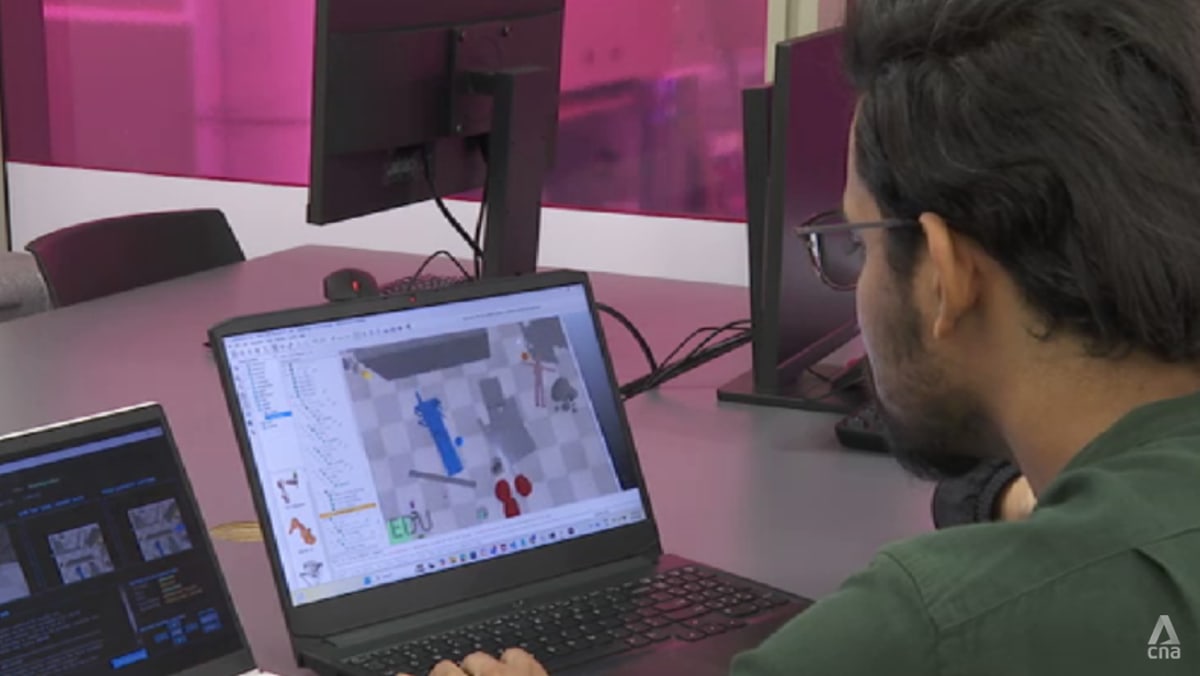
As AI takes on more technical and routine tasks, educators are placing greater emphasis on creativity, critical thinking, communication, empathy and real-world problem solving.
PSB Academy said demand for STEAM education has grown 47 per cent in the past two years. (Image: CNA)
This audio is generated by an AI tool.
SINGAPORE: Programming a robot to perform a series of movements once meant spending time writing lines of code.
Today, with artificial intelligence handling much of the technical work, students can get it done in under a minute.
That leaves them with more time to think about what they want the technology to do, and to find solutions for different scenarios.
It is a small example of a broader shift taking place in tertiary education institutions here: from STEM – science, technology, engineering and mathematics – towards STEAM, which adds arts to the mix.
CNA Games Guess Word Crack the word, one row at a time Buzzword Create words using the given letters Mini Sudoku Tiny puzzle, mighty brain teaser Mini Crossword Small grid, big challenge Word Search Spot as many words as you can Show More Show Less PSB Academy said demand for STEAM education has grown 47 per cent in the past two years, with student numbers rising from around 3,400 in 2023 to 5,000 last year. Its CEO Derrick Chang said the demand is driven by students who want to expand their skill sets beyond their main subject of study.
PSB Academy said demand for STEAM education has grown 47 per cent in the past two years, with student numbers rising from around 3,400 in 2023 to 5,000 last year.
Its CEO Derrick Chang said the demand is driven by students who want to expand their skill sets beyond their main subject of study.
He said technical students, for example, are looking to develop skills such as design thinking and communication skills, while non-technical students need to be comfortable using AI.
“Gone are the days where a technical person can just stay technical for a long time,” he said.
“As an engineer today and in the future, you need to be able to communicate your thinking, communicate your innovation.”
Noting that it was no longer “a single track”, Mr Chang said the ability to be multidisciplinary would continue to be critical to surviving in this new economy.
The private education institution is also building an Integrated STEAM Hub at Tai Seng, with larger, interdisciplinary learning spaces and high-tech facilities. The hub is expected to be ready in 2027.
FRAMING THE PROBLEM CORRECTLY
At the Singapore University of Technology and Design (SUTD), there is also a growing focus on combining technology with the humanities and social sciences.
The university said its refreshed curriculum is designed to attract students with strong interests in fields such as economics, business, psychology and philosophy, alongside those proficient in mathematics and the sciences.
Dr Grace Dixon, associate head of the programme, said these subjects should not be seen simply as “soft skills” added to a technology degree.
Instead, they help students understand the context and the problems they are trying to address before using design and AI capabilities to resolve them.
“It's not just about asking, 'can we do this', but 'should we do this', for whom and under what conditions?”
At the Singapore University of Technology and Design (SUTD), there is also a growing focus on combining technology with the humanities and social sciences. (Image: CNA)
“If you frame the problem incorrectly, even an excellent technical solution may solve the wrong problem,” she added.
At the university, students and alumni will also get funding and support via a S$35 million (US$27.6 million) investment platform to pursue entrepreneurial projects.
At the Singapore campus of James Cook University, students are similarly being pushed to tackle real-world problems.
Its new barramundi hatchery facility lets students train in conditions that mirror the aquaculture industry, including learning how to respond when things do not go according to plan.
“We're really making sure that students are problem-focused, and that they've got practical skills, and that they're resilient,” said Professor Carole-Anne Upton, the university’s deputy vice-chancellor for Singapore.
“Resilience is quite a hard thing to teach, and we talk about resilience and agility as key skills for a changing workforce."
At the Singapore campus of James Cook University, a new barramundi hatchery facility lets students train in conditions that mirror the aquaculture industry. (Image: CNA)
Other universities are taking the arts component of STEAM education more literally.
Inspired by its Arts Festival last year, Singapore Management University (SMU) is piloting a dance choreography course that explores Singapore’s culture and identity while developing creativity and empathy – skills it believes AI cannot yet replicate.
SMU’s professor of communication management (practice) Mark Chong said dance can become more than just a co-curricular activity when paired with intellectual inquiry.
“By marrying it with intellectual rigour, by using it as a platform to examine some of the cultural forces that shape the emergence of Singaporean identity … we can get students to think about not just learning dance techniques for the sake of learning the dance,” he said.
It can encourage them to ask larger questions about “what multiculturalism and national identity mean”, he added.
Inspired by its Arts Festival last year, Singapore Management University (SMU) is piloting a dance choreography course. (Image: SMU)
WHAT EMPLOYERS WANT IN THE AI ERA
The shift to adapt does not just apply to students preparing to enter the workforce.
At Kaplan, about six in 10 of its Singapore students are early or mid-career professionals.
As AI takes on more routine tasks across industries, employers are looking for a different mix of skills.
They are increasingly seeking people who can interpret information that AI gives them and turn it into decisions, said Mr Alex Chevrolle, managing director of Kaplan Singapore.
“They are looking for people that can … think about that information, analyse it, provide actionable insights, communicate those insights, advocate for them, and then collaborate with other colleagues around the business in order to execute on those insights,” he said.
A similar change is taking place at the Management Development Institute of Singapore (MDIS), where more than half its students are working adults.
A new campus next year will give students access to digital tools aimed at sparking creativity, while retaining the face-to-face learning that adult learners value.
The institute has also shifted away from exam-centred learning towards assignments based on actual business problems.
EHL Hospitality Business School, meanwhile, has seen courses taken up by working professionals rise by nearly 40 per cent year on year.
The school said adult learners are increasingly seeking practical training that can be immediately applied at work, including in people leadership, AI literacy and business transformation.
It is also seeing interest in learning that sits at the intersection of technology, business and human capabilities.
As technology continues to get smarter, educators say the premium is shifting to what people can bring to the equation – creativity, judgement and the ability to keep learning.
Get our pick of top stories and thought-provoking articles in your inbox
Stay updated with notifications for breaking news and our best stories
Join our channel for the top reads for the day on your preferred chat app
随着人工智能承担更多技术性和常规性任务,教育工作者更加重视创造力、批判性思维、沟通能力、同理心和解决现实世界问题的能力。
PSB Academy表示,过去两年里,STEAM教育的需求增长了47%。(图片来源:CNA)
这段音频由人工智能工具生成。
新加坡:过去,要让机器人执行一系列动作,需要花费时间编写代码。
如今,人工智能可以处理大部分技术工作,学生们不到一分钟就能完成。
这样一来,他们就有了更多的时间来思考他们希望这项技术实现什么目标,并为不同的场景找到解决方案。
这是本地高等教育机构正在发生的更广泛转变的一个小例子:从 STEM(科学、技术、工程和数学)转向 STEAM,后者将艺术融入其中。
CNA游戏猜词游戏:逐行破解单词;流行词游戏:用给定的字母组成单词;迷你数独:小巧的谜题,强大的脑力挑战;迷你填字游戏:小方格,大挑战;单词搜索:尽可能多地找出单词。显示更多 显示更少 PSB学院表示,过去两年对STEAM教育的需求增长了47%,学生人数从2023年的约3400人增加到去年的5000人。其首席执行官张德瑞表示,这一需求是由希望拓展主修科目以外技能的学生推动的。
PSB Academy表示,过去两年对STEAM教育的需求增长了47%,学生人数从2023年的约3400人增加到去年的5000人。
其首席执行官张德瑞表示,这种需求是由希望拓展主修科目以外技能的学生推动的。
他表示,例如,技术类学生希望培养设计思维和沟通技巧等技能,而非技术类学生则需要能够熟练使用人工智能。
他说:“技术人员可以长期从事技术工作的日子已经一去不复返了。”
“作为一名工程师,无论现在还是将来,你都需要能够表达你的想法,表达你的创新。”
张先生指出,如今已不再是“单一轨道”,多学科交叉的能力对于在新经济中生存至关重要。
这所私立教育机构还在大成校区兴建一座综合性STEAM教育中心,配备更大的跨学科学习空间和高科技设施。该中心预计将于2027年竣工。
正确地界定问题
新加坡科技设计大学(SUTD)也越来越注重将科技与人文社会科学相结合。
该大学表示,其更新后的课程旨在吸引对经济学、商业、心理学和哲学等领域有浓厚兴趣的学生,以及精通数学和科学的学生。
该项目的副负责人格蕾丝·迪克森博士表示,这些科目不应仅仅被视为添加到技术学位中的“软技能”。
相反,他们会帮助学生理解背景以及他们试图解决的问题,然后再利用设计和人工智能能力来解决这些问题。
“这不仅仅是问‘我们能不能做这件事’,而是问‘我们应该做这件事吗’,为谁做这件事,在什么条件下做这件事?”
新加坡科技设计大学(SUTD)也越来越重视将科技与人文社会科学相结合。(图片:CNA)
她补充说:“如果问题定义错误,即使是优秀的技术解决方案也可能解决错误的问题。”
大学方面,学生和校友还将通过一个3500万新元(2760万美元)的投资平台获得资金和支持,以开展创业项目。
在詹姆斯库克大学新加坡校区,学生们也同样被鼓励去解决现实世界的问题。
其新建的澳洲肺鱼孵化场设施让学生能够在模拟水产养殖业的条件下进行培训,包括学习如何在事情没有按计划进行时做出反应。
“我们正在努力确保学生以解决问题为中心,具备实用技能,并且有韧性,”该大学新加坡副校长卡罗尔-安妮·厄普顿教授说。
“韧性很难培养,而我们常说韧性和敏捷性是不断变化的劳动力的关键技能。”
在詹姆斯库克大学新加坡校区,一座新建的澳洲肺鱼孵化场让学生们能够在模拟水产养殖行业的条件下进行培训。(图片:CNA)
其他大学则更注重将 STEAM 教育中的艺术部分视为理所当然。
受去年艺术节的启发,新加坡管理大学 (SMU) 正在试行一门舞蹈编排课程,旨在探索新加坡的文化和身份认同,同时培养创造力和同理心——该大学认为人工智能目前还无法复制这些技能。
新加坡管理大学传播管理(实践)教授马克·钟表示,当舞蹈与智力探究相结合时,它就不仅仅是一项课外活动了。
他说:“通过将其与严谨的学术态度相结合,并将其作为平台来审视塑造新加坡身份认同的一些文化力量……我们可以让学生思考,学习舞蹈技巧不仅仅是为了学习舞蹈本身。”
他还补充说,这可以鼓励他们思考“多元文化主义和民族认同的意义”等更广泛的问题。
受去年艺术节的启发,新加坡管理大学(SMU)正在试行舞蹈编导课程。(图片:SMU)
人工智能时代,雇主想要什么?
这种适应性转变不仅适用于准备进入职场的学生。
Kaplan 在新加坡的学生中,约有十分之六是处于职业生涯早期或中期的专业人士。
随着人工智能在各行各业承担越来越多的常规任务,雇主们正在寻找技能组合不同的人才。
Kaplan Singapore 的总经理 Alex Chevrolle 先生表示,他们越来越需要能够解读人工智能提供的信息并将其转化为决策的人才。
他说:“他们正在寻找能够……思考这些信息、分析这些信息、提供可操作的见解、传达这些见解、倡导这些见解,然后与公司其他同事合作以执行这些见解的人。”
新加坡管理发展学院 (MDIS) 也正在发生类似的变化,该学院一半以上的学生都是在职成年人。
明年新建的校园将为学生提供旨在激发创造力的数字工具,同时保留成人学习者所重视的面对面学习。
该机构也已从以考试为中心的学习方式转向基于实际商业问题的作业。
与此同时,EHL酒店管理学院的在职专业人士选修课程的人数每年增长近40%。
该校表示,成年学习者越来越倾向于寻求能够立即应用于工作的实用培训,包括人员领导力、人工智能素养和业务转型等方面的培训。
它也看到了人们对技术、商业和人类能力交叉领域的学习的兴趣。
随着科技不断进步,教育工作者表示,人们越来越看重的是人能为教育带来的东西——创造力、判断力和持续学习的能力。
订阅我们的邮件,即可获取精选热点新闻和引人深思的文章。
订阅通知,第一时间获取突发新闻和精彩报道。
加入我们的频道,即可在您常用的聊天应用上获取当日热门文章。