Singapore supports 71% of human rights recommendations by UN member states新加坡支持联合国成员国提出的71%的人权建议。
This is more than in previous cycles of its Universal Periodic Review (UPR). Read more at straitstimes.com.
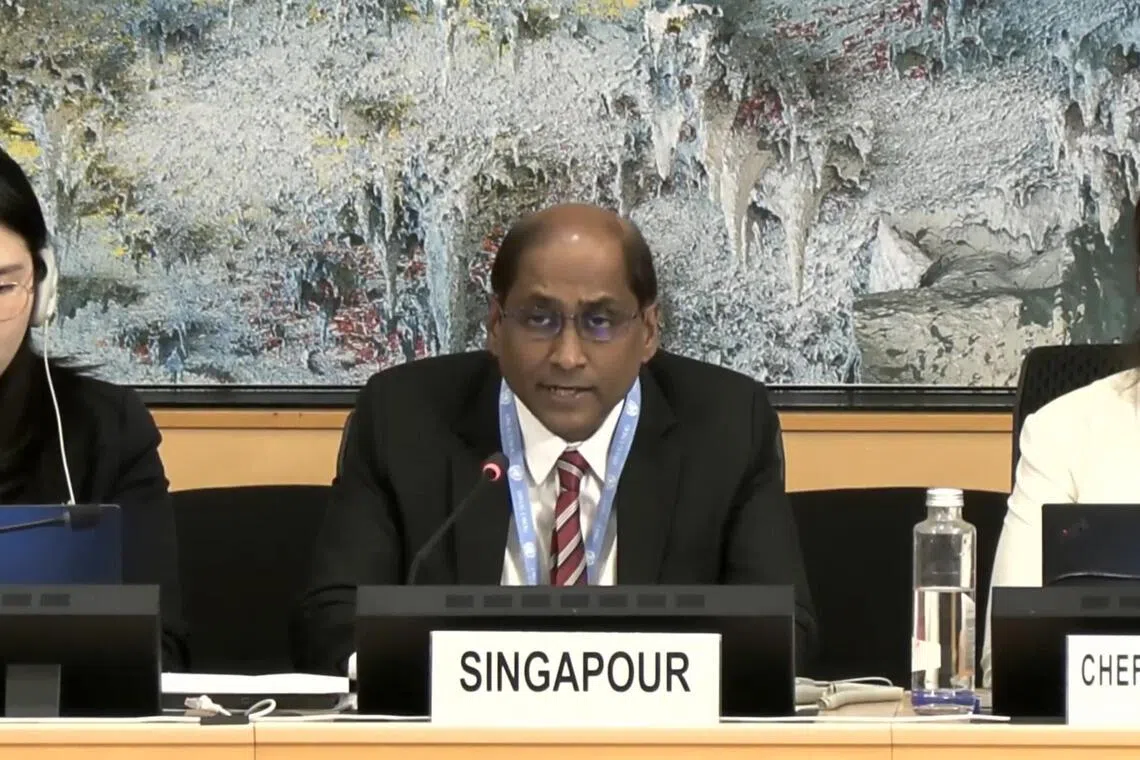
Ambassador Jaya Ratnam, Singapore’s permanent representative to the UN Office in Geneva, Switzerland, addressing delegates gathered for Singapore's fourth Universal Periodic Review on Sept 28.
Published Sep 29, 2026, 01:01 PM
Updated Sep 29, 2026, 01:01 PM
Singapore supported 71% of UN human rights recommendations, focusing on women’s empowerment, protections for vulnerable groups, and building an inclusive society.
The country emphasises pragmatism and rule of law, balancing rights with social stability, and ratifies treaties it can fully implement.
It also addressed recommendations that it did not support, including on freedom of speech, assembly, and the death penalty.
SINGAPORE - Singapore has supported 243, or 71 per cent, of the 342 recommendations made by United Nations member states as part of a regular review of the country’s human rights record.
The recommendations the Republic supported in its Universal Periodic Review (UPR) ranged from advancing women’s empowerment to enhancing protections for groups like persons with disabilities, migrant workers and low-income groups, and were adopted on Sept 28.
The UPR looks at the human rights records of all 193 member states every five years, and this was the fourth cycle. Singapore submitted its report to the UN in February and participated in its review in May, when countries provided their views and recommendations.
The city-state’s support for 71 per cent of the recommendations is higher than in previous UPR cycles, when it accepted 65 per cent of the recommendations in 2021 and 53 per cent in 2016.
Delivering the city-state’s national statement at the adoption of the UPR outcome on Sept 28, Singapore’s permanent representative to the UN Office in Geneva Jaya Ratnam said the country’s approach to human rights rests on the simple premise that progress should always be measured by tangible outcomes for its people.
Two principles that it has held on to in this regard is pragmatism, with a focus on steadily improving lives; and the rule of law, where the law is applied predictably and firmly in service of the principles of fairness, secularism, meritocracy and multi-racialism.
The ambassador said Singapore has supported recommendations that complement its efforts to build a more inclusive, cohesive and resilient society.
“Singapore’s approach to human rights has always been shaped by our diverse peoples and a pragmatic outlook,” he said. “In this spirit of continuous improvement, we will continue advancing human rights in ways that improve lives, safeguard dignity, and expand opportunities for our people.”
At the Sept 28 session in Geneva, several UN member states and civil society organisations noted Singapore’s progress in enhancing support for vulnerable groups like children, the elderly and migrant workers.
The Singapore Council of Women’s Organisations (SCWO) said the Workplace Fairness Act enacted in 2025 was an important step in strengthening protection against workplace discrimination. It also noted that the city-state has strengthened legal protections through amendments to the Women’s Charter.
Meanwhile, local charity for persons with disabilities SPD noted that Enabling Services Hubs have broadened support for those with disabilities within their neighbourhood.
Accessibility has also improved as a result of revisions to the Code on Accessibility in the Built Environment that took effect in November 2025, mandating stricter standards such as on lifts and barrier-free connectivity, it noted.
However, some civil society organisations expressed disappointment that Singapore did not support a number of recommendations on what they termed “fundamental rights”.
Of the 99 recommendations that Singapore did not support, 22 were on Singapore’s use of the death penalty, and 12 concerned rights to freedom of speech, expression and assembly.
For instance, the representative from CIVICUS - an alliance of civil society organisations - called on the Government to repeal the Protection from Online Falsehoods and Manipulation Act (POFMA), and said the Public Order Act had been used to criminalise the right to peaceful assembly.
In its national report, the Republic said every Singaporean has constitutionally protected rights to freedom of speech, freedom of expression and peaceful assembly. However, these rights were not absolute and had to be exercised responsibly.
Singapore also fully recognises the irreversibility of capital punishment, and took great effort to ensure that every such case proceeded with due, fair and transparent process.
“Capital punishment remained fundamentally a criminal justice matter and a sovereign decision for states,” it added. “The Government would continue to safeguard the right of citizens to live in safety and security.”
In his speech, Ratnam noted that about one third of the recommendations that Singapore did not support related to the ratification of international human rights treaties.
He said the city-state does not regard treaty obligations as an aspirational exercise, and only accedes to them when it is sure it can fully implement every aspect.
Singapore’s commitment to human rights is not abstract, the ambassador added.
Its efforts have been recognised internationally, he said, citing how the Republic ranked 13th globally on the UN’s 2025 Human Development Index, 2nd for the absence of corruption, and 8th for gender equality, among other international metrics.
“But we care more about the lived realities of our people than about rankings, and the work is never finished,” he said. “Every generation inherits a Singapore made by the choices of those before them.”
Ministry of Foreign Affairs
新加坡常驻瑞士日内瓦联合国办事处代表贾亚·拉特南大使于9月28日向参加新加坡第四次普遍定期审议的代表们发表讲话。
发布于 2026 年 9 月 29 日下午 1:01
更新于2026年9月29日下午1:01
新加坡支持了联合国 71% 的人权建议,重点关注妇女赋权、保护弱势群体和建设包容性社会。
该国强调务实主义和法治,在保障人权与社会稳定之间取得平衡,并批准能够全面执行的条约。
报告还阐述了它不支持的建议,包括关于言论自由、集会自由和死刑的建议。
新加坡——在联合国成员国对该国人权记录进行定期审查的过程中,新加坡支持了342项建议中的243项,即71%。
共和国在普遍定期审议(UPR)中支持的建议涵盖了从增强妇女权能到加强对残疾人、移徙工人和低收入群体等群体的保护等各个方面,这些建议于9月28日获得通过。
普遍定期审议机制每五年审查一次所有193个成员国的人权记录,今年是第四轮。新加坡于2月向联合国提交了报告,并于5月参加了审议,各国在审议中提出了各自的意见和建议。
该城邦对 71% 的建议表示支持,高于以往的普遍定期审议周期,2021 年接受了 65% 的建议,2016 年接受了 53% 的建议。
9月28日,在普遍定期审议结果通过之际,新加坡常驻日内瓦联合国办事处代表贾亚·拉特南发表了新加坡的国家声明。他表示,新加坡的人权方针基于一个简单的前提,即进步应该始终以人民的实际成果来衡量。
在这方面,它坚持的两项原则是实用主义,注重稳步改善人民生活;以及法治,即法律得到可预测和坚定地应用,以服务于公平、世俗主义、精英统治和多种族主义的原则。
大使表示,新加坡支持有助于其建设一个更具包容性、凝聚力和韧性的社会的各项建议。
他说:“新加坡的人权方针始终受到我们多元化人民和务实态度的影响。本着不断改进的精神,我们将继续推进人权,以改善人民生活、维护尊严并拓展机会。”
在9月28日于日内瓦举行的会议上,几个联合国成员国和民间社会组织注意到新加坡在加强对儿童、老人和外籍劳工等弱势群体的支持方面取得的进展。
新加坡妇女组织理事会(SCWO)表示,将于2025年颁布的《工作场所公平法》是加强对职场歧视保护的重要一步。该理事会还指出,新加坡已通过修订《妇女宪章》加强了法律保护。
与此同时,当地残疾人慈善机构 SPD 指出,赋能服务中心扩大了对社区内残疾人的支持。
报告指出,随着2025年11月生效的《建筑环境无障碍规范》修订案的出台,无障碍环境也得到了改善,该规范强制规定了更严格的标准,例如电梯和无障碍连接。
然而,一些民间社会组织对新加坡不支持他们所称的“基本权利”的若干建议表示失望。
在新加坡不支持的 99 项建议中,有 22 项是关于新加坡使用死刑的,有 12 项是关于言论、表达和集会自由的权利。
例如,公民社会组织联盟 CIVICUS 的代表呼吁政府废除《防止网络虚假信息和操纵法》(POFMA),并表示《公共秩序法》已被用来将和平集会的权利定为犯罪。
新加坡共和国在其国家报告中指出,每位新加坡公民都享有宪法保护的言论自由、表达自由和和平集会自由。然而,这些权利并非绝对,必须负责任地行使。
新加坡也充分认识到死刑的不可逆转性,并付出了巨大努力,确保每个此类案件都按照适当、公平和透明的程序进行。
声明还补充道:“死刑本质上仍然是刑事司法问题,是各国的主权决定。政府将继续保障公民在安全保障下生活的权利。”
拉特南在演讲中指出,新加坡不支持的建议中,约有三分之一与批准国际人权条约有关。
他表示,该城邦不把条约义务视为一种理想化的尝试,只有在确信能够全面履行每一项义务时才会加入。
大使补充说,新加坡对人权的承诺并非空谈。
他表示,该国的努力已获得国际认可,并列举了该国在联合国2025年人类发展指数中全球排名第13位、在反腐败方面排名第2位、在性别平等方面排名第8位等国际指标。
“但我们更关心人民的真实生活,而不是排名,而且这项工作永无止境,”他说。“每一代人继承的都是前人选择所塑造的新加坡。”
外交部