Drones, 5G battlefield comms take centre stage at SAF’s largest overseas drill in Australia无人机和5G战场通信在新加坡武装部队于澳大利亚举行的最大规模海外演习中成为焦点。
Read more at straitstimes.com.
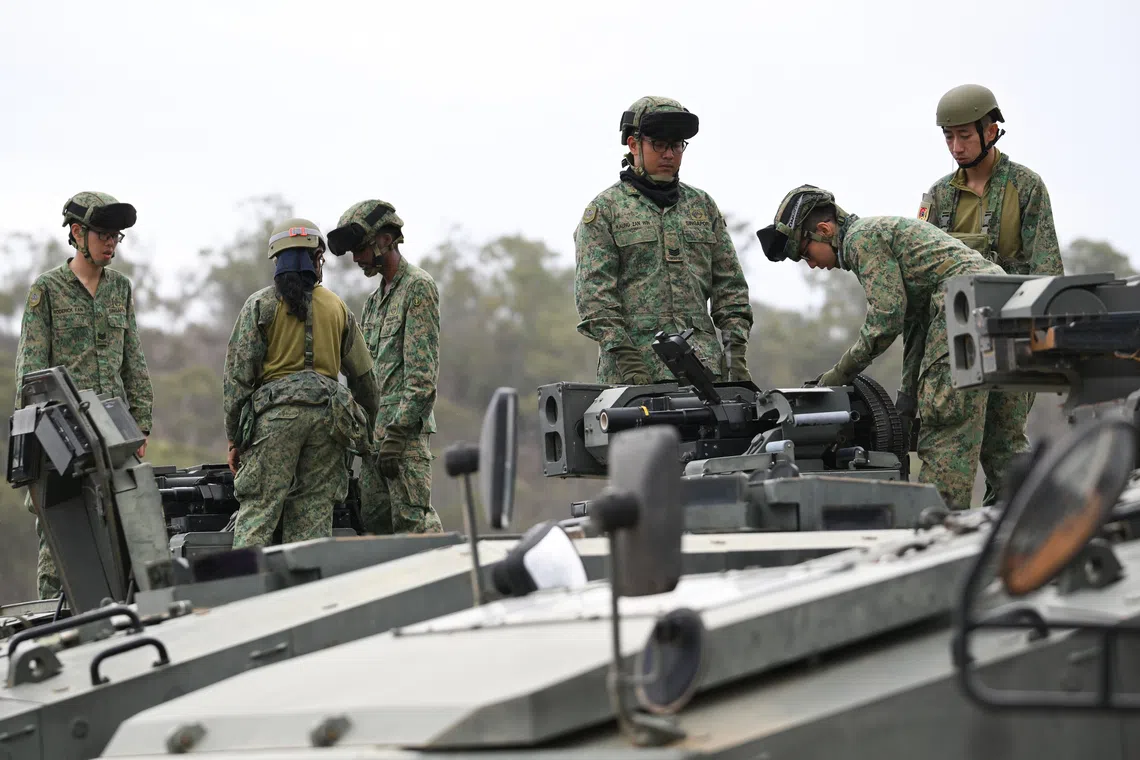
5 SIR personnel doing weapon checks on the Terrex Infantry Carrier Vehicles at Camp Tilpal in the Shoalwater Bay Training Area in Queensland, Australia on Oct 22.
ST PHOTO: LIM YAOHUI
Published Oct 23, 2026, 06:00 PM
Updated Oct 23, 2026, 06:00 PM
Exercise Wallaby in Australia is the SAF’s largest overseas drill, with 6,000 soldiers testing 5G battlefield links, drone use, and counter-UAS systems.
5SIR will trial attack-capable drones, and this will be the first year that full-time national servicemen will carry out live firing at Shoalwater Bay’s Urban Operations Live-Fire Facilities.
Commanders said drones and cyber tools are changing warfare, and the SAF is using the exercise to test new ideas for the Next Generation Infantry Battalions and future defence plans.
ROCKHAMPTON - Some 6,000 Singapore soldiers and 1,200 platforms are being put through their paces at Exercise Wallaby, the Republic’s largest unilateral overseas military drill.
The annual exercise will see the SAF validate the resilience of its battlefield connectivity through its 5G-enabled aerial communications node, while dealing with drone threats via its counter-unmanned aircraft systems (UAS).
Building on drone trials in past editions of the exercise, the Singapore Infantry Regiment’s 5th battalion (5SIR) will test its unmanned capabilities, including attack-capable drones.
5SIR will also conduct platoon urban operations live-firing in Shoalwater Bay’s Urban Operations Live-Fire Facilities, marking the first time that full-time national servicemen will undergo live-firing there.
The exercise, which is in its 36th edition, began in September and is scheduled to end on Nov 2.
SAF personnel involved include those from the Singapore Army, Republic of Singapore Air Force (RSAF), Future Systems and Technology Directorate and the Defence Science and Technology Agency.
Now in its third phase or “frame”, the drills will involve Army units such as armour, infantry and signals, as well as the RSAF’s Apache and Chinook helicopters.
The training frame’s exercise director, Colonel Joshua Goh, said Exercise Wallaby enables the SAF to evaluate emerging technologies and operating concepts under realistic field conditions.
This is as Shoalwater Bay Training Area, which is located in Australia’s eastern state of Queensland, is five times the size of Singapore.
One such concept is the Next Generation Infantry Battalions (NGIB), which the Ministry of Defence first mentioned in 2022 during the debate on its budget.
Mindef had said then that the NGIB would be one part of the larger Next Gen SAF, which by 2040 will have a range of new assets and capabilities to better defend the city-state’s land, water and skies. These include Invincible-class submarines and unmanned vessels for the Republic of Singapore Navy, and F-35 fighter jets for the RSAF.
Since then, the SAF has been expanding drone training and testing across its services and units.
In Aug 2025, Defence Minister Chan Chun Sing announced that all recruits at the Basic Military Training Centre on Pulau Tekong will learn to use drone technology and to counter it. Each company of recruits, comprising about 250 soldiers, is equipped with 40 drones. Recruits get about six hours of drone training.
At Exercise Wallaby in 2025, the SAF undertook a series of field trials involving unmanned and autonomous vehicles. These included the use of a coordinated swarm of more than 50 drones for intelligence, surveillance and reconnaissance missions.
Goh told the media on Oct 22 that the NGIB, which will be equipped with a suite of drones, represents an evolution in how the SAF’s infantry is organised and fights.
“The NGIB brings together new concepts, structures and systems to enhance operational flexibility and combat effectiveness,” he said.
Frame air director, Lieutenant-Colonel Ng Kehang, said the trialling of new technologies shows how the SAF is adapting to evolving operating environments.
For instance, the widespread use of drones in the battlefield can cause lower levels of airspace to become congested, which poses a big challenge for helicopter operations.
That is why counter-UAS operations is among the defence capabilities that are top-of-mind for the RSAF, he added.
“The proliferation of unmanned aerial systems (UAS) in recent times has really hit us quite hard. In the past, we never really thought that the UAS could be used in such a way,” said Ng.
In addition to counter-UAS trials at Exercise Wallaby, the RSAF will also validate its Helicopter Decision Support System, which leverages AI to help pilots plan routes.
Goh noted that more cyber equipment is being incorporated into the exercise than ever before, as modern warfare continues to evolve.
There is always a fight towards asymmetry: Trying to outthink, outsee and outlast the enemy, and using different means to do so, such as unmanned systems,” he said.
“These help preserve your own forces, while giving you an edge to look further.”
10 月 22 日,澳大利亚昆士兰州肖尔沃特湾训练区蒂尔帕尔营地,第 5 特种作战团人员正在对 Terrex 步兵战车进行武器检查。
ST 照片:林耀辉
发布于2026年10月23日下午6:00
更新于2026年10月23日下午6:00
在澳大利亚举行的“袋鼠”演习是新加坡武装部队规模最大的海外演习,6000名士兵测试了5G战场链路、无人机使用和反无人机系统。
5SIR 将试用具备攻击能力的无人机,今年将是全职国民服役人员在肖尔沃特湾城市作战实弹射击设施进行实弹射击的第一年。
指挥官们表示,无人机和网络工具正在改变战争,新加坡武装部队正在利用此次演习来测试下一代步兵营和未来国防计划的新思路。
罗克汉普顿——约6000名新加坡士兵和1200个平台正在参加“袋鼠”演习,这是新加坡共和国规模最大的单边海外军事演习。
在年度演习中,新加坡武装部队将通过其 5G 空中通信节点验证其战场连接的韧性,同时通过其反无人机系统 (UAS) 应对无人机威胁。
新加坡步兵团第5营(5SIR)将以以往演习中的无人机试验为基础,测试其无人作战能力,包括具备攻击能力的无人机。
5SIR 还将在肖尔沃特湾的城市作战实弹射击设施进行排级城市作战实弹射击,这将是全职国民服役人员首次在那里进行实弹射击。
这项演习已举办至第36届,于9月开始,计划于11月2日结束。
参与此次行动的新加坡武装部队人员包括来自新加坡陆军、新加坡共和国空军、未来系统与技术局以及国防科技局的人员。
目前演习已进入第三阶段或“框架”,将涉及陆军装甲部队、步兵部队和通信部队等单位,以及新加坡空军的阿帕奇和奇努克直升机。
训练框架演习指挥官吴俊豪上校表示,“袋鼠演习”使新加坡武装部队能够在真实的实地条件下评估新兴技术和作战概念。
这是因为位于澳大利亚东部昆士兰州的肖尔沃特湾训练区面积是新加坡的五倍。
其中一个概念是下一代步兵营(NGIB),国防部在 2022 年的预算辩论中首次提到了这一概念。
新加坡国防部当时表示,下一代印度海军(NGIB)将是规模更大的“下一代新加坡武装部队”(Next Gen SAF)计划的一部分。该计划旨在到2040年,为更好地保卫新加坡的陆地、水域和领空,配备一系列新型装备和能力。这些装备包括新加坡海军的“无敌”级潜艇和无人舰艇,以及新加坡空军的F-35战斗机。
从那时起,新加坡武装部队一直在其各个军种和单位中扩大无人机训练和测试。
2025年8月,国防部长陈振声宣布,德光岛基础军事训练中心的所有新兵都将学习使用无人机技术以及如何应对无人机。每个新兵连队(约250名士兵)配备40架无人机。新兵将接受约6小时的无人机训练。
在2025年的“袋鼠”演习中,新加坡武装部队进行了一系列涉及无人和自主车辆的实地试验。其中包括使用由50多架无人机组成的协同集群执行情报、监视和侦察任务。
吴先生于 10 月 22 日向媒体表示,NGIB 将配备一系列无人机,这代表了新加坡武装部队步兵组织和作战方式的演变。
“NGIB 将新的概念、结构和系统结合起来,以增强作战灵活性和作战效能,”他说。
Frame空军指挥官吴克航中校表示,新技术试验表明新加坡武装部队正在适应不断变化的作战环境。
例如,无人机在战场上的广泛使用会导致低空空域拥堵,这对直升机作战构成了巨大挑战。
他补充说,正因如此,反无人机作战是新加坡空军最为关注的国防能力之一。
“近年来无人机系统(UAS)的迅速普及确实给我们带来了相当大的冲击。过去,我们从未想过无人机系统会被这样使用,”吴先生说道。
除了在“袋鼠”演习中进行反无人机系统试验外,新加坡空军还将验证其直升机决策支持系统,该系统利用人工智能帮助飞行员规划航线。
吴指出,随着现代战争的不断发展,此次演习中纳入的网络装备比以往任何时候都多。
“我们始终都在追求不对称性:努力在思想上胜过敌人,在洞察力上胜过敌人,并在持久战中胜过敌人,并使用不同的手段来实现这一目标,例如无人系统,”他说。
“这些措施有助于保存你自身的实力,同时让你在放眼更远的地方占据优势。”