Faster charging, fewer apps: Tesla opens chargers to other EVs; SimplyGo rolls out search and pay更快的充电速度,更少的应用程序:特斯拉向其他电动汽车开放充电桩;SimplyGo推出搜索和支付功能。
Tesla opens chargers to other EVs as SimplyGo adds charging across operators in Singapore Read more at straitstimes.com.
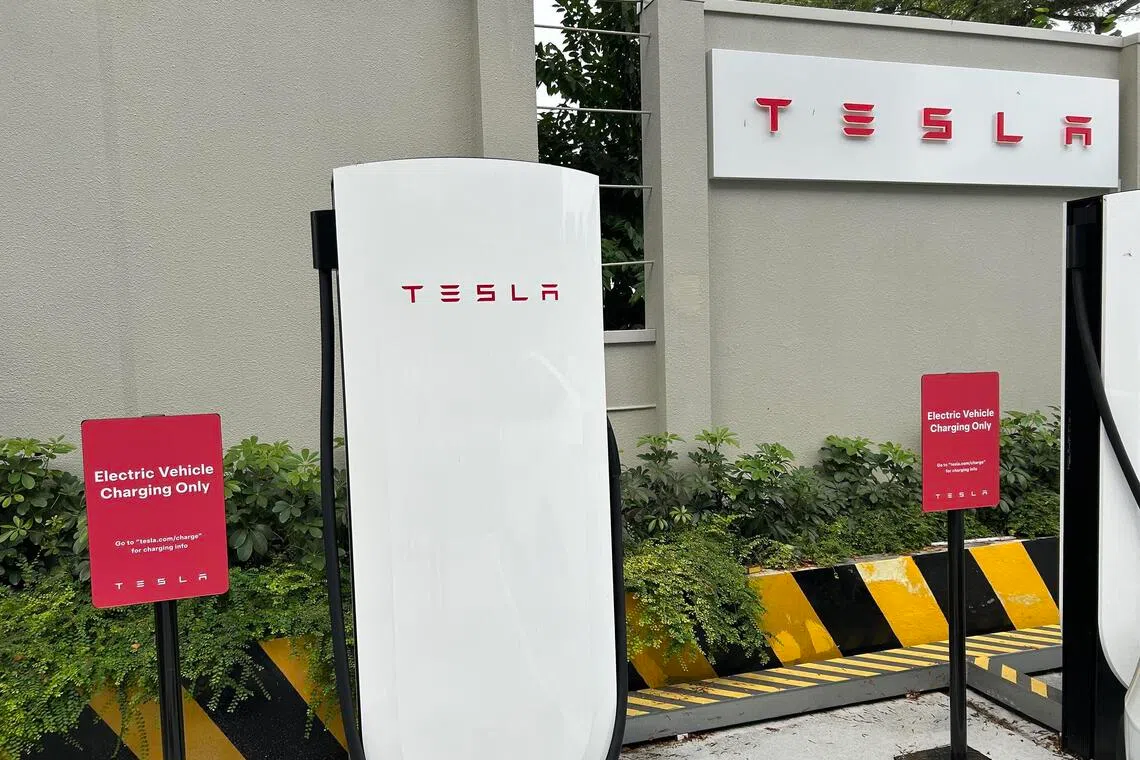
The four Tesla high-speed chargers at Dunearn Village are the first ones in Singapore to be open to non-Tesla vehicles.
ST PHOTO: LEE NIAN TJOE
Published Oct 25, 2026, 05:00 AM
Updated Oct 25, 2026, 05:00 AM
Tesla has opened its 250kW chargers at Dunearn Village to all EVs, but Tesla still has 18 exclusive sites.
SimplyGo now lets drivers search and pay for charging across six smaller operators, covering over 1,100 points in 332 locations, with more operators to join.
Experts and drivers say a single app would help, but larger operators may keep their own systems to control data and sales, so full unity may need official action.
SINGAPORE – Electric vehicle (EV) drivers can now access more charging options, as Tesla opens its high-speed charging bays to all EV owners and the SimplyGo app makes it easier to locate chargers and pay across six operators.
The moves are a small step towards a more unified charging landscape in Singapore.
There are 28 EV charging operators listed in the Land Transport Authority’s MyTransport app. Most have their own proprietary smartphone apps and require users to sign up and pay a deposit.
The four EV Tesla charging spaces at Dunearn Village, a shopping mall in the Bukit Timah area, started operating in early October.
Drivers have to download the Tesla app to use the service.
Depending on the time of day, it costs between 63 cents and 91 cents per kilowatt hour (kWh) for non-Tesla vehicles, compared with 47 cents to 67 cents per kWh for Tesla owners.
These are high-speed chargers rated at 250kW, capable of adding over 280km of driving range with 15 minutes of charging. Most fast chargers in Singapore’s public EV charging network are rated between 50kW and 120kW.
The other 18 Tesla EV charging sites remain exclusive to Tesla vehicles. The company did not comment when asked whether it planned to open them to other EVs.
Tesla’s global charging network was initially exclusive to its EVs. In more recent years, however, the company has opened some of its charging points to other brands of EVs in places like Australia, Malaysia and various European countries.
Meanwhile, public transit platform SimplyGo has made it easier for EV drivers to locate available charging points and pay for charging across six operators: Busways, Busways Public, G. Tech, City Energy Go, MNL Asia and EV Mobility.
This feature was rolled out on its app in early October.
EV drivers have access to over 1,100 charging points in 332 locations, mostly in condominiums and commercial buildings.
However, larger operators like Charge+, CDG Energy, Shell Recharge and SP Mobility, which have charging points in Housing Board carparks , are not on the SimplyGo platform.
In response to queries from The Straits Times, a SimplyGo spokesperson said that it is working to bring more operators onboard.
In terms of performance, the chargers listed on the SimplyGo app range from 7kW alternating current chargers to 240kW direct current chargers. It costs between 30 cents and 86 cents per kWh to use them, depending on the location, operator and charger type.
Some of the charging points on the app are not open to the public. A SimplyGo spokesperson said that access is subject to individual access rules for each location.
Walter Theseira, a transport economist at the Singapore University of Social Sciences, said that it is technologically possible for a single app to handle charging and payment across operators.
However, the larger operators may prefer to keep users within their own apps and platforms to control user data, sell more services to customers, or achieve economies of scale.
He is therefore not surprised that the operators who agreed to be on the SimplyGo app so far are the smaller companies that may have less control over their users.
On Tesla’s decision to open up its chargers to non-Tesla drivers, Theseira said the move made sense as the company’s charging network expands. While the brand’s proprietary charging network was previously a useful differentiator that helped drive Tesla EV sales, he said that the appeal has diminished with Singapore’s growing public charging network.
He noted that Tesla calibrates its EV charging rates, offering significant discounts during off-peak periods to manage demand and reduce long waits. Other operators, by contrast, charge a fixed rate.
While Tesla’s charging rates are higher than before, he said that they are still generally cheaper than other providers in the same area.
Samuel Ong, who has been a Tesla owner since 2021, said that having to download different smartphone apps and sign up with individual charging service operators is an annoyance. While he hopes for a unified payment system for EV charging, he believes that the authorities will have to step in because the large operators will not introduce one voluntarily.
The 39-year-old business consultant has downloaded eight charging apps but relies on three operators – SP Mobility, Great Charge and Tesla. His decision on which operator to use depends on convenience and the total cost of charging, which includes parking fees.
Ong is not bothered by Tesla’s decision to open its chargers to non-Tesla EVs, as Tesla owners still enjoy cheaper charging rates. He believes that Tesla plays a useful role in Singapore’s public EV charging network, and that its presence “keeps the bigger operators in check”.
For some EV owners, having multiple apps is not an issue.
Ler Hwee Tiong, director of an automotive after-market workshop chain, usually charges his EV at home.
However, the 56-year-old has downloaded a few apps “in case of emergency”.
Leslie Chang, 63, who drives an Opel Corsa-e, occasionally needs to charge on the go because the vehicle has a range of less than 300km.
He charges just enough to get home or to the office, where he usually plugs in his car.
While the watch distributor can put up with the slight inconvenience of switching between apps, he said it would be nice to have a smoother charging experience.
Lee Nian Tjoe is senior transport correspondent at The Straits Times, where he also oversees the Motoring section.
Electric and hybrid vehicles
杜尼安村的四个特斯拉高速充电桩是新加坡首批向非特斯拉车辆开放的充电桩。
照片:李年卓
发布于2026年10月25日 上午5:00
更新于2026年10月25日上午5:00
特斯拉已向所有电动汽车开放了位于 Dunearn Village 的 250kW 充电桩,但特斯拉仍然拥有 18 个专属充电桩。
SimplyGo 现在允许司机搜索和支付六家小型运营商的充电费用,覆盖 332 个地点的 1100 多个充电点,未来还将有更多运营商加入。
专家和司机表示,单一应用程序会有所帮助,但大型运营商可能会保留自己的系统来控制数据和销售,因此完全统一可能需要官方行动。
新加坡——电动汽车 (EV) 车主现在可以获得更多充电选择,因为特斯拉向所有电动汽车车主开放了其高速充电桩,而 SimplyGo 应用程序让车主更容易找到充电桩并在六家运营商之间进行支付。
这些举措是新加坡朝着更加统一的充电格局迈出的一小步。
陆路交通管理局的MyTransport应用程序中列出了28家电动汽车充电运营商。大多数运营商都有自己的专属智能手机应用程序,并要求用户注册并支付押金。
位于武吉知马地区购物中心 Dunearn Village 的四个特斯拉电动汽车充电桩于 10 月初开始运营。
车主需要下载特斯拉应用程序才能使用该服务。
根据一天中不同时间,非特斯拉车辆的电费在每千瓦时 (kWh) 63 美分到 91 美分之间,而特斯拉车主的电费则在每千瓦时 47 美分到 67 美分之间。
这些是额定功率为 250kW 的高速充电桩,充电 15 分钟即可增加超过 280 公里的续航里程。新加坡公共电动汽车充电网络中的大多数快速充电桩的额定功率在 50kW 到 120kW 之间。
其余18个特斯拉电动汽车充电站仍仅供特斯拉车辆使用。当被问及是否计划向其他电动汽车开放这些充电站时,该公司未予置评。
特斯拉的全球充电网络最初仅供其电动汽车使用。但近年来,该公司已在澳大利亚、马来西亚和欧洲多个国家向其他品牌的电动汽车开放了部分充电桩。
与此同时,公共交通平台 SimplyGo 让电动汽车车主更容易找到可用的充电桩,并支付六个运营商(Busways、Busways Public、G. Tech、City Energy Go、MNL Asia 和 EV Mobility)的充电费用。
该功能于 10 月初在其应用程序中推出。
电动汽车车主可以使用分布在 332 个地点的 1100 多个充电桩,这些充电桩大多位于公寓和商业建筑内。
然而,像 Charge+、CDG Energy、Shell Recharge 和 SP Mobility 这样的大型运营商,虽然在建屋发展局停车场设有充电桩,但并未加入 SimplyGo 平台。
针对《海峡时报》的询问,SimplyGo 的一位发言人表示,该公司正在努力吸引更多运营商加入。
就性能而言,SimplyGo 应用上列出的充电桩功率范围从 7kW 交流电到 240kW 直流电不等。使用费用根据地点、运营商和充电桩类型而有所不同,每千瓦时电费在 30 美分到 86 美分之间。
该应用程序上列出的一些充电点不对公众开放。SimplyGo 的一位发言人表示,每个充电点的具体使用规则各不相同。
新加坡社会科学大学的交通经济学家沃尔特·特塞拉表示,从技术上讲,一个应用程序可以处理跨运营商的收费和支付。
然而,规模较大的运营商可能更倾向于将用户留在自己的应用程序和平台内,以便控制用户数据、向客户销售更多服务或实现规模经济。
因此,他并不惊讶于目前为止同意加入 SimplyGo 应用的运营商都是规模较小的公司,这些公司可能对用户的控制力较弱。
针对特斯拉决定向非特斯拉车主开放其充电桩,Theseira表示,随着公司充电网络的扩张,此举合情合理。他指出,虽然特斯拉的专属充电网络此前曾是推动其电动汽车销量增长的有效差异化优势,但随着新加坡公共充电网络的日益完善,这一优势已有所减弱。
他指出,特斯拉会根据用电低谷时段调整电动汽车充电价格,提供大幅折扣以控制需求并减少长时间等待。相比之下,其他运营商则采用固定价格。
他表示,虽然特斯拉的充电价格比以前高了,但总体而言仍然比同一地区的其他供应商便宜。
自2021年起就拥有特斯拉的Samuel Ong表示,需要下载不同的手机应用程序并注册各个充电服务运营商的服务非常麻烦。他希望电动汽车充电能有一个统一的支付系统,但他认为这需要政府部门介入,因为大型运营商不会主动推行这样的系统。
这位39岁的商业顾问下载了八款充电应用程序,但只使用三家运营商——SP Mobility、Great Charge和特斯拉。他选择哪家运营商取决于便利性和充电总成本,其中包括停车费。
Ong并不担心特斯拉决定向非特斯拉电动汽车开放充电桩,因为特斯拉车主仍然可以享受更低的充电价格。他认为特斯拉在新加坡的公共电动汽车充电网络中扮演着重要的角色,它的存在“对大型运营商起到了一定的制约作用”。
对于一些电动汽车车主来说,拥有多个应用程序并不是问题。
汽车售后维修连锁店的负责人 Ler Hwee Tiong 通常在家给他的电动汽车充电。
不过,这位 56 岁的老人下载了一些应用程序以备不时之需。
63岁的莱斯利·张驾驶着一辆欧宝Corsa-e,由于该车续航里程不足300公里,他偶尔需要在行驶途中充电。
他只充够回家或到办公室的电,通常会在办公室给车充电。
虽然手表经销商可以忍受在应用程序之间切换带来的些许不便,但他表示,如果充电体验能更流畅一些就更好了。
李念祖是《海峡时报》的高级交通记者,同时负责汽车版块。
电动和混合动力汽车