Funding, force-structure issues could hinder Hegseth’s new autonomous command资金和兵力结构问题可能会阻碍赫格塞斯的新自主指挥部。
The money to start AUTOWARCOM is to come from a reconciliation bill whose passage is in doubt.
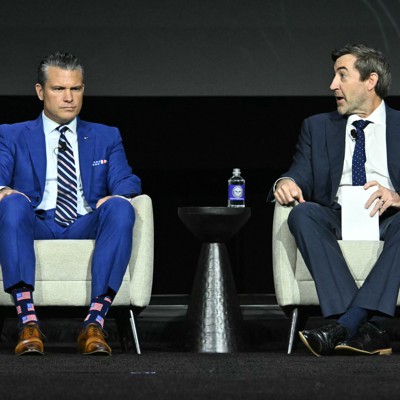
Defense Secretary Pete Hegseth listens as Owen West, leader of a new Pentagon unmanned-systems office, speaks at AUSA 2026 in Washington, D.C., on October 14, 2026. Jim WATSON / AFP via Getty Images
The money to start AUTOWARCOM is to come from a reconciliation bill whose passage is in doubt.
The Pentagon’s effort to launch a new combatant command for autonomous warfare depends on an unusual funding bill whose passage is far from assured. And while Defense Secretary Pete Hegseth has given his department a full year to start up U.S. Autonomous Warfare Command, the Pentagon has little of the relevant force structure that earlier functional COCOMs could draw on.
“They have no idea. They don't know, nor should they. There's nobody on that stage that actually knows how to build anything like this,” John G. Ferrari, a nonresident senior fellow at the American Enterprise Institute and retired two-star general, told Defense One.
Ferrari was referring to an Oct. 14 panel featuring Hegseth, the service secretaries, and the Pentagon’s top special operations civilian .
“But they've now set the direction and the intent,” he said. “And they're going to give it to a commander and say, ‘Now go build it.’ ”
Hegseth sat down to discuss the new command on the final day of the AUSA annual meeting in Washington, D.C., moderated by Owen West, the first CEO of the new Direct Reporting Portfolio Manager for Unmanned Systems. The secretary said AUTOWARCOM would become the Pentagon’s official purchaser of autonomous technology, but offered few other details.
“My vision for AUTOWARCOM, in two years, is that we're still iterating, we're still adapting, we're still learning, and we're moving faster and faster because we're doing it,” he said. “We understand how to do it better with each iteration.”
West later ribbed Hegseth, saying that he counted the secretary saying “iteration” and “adaptation” seven times during an answer to one question. Indeed, most of the Pentagon’s messaging about AUTOWARCOM has included what they want to do, and less how they are going to do it.
Needed: force structure
Though U.S. Autonomous Warfare Command would be a functional combatant command like Cyber Command and Special Operations Command before it, in many ways it will be working backwards rather than building upon existing force structure. The plan calls for creating service component commands where there were none; and creating a new autonomous-warfare corps of officers and enlisted service members. Neither Hegseth’s memo directing the creation of the command nor the more recently released “operational roadmap" describe how these specialties will integrate with existing units.
A four-star combatant command whose primary mission is acquisitions doesn’t make a whole lot of sense, according to Mark Cancian, a senior adviser at the Center for Security and International Studies.
“Typically, [COCOMs] operate forces. So having one that just does acquisition requires a wide variety of new authorities on acquisition, which they might be able to get,” Cancian said. “It's not that it can't be done, but you know, I think there are structures that would be better for accomplishing what it is they want, which is the more rapid development of drone capabilities.”
Cancian has argued that a model more like the Missile Defense Agency, a three-star command with its own significant budget, is probably better suited to what Hegseth would like to accomplish with AUTOWARCOM.
“The model of, ‘they develop a technology, develop a system, and then hand it off to the services’—that makes a lot of sense,” he said. “It would be a very bad idea to have this command take over drone operations for all the services, because those operations need to be very tightly coordinated, very tightly integrated with the operating forces, and having them work for someone far away, and someone separate and centralized, I think, would be a very bad idea.”
Ferrari said it’s more likely that AUTOWARCOM will have responsibility for some training and doctrine associated with the new systems, rather than the actual use of them.
“The responsibility is going to be to pull all of this stuff together, and take all these disparate organizations that are working on this stuff, focus them with money, and then get the stuff in the hands of warfighters, right?” he said. “Because buying it is the easy part. Using it is the hard part.”
Then there is the matter of what the command’s force structure will look like. The day after Hegseth announced AUTOWARCOM, the Army announced it would bring online its own autonomy command promptly. Days later, the service rebranded its Futures and Concepts Command as Futures and Autonomy Command, creating a fully staffed and funded AUTOWARCOM component command with minimal friction.
The Navy and Air Force, when asked about their plans to set up component commands, referred Defense One to the Office of the Secretary of Defense.
“I think, you know, if they actually did this, they'd create some sort of component command,” Cancian said. “Probably dual-task some existing organization, the way the Army has done.”
The Pentagon is working with the services to “ensure autonomous capabilities are integrated,” a Pentagon official, who was not authorized to speak on the record, told Defense One.
“The Services support AUTOWARCOM and are taking complementary actions to organize and integrate autonomous capabilities within their respective forces, based on their unique operational requirements, force-development responsibilities, and domain expertise,” the official said.
They pointed to the Navy’s new Direct Reporting Portfolio Manager for Robotic and Autonomous Systems and said the Air Force is “actively exploring organizational structure elements to enable rapid implementation and training of unmanned systems.”
The official did not directly answer a question about whether Hegseth was inspired to create AUTOWARCOM by pre-existing Army plans, instead reiterating that the service’s announcement followed the secretary’s.
Who will lead the new command? The military already has enlisted drone operators, some junior officers with experience integrating unmanned and autonomous systems into their units, and a handful of senior officers who have been leading larger formations as they have integrated more unmanned capabilities.
“There are a lot of warfighters out there who know what they're doing,” Ferrari said. ”And it's unfortunate, because you’ve got a [Chris] Donahue , or Erik Kurilla , or Randy George , right? So there are three people who could have led that thing. Warfighters.”
Those former Army four-stars—the former head of U.S. European and Africa Command, head of U.S. Central Command, and Army chief of staff, respectively—were forced into retirement over the past year or so.
Kurilla and Donahue weren’t selected for follow-on jobs, despite expectations. George was flat-out asked to leave early, opening an opportunity for Hegseth’s senior military aide, Gen. Chris LaNeve , to take over as Army chief.
The department will announce leaders when appropriate, the Pentagon official said. A plan of action and milestones is due at the end of this month.
The funding elephant in the room
Earlier this year, the Defense Department asked for $54 billion to fund the Defense Autonomous Warfare Group, which Hegseth has since said would be used to get the new command off the ground.
But the Trump administration elected to request that sum, along with several other top military priorities , not in the $1 trillion defense budget but in a separate bill to be passed under a process rarely used for Pentagon spending before last year.
“We’re running fast immediately with the committees to ensure that that reconciliation bill, at a minimum of $350 billion, potentially more, ultimately fills up what this department needs,” the Pentagon official said.
But reconciliation bills are a hard sell , even for Republican members of Congress allied with the Trump administration. As the midterm election threatens to shift the balance of power back to Democrats, extra funding on top of the budget request is not even remotely a done deal.
“Either the money shows up by Christmas or it ain't coming, because when the new Congress gets seated in January, there is no reconciliation anymore,” Ferrari said. “It's over.”
He said the Pentagon could still stand up the organization, but it won’t have the buying power necessary to meet its mission.
Or, Cancian suggested, they can try to squeeze some acquisition money out of the services.
“And the services are not going to be happy about that,” he said. “You're already going to have to give a whole bunch of people to this new command. They'll be levied for joint billets. To say, ‘All right, we want you to give up a thousand people and X billion dollars for this new thing’—it’ll be very difficult to do.”
Asked whether the Pentagon has a back-up plan to fund AUTOWARCOM, the official reiterated that the department is asking for the $54 billion through reconciliation.
Said Ferrari: “If there's no money, it's an interesting concept, and we can ponder on this thing over the next two or three years, because it's not going to go anywhere fast.”
Help us report on the future of national security . Contact Meghann Myers: mmyers@defenseone.com, meghannmyers.55 on Signal.
NEXT STORY: Critical flaws in ubiquitous website software draw urgent warning from NSA, FBI
2026年10月14日,在华盛顿特区举行的美国陆军协会(AUSA)2026年年会上,国防部长皮特·赫格塞斯聆听五角大楼新成立的无人系统办公室负责人欧文·韦斯特的发言。图片来源:Jim WATSON / AFP via Getty Images
启动 AUTOWARCOM 的资金将来自一项和解法案,但该法案能否通过尚存疑问。
五角大楼组建新的自主作战司令部的努力取决于一项不同寻常的拨款法案,而该法案能否获得通过远未可知。尽管国防部长皮特·赫格塞斯已给予国防部一整年的时间来组建美国自主作战司令部,但五角大楼几乎没有以往各作战司令部赖以运作的相关兵力储备。
“他们一无所知。他们不知道,也不应该知道。台上没有人真正知道如何建造这样的东西,”美国企业研究所非常驻高级研究员、退役少将约翰·G·法拉利告诉《防务一号》杂志。
法拉利指的是 10 月 14 日举行的小组讨论会,与会者包括赫格塞斯、各军种部长和五角大楼最高特种作战文职人员。
“但他们现在已经确定了方向和意图,”他说。“他们会把任务交给指挥官,然后说,‘现在去执行。’”
在华盛顿特区举行的美国陆军协会(AUSA)年会最后一天,赫格塞斯与人会面,讨论了新成立的“自主战区司令部”(AUTOWARCOM)。此次会面由新成立的“无人系统直接报告组合管理机构”(Direct Reporting Portfolio Manager for Unmanned Systems)的首任首席执行官欧文·韦斯特主持。赫格塞斯表示,“自主战区司令部”将成为五角大楼的官方自主技术采购机构,但并未透露更多细节。
“我对AUTOWARCOM的愿景是,两年后我们将继续迭代、继续调整、继续学习,并且因为一直在实践,所以我们的进步速度会越来越快,”他说。“每一次迭代,我们都会更好地了解如何做得更好。”
韦斯特后来打趣赫格塞斯,说他数了数,这位部长在回答一个问题时就说了七次“迭代”和“适应”。的确,五角大楼关于自动战司令部的大部分信息都集中在他们想做什么,而很少提及他们将如何去做。
所需:力结构
尽管美国自主作战司令部将像之前的网络司令部和特种作战司令部一样,成为一个功能齐全的作战司令部,但在许多方面,它并非在现有部队结构的基础上发展,而是在逆向工程。该计划要求在之前没有军种组成司令部的地方创建军种组成司令部,并组建一支由军官和士兵组成的新型自主作战部队。无论是赫格塞斯指示创建该司令部的备忘录,还是最近发布的“作战路线图”,都没有说明这些专业将如何与现有部队整合。
安全与国际研究中心高级顾问马克·坎西安表示,一个以采购为主要任务的四星级作战司令部意义不大。
坎西安说:“通常情况下,联合作战司令部负责部队作战。因此,如果设立一个专门负责采购的司令部,就需要获得各种新的采购权限,他们或许能够获得这些权限。这并非不可能,但我认为,对于他们想要实现的目标——更快地发展无人机能力——来说,存在更合适的架构。”
坎西恩认为,更像导弹防御局那样的模式(一个拥有自己大量预算的三星级司令部)可能更适合赫格塞斯希望通过自动战司令部实现的目标。
他说:“‘他们开发技术,开发系统,然后将其移交给各军种’这种模式很有道理。让这个指挥部接管所有军种的无人机作战行动将是一个非常糟糕的主意,因为这些行动需要非常紧密的协调,与作战部队紧密结合,让它们为远在天边、独立于指挥中心的某个机构工作,我认为这将是一个非常糟糕的主意。”
法拉利表示,AUTOWARCOM更有可能负责与新系统相关的一些训练和理论,而不是实际使用这些系统。
他说:“我们的责任是把所有这些资源整合起来,把所有分散的、负责这项工作的机构聚集起来,用资金集中支持它们,然后把这些资源送到作战人员手中,对吧?因为购买很容易,使用才是难点。”
接下来是该司令部兵力结构的问题。在赫格塞斯宣布成立“自主作战司令部”(AUTOWARCOM)的第二天,陆军就宣布将迅速建立自己的自主作战司令部。几天后,陆军将其“未来与概念司令部”(Futures and Concepts Command)更名为“未来与自主司令部”(Futures and Autonomy Command),从而以最小的阻力创建了一个人员配备齐全、资金充足的“自主作战司令部”下属司令部。
当被问及设立组成司令部的计划时,海军和空军均将Defense One转介至国防部长办公室。
坎西安说:“我认为,如果他们真的要这么做,他们会设立某种组成指挥部。可能会像陆军那样,让一些现有的机构承担双重任务。”
一位不愿透露姓名的五角大楼官员告诉《国防一号》网站,五角大楼正在与各军种合作,“确保自主能力得到整合”。
“各军种支持自主作战司令部,并根据各自独特的作战需求、部队发展责任和领域专业知识,采取互补行动,在其各自部队内组织和整合自主能力,”该官员表示。
他们指出海军新设立了机器人和自主系统直接报告项目经理,并表示空军“正在积极探索组织结构要素,以实现无人系统的快速部署和培训”。
这位官员没有直接回答关于赫格塞斯是否受到陆军现有计划的启发而创建自动战区的问题,而是重申该部门的声明是在部长声明之后发布的。
谁将领导新的指挥部?军方已经拥有一些无人机操作员,一些有将无人和自主系统整合到各自部队经验的初级军官,以及少数在整合更多无人能力的过程中领导过更大规模部队的高级军官。
“有很多作战人员知道自己在做什么,”法拉利说。“很遗憾,因为有像克里斯·多纳休、埃里克·库里拉或者兰迪·乔治这样的人,对吧?他们三个本来可以领导这件事的。他们都是作战人员。”
过去一年左右的时间里,这几位前陆军四星上将——分别是前美国欧洲和非洲司令部司令、前美国中央司令部司令以及前陆军参谋长——被迫退休。
尽管外界预期库里拉和多纳休会获得后续职位,但他们并未获选。乔治则被直接要求提前离职,这为赫格塞斯的高级军事助理克里斯·拉内夫将军接任陆军参谋长一职创造了机会。
五角大楼官员表示,该部门将在适当的时候宣布领导人选。行动计划和里程碑将于本月底公布。
资金问题,这个显而易见却又难以启齿的难题。
今年早些时候,国防部申请拨款 540 亿美元,用于资助国防自主作战小组。赫格塞斯后来表示,这笔资金将用于启动这个新的指挥部。
但特朗普政府选择将这笔款项以及其他几项最重要的军事优先事项,不计入 1 万亿美元的国防预算,而是列入一项单独的法案中,该法案将按照五角大楼去年之前很少采用的程序通过。
五角大楼官员表示:“我们正在立即与各委员会加快步伐,以确保这项预算协调法案至少达到 3500 亿美元,甚至可能更多,最终能够满足该部门的需求。”
但即便对于与特朗普政府结盟的共和党国会议员来说,预算协调法案也难以获得通过。随着中期选举有可能将权力天平重新向民主党倾斜,在预算申请之外追加拨款远未成定局。
“要么圣诞节前把钱到账,要么就别想到了,因为等到明年一月新一届国会就职,就再也没有和解的余地了,”法拉利说。“一切都结束了。”
他说,五角大楼仍然可以成立这个组织,但它将不具备完成其使命所需的购买力。
或者,正如坎西安所建议的,他们可以尝试从这些服务中榨取一些收购资金。
“各军种肯定不会乐意的,”他说。“你们本来就得把一大批人调到这个新指挥部。这些人会被征召到联合岗位。现在要我说,‘好吧,我们要你们为了这个新项目放弃一千人和十亿美元’——这很难做到。”
当被问及五角大楼是否有为AUTOWARCOM提供资金的备用计划时,这位官员重申,该部门正在通过预算协调程序申请540亿美元的拨款。
法拉利表示:“如果没有资金,这的确是一个有趣的概念,我们可以在接下来的两三年里仔细考虑一下,因为它不会很快取得任何进展。”
请帮助我们报道国家安全的未来。请联系 Meghann Myers:mmyers@defenseone.com,或在 Signal 上联系 meghannmyers.55。
下一篇报道:无处不在的网站软件存在严重缺陷,美国国家安全局和联邦调查局发出紧急警告