India plans to spend $3 billion on space. Can it catch up to China?印度计划在太空领域投资30亿美元。它能赶上中国吗?
A top Indian general says the military cannot remain dependent on foreign constellations.
Editor’s note: Vivek Raghuvanshi, a journalist and freelancer to Defense News for more than three decades, was jailed in mid-May by India’s Central Bureau of Investigation on charges of espionage. The Indian government has released minimal information on his arrest. Sightline Media Group, which owns Defense News, has not seen any evidence to substantiate these charges and repudiates attacks on press freedom.
CHRISTCHURCH, New Zealand — India plans to spend about $3 billion on space-related contract awards over the next few years to reduce its dependence on foreign satellites and bolster its counter-space capabilities, according to the head of the military.
Gen. Anil Chauhan’s call to close the gap between India’s own capabilities and other nations that are developing countermeasures in space comes amid tension with China . The neighbors have clashed over a shared border area in the eastern Ladakh region, with both sides in 2020 suffering casualties. In August 2023, Indian Prime Minister Narendra Modi met with Chinese President Xi Jinping to discuss the unresolved border issue and try to deescalate the situation.
Speaking at the DEFSAT conference, held Feb. 7-9 in New Delhi, Chauhan called for greater investment in India’s military space sector and noted the military has already signed five contracts with the private sector, with four more being drawn up. In addition, the government plans to spend 250 billion Indian rupees — or about $3 billion — on contract awards over the next few years, he added.
“It’s the right time for the private industry to utilize this opportunity,” Chauhan said. “Our leadership has envisioned big targets for the nation, from space augmentation to space exploration.”
Sino-Indian space race
During his speech, Chauhan outlined several areas of focus for India’s space sector. First, he called for an indigenous constellation of intelligence, surveillance and reconnaissance satellites equipped with optical and hyperspectral sensors.
Next, he said, the military cannot remain dependent on foreign constellations for positioning, navigation and timing requirements.
“We should also be investing in launch on-demand capabilities in the near future. As the national requirements of ISR, PNT and communication grow, this will resultantly increase the number of Indian satellites orbiting the space, [thus requiring the need for] securing these particular assets, which will require space situational awareness.”
To fill these gaps, the general recommended high-speed satellite communications, a satellite-based internet of things and robust, ground-based infrastructure.
A dish antenna is seen inside the Indian Space Research Organisation's Telemetry Tracking and Command Network facility on Aug. 23, 2023, in Bengaluru, India. (Abhishek Chinnappa/Getty Images)
“Lastly, when we are developing all this, I think we need to look at counter-space capabilities, which nations are developing, as a means of deterrence. And maybe this would be required in [the] future to safeguard our assets. In order to ensure that these capabilities are rightfully utilized, doctrinal and connected concepts need to be developed,” he added.
Indeed, there is an inequality in China’s space-based assets compared to those of India. According to the “Military Balance” report released in February by the International Institute of Strategic Studies, China operates 245 military satellites, compared to India’s 26. China also has a reusable spacecraft and counter-space technology, the London-based think tank found.
China is certainly interested in dominating the space domain in terms of control and denying access to adversaries, according to Malcolm Davis, a senior analyst focused on space and Chinese military modernization at the Australian Strategic Policy Institute.
“They’re also developing the counter-space capabilities to threaten U.S. and allied satellites and developing sophisticated launch capabilities that are moving much more toward reusable launch vehicles, heavy-lift and encouraging the growth of commercial space,” he told Defense News. “So in every sense of the word, I think the Chinese are determined to overtake the U.S. in space.”
India is a major ally of the United States, whose own Defense Department warned last year of China’s rise in space capabilities. Its report last year asserted more than 290 systems made up China’s ISR satellite fleet.
“The PLA [People’s Liberation Army] owns and operates about half of the world’s ISR systems, most of which could support monitoring, tracking, and targeting of U.S. and allied forces worldwide, especially throughout the Indo-Pacific region. These satellites also allow the PLA to monitor potential regional flashpoints, including the Korean Peninsula, Taiwan, Indian Ocean, and the SCS [South China Sea],” the report noted.
For example, China has dozens of Yaogan-class satellites in orbit, with 54 dedicated to ISR and another 46 providing electronic or signals intelligence, per IISS data, gathered as late as November.
A Long March-4C rocket carrying China's Yaogan-31 remote sensing satellites lifts off from the country's Jiuquan Satellite Launch Center in 2021. (STR/AFP via Getty Images)
On Dec. 15, China launched the large Yaogan-41 optical satellite into geostationary orbit. There are also about five Huoyan-1 early warning satellites, and China is testing a quantum-enabled communications satellite that could lead to virtually unbreakable communications.
Beijing’s progress in space, including the creation of its Strategic Support Force in 2015, which is responsible for nearly all PLA space operations, shows “forward thinking,” said David Stupples, an expert in space-based systems and professor at City, University of London.
“China [has] a very agile military, and they follow the latest trends very quickly,” he said, comparing the nation to the U.S. and NATO, which have historically focused more on kinetic capabilities. “Warfare has changed a lot over the last four to five years: Whereas it was 90% kinetic and 10% electronic warfare, it’s now probably 50% to 60% electronic warfare and 40% kinetic.”
China also has its own facsimile of GPS. Known as BeiDou, this constellation has 45 satellites, with the final system launched in June 2020 to provide positioning accuracy at up to 5 meters (16 feet).
China now has a fully functioning BeiDou navigation system to rival the American GPS. (Gordon Arthur/Staff)
China is also developing counter-space capabilities through direct-ascent technology, co-orbital systems, electronic warfare, cyberattacks and directed-energy weapons. These can deny access to and operations in the space domain.
“What you’re seeing is that while the Chinese are developing [these] sort of direct-ascent, kinetic-kill anti-satellite [technology], the favored capability for them will be soft-kill systems that are either co-orbital or ground-based because they can deliver reversible, scalable effects, and they also don’t create clouds of space debris,” Davis said.
Asked whether China has interfered with foreign satellites, Davis said he hasn’t heard of “actual attacks so far, but what they’re demonstrating — perfecting — is the technological means to do these sort of attacks in a crisis leading up to war, to exploit the gray zone attack using, for example, a dual-role commercial satellite that has an anti-satellite capability.” (Gray zone military activities fall below the level of traditional armed conflict.)
China reportedly has multiple ground-based lasers that can disrupt, degrade or damage satellites, with the Pentagon describing the technology as a “current limited capability.”
“They do have lasers powerful enough at the moment probably to destroy a satellite in low Earth orbit,” Stupples concurred. “But they’re also developing satellite-killer satellites, which will go alongside another satellite and then aim a laser at the solar panels or antennas.”
China demonstrated its counter-space work with an anti-satellite test against a defunct weather satellite in 2007. It has continued to launch multiple anti-satellite missiles, like the SC-19 used in 2007, proving Beijing can target systems both in low-Earth and geosynchronous orbits. And in 2018, Lt. Gen. Robert Ashley, then-director of the U.S. Defense Intelligence Agency, warned China was working on the ability to jam satellites from the ground.
Stupples said while the anti-satellite threat is “very serious,” any attack would lead to fratricide due to the likelihood of American retaliation. “What China has then said is: ‘OK, you can do all of that, but we will flood space with our signals intelligence satellites and our reconnaissance satellites, etc., and therefore we’ll make it very difficult to do that.’”
Other notable Chinese capabilities include three tests of a reusable spaceplane and the fielding of transportable, quick-response, solid-fueled space launch vehicles. These could help the PLA rapidly reconstitute its low-Earth orbit capabilities by launching replacement satellites.
China’s commercial constellations also benefit the government, Stupples noted. For instance, Beijing is working on its Guo Wang constellation that could include 13,000 satellites for widespread internet coverage — a concept similar to the Starlink network created by American firm SpaceX. The state-owned company SatNet is to operate this massive constellation.
Juliana Suess, an analyst with the British think tank Royal United Services Institute, wrote in an article that “there are many reasons why China would build a satellite-enabled internet constellation in LEO,” not least of which is to expand its influence overseas.
“The existing strides that China has made in terms of soft power, specifically on the continent of Africa and with regard to internet infrastructure, suggest a relatively fast and easy plug-in into Guo Wang,” she noted.
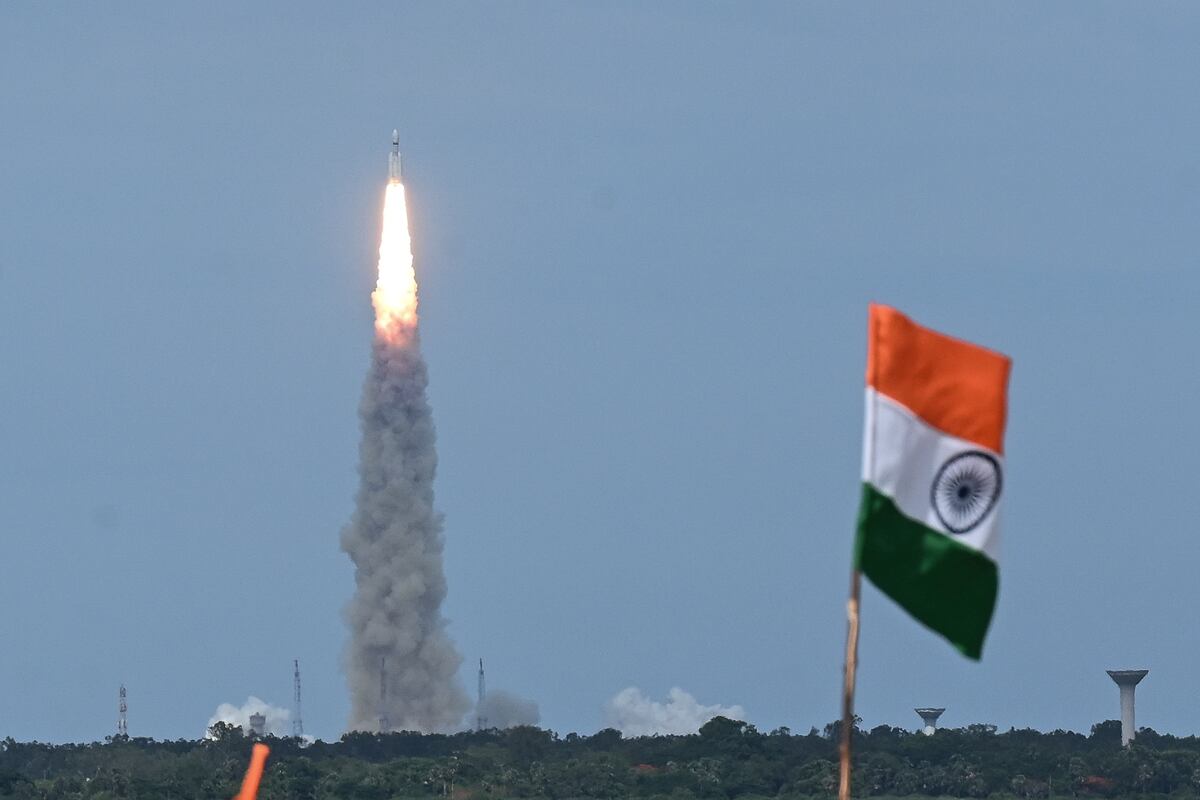
In comparison, India’s space efforts, historically headlined by the Indian Space Research Organisation, appear rather modest. But the country has achieved notable feats, including the July 14 launch of the Chandrayaan-3 mission into orbit, which then successfully landed on the moon.
M. Matheswaran, a retired Indian Air Force air marshal, told Defense News the major drivers for India’s focus on space are the 1999 Kargil War, fought against Pakistan over disputed territory, and China’s 2007 anti-satellite test. The Indian government eventually created its tri-service Defence Space Agency in 2019.
“Now the government has brought out a new space policy opening up the space segment to the private sector,” said Matheswaran, who leads The Peninsula Foundation, an India-based think tank. “India is on the right track now to meeting both its civilian and military requirements, but the pace is not going to be comparable to China’s.”
An engineer works on a component at a Godrej Aerospace manufacturing plant, which makes parts for the Vikas and cryogenic engines for the Indian Space Research Organisation, in Mumbai on July 10, 2023. (Punit Paranjpe/AFP via Getty Images)
“There are startups that are doing well, and ISRO [Indian Space Research Organisation] is supporting them as well. That needs to be accelerated, which can only be achieved by adequate government and funding support,” he added. “I suppose India will close the gap, but catching up with where China is today is going to take a long time.”
Stupples agreed India is “a long way behind,” citing a lack of research and funding for military space initiatives. “India has the capability of launching satellites,” he said, “but it doesn’t have the impetus to develop this further. Its thinking is more like America’s — you know, kinetic.”
Last year, the Indian government released a space policy to encourage developments in the domestic space sector through private participation. And in February 2024, the government approved a more liberal foreign direct investment policy to attract investors to the industry.
ISRO also announced plans for 30 space launches by March 2025; that’s compared to an average of about three annually in recent years, Matheswaran said.
Meanwhile, China plans to execute about 100 space launch missions this year, according to the state-run Xinhua news agency.
Among India’s private sector, Tata Advanced Systems has emerged as a key player, with local media reporting it can build up to 24 LEO satellites annually. And the startup GalaxEye Space plans to launch its Drishti satellite this year equipped with synthetic aperture radar and multiple sensors to perform multispectral imaging.
The Indian military is also eyeing December for the launch of its GSAT-7R communications satellite for the Navy, reportedly followed by a 2026 deployment of the GSAT-7B that will provide the Army with its first dedicated communications satellite.
India is increasing its navigation capabilities with the so-called NavIC system; that constellation is to grow from seven satellites to 11 within the next five years. A decade later, the government hopes to have 26 satellites in operation to give India a GPS equivalent.
But among India’s production efforts are destructive aims. In 2019, the country test-fired an anti-satellite weapon that destroyed a low-Earth orbit satellite and resulted in additional space debris. Modi said the test was “not against anyone.”
A family watches Indian Prime Minister Narendra Modi address the nation on March 27, 2019. The government had successfully tested an anti-satellite weapon. (Rajesh Kumar Singh/AP)
However, Matheswaran said the experiment was meant “to send a message to the rest of the world, particularly to China, because they did it in 2007.″ He said the move exhibited India’s “capability to protect our assets in space, [showing] we have the ability to interfere with your assets in space as well.”
He agreed with Chauhan that India is overly reliant on foreign sources for surveillance data. “When it comes to security-related issues, India cannot depend on that alone for our entire capability. There’s no substitute for creating your complete independence in that capability from other countries, and therefore this is an urgent requirement.”
In January, India and France signed a memorandum of understanding covering satellite launches and space exploration initiatives. The collaboration is expected to lead to a joint constellation of surveillance satellites focused on the Indian Ocean within four years.
They key here is collaboration rather than dependence, Matheswaran said.
“Down the line, it should result in joint training, joint research and development and joint work, including industrial partnerships,” he said. “That’s the way to go.”
Gordon Arthur is an Asia correspondent for Defense News. After a 20-year stint working in Hong Kong, he now resides in New Zealand. He has attended military exercises and defense exhibitions in about 20 countries around the Asia-Pacific region.
编者按:维韦克·拉古万什(Vivek Raghuvanshi)是一位为《防务新闻》(Defense News)撰稿三十余年的记者和自由撰稿人,于五月中旬被印度中央调查局以间谍罪名逮捕入狱。印度政府对其逮捕事件的披露信息甚少。《防务新闻》的母公司Sightline Media Group表示,他们尚未发现任何证据支持这些指控,并强烈谴责对新闻自由的攻击。
新西兰基督城——据印度军方负责人称,印度计划在未来几年内花费约 30 亿美元用于与太空相关的合同授予,以减少对外国卫星的依赖并加强其反太空能力。
阿尼尔·乔汉将军呼吁缩小印度自身能力与正在发展太空反制措施的其他国家之间的差距,此举正值印中关系紧张之际。两国在拉达克东部地区的共同边界地带发生冲突,双方在2020年均有人员伤亡。2023年8月,印度总理纳伦德拉·莫迪与中国国家主席习近平会晤,讨论悬而未决的边界问题,并试图缓和局势。
在2月7日至9日于新德里举行的DEFSAT会议上,乔汉呼吁加大对印度军事航天领域的投资,并指出军方已与私营企业签署了五份合同,另有四份正在拟定中。他还补充说,政府计划在未来几年内斥资2500亿印度卢比(约合30亿美元)用于合同授予。
“现在正是私营企业利用这一机遇的良机,”乔汉说。“我们的领导层为国家制定了宏伟的目标,从太空增强到太空探索。”
中印太空竞赛
在演讲中,乔汉概述了印度航天领域的几个重点方向。首先,他呼吁建立一套配备光学和高光谱传感器的国产情报、监视和侦察卫星星座。
其次,他表示,军方不能继续依赖外国星座来满足定位、导航和授时需求。
“我们也应该在不久的将来投资于按需发射能力。随着国家对情报、监视与侦察(ISR)、定位、导航和授时(PNT)以及通信的需求不断增长,这将导致印度在轨卫星数量增加,从而需要保障这些特定资产的安全,而这需要具备空间态势感知能力。”
为了弥补这些差距,普遍建议采用高速卫星通信、基于卫星的物联网和强大的地面基础设施。
2023年8月23日,在印度班加罗尔,印度空间研究组织遥测跟踪与指挥网络设施内可见一枚碟形天线。(Abhishek Chinnappa/Getty Images)
“最后,我认为在发展所有这些能力时,我们需要关注各国正在发展的反太空能力,将其作为一种威慑手段。未来或许需要这种能力来保护我们的资产。为了确保这些能力得到合理运用,我们需要制定相关的理论和概念,”他补充道。
事实上,中国在太空资产方面与印度存在差距。根据国际战略研究所2月份发布的《军事平衡》报告,中国拥有245颗军用卫星,而印度只有26颗。这家总部位于伦敦的智库还发现,中国拥有可重复使用的航天器和反太空技术。
澳大利亚战略政策研究所专注于太空和中国军事现代化的资深分析师马尔科姆·戴维斯表示,中国当然有兴趣在太空领域占据主导地位,控制太空并阻止对手进入。
“他们还在发展反太空能力,以威胁美国及其盟国的卫星,并发展更先进的发射能力,这些能力正朝着可重复使用运载火箭、重型运载火箭的方向发展,并鼓励商业航天的发展,”他告诉《防务新闻》。“因此,我认为无论从哪个角度来看,中国都决心在太空领域超越美国。”
印度是美国的重要盟友,而美国国防部去年曾警告称,中国的太空能力正在崛起。该部门去年的报告指出,中国的情报、监视和侦察(ISR)卫星群由超过290个系统组成。
报告指出,“解放军拥有并运营着全球约一半的情报、监视与侦察(ISR)系统,其中大部分系统可用于监控、跟踪和瞄准美国及其盟军在全球范围内的目标,尤其是在印太地区。这些卫星还使解放军能够监控潜在的区域冲突热点,包括朝鲜半岛、台湾、印度洋和南海。”
例如,根据国际战略研究所(IISS)截至 11 月收集的数据,中国有数十颗遥感级卫星在轨运行,其中 54 颗用于情报、监视和侦察(ISR),另有 46 颗用于提供电子或信号情报。
2021年,一枚搭载中国遥感31号卫星的长征四号丙运载火箭从中国酒泉卫星发射中心升空。(STR/AFP via Getty Images)
12月15日,中国将大型遥感41号光学卫星送入地球同步轨道。此外,还有大约5颗火眼一号预警卫星,中国还在测试一颗量子通信卫星,该卫星有望实现几乎无法破解的通信。
伦敦城市大学天基系统专家、教授大卫·斯图普尔斯表示,北京在太空领域取得的进展,包括2015年成立负责解放军几乎所有太空行动的战略支援部队,都展现了“前瞻性思维”。
“中国军队非常灵活,能够迅速跟上最新趋势,”他将中国与美国和北约进行比较,后者历来更注重动能作战能力。“过去四五年里,战争形式发生了巨大变化:以前是90%的动能作战和10%的电子战,现在可能是50%到60%的电子战和40%的动能作战。”
中国也有自己的GPS系统,名为北斗。该星座由45颗卫星组成,最后一颗卫星于2020年6月发射,定位精度可达5米(16英尺)。
中国现在拥有功能完善的北斗导航系统,足以与美国的GPS相媲美。(戈登·阿瑟/工作人员)
中国还在通过直接上升技术、共轨系统、电子战、网络攻击和定向能武器等手段发展反太空能力。这些能力可以阻止他国进入太空领域并开展太空行动。
戴维斯说:“你现在看到的是,虽然中国正在研发这类直接上升式动能杀伤反卫星技术,但他们更青睐的是共轨或地面软杀伤系统,因为这些系统能够产生可逆、可扩展的效果,而且不会产生太空碎片云。”
当被问及中国是否干扰过外国卫星时,戴维斯表示,他目前还没有听说过“实际的攻击事件,但他们正在展示——或者说是完善——在危机时期,尤其是在战争爆发前夕,利用灰色地带进行攻击的技术手段,例如使用具备反卫星能力的双用途商用卫星。”(灰色地带的军事活动低于传统武装冲突的程度。)
据报道,中国拥有多款地面激光器,可以干扰、削弱或损坏卫星,五角大楼称该技术目前仍处于“有限的能力”状态。
“他们目前确实拥有足以摧毁近地轨道卫星的激光武器,”斯图普尔斯表示赞同。“但他们也在研发‘卫星杀手’卫星,这种卫星会伴随另一颗卫星运行,然后用激光瞄准其太阳能电池板或天线。”
2007年,中国进行了一次反卫星试验,目标是一颗失效的气象卫星,以此展示了其反太空能力。此后,中国持续发射多枚反卫星导弹,例如2007年使用的SC-19导弹,这表明北京有能力打击近地轨道和地球同步轨道上的目标。2018年,时任美国国防情报局局长罗伯特·阿什利中将警告称,中国正在研发从地面干扰卫星的能力。
斯图普尔斯表示,虽然反卫星威胁“非常严重”,但任何攻击都可能导致自相残杀,因为美国很可能会进行报复。“中国方面回应说:‘好吧,你们可以这么做,但我们会用信号情报卫星、侦察卫星等等向太空倾泻而下,因此我们会让你们的行动变得非常困难。’”
中国其他值得关注的能力包括三次可重复使用空天飞机试验以及可运输、快速响应的固体燃料航天运载火箭的部署。这些能力有助于解放军通过发射替代卫星迅速恢复其近地轨道能力。
斯图普尔斯指出,中国的商业卫星星座也使政府受益。例如,北京正在建设“国望”卫星星座,该星座可能包含13000颗卫星,旨在提供广泛的互联网覆盖——其概念类似于美国SpaceX公司开发的“星链”网络。国有企业卫星网络公司(SatNet)将负责运营这一庞大的卫星星座。
英国智库皇家联合军种研究所的分析师朱莉安娜·苏斯在一篇文章中写道,“中国在低地球轨道上建立卫星互联网星座有很多原因”,其中最重要的原因之一就是扩大其在海外的影响力。
她指出:“中国在软实力方面,尤其是在非洲大陆和互联网基础设施方面取得的现有进展,表明中国可以相对快速、轻松地融入‘国望’。”
相比之下,印度的太空探索事业,历来以印度空间研究组织为首,显得较为逊色。但印度也取得了一些显著成就,包括7月14日成功发射“月船3号”探测器进入轨道,并随后成功登月。
印度空军退役空军元帅马特斯瓦兰告诉《防务新闻》,印度重视太空的主要驱动因素是1999年与巴基斯坦就争议领土爆发的卡吉尔战争,以及中国2007年的反卫星试验。印度政府最终于2019年成立了三军联合的国防航天局。
“现在政府出台了新的太空政策,向私营部门开放了太空领域,”总部位于印度的智库半岛基金会负责人马特斯瓦兰表示。“印度目前正朝着满足其民用和军事需求的方向前进,但速度无法与中国相提并论。”
2023年7月10日,在孟买,一名工程师在戈德瑞航空航天公司(Godrej Aerospace)的制造工厂内加工零部件,该工厂为印度空间研究组织(ISRO)的维卡斯(Vikas)火箭和低温发动机生产部件。(图片来源:Punit Paranjpe/AFP via Getty Images)
“有些初创企业发展势头良好,印度空间研究组织(ISRO)也在支持它们。这种发展需要加速,而这只有通过充足的政府和资金支持才能实现,”他补充道。“我认为印度最终会缩小差距,但要赶上中国目前的水平还需要很长时间。”
斯图普尔斯也认为印度“远远落后”,他指出印度缺乏对军事航天计划的研究和资金投入。“印度有能力发射卫星,”他说,“但它没有进一步发展的动力。它的思维方式更像美国——你知道,更注重实战。”
去年,印度政府发布了一项太空政策,旨在通过私营部门参与鼓励国内太空领域发展。2024年2月,政府批准了一项更为宽松的外国直接投资政策,以吸引投资者进入该行业。
印度空间研究组织(ISRO)还宣布了到 2025 年 3 月进行 30 次太空发射的计划;马特斯瓦兰表示,相比之下,近年来平均每年只有大约 3 次发射。
与此同时,据官方新华社报道,中国计划今年执行约100次太空发射任务。
在印度私营企业中,塔塔先进系统公司已成为一家关键企业,据当地媒体报道,该公司每年可建造多达24颗低地球轨道卫星。此外,初创公司GalaxEye Space计划今年发射其Drishti卫星,该卫星配备合成孔径雷达和多个传感器,可进行多光谱成像。
印度军方也计划在 12 月发射其为海军使用的 GSAT-7R 通信卫星,据报道,随后将在 2026 年部署 GSAT-7B,这将为陆军提供其第一颗专用通信卫星。
印度正通过名为NavIC的系统提升其导航能力;该系统的卫星星座将在未来五年内从7颗增加到11颗。十年后,印度政府希望投入运行26颗卫星,使印度拥有与GPS类似的导航系统。
但印度的军事生产活动也包含破坏性目的。2019年,印度试射了一枚反卫星武器,摧毁了一颗近地轨道卫星,并产生了更多太空碎片。莫迪称,这次试验“并非针对任何人”。
2019年3月27日,一家人观看印度总理纳伦德拉·莫迪向全国发表讲话。当天,印度政府成功测试了一种反卫星武器。(Rajesh Kumar Singh/AP)
然而,马特斯瓦兰表示,这项实验旨在“向世界其他国家,特别是中国,传递一个信息,因为他们在2007年也进行过类似的实验。” 他说,此举展现了印度“保护我们在太空资产的能力,同时也表明我们有能力干扰你们在太空的资产。”
他同意乔汉的观点,即印度过度依赖外国的监控数据。“在安全问题上,印度不能仅仅依靠外国数据来应对所有挑战。我们必须完全摆脱对其他国家的依赖,建立起这种能力,这是当务之急。”
今年1月,印度和法国签署了一份谅解备忘录,内容涵盖卫星发射和太空探索计划。预计双方将在四年内合作建立一个联合的印度洋监视卫星星座。
马特斯瓦兰表示,关键在于合作而不是依赖。
“从长远来看,这应该会促成联合培训、联合研发和联合工作,包括产业合作,”他说。“这才是正确的方向。”
戈登·阿瑟是《防务新闻》的亚洲特派记者。在香港工作20年后,他现居新西兰。他曾到访亚太地区约20个国家,参加过军事演习和防务展览。