Amid Russia jitters, NATO drills flowing troops across Polish rivers在俄罗斯局势紧张之际,北约演习调动部队跨越波兰河流。
Polish exercise organizers chose winter time for the drill because the Vistula river is especially wide and crosswinds on the water are hefty.
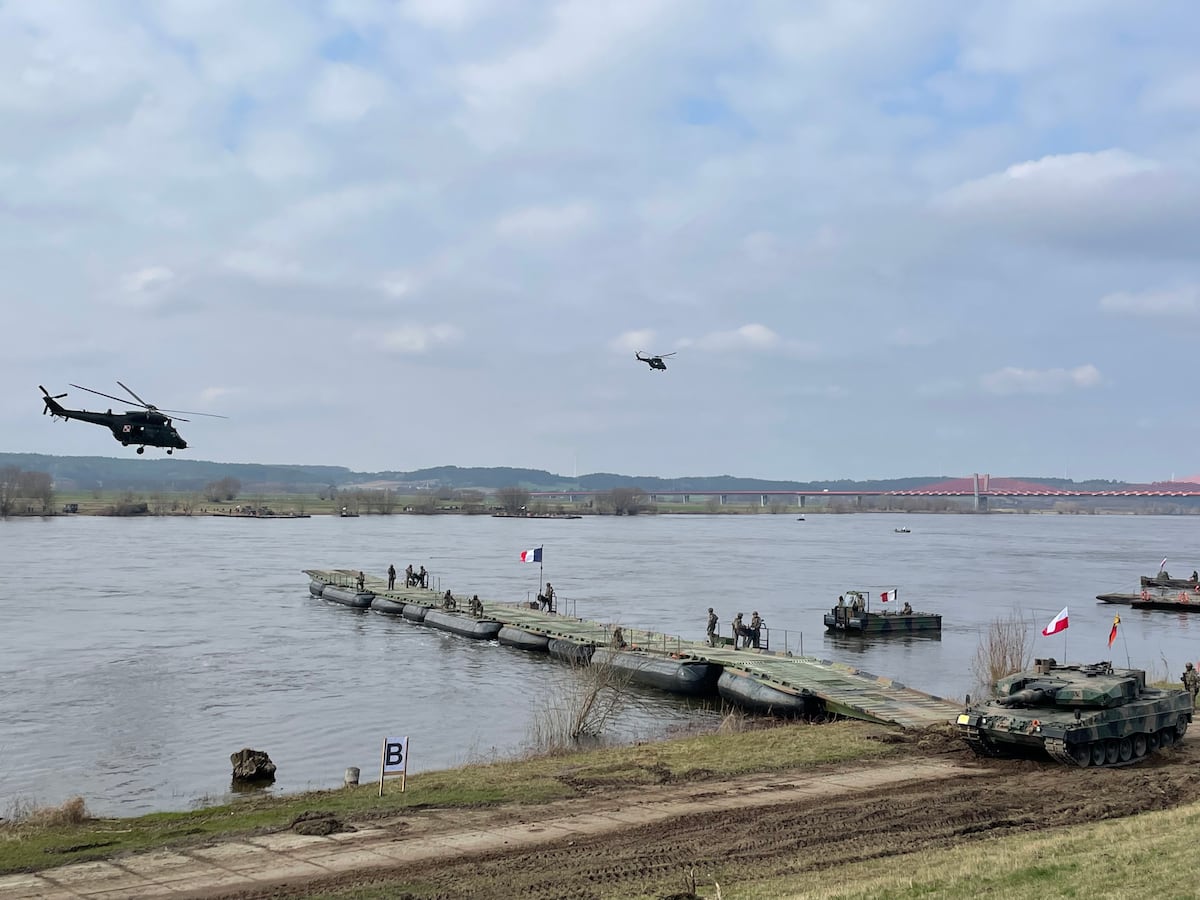
KORZENIEWO, Poland — Some one hundred kilometers away from Poland’s border with the Russian exclave of Kaliningrad on the Baltic Sea, forces from nine NATO member countries were busy setting up the last of their amphibious gear.
They are part of a large multi-domain operations exercise that entails a notoriously tricky river crossing in the remote northern Polish countryside here, as European officials are worried about the possibility of a Russian attack, depending on the outcome of the war in Ukraine.
As part of the Polish-led Dragon-24 military exercise, organized here on March 4-5, American, British, French, German, Spanish, Turkish, Slovenian and Lithuanian soldiers traveled across the 320 meter “wet gap” crossing of the Vistula River, a military jargon term for traversing rivers and swamps.
It was no coincidence that the winter time was chosen by the Polish Armed Forces to host this event, as the waterway can be especially difficult to navigate in this season, according to Maj. Gen. Cezary Wiśniewski, a senior military official.
“We chose this time because we wanted the most challenging conditions – the water levels of the river are very high and the winds are usually strong,” he told reporters during a media briefing.
During his presentation, the official noted some of the key objectives of the training: synchronizing forces conducting defense in cooperation with non-military defense system in crisis and small-scale armed conflict; assessing logistics capabilities as part of the lessons learned from the war in Ukraine; and practicing cooperation between front and rear logistic support elements.
The river crossing entailed the positioning of countries’ floating bridges, which then had to be loaded with tanks, to navigate from the opposite side of the bank from point A to point B and dock safely for the vehicles to disembark and continue their path.
The simulated crisis also includes the movement of a large number of personnel and combat vehicles across Polish territory , an element Wiśniewski said is key.
“The movement of troops is a crucial part of the exercise, as the rapid deployment of forces from the west to the east of Poland is both important and challenging – especially in a situation like today where we have large formations of troops involved, with 20,000-plus military personnel and 3,500 pieces of equipment,” he said.
A tactical road march is set to begin later this week from Korzeniewo, where both wheeled and tracked military vehicles will cover approximately 300 kilometers over the span of multiple days toward the Bemowo Piskie training area.
They will navigate public roads and forested areas while also being faced with ambushes, sabotage, misinformation as well as “Little Green Men,” as media briefing called them. The term is a reference to the 2014 Russian occupation of Ukraine’s Crimea peninsula, which involved Russian soldiers equipped with weapons but dressed with unmarked green military uniforms.
The Polish national drill is part of the larger-scale Steadfast Defender-24 exercise organized by NATO, which will run until the end of May.
According to a recent statement published by the Polish Ministry of Defense, while both exercises are defensive ones and not directed against any state, they are deemed to be “a demonstration of the ability to counter any aggressive policies and provocative activities of the Russian Federation.”
Elisabeth Gosselin-Malo was a Europe correspondent for Defense News. She covers a wide range of topics related to military procurement and international security, and specializes in reporting on the aviation sector. She is based in Milan, Italy.
波兰科热涅沃——距离波兰与俄罗斯飞地加里宁格勒在波罗的海的边界约一百公里处,来自九个北约成员国的部队正在忙着安装最后的两栖装备。
他们是大型多领域作战演习的一部分,演习内容包括在波兰北部偏远乡村进行一次出了名的棘手的渡河行动。欧洲官员担心,根据乌克兰战争的结果,俄罗斯可能会发动袭击。
作为波兰领导的“龙-24”军事演习的一部分,3月4日至5日,美国、英国、法国、德国、西班牙、土耳其、斯洛文尼亚和立陶宛的士兵穿越了维斯瓦河320米长的“湿地”,这是军事术语,指穿越河流和沼泽。
波兰武装部队选择在冬季举办这项赛事并非偶然,高级军事官员塞扎里·维斯涅夫斯基少将表示,因为冬季水道航行会特别困难。
“我们选择这个时间是因为我们想要最具挑战性的条件——河流水位很高,而且风力通常很强,”他在新闻发布会上告诉记者。
在报告中,这位官员指出了此次训练的一些关键目标:协调在危机和小规模武装冲突中与非军事防御系统合作进行防御的部队;评估后勤能力,吸取乌克兰战争的经验教训;以及演练前后后勤支援部门之间的合作。
渡河需要各国架设浮桥,然后装载坦克,从河对岸的 A 点航行到 B 点,并安全停靠,以便车辆下车继续前进。
模拟危机还包括大量人员和作战车辆穿越波兰领土的调动,维斯涅夫斯基表示,这是关键因素。
他说:“部队调动是演习的关键部分,因为从波兰西部向东部快速部署部队既重要又具有挑战性——尤其是在像今天这样有庞大部队参与的情况下,有超过 2 万名军事人员和 3500 件装备。”
本周晚些时候,一支战术公路行军队伍将从科尔泽涅沃出发,轮式和履带式军用车辆将在数天内行进约 300 公里,前往贝莫沃皮斯基训练区。
他们将穿越公共道路和森林地区,同时还要面对伏击、破坏、虚假信息以及媒体简报中所谓的“小绿人”。“小绿人”一词指的是2014年俄罗斯占领乌克兰克里米亚半岛的事件,当时俄罗斯士兵身着无标识的绿色军服,却配备了武器。
波兰全国演习是北约组织的大规模“坚定捍卫者-24”演习的一部分,该演习将持续到5月底。
根据波兰国防部最近发表的一份声明,虽然这两项演习都是防御性的,并非针对任何国家,但它们被认为是“展示应对俄罗斯联邦任何侵略性政策和挑衅行为的能力”。
伊丽莎白·戈斯林-马洛曾任《防务新闻》欧洲通讯员。她的报道涵盖军事采购和国际安全等广泛领域,尤其擅长航空领域的报道。她常驻意大利米兰。