EXCLUSIVE: SOUTHCOM chief seeks unmanned river solution as he embraces autonomy独家报道:南方司令部司令寻求无人河道解决方案,拥抱自主化
In an interview with Breaking Defense, Gen. Francis Donovan said autonomous systems are “not just for testing anymore” but “taking the fight to the enemy.”
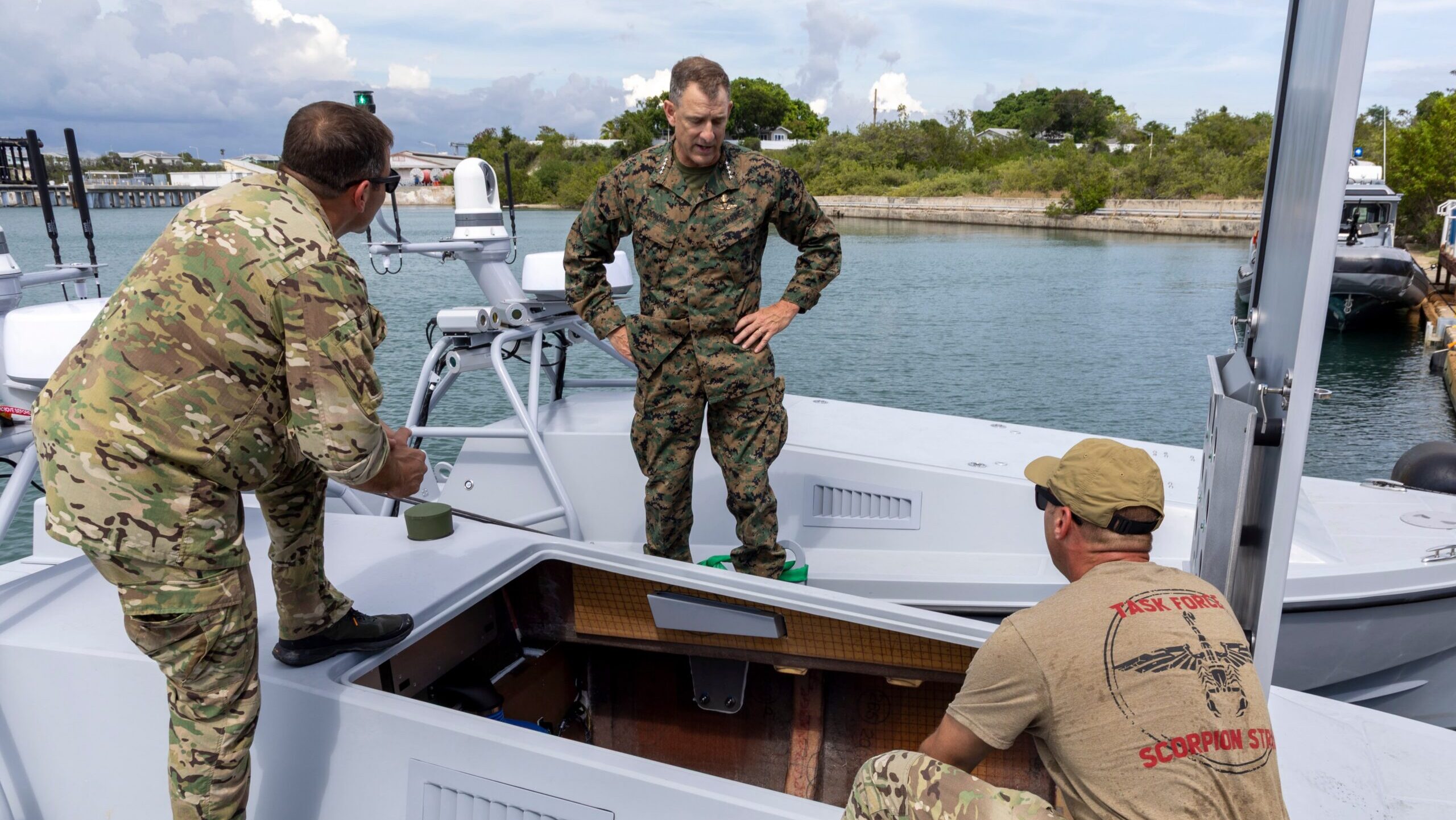
SOUTHCOM Commander General Frank Donovan provides guidance on his vision for a theater-level joint force approach to Autonomous and Unmanned Systems Warfare while attending a capabilities demonstration at one of SOUTHCOM’s AutoWarCom (SAWC) Forward Staging and Training Sites – Naval Station Guantanamo Bay, Cuba. (U.S. Southern Command)
WASHINGTON — The top officer for US Southern Command is in the market for new, bespoke unmanned and autonomous maritime systems for the counter-drug fight, he told Breaking Defense in an exclusive interview.
Gen. Francis Donovan, who took over SOUTHCOM in February of this year, said that among other capabilities, he’s interested in a “unique river reconnaissance system, representing a tailorable mix of unmanned surface, air and sub surface autonomous platforms.”
The idea is for an autonomous vessel to sail through South American and Central American rivers for reconnaissance missions and to collect data.
“We want to understand how criminal networks use rivers [to transport narcotics] and how they use the foliage to hide the sites where narco vessels are assembled,” the general said during an interview on Oct. 13. In other words, SOUTHCOM wants “systems uniquely tailored to our environment.”
Donovan made the comments just months after the command stood up its SOUTHCOM Autonomous Warfare Command (SAWC), which is officially “dedicated to employing autonomous, semi-autonomous, and unmanned platforms and systems to counter threats and challenges across domains, linking tactical missions to long-term strategic effects.”
Donovan described SAWC as the place for not only SOUTHCOM but other US and allied forces to train and experiment with unmanned tech, including using an in-theater facility based in Guantanamo Bay, Cuba. Other federal agencies and industry are also invited to bring their latest wares.
“We want to partner with anyone to test platforms in our Area of Responsibility,” he said. “We are open for business.”
Weaponizing the supply chain for a liquid-fueled howitzer-fired munition that flies 150 km
The goal of such weaponization is to tie warfighter needs to the RDT&E cycle.
But, he said, testing and training is not the end goal — operations are.
“We will test and operate these systems in proximity with hemispheric threats,” he said. Autonomous systems “will be used to take the fight to the enemy. They are not just for testing anymore.”
For instance, Donovan said Saronic -made Corsair USVs have been moved to Guantanamo, but the vessels have now also been deployed on either side of the Panama Canal.
There, the unmanned ships are “assisting local forces in narco-terrorist operations and [supporting] the physical security of the [Panama] Canal,” he said.
SOUTHCOM’s Autonomous Warfare Command was established months before Secretary of Defense Pete Hegseth announced plans for a new 4-star Autonomous Warfare Command, or AUTOWARCOM, in September. In a follow-up email, a SOUTHCOM spokesperson told Breaking Defense that SAWC is “collaborating closely” with the Pentagon to integrate autonomous platforms and AI.
SAWC is also expanding, the spokesperson said, and has “attracted personnel” from different services including “USAF Pararescue (PJs), U.S. Navy SEALs and Riverine Surface Warfare personnel, U.S. Army Green Berets, USMC Ground Intelligence and Information Warfare Specialists, Maritime ISR Officers,” among others.
SOUTHCOM In The Spotlight
While combating narco-terrorism is not a new mission for US Southern Command, the Trump administration has placed significant emphasis on the mission. SOUTHCOM is leading Joint Task Force Western Hemisphere (which replaced Operation Southern Spear), the controversial effort to stem the flow of drugs from South America to the US, including through lethal strikes and joint ground operations.
Still, Donovan said that like any other command, he has to compete for joint resources – which makes the use of unmanned platforms that much more attractive.
For example, Donovan said that SOUTHCOM doesn’t necessarily need a destroyer to linger at sea for a long period of time and can instead use a “cheap platform” for some operations. Then they can bring in the destroyer “for a very specific mission, thereby reducing stress on the joint force.”
SOUTHCOM is also employing aerial unmanned systems, including MQ-9 systems. Donovan declined to comment on the reported shift of airframes from US Africa Command to US Southern Command, but he generally highlighted the importance of data those kinds of systems collect.
“The critical issue is data, which can help us increase domain awareness,” Donovan explained, adding that US partners in the Americas also “need assistance with domain awareness at sea, land and air.” Said data can also help US assets carry out an interdiction or military operations.
Overall, Donovan said the ultimate goal of SAWC is to accelerate autonomous warfare across the Command’s AOR “for us to carry out our missions and to assist our partners,” in areas like domain awareness.
Breaking Defense Video
Army’s tech chief talks autonomy, acquisition and the future of drones
Drones take over AUSA, plus the Army’s plan to bring in new vendors
Hegseth talks autonomy at AUSA, a key show focus
Army doubles down on autonomy, stakes out Indo-Pacific role: AUSA Day 2
Telle talks ‘manufacturing rodeo,’ supply chain ‘weak links’: AUSA Day 1
New leaders, new drone command: What we expect from AUSA 2026
Unpacking Boeing’s F/A-XX win, plus a report from wartime Ukraine
How Hegseth envisions a new Autonomous Warfare Command
What Europe’s military air fleets will look like in 30 years
Riyadh gets closer to F-35s, Damascus presses sovereignty and an expert take on Iran
美国南方司令部司令弗兰克·多诺万将军在古巴关塔那摩湾海军基地——南方司令部自主战司令部(SAWC)前沿集结和训练基地之一——出席能力演示活动时,阐述了他对战区级联合部队自主和无人系统作战的愿景。(美国南方司令部)
华盛顿——美国南方司令部最高指挥官在接受《防务新闻》独家采访时表示,他正在为禁毒斗争寻找新的、定制的无人自主海上系统。
今年二月接管南方司令部的弗朗西斯·多诺万将军表示,除其他能力外,他对“独特的河流侦察系统”很感兴趣,该系统代表着可定制的无人水面、空中和水下自主平台的组合。
其设想是建造一艘自主航行的船只,在南美洲和中美洲的河流上航行,执行侦察任务并收集数据。
“我们想了解犯罪网络如何利用河流运输毒品,以及他们如何利用植被掩盖贩毒船只的集结地点,”这位将军在10月13日接受采访时说。换句话说,南方司令部想要“专门针对我们环境量身定制的系统”。
多诺万发表这番言论的几个月前,该司令部刚刚成立了南方司令部自主作战司令部(SAWC),该司令部正式的宗旨是“致力于运用自主、半自主和无人平台及系统来应对各个领域的威胁和挑战,并将战术任务与长期战略效果联系起来”。
多诺万表示,SAWC不仅是美国南方司令部,也是其他美国及盟军部队训练和试验无人技术的场所,包括使用位于古巴关塔那摩湾的战区内设施。其他联邦机构和企业也被邀请带来他们的最新产品。
他说:“我们希望与任何合作伙伴共同测试我们责任区域内的平台。我们欢迎合作。”
将供应链武器化,用于生产射程达150公里的液体燃料榴弹炮弹药
这种武器化的目标是将作战人员的需求与研发、测试和评估周期联系起来。
但他表示,测试和训练并不是最终目标——实战才是。
他说:“我们将在面临半球威胁的地区测试和运行这些系统。”自主系统“将被用于主动出击,打击敌人。它们不再仅仅用于测试。”
例如,多诺万表示,萨罗尼克制造的“海盗”无人水面艇已被转移到关塔那摩,但现在这些船只也已部署在巴拿马运河的两侧。
他说,这些无人船在那里“协助当地部队开展毒品恐怖主义行动,并支持巴拿马运河的实体安全”。
南方司令部自主作战司令部(SAWC)的成立时间比国防部长皮特·赫格塞斯9月份宣布成立新的四星级自主作战司令部(AUTOWARCOM)的计划早几个月。在随后的一封电子邮件中,南方司令部发言人告诉《防务新闻》(Breaking Defense),SAWC正在与五角大楼“密切合作”,以整合自主平台和人工智能。
发言人表示,SAWC 也在扩张,并“吸引了”来自不同军种的人员,其中包括“美国空军伞降救援队 (PJ)、美国海军海豹突击队和河川水面作战人员、美国陆军绿色贝雷帽、美国海军陆战队地面情报和信息战专家、海上情报监视侦察 (ISR) 军官”等。
南方司令部成为焦点
打击毒品恐怖主义并非美国南方司令部的新任务,但特朗普政府对此任务给予了高度重视。南方司令部领导着西半球联合特遣部队(取代了“南方之矛行动”),这项备受争议的行动旨在阻止毒品从南美流入美国,其手段包括致命打击和联合地面行动。
不过,多诺万表示,与其他任何指挥部一样,他必须争取联合资源——这使得使用无人平台更具吸引力。
例如,多诺万表示,南方司令部并不一定需要驱逐舰长时间在海上停留,而是可以使用“廉价平台”执行某些行动。然后,他们可以将驱逐舰调来执行“非常具体的任务,从而减轻联合部队的压力”。
美国南方司令部也在使用包括MQ-9在内的空中无人系统。多诺万拒绝就有关美国非洲司令部向美国南方司令部转移无人机系统的报道发表评论,但他总体上强调了这类系统收集的数据的重要性。
多诺万解释说:“关键在于数据,数据可以帮助我们提升态势感知能力。”他还补充道,美国在美洲的合作伙伴也“需要在海、陆、空三个方面获得态势感知方面的帮助”。这些数据还可以帮助美国力量执行拦截或军事行动。
多诺万表示,总体而言,SAWC 的最终目标是加速该司令部责任区内的自主战争,“以便我们能够执行任务并协助我们的合作伙伴”,例如在领域感知方面。
突破性防御视频
陆军技术主管谈无人机的自主性、采购和未来
无人机主导了美国陆军协会(AUSA)的会议,此外,陆军还计划引入新的供应商。
Hegseth 在 AUSA 大会上谈到了自主性,这是本次大会的一个重点议题。
陆军加倍强调自主性,明确印太地区角色:AUSA第二天
特勒谈“制造业乱象”、供应链“薄弱环节”:AUSA第一天
新领导人,新无人机指挥部:我们对 AUSA 2026 的期待
深入剖析波音F/A-XX的中标,以及来自战时乌克兰的报道
赫格塞斯设想的新型自主作战指挥部
30年后欧洲军用空军机队会是什么样子
利雅得距离F-35战机更近一步,大马士革强调主权,以及专家对伊朗的看法