Singapore, Germany to collaborate on AI use in industries, step up research on new tech新加坡和德国将在人工智能行业应用方面展开合作,并加强对新技术的研究。
The two countries will also work towards strengthening cooperation between ASEAN and the EU. Read more at straitstimes.com.
新闻视频
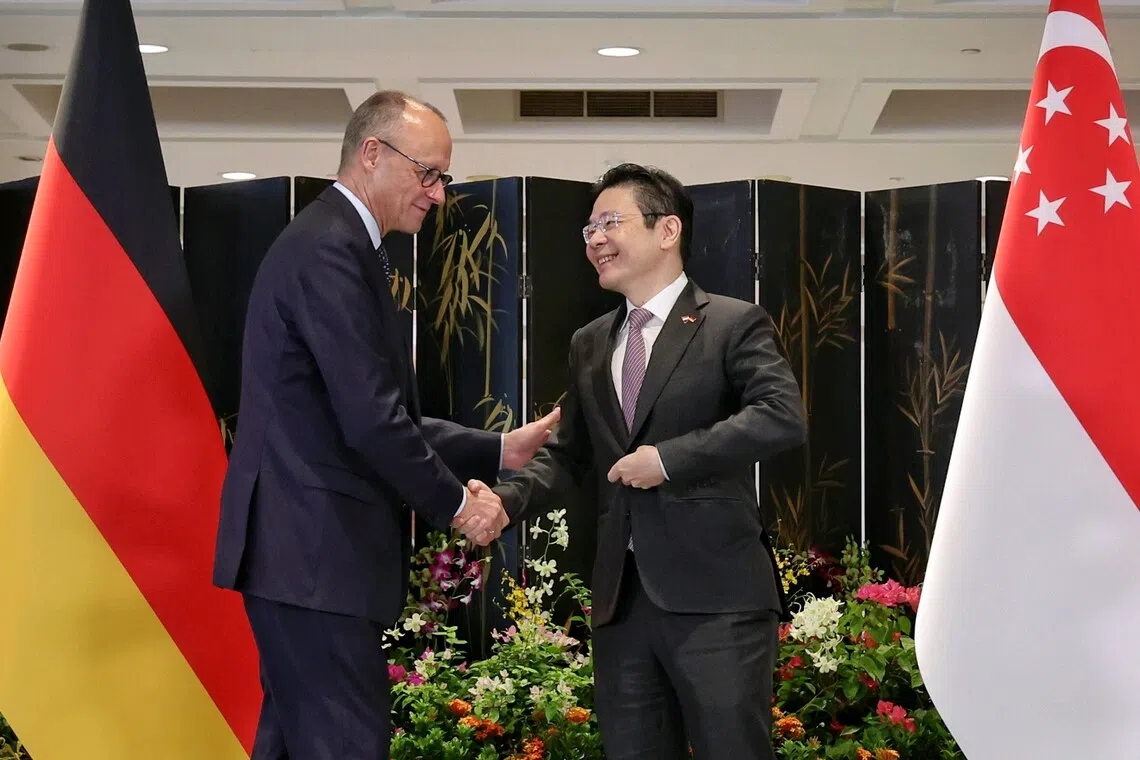
Singapore Prime Minister Lawrence Wong (right) and Chancellor of Germany Friedrich Merz at a joint press conference at the Parliament House on Oct 27.
Published Oct 27, 2026, 03:15 PM
Updated Oct 27, 2026, 03:25 PM
Singapore and Germany will deepen ties on AI, digital economy, research and innovation, and ASEAN after Prime Minister Lawrence Wong and Chancellor Friedrich Merz meet.
Both sides will work on industrial AI, while keeping it “safe, trusted, and human-centred” and improving AI security through new safety institutions.
They also plan more joint research, closer ASEAN-EU trade and digital links, support for the ASEAN power grid, and protection of underwater cables and pipelines.
SINGAPORE - Singapore and Germany will deepen cooperation in the digital realm, particularly in the development and deployment of artificial intelligence for the industrial sector.
This comes as both countries announced a refreshed roadmap to further bilateral ties and collaboration on Oct 27, after a meeting between Prime Minister Lawrence Wong and German Chancellor Friedrich Merz.
At a joint press conference at Parliament House, PM Wong said both leaders had a fruitful discussion and agreed there was much more to be accomplished together under the strategic partnership between Singapore and Germany.
The updated joint work plan covers collaboration in areas such as AI, digital economy, research and innovation, and ASEAN, among others, and builds on an earlier roadmap from 2024.
“Singapore and Germany may be geographically far apart, but we share many common interests and convictions, and this was very clear from our discussions this morning,” said PM Wong.
“These shared convictions have underpinned our friendship over the past six decades. And in a world that is becoming more uncertain and fragmented, our ties will be even more important in bringing our two countries and our two regions closer together.”
The German leader agreed, adding that Singapore and Germany are “firmly convinced to further develop our strategic partnership, and we are in for the long haul”.
On AI, PM Wong said both leaders recognise the enormous potential of the technology to transform their countries’ economies and create new opportunities for businesses and workers.
That is why both sides want to move beyond digital technologies to work together on industrial AI, he said.
Industrial AI involves the application of the technology in physical operations, robotics and machinery, such as in manufacturing systems and logistics systems.
PM Wong said Singapore and Germany bring complementary strengths to the table to this end.
“At the same time, we recognise that AI brings new risks and challenges,” he added.
“And so, even as we cooperate on AI deployment, we will ensure that this is done in a way that remains safe, trusted, and human-centred.”
In response to a question from the media on whether middle powers can work together on AI to overtake bigger powers like the United States and China, PM Wong noted that a lot of the frontier developments are taking place in America and to some extent China.
Singapore is focused on the application of AI where it has some advantages to offer, said PM Wong.
As a small, compact, and highly connected society where there is rule of law and clear protections for intellectual property, Singapore can push the frontiers of actual AI deployment in healthcare, logistics, finance, and advanced manufacturing.
Chancellor Merz said both countries’ will also work together on AI security, through their newly set up AI safety and security institutions.
Singapore and Germany will also further cooperation in research and innovation, said PM Wong.
In conjunction with the Singapore-Germany Year of Innovation, both countries intend to pursue more joint research and innovation projects in emerging technologies, covering areas such as AI, advanced manufacturing, green technologies, semiconductors, quantum, and space technologies, he added.
He noted that the strong German academic and research presence here – the Technical University of Munich campus opened in Singapore 2002, and the Max-Planck Centres for Data Driven Chemistry and Biocultural Worlding in April – has created valuable opportunities for collaboration over the years.
Amid a more fragmented world, both sides will also work to strengthen cooperation between ASEAN and the European Union, which marks 50 years of relations in 2026.
“The zeitgeist is turning against openness and trade, our response is not to turn inwards. Instead, it is to work with like-minded partners to build new connections,” said PM Wong.
He said as ASEAN chair in 2027, Singapore will work with Germany to deepen the 11-member grouping’s partnership with the EU, including by making progress towards an ASEAN-EU free trade agreement.
Asked about concrete steps towards this pact, PM Wong said it will be “challenging” and “complex” but there is reason for some optimism.
The EU has started to establish bilateral trade pacts with individual ASEAN countries such as Singapore and Vietnam, and is negotiating more such pacts with Indonesia, Malaysia and Thailand.
“That gives us more confidence that ASEAN as a bloc can also make progress in our trade discussions for a free trade agreement with the EU,” he said.
Besides trade, both sides are also looking at how to bring the digital systems of the two regions together, he said, citing ASEAN’s Digital Economy Framework Agreement, the first region-wide agreement on digital economy governance covering areas such as digital trade, cross-border e-commerce, cyber security, digital identity, digital payments and cross-border data flows.
He noted that Germany was made an ASEAN sectoral dialogue partner in July, an important step in bringing Germany and South-east Asia closer together.
Many of the 2,900 German companies based here use Singapore as a gateway to access opportunities across ASEAN and the wider Pacific region, he said.
Chancellor Merz, speaking at the press conference, said amid geopolitical instability in the world, there is “a very good chance of achieving an even deeper cooperation with the countries of the region”.
Speaking in German, he said he was in favour of working to integrate the existing free trade structures with Germany’s different regional partners like Singapore, Malaysia, India, and Indonesia.
“This will open up better opportunities in the region to us and our companies,” he said.
He said Germany was also ready to support the ASEAN power grid initiative, that aims to connect electricity networks across the region to enable cross-border energy trading and enhance energy security.
PM Wong said Singapore and Germany are also natural partners in upholding the international rules-based order, with both countries committed to international law and multilateral cooperation.
He welcomed Germany’s endorsement of the the Guiding Principles for Underwater Infrastructure Defence Exchanges, or GUIDE, a voluntary initiative focused on protecting critical underwater infrastructure like subsea cables and pipelines
Singapore is among the 17 founding members of the initiative launched earlier this year.
PM Wong said it has strengthened cooperation across regions to protect critical underwater infrastructure, which is essential to security and connectivity.
“We believe that countries large and small benefit from a world where the rules are respected, commitments are honored, and disputes resolved peacefully,” he added.
Ministry of Foreign Affairs
10月27日,新加坡总理黄循财(右)和德国总理弗里德里希·默茨在国会大厦举行联合新闻发布会。
发布于 2026 年 10 月 27 日下午 3:15
更新于2026年10月27日下午3:25
新加坡总理黄循财和德国总理默茨会晤后,新加坡和德国将深化在人工智能、数字经济、研发创新和东盟等领域的联系。
双方将致力于工业人工智能的发展,同时确保其“安全、可信、以人为本”,并通过建立新的安全机构来提高人工智能的安全性。
他们还计划开展更多联合研究,加强东盟与欧盟的贸易和数字联系,支持东盟电网,并保护海底电缆和管道。
新加坡——新加坡和德国将深化在数字领域的合作,尤其是在工业领域人工智能的开发和部署方面。
此前,两国于 10 月 27 日宣布了进一步加强双边关系与合作的新路线图,此前,加拿大总理黄循财和德国总理默茨举行了会晤。
在国会大厦举行的联合新闻发布会上,黄英贤总理表示,两位领导人进行了富有成效的讨论,并一致认为新加坡和德国在战略伙伴关系框架下还有更多工作要做。
更新后的联合工作计划涵盖人工智能、数字经济、研究与创新以及东盟等领域的合作,并以2024年的早期路线图为基础。
黄之锋总理表示:“新加坡和德国虽然地理位置遥远,但我们有很多共同的利益和信念,这一点从我们今天上午的讨论中已经非常清楚地看出。”
“这些共同的信念在过去六十年里一直是我们友谊的基石。在一个日益不确定和分裂的世界里,我们的关系对于拉近两国和我们两个地区的距离将变得更加重要。”
德国领导人表示赞同,并补充说,新加坡和德国“坚定地致力于进一步发展我们的战略伙伴关系,我们将长期坚持下去”。
关于人工智能,黄英贤总理表示,两国领导人都认识到这项技术具有巨大的潜力,可以改变两国的经济,并为企业和劳动者创造新的机遇。
他说,正因如此,双方都希望超越数字技术,在工业人工智能领域展开合作。
工业人工智能是指将该技术应用于物理操作、机器人和机械,例如制造系统和物流系统。
黄循财总理表示,新加坡和德国在这方面可以发挥互补优势。
“与此同时,我们也意识到人工智能带来了新的风险和挑战,”他补充道。
“因此,即使我们在人工智能部署方面开展合作,我们也会确保以安全、可信和以人为本的方式进行。”
针对媒体提出的中等强国能否在人工智能领域合作超越美国和中国等大国的问题,黄英贤总理指出,许多前沿发展都发生在美国,在某种程度上也发生在中国。
黄循财总理表示,新加坡专注于人工智能具有优势的领域,并致力于应用人工智能技术。
新加坡是一个规模小、结构紧凑、联系紧密的社会,拥有法治和明确的知识产权保护,因此可以推动人工智能在医疗保健、物流、金融和先进制造业等领域的实际应用。
梅尔茨总理表示,两国还将通过新成立的人工智能安全机构,在人工智能安全方面开展合作。
黄循财总理表示,新加坡和德国还将进一步加强在研发和创新领域的合作。
他补充说,值此新加坡-德国创新年之际,两国计划在人工智能、先进制造、绿色技术、半导体、量子技术和空间技术等领域的新兴技术领域开展更多联合研究和创新项目。
他指出,德国强大的学术和研究力量——慕尼黑工业大学新加坡分校于 2002 年成立,马克斯·普朗克数据驱动化学和生物文化世界中心于 4 月成立——多年来为合作创造了宝贵的机会。
在世界日益分裂的背景下,双方还将努力加强东盟与欧盟之间的合作,2026年将是东盟与欧盟建交50周年。
黄循财总理表示:“时代精神正在转向反对开放和贸易,我们的应对之策不是闭关锁国,而是与志同道合的伙伴合作,建立新的联系。”
他表示,新加坡将在2027年担任东盟轮值主席国,届时将与德国合作,深化东盟11个成员国与欧盟的伙伴关系,包括在东盟-欧盟自由贸易协定方面取得进展。
当被问及达成这项协议的具体步骤时,黄循财总理表示,这将“充满挑战”且“复杂”,但也有理由保持乐观。
欧盟已开始与新加坡、越南等东盟国家建立双边贸易协定,并正在与印度尼西亚、马来西亚和泰国谈判更多此类协定。
他说:“这让我们更有信心,东盟作为一个整体,也能在与欧盟的自由贸易协定谈判中取得进展。”
他表示,除了贸易之外,双方还在探讨如何将两个地区的数字系统连接起来,并援引了东盟数字经济框架协议。该协议是首个涵盖数字贸易、跨境电子商务、网络安全、数字身份、数字支付和跨境数据流动等领域的区域性数字经济治理协议。
他指出,德国于7月成为东盟部门对话伙伴,这是拉近德国与东南亚距离的重要一步。
他说,在新加坡设立分支机构的 2900 家德国公司中,有很多都将新加坡作为进入东盟及更广泛的太平洋地区寻求机遇的门户。
梅尔茨总理在新闻发布会上表示,在世界地缘政治不稳定的背景下,“很有可能与该地区各国实现更深入的合作”。
他用德语表示,他赞成努力将现有的自由贸易结构与德国的不同区域伙伴(如新加坡、马来西亚、印度和印度尼西亚)进行整合。
“这将为我们和我们的公司在该地区创造更好的机遇,”他说。
他表示,德国也准备支持东盟电网倡议,该倡议旨在连接该地区的电力网络,以实现跨境能源交易并增强能源安全。
黄循财总理表示,新加坡和德国也是维护以规则为基础的国际秩序的天然伙伴,两国都致力于遵守国际法和多边合作。
他欢迎德国对《水下基础设施防御交流指导原则》(GUIDE)的支持,这是一项旨在保护海底电缆和管道等关键水下基础设施的自愿性倡议。
新加坡是今年早些时候启动的这项倡议的17个创始成员国之一。
黄总理表示,此举加强了各区域间的合作,以保护对安全和互联互通至关重要的关键水下基础设施。
他补充说:“我们相信,在一个规则得到尊重、承诺得到履行、争端得到和平解决的世界里,无论大小国家都能从中受益。”
外交部