Singapore unveils new initiatives to help companies harness AI, such as to develop new products新加坡推出新举措,帮助企业利用人工智能开发新产品等。
Singapore launched three new initiatives to support companies of all sizes in boosting their capability to implement and scale artificial intelligence, and use the technology to transform their businesses. Read more at straitstimes.com.
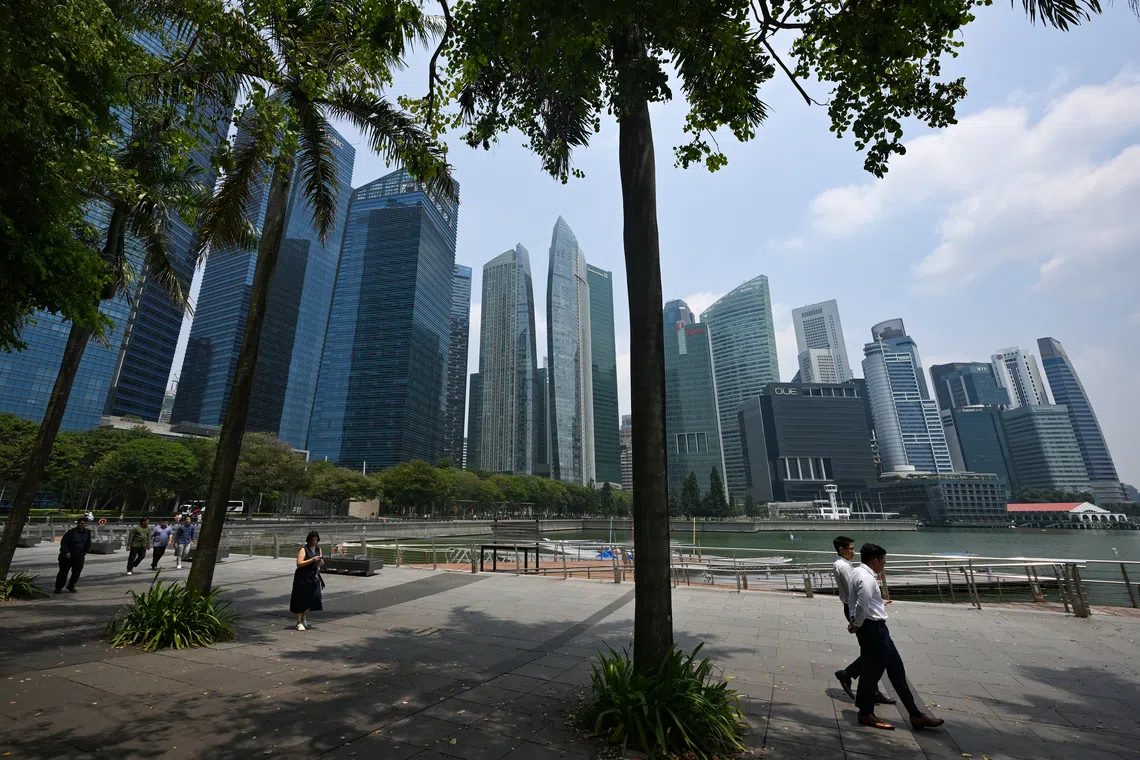
The initiatives reflect Singapore’s recognition that AI will rapidly become the defining force behind the next wave of innovation.
ST PHOTO: LIM YAOHUI
Published Oct 27, 2026, 10:02 AM
Updated Oct 27, 2026, 12:26 PM
SINGAPORE – Singapore launched four new initiatives to support companies of all sizes in boosting their capability to implement and scale artificial intelligence, and use the technology to transform their businesses.
The initiatives reflect Singapore’s recognition that AI will rapidly become the defining force behind the next wave of innovation, transforming how new ideas, products and services are developed and commercialised.
Deputy Prime Minister Gan Kim Yong announced the initiatives at the 2026 Singapore Week of Innovation and Technology (SWITCH) on Oct 27, noting that Singapore will explore ways to make AI work better for its industries and workers, to build an economy that is more innovative, competitive and inclusive.
“AI offers opportunities to raise productivity, and develop new products and capabilities,” he said in his speech at the event’s opening ceremony held at Marina Bay Sands.
The initiatives follow the four national AI missions – advanced manufacturing, finance, healthcare and connectivity – announced by Prime Minister Lawrence Wong during Budget 2026.
Led by Enterprise Singapore (EnterpriseSG) in partnership with other Government agencies, the new initiatives include a Champions of AI programme to help ambitious Singapore-based companies committed to making AI a core driver of growth.
Dubbed by EnterpriseSG as the national flagship AI initiative, the programme will begin with a cohort of 24 companies across various industries, with more companies progressively coming on board.
The list of champions includes well-known local names such as DBS, OCBC, UOB, ST Engineering, Seatrium, PSA International, Singapore Airlines, Singtel Singapore, Keppel and Sembcorp.
The agency will work closely with these companies to develop tailored, long-term AI transformation road maps and provide them with access to curated AI expertise and solution providers, supporting enterprise-wide deployment of AI and change management, as well as workforce redesign and upskilling.
The second initiative is a series of agentic AI workshops to provide hands-on guidance to small and medium-sized enterprises (SMEs) for adopting and scaling AI solutions.
Agentic AI is an artificial intelligence system that can accomplish a specific goal with limited supervision. It consists of AI agents, or machine learning models that mimic human decision-making to solve problems in real time.
The workshops will enable micro-entrepreneurs and small business owners to start their AI journey, identify practical use cases and build working prototypes tailored to their own businesses.
In the pilot run, more than 280 small businesses were supported to apply agentic AI tools in areas such as marketing, sales and customer service.
More workshops will be rolled out next month and scaled further in 2027.
The third initiative, termed Catalytic AI Solutions, aims to advance sector-wide AI adoption, starting with the advanced manufacturing, trade, and logistics sectors.
This initiative will help advanced manufacturers tackle key operational challenges and boost workflows, rice importers make smarter procurement and inventory management decisions, and logistic firms optimise routing decisions and allocating jobs across their fleet.
Perhaps the most ambitious of the four initiatives is MARVEL-AI, which stands for Accelerating Advanced Materials Innovation through AI and Automation.
Advanced materials are substances intentionally engineered, modified, or synthesised to exhibit novel or significantly enhanced physical and chemical properties. These deliver superior performance, structural strength, durability, and sustainability compared to traditional metals, ceramics or polymers.
These engineered materials act as the baseline enabling agents for industries – such as semiconductors, advanced manufacturing, energy and chemicals – and allow breakthroughs that are physically impossible with conventional inputs.
While newer materials can unlock better products, each material candidate has to go through a lengthy R&D process of experimentation, characterisation, validation, process development and industrial translation.
This can involve multiple development cycles, substantial resources and separate hand-offs between research and downstream development.
MARVEL-AI is designed to change the speed and scale of materials innovation, with a differentiated proposition that connects AI-enabled materials discovery, experimentation and validation with the pathway towards real-world industrial applications.
The initiative is likely to put Singapore on the map of advanced materials innovation – an area of intense competition among a handful of countries, including the US, Britain, China, Japan, South Korea and Switzerland.
Led by A*STAR, the initiative is supported by the Ministry of Energy, Trade and Industry, EnterpriseSG, Singapore Economic Development Board and National Research Foundation.
The initiative received initial funding of $150 million from the Research, Innovation and Enterprise 2030 (RIE2030), Singapore’s five-year $37 billion science and innovation masterplan announced in 2025.
MARVEL-AI is focused on four materials classes: metal alloys, polymers and organics, ceramics, and composites.
It also aims to create high-value start-ups, anchor large multinationals with materials development mandates and uplift local enterprises with frontier technologies.
Gan, who is also the Minister for Energy, Trade and Industry (Trade), said AI models such as Google’s Project GNoME (Graph Networks for Materials Exploration) and Microsoft’s MatterGen have shown the potential of AI to accelerate materials discovery.
He said the AI models will identify promising materials and design experiments, while the highly automated A*STAR laboratories will rapidly synthesise and test them.
“This will create opportunities for industry partnerships, enterprise growth and new ventures. We will also develop talent with capabilities spanning materials science, AI and automation, creating good job opportunities.
“Together, these efforts can deepen our industrial capabilities, develop new sources of growth, and strengthen Singapore’s position in advanced materials innovation,” he said.
Ovais Subhani is senior business correspondent at The Straits Times. He writes stories that demystify the latest economics, trade and finance news.
AI/artificial intelligence
SME/Small and medium-sized enterprise
Technology and research
这些举措体现了新加坡对人工智能将迅速成为下一波创新浪潮背后的决定性力量的认识。
ST 照片:林耀辉
发布于 2026 年 10 月 27 日上午 10:02
更新于2026年10月27日下午12:26
新加坡——新加坡推出了四项新举措,旨在支持各种规模的公司提高其实施和扩展人工智能的能力,并利用该技术来改变其业务。
这些举措体现了新加坡对人工智能将迅速成为下一波创新浪潮背后的决定性力量的认识,它将改变新理念、产品和服务的开发和商业化方式。
新加坡副总理颜金勇于 10 月 27 日在 2026 年新加坡创新与科技周 (SWITCH) 上宣布了这些举措,并指出新加坡将探索如何让人工智能更好地服务于其各行各业和劳动者,以建立一个更具创新性、竞争力和包容性的经济体。
“人工智能为提高生产力、开发新产品和新能力提供了机会,”他在滨海湾金沙酒店举行的活动开幕式上发表讲话时说道。
这些举措遵循了总理黄循财在 2026 年财政预算案中宣布的四大国家人工智能发展方向——先进制造业、金融、医疗保健和互联互通。
这些新举措由新加坡企业发展局 (EnterpriseSG) 牵头,并与其他政府机构合作推出,其中包括一项“人工智能领军企业”计划,旨在帮助致力于将人工智能作为核心增长驱动力的、雄心勃勃的新加坡企业。
该计划被新加坡企业发展局(EnterpriseSG)称为国家旗舰人工智能计划,将首先由来自各个行业的 24 家公司组成,之后将逐步有更多公司加入。
获奖名单中包括一些知名的本地企业,例如星展银行、华侨银行、大华银行、新加坡科技工程、Seatrium、PSA国际集团、新加坡航空公司、新加坡电信、吉宝集团和胜科集团。
该机构将与这些公司密切合作,制定量身定制的长期人工智能转型路线图,并向他们提供精选的人工智能专业知识和解决方案提供商,支持企业范围内的人工智能部署和变革管理,以及劳动力重组和技能提升。
第二项举措是举办一系列人工智能智能研讨会,为中小企业 (SME) 提供采用和扩展人工智能解决方案的实践指导。
智能体人工智能是一种能够在有限监督下完成特定目标的人工智能系统。它由人工智能代理(或机器学习模型)组成,这些代理或模型模仿人类的决策过程来实时解决问题。
这些研讨会将帮助微型企业家和小企业主开启他们的 AI 之旅,确定实际应用案例,并构建适合他们自身业务的工作原型。
在试点运行中,超过 280 家小型企业获得了支持,在市场营销、销售和客户服务等领域应用了智能人工智能工具。
下个月将推出更多研讨会,并在 2027 年进一步扩大规模。
第三项举措名为“催化型人工智能解决方案”,旨在推进人工智能在各行业的应用,首先从先进制造业、贸易和物流行业入手。
这项举措将帮助先进制造商应对关键运营挑战并提高工作流程效率,帮助大米进口商做出更明智的采购和库存管理决策,并帮助物流公司优化路线选择和车队作业分配。
这四项计划中,最雄心勃勃的或许是 MARVEL-AI,它代表“通过人工智能和自动化加速先进材料创新”。
先进材料是指经过精心设计、改性或合成,使其具有新颖或显著增强的物理和化学性质的物质。与传统金属、陶瓷或聚合物相比,这些材料具有更优异的性能、结构强度、耐久性和可持续性。
这些工程材料是半导体、先进制造、能源和化工等行业的基础使能剂,能够实现传统投入在物理上不可能实现的突破。
虽然新材料可以带来更好的产品,但每种候选材料都必须经过漫长的研发过程,包括实验、表征、验证、工艺开发和工业转化。
这可能涉及多个开发周期、大量资源以及研究和下游开发之间的单独交接。
MARVEL-AI 旨在改变材料创新的速度和规模,其差异化方案将人工智能赋能的材料发现、实验和验证与通往现实世界工业应用的途径联系起来。
这项举措有望使新加坡在先进材料创新领域占据一席之地——这是一个竞争异常激烈的领域,美国、英国、中国、日本、韩国和瑞士等少数几个国家都在积极参与其中。
该计划由新加坡科技研究局 (A*STAR) 牵头,并得到能源、贸易和工业部、新加坡企业发展局 (EnterpriseSG)、新加坡经济发展局和国家研究基金会的支持。
该计划从新加坡于 2025 年宣布的五年期 370 亿美元科学与创新总体规划“2030 年研究、创新与企业发展计划”(RIE2030)中获得了 1.5 亿美元的初始资金。
MARVEL-AI 专注于四类材料:金属合金、聚合物和有机物、陶瓷和复合材料。
它还旨在创建高价值的初创企业,为大型跨国公司提供材料开发方面的支持,并利用前沿技术提升本地企业。
兼任能源、贸易和工业部长(贸易部长)的颜金勇表示,谷歌的 Project GNoME(用于材料探索的图网络)和微软的 MatterGen 等人工智能模型已经展现了人工智能在加速材料发现方面的潜力。
他表示,人工智能模型将识别有前景的材料并设计实验,而高度自动化的A*STAR实验室将快速合成和测试这些材料。
“这将为产业合作、企业发展和新创企业创造机会。我们还将培养具备材料科学、人工智能和自动化等领域能力的人才,创造良好的就业机会。”
他表示:“这些努力可以共同深化我们的工业能力,开发新的增长点,并加强新加坡在先进材料创新领域的地位。”
奥瓦伊斯·苏巴尼是《海峡时报》的资深商业记者。他撰写的文章深入浅出地解读最新的经济、贸易和金融新闻。
人工智能
中小企业
技术与研究