Singapore’s renewed solar push: Hanging panels, clay-like tiles for heritage buildings among plans新加坡重启太阳能发展计划:悬挂式太阳能板、用于历史建筑的仿陶瓦等方案
Help will also be provided to private homeowners wishing to install solar panels on their roofs. Read more at straitstimes.com.
AI-generated rendering of solar panels hanging across industrial buildings at 15 Woodlands Loop.
Published Oct 27, 2026, 04:00 PM
Updated Oct 27, 2026, 04:00 PM
SINGAPORE – From placing solar panels on containers to hanging them between buildings, Singapore is finding unique ways to squeeze as much power from sunlight as possible, to meet its new 2035 solar target.
The authorities are pushing ahead to meet the renewed target of harnessing 4 gigawatt-peak (GWp) of solar energy by 2035, by working with government agencies, companies and even homeowners.
These were among plans to step up the country’s solar push announced by Minister of State for Energy, Trade and Industry Gan Siow Huang on Oct 27 at the Singapore International Energy Week.
Work is also under way to trial solar panels that resemble clay tiles for installation on heritage buildings without greatly altering their look.
The target 4GWp of solar represents around 5% of Singapore’s electricity demand projected for 2035.
The country now generates about 2.3GWp of solar energy and aims to reach 3GWp by the end of 2030 .
To encourage more private homeowners to install solar panels on their roofs, the Energy Market Authority (EMA) will partner the Sustainable Energy Association of Singapore to develop a digital portal.
The portal will provide solar-related information and services, help homeowners connect with solar installers, and explore group purchase opportunities, said EMA on Oct 27.
There are over 8,000 residential solar installations currently.
In tandem with the push for more private home solar installations, EMA will embark on a research collaboration with the Energy Research Institute @ NTU (ERI@N) to study and map the capacity of local electricity networks, to accommodate more solar in landed housing estates and cope with more power flowing from solar panels back to the grid.
On Oct 27, EMA also launched an initiative to handle the demand for solar energy across all public and government buildings.
A panel of solar installers will be appointed to help government agencies assess the solar potential of their premises and develop tailored solutions.
By amassing demand across agencies, the initiative can create greater economies of scale, and also come up with the best solutions for sites with different tenures, operational needs and conditions, said EMA.
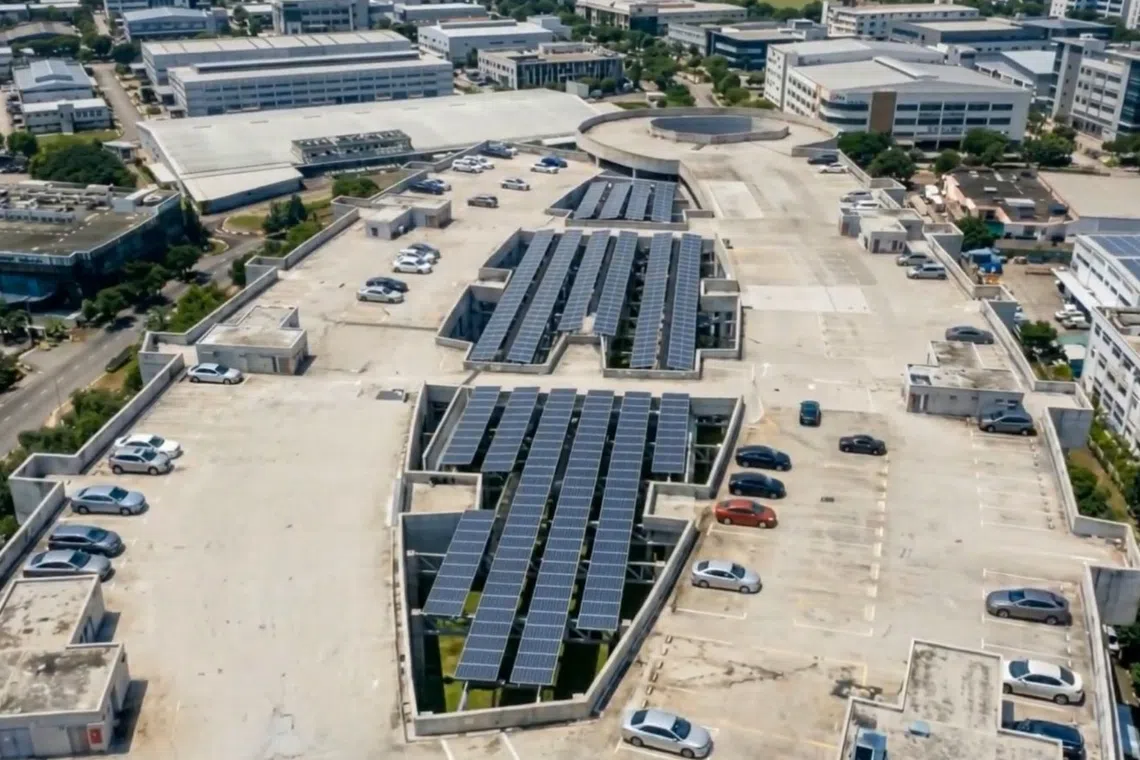
Agencies can also explore innovative solutions such as solar roofs at parking lots and replacing windows or building facades with special solar panels.
Singapore now has installed rooftop solar on over 5,000 HDB blocks and public buildings through HDB’s SolarNova programme and other efforts, Gan noted.
To further identify where and how Singapore can maximise solar, EMA will collaborate with the Solar Energy Research Institute of Singapore to “assess solar deployment opportunities across diverse types of surfaces”, the authority said.
Portable solar solutions
Apart from HDB, industrial developer JTC Corporation has been another major player in Singapore’s solar deployment – it is responsible for 45 per cent of the country’s current solar capacity, with panels across the industrial estates it manages. It also runs the country’s largest ground-mounted solar installation on Jurong Island.
JTC is now piloting innovative ways to harness the renewable energy from unconventional spaces in its industrial estates.
An AI rendering of solar panels suspended across buildings. PHOTO: EDP APAC
An AI rendering of solar panels suspended across buildings.
These include a project where solar panels will be suspended between two existing industrial buildings at 15 Woodlands Loop. Renewable energy firm EDP APAC will build and test this overhang solar structure over 15 months from October .
Such structures come with engineering and operational challenges, said JTC. For one thing , the overhang structure must safely carry its own weight and that of the panels, while withstanding wind forces at height.
JTC also announced an innovation call on Oct 27 seeking portable solar solutions at construction sites with limited access to the national grid. One solution that could be explored is the use of solar panels on containers with mobile energy storage systems.
“This solution will help many temporary worksites that have limited or no access to the power grid and currently rely heavily on noisy and pollutive diesel generators,” said Gan.
On the research front, EMA is partnering the Singapore Land Authority and CSEM, a Swiss technology innovation centre, to pilot the use of solar photovoltaic (PV) roof tiles on heritage buildings.
Clay-like solar roofs installed on a building in Switzerland. PHOTO: FREESUNS
Clay-like solar roofs installed on a building in Switzerland.
Designed to resemble traditional clay roof tiles, the solar PV tiles enable a larger roof area to generate clean electricity while retaining the character of older buildings, said EMA.
“We are really pushing all boundaries and surfaces literally, and capturing every opportunity to harness solar across Singapore,” said Gan.
But she noted that there are limits to the amount of solar energy Singapore can harness, due to land scarcity and intermittency due to cloud cover.
Gan said that, at most, solar energy can meet 10% of Singapore’s electricity needs by 2050, the year the country has pledged to reach net zero on its carbon emissions .
AI生成的渲染图,展示了伍德兰兹环路15号工业建筑上悬挂的太阳能电池板。
发布于2026年10月27日下午4:00
更新于2026年10月27日下午4:00
新加坡——从在集装箱上安装太阳能电池板到将太阳能电池板悬挂在建筑物之间,新加坡正在寻找独特的方法来尽可能多地利用阳光发电,以实现其新的 2035 年太阳能目标。
当局正与政府机构、公司甚至房主合作,努力实现到 2035 年利用 4 吉瓦峰值 (GWp) 太阳能的新目标。
这些计划是新加坡能源、贸易及工业部政务部长颜晓煌于10月27日在新加坡国际能源周上宣布的,旨在加大国家太阳能发展力度。
目前也在进行试验,研究如何将外观类似粘土瓦的太阳能电池板安装在历史建筑上,而不会大幅改变其外观。
4GWp 的太阳能发电目标约占新加坡 2035 年预计电力需求的 5%。
该国目前太阳能发电量约为 2.3 吉瓦峰值功率 (GWp),目标是在 2030 年底达到 3 吉瓦峰值功率 (GWp)。
为了鼓励更多私人住宅业主在屋顶上安装太阳能电池板,能源市场管理局(EMA)将与新加坡可持续能源协会合作开发一个数字门户网站。
EMA 于 10 月 27 日表示,该门户网站将提供与太阳能相关的信息和服务,帮助房主联系太阳能安装商,并探索团购机会。
目前已有超过8000套住宅太阳能装置。
为了配合推动更多私人住宅安装太阳能装置的举措,EMA 将与南洋理工大学能源研究所 (ERI@N) 开展研究合作,以研究和绘制当地电网的容量图,以便在有地住宅区容纳更多太阳能,并应对更多从太阳能电池板回流到电网的电力。
10月27日,EMA还启动了一项计划,以满足所有公共和政府建筑对太阳能的需求。
将指定一个太阳能安装商小组,帮助政府机构评估其场所的太阳能潜力,并制定量身定制的解决方案。
EMA表示,通过汇集各机构的需求,该举措可以创造更大的规模经济效益,并为具有不同期限、运营需求和条件的场地提出最佳解决方案。
各机构还可以探索创新解决方案,例如在停车场安装太阳能屋顶,以及用特殊的太阳能电池板替换窗户或建筑物外墙。
颜先生指出,新加坡目前已通过建屋发展局的 SolarNova 计划和其他努力,在超过 5000 座组屋和公共建筑上安装了屋顶太阳能系统。
为了进一步确定新加坡可以在哪些地方以及如何最大限度地利用太阳能,EMA表示将与新加坡太阳能研究院合作,“评估在各种类型的表面上部署太阳能的机会”。
便携式太阳能解决方案
除了建屋发展局(HDB)之外,工业地产开发商裕廊集团(JTC Corporation)也是新加坡太阳能部署的另一大参与者——该公司负责该国目前45%的太阳能发电装机容量,其管理的工业园区内均安装了太阳能电池板。此外,该公司还在裕廊岛运营着新加坡最大的地面太阳能发电装置。
裕廊集团目前正在试点创新方法,利用其工业园区内非常规空间中的可再生能源。
人工智能渲染的悬挂在建筑物上的太阳能电池板。图片:EDP亚太区
人工智能渲染的悬挂在建筑物上的太阳能电池板。
其中包括位于伍德兰兹环路15号的两栋现有工业建筑之间悬挂太阳能电池板的项目。可再生能源公司EDP APAC将从10月开始,用15个月的时间建造和测试这个悬臂式太阳能结构。
裕廊集团表示,此类结构在工程和运营方面都面临挑战。首先,悬挑结构必须安全地承载自身重量和面板重量,同时还要承受高空风力。
裕廊集团(JTC)于10月27日发布了一项创新征集,旨在为接入国家电网有限的建筑工地寻找便携式太阳能解决方案。其中一个值得探索的方案是将太阳能电池板安装在集装箱上,并配备移动储能系统。
“这项解决方案将帮助许多无法或难以接入电网的临时工地,这些工地目前严重依赖噪音大、污染严重的柴油发电机,”甘先生说。
在研究方面,EMA正与新加坡土地管理局和瑞士技术创新中心CSEM合作,试点在历史建筑上使用太阳能光伏(PV)屋顶瓦。
瑞士一栋建筑上安装了类似粘土的太阳能屋顶。图片:FREESUNS
瑞士一栋建筑上安装了类似粘土的太阳能屋顶。
EMA表示,这种太阳能光伏瓦的设计模仿了传统的粘土屋顶瓦,可以在更大的屋顶面积上产生清洁电力,同时保留老建筑的特色。
“我们正在真正突破所有界限和表面,抓住每一个机会,在新加坡各地利用太阳能,”颜先生说。
但她指出,由于土地稀缺和云层覆盖造成的间歇性问题,新加坡能够利用的太阳能数量是有限的。
颜金勇表示,到 2050 年,太阳能最多只能满足新加坡 10% 的电力需求。新加坡已承诺在 2050 年实现碳排放净零排放。