US Army looks to high-flying balloons to help see, strike along front lines with China美国陆军希望借助高空气球来侦察并打击与中国的前线目标。
Amid renewed interest in high-altitude balloons, soldiers are looking to them to extend their reach along the first island chain.
Share on Facebook (Opens in new window) Facebook
Share on X (Opens in new window) X
Share on Bluesky (Opens in new window) Bluesky
Share on Reddit (Opens in new window) Reddit
Share on LinkedIn (Opens in new window) LinkedIn
Share using Native tools Share Copied to clipboard
Share on Mail (Opens in new window) Mail
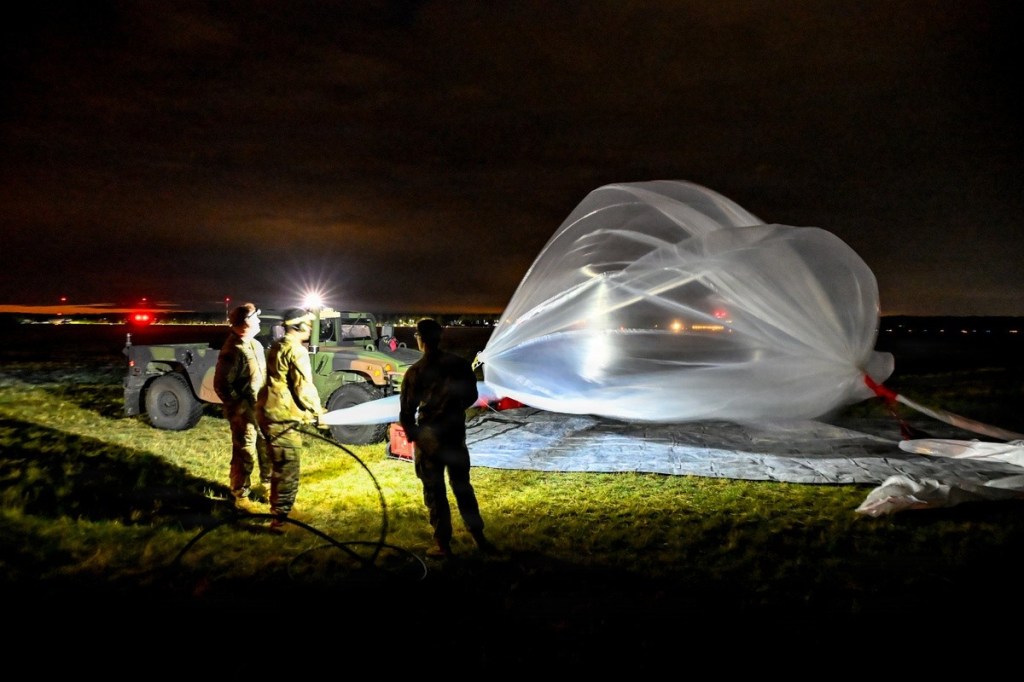
U.S. soldiers inflate a High-Altitude Balloon before launch during nighttime operations in Powidz, Poland, Jul. 28, 2026. (Sgt. 1st Class Rajheem Dixon/U.S. Army)
To burst China’s anti-access/area-denial bubble, the U.S. Army is looking at using high-flying balloons with payloads that can monitor the battlefield, relay communications and strike adversaries.
The Army has tinkered with high-altitude balloons for some time, but interest and experimentation have grown in recent years. Against China’s growing arsenal in the vastness of the Pacific , those balloons could provide a cheaper, lower-signature platform that can be employed from dispersed positions, Maj. Gen. Bernard Harrington, commander of the Army’s 7th Infantry Division/Multi-Domain Command-Pacific, or MDC-P, said at the Association of the U.S. Army’s annual conference in Washington, D.C., earlier this month.
Harrington’s command was recently established to merge the ground-maneuver elements of the 7th Infantry Division and long-range capabilities of the 1st Multi-Domain Task Force. Part of the unit’s mission is to operate in space, cyberspace and the electromagnetic spectrum and use long-range fires to help the rest of the Joint Force maneuver, including by opening gaps in China’s anti-access/area-denial network — the air, sea and land-based sensors and weapons designed to keep U.S. forces at bay.
“For us in the Pacific, we really are looking at a specific pacing threat and an anti-access/area-denial network,” against which MDC-P aims to create “windows of opportunity for that Joint Force, whether it be a carrier strike group that’s going to pulse into the weapons engagement zone , whether it be a bomber task force, whether it be a ground unit doing a joint forcible-entry operation,” Harrington said.
High-altitude balloons, or HABs, could facilitate that by carrying “launched effects” — the Army’s term for an aerial system deployed from crewed and uncrewed vehicles for reconnaissance, communications, strikes and other missions. HABs would give MDC-P soldiers more ways to employ attack drones and munitions that are cheaper than “exquisite” missiles, available in greater numbers and harder for adversaries to spot.
Interest in HABs has grown in part due to technological improvements that allow them to stay aloft for weeks or months at a time and give operators more control over where they go. That enhances balloons’ value as platforms for radars and other sensors which, at operating altitudes above 60,000 feet, can see far into rival territory while remaining in international airspace. They also offer a cost-effective complement to satellites, which are more expensive and whose orbits limit their time over any one area.
Harrington described high-altitude balloons as part of “an ecosystem” of data-collecting assets in space, in the air, on land and at sea. HABs in particular could compensate if space-based assets are taken out , Harrington said. “So our ability to employ HABs [and] have HABs be persistent enables both our collection and targeting as well as us [to] provide that information to the Joint Force for their collection and targeting.”
Harrington also described a role for balloon- or unmanned surface vessel-launched effects in kinetic strikes. With the right timing and enough precision, those strikes may not even need to eliminate their target to create an opening.
“Maybe I don’t necessarily need to sink a ship, but if I take out certain systems on that vessel, well, then it creates this temporal window of opportunity,” Harrington said.
“We saw great value [in] that maybe I don’t have to use specifically or unmask an exquisite system to achieve that effect. If I can achieve effect of mass utilizing lower-cost systems, maybe that will get me there,” Harrington added. “So we modeled that, and what we saw was — particularly with our unmanned surface vessels, long-range one-way attack, long-range launched effects — the ability to synchronize and mass that could potentially get us to achieve that effect.”
Harrington’s command experimented with some of those systems during Bayonet Quest 26, an exercise held in Michigan and on Lake Huron from late September to early October. An official video showed soldiers working with air and maritime drones, including a quadcopter launched from a surface vessel and a fixed-wing drone hooked up to a balloon. Harrington said Bayonet Quest tested MDC-P’s ability to “orchestrate those systems” by launching them, gathering data from their sensors, and using AI and LLMs to process that data and produce tasking orders.
“If you see [a potential target], then task a UAS to be able to come over and actually validate if that meets the target folder,” Harrington said, describing the approach. “Then I can task long-range one-way attack [or] an attack USV to be able to achieve that effect or I could send that as a potential fire mission to a more exquisite munition to be able to close that kill chain.”
That reduces the need for a large, easily targetable ground presence, Harrington added: “This is all about integration: Integrate multiple systems into one data layer, be able to lay something like a large language model on top of it, and allow orchestration so we don’t have a lot of soldiers in fixed sites on ground control stations.”
Harrington’s comments come amid a flurry of HAB-related experiments by the Army in North Africa , the Middle East , Europe and the Pacific.
At exercise Valiant Shield in Guam this summer, soldiers experimented with HABs and launched effects “within an island-chain operational construct.” One test sent a HAB aloft towing a long-endurance drone “to evaluate stratospheric payload deployment capabilities.” Soldiers tested the same balloon-drone combo in Japan during Orient Shield in September.
The Army’s Multi-Domain Command-Europe has done dozens of HAB launches over the past year to examine the logistics of employing balloons and to test sensing and communications capabilities using “ experimental payloads .”
Speaking alongside Harrington this month, MDC-E commander Brig. Gen. Steven Carpenter said HABs have a role, alongside other sensors and weapons, in opening “windows of opportunity” against anti-access/area-denial networks, in particular by providing resilient communications and additional strike platforms.
“We like to proliferate the stratosphere with high-altitude balloons, but I mean 200, 300 at a time. We like to use them as drones, [communications retransmission], electromagnetic sensing, electronic attack, and then to drop them down and have air-launched effects,” Carpenter said. “During different seasons, the flight paths are different. We study that. We understand during what seasons, where the best places are to launch those high-altitude systems and then, again, to hold enemy cities and capabilities at risk at any time.”
分享至 Facebook(在新窗口中打开) Facebook
分享至 X(在新窗口中打开)X
在 Bluesky 上分享(在新窗口中打开)Bluesky
分享到 Reddit(在新窗口中打开)
在领英上分享(在新窗口中打开)领英
使用原生工具分享 已复制到剪贴板
分享至邮件(在新窗口中打开)邮件
2026年7月28日,在波兰波维兹,美军士兵在夜间行动中为高空气球充气准备发射。(一级军士长拉吉姆·迪克森/美国陆军)
为了打破中国的反介入/区域拒止能力,美国陆军正在考虑使用携带有效载荷的高空气球,这些气球可以监视战场、中继通信和打击对手。
美国陆军对高空气球的研究已有一段时间,但近年来,人们对高空气球的兴趣和试验力度显著增强。陆军第七步兵师/太平洋多域司令部(MDC-P)司令伯纳德·哈灵顿少将本月初在华盛顿特区举行的美国陆军协会年会上表示,面对中国在广袤的太平洋地区日益增长的武器库,这些气球可以提供一种更经济、更低特征的平台,并且可以从分散的阵地部署。
哈灵顿指挥部近期成立,旨在整合第7步兵师的地面机动部队和第1多域特遣部队的远程作战能力。该部队的部分任务是在太空、网络空间和电磁频谱中开展行动,并利用远程火力支援联合部队其他成员的机动,包括突破中国的反介入/区域拒止网络——即旨在阻止美军行动的空中、海上和陆地传感器及武器系统。
哈灵顿说:“对于我们在太平洋地区来说,我们真正关注的是一种特定的快速推进威胁和反介入/区域拒止网络。”MDC-P 的目标是针对这种威胁创造“联合部队的机会窗口,无论是即将进入武器交战区的航母打击群,还是轰炸机特遣队,亦或是执行联合强行进入行动的地面部队。”
高空气球(HABs)可以通过携带“发射效应”(陆军对从有人或无人驾驶飞行器上部署的空中系统的称呼,用于侦察、通信、打击和其他任务)来实现这一目标。高空气球将为MDC-P士兵提供更多使用攻击无人机和弹药的途径,这些弹药比“精密”的导弹更便宜、数量更多,而且更难被敌方发现。
人们对高空气球的兴趣日益浓厚,部分原因是技术进步使得气球能够一次在空中停留数周甚至数月,并让操作人员更好地控制其飞行路线。这提升了气球作为雷达和其他传感器平台的价值,在6万英尺以上的飞行高度,气球能够在国际空域内探测到敌方领空深处。此外,气球也为卫星提供了一种经济高效的补充,卫星价格更高,且轨道限制了其在任何特定区域上空的停留时间。
哈灵顿将高空气球描述为太空、空中、陆地和海上数据收集资产“生态系统”的一部分。他表示,如果天基资产被摧毁,高空气球尤其可以起到弥补作用。“因此,我们利用高空气球并使其持续运行的能力,既能帮助我们进行数据收集和目标定位,也能让我们将这些信息提供给联合部队,供他们进行数据收集和目标定位。”
哈灵顿还描述了气球或无人水面舰艇发射的效应在动能打击中的作用。如果时机把握得当且精度足够高,这些打击甚至可能无需摧毁目标就能制造突破口。
“也许我不一定非要击沉一艘船,但如果我摧毁那艘船上的某些系统,那么就会创造出一个短暂的机会窗口,”哈灵顿说。
哈灵顿补充道:“我们看到了一个很大的价值,那就是或许我并不需要专门使用或公开一套精密的系统就能达到那种效果。如果我能利用成本更低的系统实现大规模打击的效果,或许就能实现目标。所以我们对此进行了建模,结果发现——尤其是在我们的无人水面舰艇、远程单向攻击和远程发射方面——同步和大规模打击的能力有可能让我们达到那种效果。”
哈灵顿的指挥部在“刺刀探索26”(Bayonet Quest 26)演习中对其中一些系统进行了试验。该演习于9月下旬至10月初在密歇根州和休伦湖举行。一段官方视频显示,士兵们正在操作空中和海上无人机,包括从水面舰艇上发射的四旋翼无人机和连接在气球上的固定翼无人机。哈灵顿表示,“刺刀探索”演习测试了MDC-P系统“协调这些系统”的能力,具体包括发射无人机、收集传感器数据,以及利用人工智能和LLM(逻辑逻辑模型)处理数据并生成任务指令。
哈灵顿在描述这种方法时说:“如果你发现潜在目标,就派无人机飞过去,确认它是否符合目标文件夹的要求。然后我可以派出远程单向攻击无人机或攻击型无人水面艇来完成打击,或者我可以将其作为潜在的火力支援任务,使用更精密的弹药来完成杀伤链。”
哈灵顿补充说,这减少了对大量易受攻击的地面部队的需求:“这一切都与集成有关:将多个系统集成到一个数据层中,能够在其上构建类似大型语言模型的东西,并允许进行协调,这样我们就不需要在地面控制站的固定地点部署大量士兵。”
哈灵顿发表这番言论之际,美国陆军正在北非、中东、欧洲和太平洋地区开展一系列与有害藻华相关的试验。
今年夏天在关岛举行的“英勇之盾”演习中,士兵们试验了高空气球(HAB)并“在岛链作战框架内”投放了相关效应物。其中一项测试将一个高空气球拖曳一架长航时无人机升空,“以评估平流层有效载荷部署能力”。士兵们在9月份于日本举行的“东方之盾”演习中也测试了同样的气球-无人机组合。
过去一年,美国陆军多域司令部-欧洲分部进行了数十次高空气球发射,以检验使用气球的后勤保障,并利用“实验有效载荷”测试传感和通信能力。
本月,MDC-E 指挥官史蒂文·卡彭特准将与哈灵顿一同发表讲话,他表示,HAB 与其他传感器和武器一起,在打开对抗反介入/区域拒止网络的“机会之窗”方面发挥着作用,特别是通过提供弹性通信和额外的打击平台。
“我们喜欢在平流层投放大量高空气球,一次投放200到300个。我们喜欢把它们用作无人机、通信中继、电磁探测、电子攻击,然后再投放到地面,产生空袭效果,”卡彭特说。“不同季节的飞行路线也不同。我们对此进行研究。我们了解在哪些季节、哪些地点是投放这些高空气球系统的最佳时机,以便随时威胁敌方城市和作战能力。”