Ukraine claims to have fielded a drone-killing laser weapon乌克兰声称已部署了一种可击落无人机的激光武器。
The device is known as “Tryzub,” or trident in English, referencing the Ukrainian national symbol.
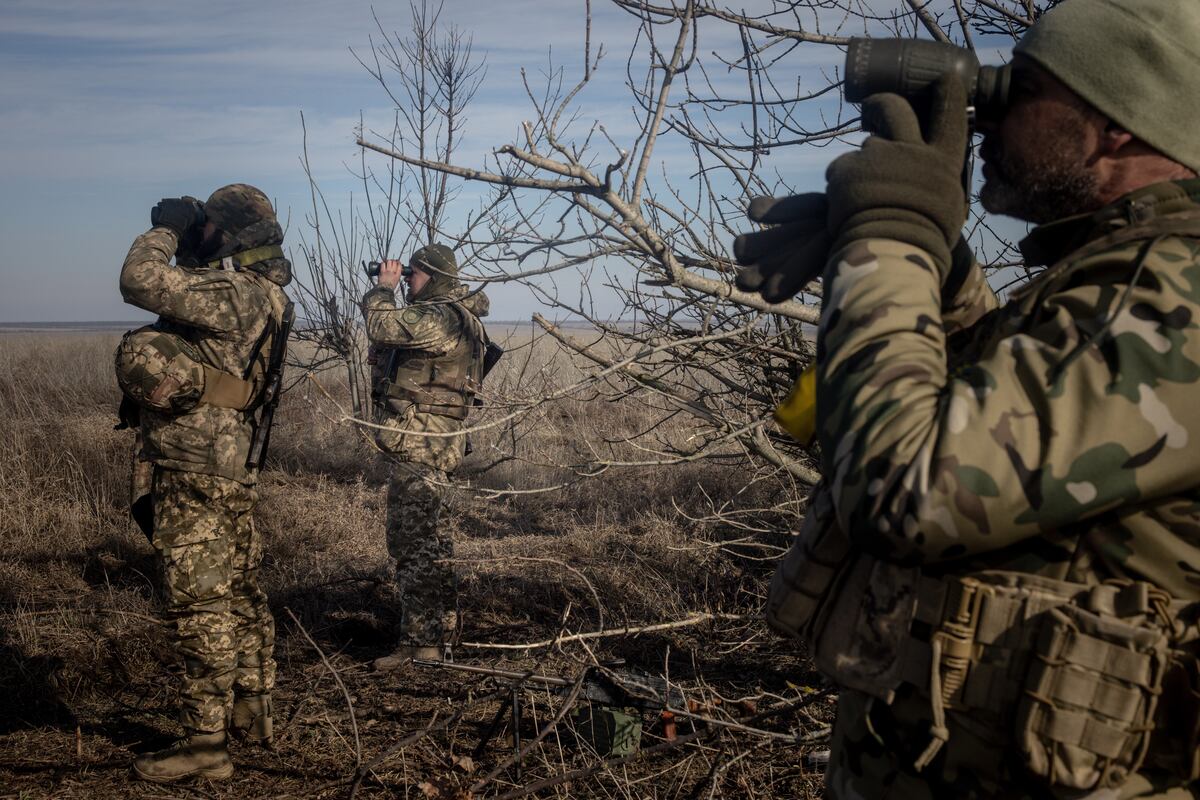
THE HAGUE, Netherlands — Ukraine claims to be one of the first countries to have successfully developed a laser anti-aircraft weapon, according to a high-ranking military official.
The secretive device has reportedly been employed on the battlefield against low-flying targets, likely unmanned aerial vehicles like the Iranian-made Shahed drones. It was first revealed in an interview with a Ukrainian news outlet by Colonel Vadym Sukharevskyi, the commander of the unmanned systems forces within the Ukrainian military.
The device is known as “Tryzub,” or trident in English, referencing the Ukrainian national symbol, which is superimposed in yellow on a blue background in the country’s now world-famous coat of arms.
Information on the new system is scarce and jealously guarded. It was first publicly mentioned by Sukharevskyi in mid-December when he revealed the weapon’s existence and some key parameters at a defense industry conference in Kyiv, as reported by the Ukrainian Interfax news agency. Asked about it again by Radio Free Europe in February of this year, he confirmed that the weapon was operationally deployed.
Speaking in the context of battlefield innovations to counter the threat of Shahed and similar drones and loitering munitions, he said that: “I repeat – laser technologies are already striking objects at a certain height.”
No pictures of the Tryzub have been released yet and it was not possible to independently verify the Ukrainian military’s claims. Nor have there been any indications as to where it was deployed or exactly what or how many targets it has engaged.
A spokesperson for Brave1, the Ukrainian government’s “united coordinational platform for defense tech,” said that it was “unable to provide any comments regarding the Tryzub weapons system or its development” in response to an inquiry.
It is unclear to what extent the Ukrainian laser weapon may still be in an experimental phase. Although the military has claimed that it succeeded in shooting down enemy “aircraft,” it is entirely possible that there may be just a single system and its mobility may be limited.
Laser weapons can be rather bulky due to their need for power generation and cooling infrastructure. This is a big part of why many of the systems developed around the world are ship-based. However, experts said that a laser weapon system with the specifications that Ukraine reportedly has may be made to fit onto a truck bed.
Comparable weapons, such as the South Korean Skylight, which entered regular production last year and has a similar range of two to three kilometers, is housed in a container with a volume of 81 cubic meters and generates approximately 700°C heat during ten- to twenty-second impulses. It entered service in December 2024.
Despite the technological challenges, many major players have toyed with the idea of developing similar weapons, and some have dabbled in research and design. The promised advantages primarily focus on the ability to defending against large numbers of low-cost attack aircraft, including drone swarms, at low cost.
In fielding such a system, Ukraine would join an elite club of significant military-industrial powers that have developed laser weapons and an even smaller group that has deployed them. It comes as part of broader Ukrainian efforts to reshape the battlefield through innovation.
The Unmanned Systems Forces, which appear to be involved in the operation and possibly the development of Tryzub, considering its commander’s role in announcing the system’s existence, was only established in 2024. It has also been involved in Ukrainian innovations of drone-swarming technologies that reportedly enhanced their ability to strike deep within enemy territory.
Lessons learned from Russia’s war against Ukraine may have hastened the development of laser weapons in other parts of the world. A month before South Korea’s laser weapon entered service, Japan revealed its own truck-based 10-kilowatt laser, which had been in development for more than four years.
Ukraine’s opponent, Russia, has also invested in laser technologies. In 2019, its Peresvet system was officially announced as having been deployed with five strategic missile divisions around the country. This weapon, however, is primarily meant to blind satellites in space rather than destroy drones much closer to Earth. Russia’s deputy prime minister in 2022 claimed that a new laser weapon, named Zadira , was deployed in Ukraine capable of destroying targets up to five kilometers away within five seconds, much more akin to the Tryzub that Ukraine now claims to have developed.
The U.S. and Ukraine at the time said there was no indication such a system was actually in use by Russian forces.
Germany, Israel and the United States all also have near-operational, land-based laser weapons systems, while other countries like Turkey and Australia are also indigenously working on them.
There has been some speculation whether the Ukrainian laser might be a derivative of the British DragonFire system. Significant amounts of the British “lethal aid” for Ukraine remain classified “for both operational and commercial reasons,” as the defense ministry has stated.
The U.K. government had teased its intention of sending its laser system to Ukraine in April 2024, before backtracking a month later and stating that it would not be included in the government’s 2024 aid package, UK Defence Journal reported. Leo Docherty, the British armed forces minister at the time, noted that the system was not yet ready, with the expected date for completion being 2027, a deadline that had been moved forward from 2033. Docherty’s statement left the door open for potentially sending the weapon to Ukraine once the development phase was complete.
Defense News reached out to the companies cooperating on the DragonFire system. MBDA, which leads the project, declined to comment, while Leonardo said that “there is no connection between Tryzub and the Dragonfire system.” Qinetiq did not respond to the request.
It is entirely possible that Tryzub is indeed an indigenous Ukrainian development. The country has a significant military-industrial base rooted in its significance to the Soviet military complex, important parts of which were based in the now-independent country. Combined with what is commercially available in the laser realm, crafty local engineers might have been able to build a Tryzub-like weapon, industry experts said, adding that the few publicly released parameters seem plausible.
“Laser directed-energy systems, in a military context, are predominantly at the proof of concept stage,” an industry insider, who asked to remain unnamed to discuss sensitive technologies, said. “These could, in theory, be fielded as an initial operating capability.”
The country has radically restructured its defense R&D and acquisition procedures, which has dramatically boosted innovation and responsiveness, a January report by the Center for Strategic and International Studies think tank showed. In the first nine months of 2024 alone, over 600 domestically developed new weapon systems were approved by the Ukrainian government.
And Ukraine’s February defense expo showcasing domestic military developments, Defense Tech 2025, promised a special focus on lasers and anti-Shahed weapons in its promotional materials – descriptions that fit the Tryzub – alongside other cutting-edge technologies like swarming drones, lethal autonomous weapons and sea drones.
Ukraine’s Unmanned Systems Forces did not respond to a request for comment on this topic.
Linus Höller is Defense News' Europe correspondent and OSINT investigator. He reports on the arms deals, sanctions, and geopolitics shaping Europe and the world. He holds master’s degrees in WMD nonproliferation, terrorism studies, and international relations, and works in four languages: English, German, Russian, and Spanish.
荷兰海牙——据一位高级军官称,乌克兰声称是首批成功研制出激光防空武器的国家之一。
据报道,这种秘密装置已在战场上用于攻击低空目标,很可能是伊朗制造的“沙赫德”无人机等无人飞行器。乌克兰军方无人系统部队指挥官瓦迪姆·苏哈列夫斯基上校在接受一家乌克兰新闻媒体采访时首次披露了这一消息。
该装置被称为“Tryzub”,在英语中意为三叉戟,指的是乌克兰的国家象征,该象征以黄色叠加在蓝色背景上,出现在该国如今举世闻名的国徽上。
关于这套新系统的信息十分稀少,且受到严密保护。据乌克兰国际文传电讯社报道,苏哈列夫斯基在去年12月中旬于基辅举行的一次国防工业会议上首次公开提及该系统,并透露了该武器的存在及其一些关键参数。今年2月,自由欧洲电台再次就此询问苏哈列夫斯基,他确认该武器已投入使用。
在谈到为应对“沙赫德”及类似无人机和巡飞弹的威胁而进行的战场创新时,他表示:“我再说一遍——激光技术已经能够打击一定高度的目标。”
目前尚未公布“三叉戟”导弹系统的任何照片,也无法独立核实乌克兰军方的说法。此外,也没有任何迹象表明该系统部署在何处,或者它究竟攻击了哪些目标、攻击了多少目标。
乌克兰政府“国防技术联合协调平台”Brave1的一位发言人在回应询问时表示,“无法就Tryzub武器系统或其研发提供任何评论”。
目前尚不清楚乌克兰的激光武器在多大程度上仍处于实验阶段。尽管军方声称已成功击落敌方“飞机”,但完全有可能这只是一套系统,而且其机动性也有限。
激光武器由于需要发电和冷却设施,体积通常相当庞大。这也是世界各地许多激光武器系统都采用舰载部署的主要原因。然而,专家表示,乌克兰据称拥有的那种规格的激光武器系统,或许可以设计成能够安装在卡车车厢上的。
类似的武器,例如去年投入批量生产的韩国“天光”导弹,射程也相近,约为两到三公里,其弹体容积为81立方米,在10到20秒的脉冲发射过程中会产生约700摄氏度的高温。该导弹于2024年12月投入使用。
尽管面临技术挑战,许多主要国家都曾考虑过研发类似武器,一些国家甚至已经开始进行相关研究和设计。此类武器的优势主要体现在能够以低成本防御大量低成本攻击机,包括无人机群。
如果乌克兰部署这样一套系统,它将加入一个由少数几个已研发激光武器的重要军工大国组成的精英俱乐部,而真正部署激光武器的国家则更是寥寥无几。这是乌克兰通过创新重塑战场格局的更广泛努力的一部分。
无人系统部队似乎参与了“三叉戟”(Tryzub)系统的行动,甚至可能参与了其研发,因为其指挥官在宣布该系统存在方面发挥了作用。该部队成立于2024年,还参与了乌克兰无人机集群技术的创新,据报道,这些技术增强了他们深入敌方领土进行打击的能力。
俄罗斯对乌克兰战争的教训或许加速了世界其他地区激光武器的研发。在韩国激光武器投入使用前一个月,日本展示了其研发了四年多的车载式10千瓦激光武器。
乌克兰的对手俄罗斯也投资了激光技术。2019年,俄罗斯正式宣布其“佩列斯韦特”(Peresvet)系统已部署在乌克兰境内的五个战略导弹师。然而,这种武器的主要目的是使太空卫星失效,而非摧毁距离地球更近的无人机。2022年,俄罗斯副总理声称,一种名为“扎迪拉”(Zadira)的新型激光武器已部署在乌克兰,能够在五秒内摧毁五公里外的目标,这与乌克兰现在声称已研发的“特里祖布”(Tryzub)激光武器更为相似。
美国和乌克兰当时表示,没有迹象表明俄罗斯军队实际使用了这样的系统。
德国、以色列和美国也都拥有接近投入使用的陆基激光武器系统,而土耳其和澳大利亚等其他国家也在自主研发此类系统。
有人猜测乌克兰的激光武器可能是英国“龙火”(DragonFire)系统的衍生产品。正如英国国防部所言,出于“作战和商业原因”,英国向乌克兰提供的大量“致命性援助”仍属机密。
据英国《国防杂志》报道,英国政府曾暗示计划在2024年4月向乌克兰提供激光武器系统,但一个月后又改口,表示该系统不会纳入政府2024年的援助计划。时任英国武装部队大臣利奥·多赫蒂指出,该系统尚未准备就绪,预计完成日期为2027年,比原计划的2033年提前了一段时间。多赫蒂的声明也暗示,一旦研发阶段完成,英国仍有可能向乌克兰提供该武器。
《防务新闻》联系了参与“龙火”(DragonFire)系统合作的各家公司。牵头该项目的MBDA公司拒绝置评,而莱昂纳多公司则表示“Tryzub公司与‘龙火’系统没有任何关联”。Qinetiq公司未对此置评。
“特里祖布”导弹完全有可能确实是乌克兰自主研发的。乌克兰拥有庞大的军工产业基础,这源于其在苏联军事体系中的重要地位,而苏联军事体系的重要组成部分就设在这个如今已独立的国家。业内专家表示,结合当时市面上已有的激光技术,乌克兰本土的工程师们或许能够制造出类似“特里祖布”的武器,并补充说,目前公开的少数参数似乎也合情合理。
一位因涉及敏感技术而要求匿名的业内人士表示:“在军事领域,激光定向能系统主要仍处于概念验证阶段。理论上,这些系统可以作为初始作战能力部署。”
战略与国际研究中心(CSIS)1月份发布的一份报告显示,乌克兰对其国防研发和采购流程进行了彻底改革,显著提升了创新能力和响应速度。仅在2024年的前九个月,乌克兰政府就批准了600多种国产新型武器系统。
乌克兰二月份举办的国防科技展(Defense Tech 2025)展示了国内军事发展成果,其宣传材料承诺将重点关注激光武器和反沙赫德武器——这些描述与“三叉戟”无人机相符——以及其他尖端技术,如集群无人机、致命自主武器和海上无人机。
乌克兰无人系统部队未回应就此话题发表评论的请求。
林努斯·霍勒是《防务新闻》的欧洲记者和开源情报调查员。他报道影响欧洲乃至全球的军火交易、制裁和地缘政治。他拥有大规模杀伤性武器不扩散、恐怖主义研究和国际关系三个硕士学位,并精通英语、德语、俄语和西班牙语四种语言。