Amid setback, South Korea pushes forward on drones, loyal wingman尽管遭遇挫折,韩国仍推进无人机和忠诚僚机项目。
The country is under the gun to accelerate its drone plans because the low birth rate won't be able to keep up with human pilot needs, said one analyst.
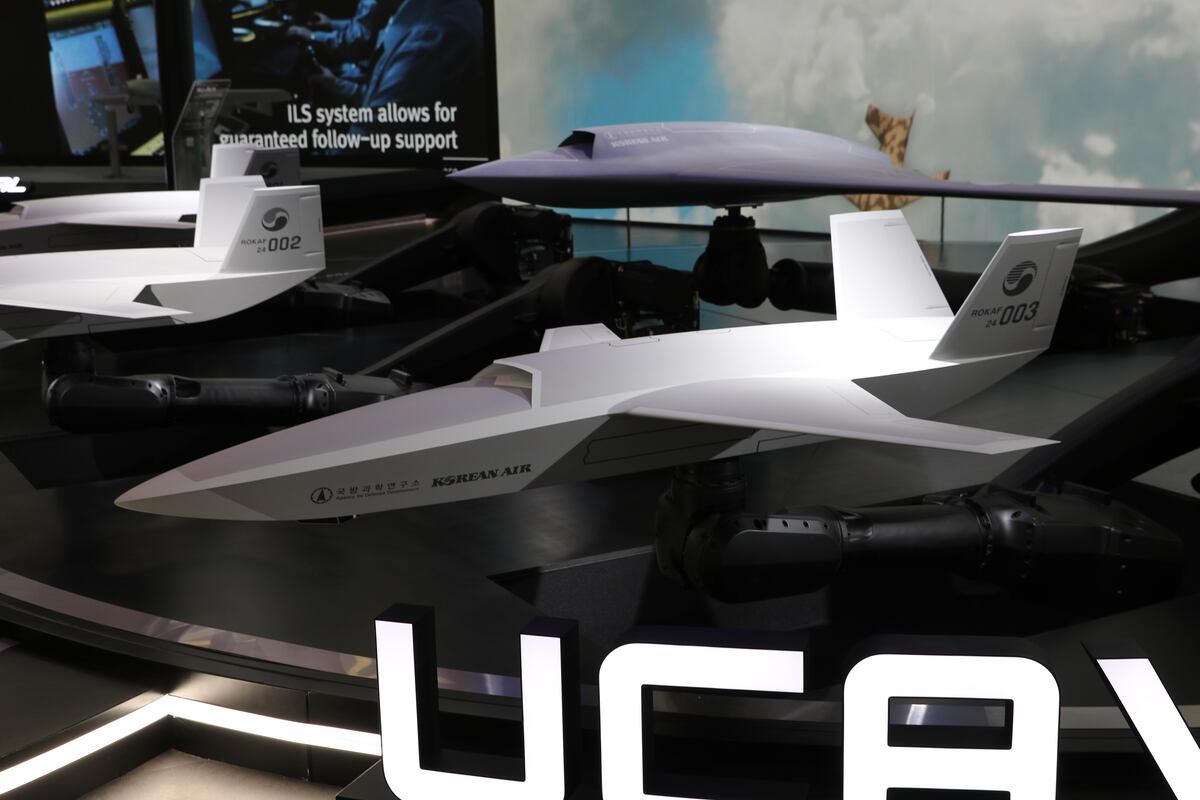
CHRISTCHURCH, New Zealand — Despite a recent accident with an Israeli-built drone, South Korea’s military is pressing ahead ahead with unmanned technology, including a stealthy loyal wingman designed to accompany the air force’s new KF-21 Boramae fighters.
The accident occurred on March 17, when an IAI Heron-1 drone belonging to Korea’s army veered off a runway upon landing at Yangju, subsequently colliding with a parked Surion helicopter. Both aircraft were written off, meaning the army has now lost all three of its Herons in accidents.
Nonetheless, the country is under the gun to accelerate its drone plans – and for reasons outside immediate military-equipment considerations.
Kim Jae Yeop, senior researcher at the Sungkyun Institute for Global Strategy in Seoul, told Defense News South Korea’s low birth rate, amongst the lowest in the world, is looming large.
“The number of regular troops in the armed forces, which is now roughly 500,000, will highly likely decrease to fewer than 400,000 in the next decade,” he said.
“As a result,” Kim explained, “Seoul is taking active measures to expand the role of military unmanned systems to offset the reduction in troops. They can be acquired at significant scale at a lower cost and without risk to life in missions.”
One important program saw Korean Air roll out a new loyal wingman technology demonstrator – called the Low Observable Unmanned Wingman System, or LOWUS – on Feb. 25.
The stealthy turbofan-powered LOWUS, funded by the Agency for Defense Development since 2021, was unveiled at the Korean Air Tech Center in Pusan. Its maiden flight is expected later this year, ahead of manned-unmanned teaming flight tests in 2027.
Possessing an internal weapons bay and looking similar to the American XQ-58A Valkyrie, Korean Air lists a length of 10.4m and wingspan of 9.4m for the aicraft.
As with similar loyal wingman concepts by other major powers, the idea for the drone sidekicks is fly missions ranging from strike to surveillance, jamming and escort.
The LOWUS will likely have a domestic engine and active electronically scanned array radar. Korean Air gained experience with requisite stealth technologies when developing the blended-wing KUS-FC, or Kaori-X, drone that first flew in 2015.
In the future, Korea’s air force is expected to introduce composite squadrons of manned fighters and loyal wingmen.
“Considering the fact that only a small number of countries like the U.S., Australia and Russia have been producing and testing similar kinds of systems, the LOWUS highlights Seoul’s technological achievements,” said Kim.
Another program currently underway comprises a search for loitering munitions for Korean special forces units. A platform is due to be selected later this year, and Seoul is allocating around $22 million to this acquisition.
Foreign types like the Switchblade 600 and Hero 120 are under consideration, with the aim being to give special forces strike drones they can use independently against North Korean invaders without the need for calling in external fire support.
Gordon Arthur is an Asia correspondent for Defense News. After a 20-year stint working in Hong Kong, he now resides in New Zealand. He has attended military exercises and defense exhibitions in about 20 countries around the Asia-Pacific region.
新西兰基督城——尽管最近发生了一起以色列制造的无人机事故,韩国军方仍在推进无人技术的发展,其中包括一种隐形忠诚僚机,旨在伴随空军的新型 KF-21 波拉梅战斗机。
事故发生在3月17日,韩国陆军一架IAI Heron-1无人机在杨州机场降落时偏离跑道,随后与一架停放的Surion直升机相撞。两架飞机均报废,这意味着韩国陆军的三架Heron无人机全部因事故损失。
尽管如此,该国仍面临着加快无人机计划的压力——而且其原因并非出于直接的军事装备考虑。
首尔成均全球战略研究所高级研究员金载烨告诉《防务新闻》,韩国的低出生率(世界最低出生率之一)正成为一个严峻的问题。
他说:“目前武装部队的正规军人数约为50万人,未来十年很可能会减少到40万人以下。”
金解释说:“因此,首尔正在积极采取措施,扩大军事无人系统的作用,以弥补兵力减少的影响。这些系统可以以较低的成本大规模采购,而且在执行任务时不会危及生命。”
一项重要的计划是,大韩航空于 2 月 25 日推出了一种新的忠诚僚机技术演示器——低可观测性无人僚机系统(LOWUS)。
由韩国国防发展局自2021年起资助研发的隐形涡扇动力无人机LOWUS在釜山大韩航空技术中心亮相。预计将于今年晚些时候进行首飞,并在2027年进行有人-无人协同飞行测试。
该机拥有内部武器舱,外形与美国 XQ-58A 女武神战斗机相似,大韩航空公布的数据显示,该机长度为 10.4 米,翼展为 9.4 米。
与其他主要大国类似的忠诚僚机概念一样,无人机僚机的想法是执行从打击到监视、干扰和护航等各种任务。
LOWUS无人机很可能采用国产发动机和有源相控阵雷达。大韩航空在研发2015年首飞的KUS-FC(Kaori-X)混合翼无人机时,积累了必要的隐身技术经验。
未来,韩国空军有望引入有人驾驶战斗机和忠诚僚机组成的混合中队。
金表示:“考虑到只有美国、澳大利亚和俄罗斯等少数几个国家生产和测试过类似类型的系统,LOWUS 凸显了首尔的技术成就。”
另一项正在进行的项目是为韩国特种部队寻找巡飞弹。预计将于今年晚些时候选定一款平台,首尔方面为此采购拨款约2200万美元。
目前正在考虑引进 Switchblade 600 和 Hero 120 等外国型号,目的是为特种部队提供可以独立用于对抗朝鲜入侵者的攻击无人机,而无需呼叫外部火力支援。
戈登·阿瑟是《防务新闻》的亚洲特派记者。在香港工作20年后,他现居新西兰。他曾到访亚太地区约20个国家,参加过军事演习和防务展览。