Quantedge Foundation pledges $50m to social mobility, including new Bukit Merah collaboration spaceQuantedge基金会承诺投入5000万美元用于社会流动性,其中包括在武吉美拉新建一个合作空间。
It will also study more than 3,000 lower-income households to see how social networks influence mobility. Read more at straitstimes.com.
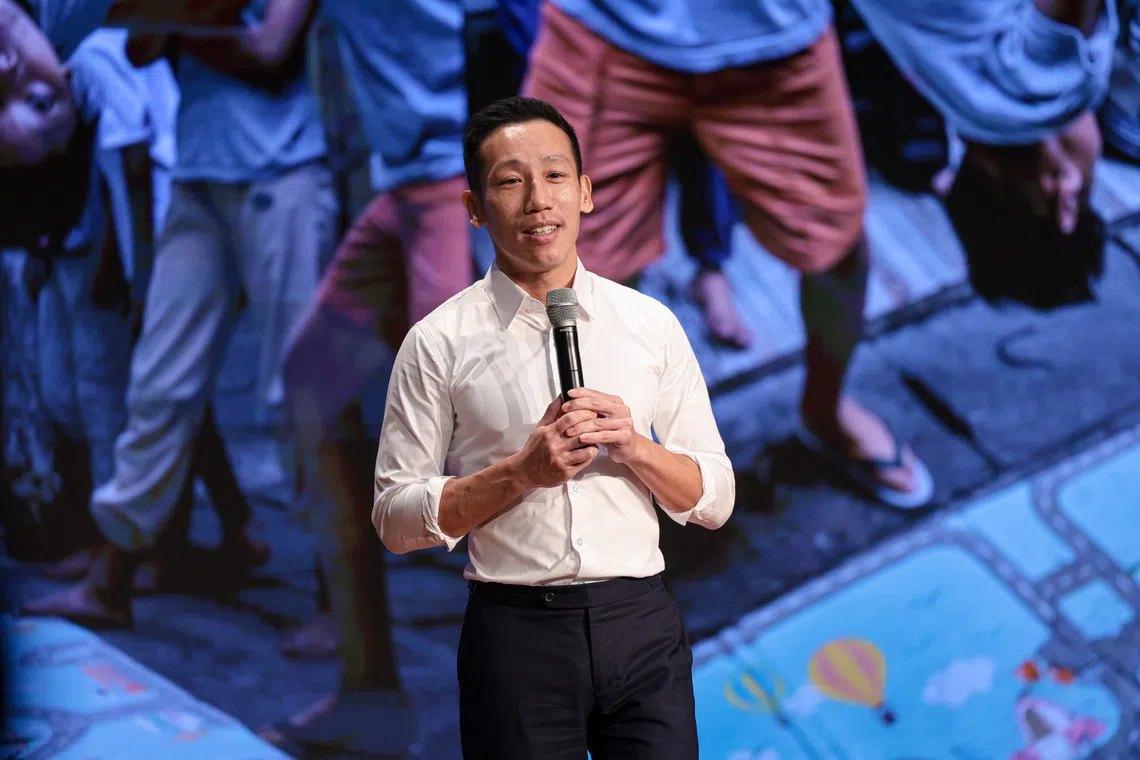
Quantedge Foundation chief executive Xie Yao Quan said the philanthropic organisation is prepared to commit “up to a few multiples” of $50 million if needed.
PHOTO: LIANHE ZAOBAO
Published Oct 28, 2026, 08:00 PM
Updated Oct 28, 2026, 08:00 PM
SINGAPORE – $50 million will go to advancing social mobility in Singapore over the next 10 years through initiatives funded by philanthropic organisation Quantedge Foundation Singapore , its chief executive Xie Yao Quan said on Oct 28.
These include a new collaborative space in Bukit Merah for organisations to work together on the issue, and increased funding for social sector innovators.
Quantedge Foundation will also work on a six-year longitudinal study of more than 3,000 lower-income households in Singapore to see how social networks influence mobility.
Xie announced this at an event marking the 10th anniversary of the organisation – which is the philanthropic arm of Singapore hedge fund Quantedge Capital – held at ITE College Central.
Education Minister Desmond Lee, who was the guest of honour, said Singapore has made encouraging progress on social mobility, but sustaining it is becoming harder as the country matures.
The Government is committed to working on the issue so that opportunities remain open to all, but cannot do it alone, he said in a speech.
“We need partners like Quantedge Foundation, who bring networks, expertise and fresh ideas, to extend our reach on the ground and strengthen our ecosystem of support,” he said.
The new space is set to open in 2028 and will be known as the Quantedge Opportunity Lab or QOLAB.
Located in the former Jalan Bukit Ho Swee Community Centre, it will bring organisations working to advance social mobility together with others who support them, said Lee.
“It will be a shared space designed to spark interaction, collaboration and learning across organisations,” said Lee. Plans are for it to house 250 people.
The idea is for QOLAB to help promising projects scale up, Xie told reporters in an interview before the event.
“Excellent pilots are not enough. Excellent pilots that just remain as pilots are not enough to meet the systemic social mobility challenge,” he said.
On the initiative to fund innovators in the social service sector, Xie said it is an improvement on something Quantedge Foundation already runs known as the philanthropreneur-in-residence (PIR) programme.
Under the expanded programme, it will provide each PIR up to $2 million in funding over five years, and is prepared to support exceptional ones for up to eight years.
It will also go beyond funding to provide them with support in building up their services, from how to select board members to designing their organisations.
On the third initiative – the study – Xie said the aim is to create a high-quality, representative and novel data set that will undergird and inform social mobility research in Singapore.
“We hope that this data set will be able to enable the development of models that can predict and simulate different drivers of social mobility, and so these models can inform, for example, particular interventions.”
The initial $50 million is just the start. It comes after the foundation gave close to $40 million to social mobility initiatives in the past decade.
Xie said Quantedge Foundation is prepared to commit “up to a few multiples” of $50 million if needed, to help close what he called a “systemic opportunity gap” in Singapore’s society.
He cited stats released by the Ministry of Finance in a February paper that showed signs that social mobility is slowing in Singapore .
The paper showed that the proportion of children born to fathers at the bottom 20% of incomes who make it to the top 20% of income earners as adults had fallen for younger cohorts of Singaporeans.
“If we leave the issue as it is and just leave things on their own, that proportion will continue decreasing and mobility will continue slowing,” said Xie, who is also MP for Jurong Central, and deputy speaker of Parliament.
As Singapore continues to succeed economically, parents who have done well naturally pass their resources and advantages to their children, he said.
“The gap in opportunities for children born to different backgrounds will only widen – as borne out by the statistics.”
These gaps are seen across various segments of society including the education system, but also in systems outside schools like the enrichment industry, he said.
That is why Quantedge Foundation hopes to create a “system-level approach” to tackling the issue through its initiatives, said Xie.
It will be extremely difficult to achieve total equality of opportunities, Xie acknowledged.
“We should try to at least lean against the trend and hopefully thwart the erosion of social mobility.”
Quantedge基金会首席执行官谢耀泉表示,如有需要,该慈善机构准备投入“高达5000万美元数倍”的资金。
图片来源:联合早报
发布于2026年10月28日晚上8点
更新于2026年10月28日晚上8点
新加坡——慈善组织 Quantedge 基金会新加坡分会首席执行官谢耀泉于 10 月 28 日表示,未来 10 年,将有 5000 万美元用于通过该基金会资助的各项举措,促进新加坡的社会流动性。
其中包括在红山设立一个新的协作空间,供各组织共同探讨该问题,以及增加对社会领域创新者的资助。
Quantedge 基金会还将对新加坡 3000 多个低收入家庭进行为期六年的纵向研究,以了解社交网络如何影响流动性。
谢先生在新加坡工艺教育学院中心校区举行的该组织成立十周年纪念活动上宣布了这一消息。该组织是新加坡对冲基金 Quantedge Capital 的慈善机构。
作为主宾的教育部长李智陞表示,新加坡在社会流动性方面取得了令人鼓舞的进展,但随着国家的发展成熟,维持这种流动性变得越来越困难。
他在一次演讲中表示,政府致力于解决这个问题,以确保所有人都能获得机会,但政府无法独自完成这项工作。
他说:“我们需要像 Quantedge 基金会这样的合作伙伴,他们能够带来人脉、专业知识和新思路,以扩大我们在当地的影响力,并加强我们的支持生态系统。”
新空间计划于 2028 年开放,并将被称为 Quantedge Opportunity Lab 或 QOLAB。
李表示,该机构位于原武吉胡绥民众俱乐部旧址,将把致力于促进社会流动性的组织与支持他们的其他组织聚集在一起。
李说:“这将是一个共享空间,旨在促进跨组织间的互动、协作和学习。” 该空间计划容纳250人。
谢在活动前接受记者采访时表示,QOLAB 的理念是帮助有前景的项目扩大规模。
他说:“优秀的飞行员还不够。优秀的飞行员如果只是继续当飞行员,也无法应对系统性的社会流动性挑战。”
谢先生表示,资助社会服务领域创新者的倡议是对 Quantedge 基金会已开展的名为“慈善企业家驻场计划 (PIR)”的项目的改进。
根据扩大后的计划,该计划将在五年内为每个 PIR 提供高达 200 万美元的资金,并准备为特别优秀的 PIR 提供长达八年的支持。
除了提供资金外,还将为他们提供建立服务方面的支持,包括如何选择董事会成员以及如何设计组织架构。
关于第三项举措——研究——谢表示,其目标是创建一个高质量、具有代表性和新颖性的数据集,为新加坡的社会流动性研究提供基础和信息。
“我们希望这个数据集能够帮助开发预测和模拟社会流动性不同驱动因素的模型,从而使这些模型能够为具体的干预措施提供信息。”
首笔5000万美元的捐款仅仅是个开始。此前十年,该基金会已向社会流动性项目捐赠了近4000万美元。
谢先生表示,如果需要,Quantedge基金会准备投入“高达5000万美元数倍”的资金,以帮助弥合他所说的新加坡社会中存在的“系统性机会差距”。
他引用了财政部在二月份发布的一份文件中公布的统计数据,这些数据表明新加坡的社会流动性正在放缓。
该论文显示,在新加坡年轻一代中,父亲收入处于最低 20% 的子女成年后跻身收入最高 20% 的比例有所下降。
“如果我们放任不管,任其发展,那么人口比例将继续下降,人口流动速度也将继续放缓,”谢先生说道。他同时也是裕廊中心区国会议员和国会副议长。
他说,随着新加坡经济的持续成功,那些事业有成的父母自然会将他们的资源和优势传递给他们的孩子。
“不同背景的孩子所面临的机会差距只会越来越大——统计数据也证实了这一点。”
他说,这些差距不仅存在于社会各个领域,包括教育系统,也存在于学校以外的系统,例如课外辅导行业。
谢先生表示,正因如此,Quantedge基金会希望通过其各项举措,创建一个“系统层面的方法”来解决这个问题。
谢承认,要实现机会完全平等将极其困难。
“我们至少应该努力扭转这种趋势,并希望能够阻止社会流动性的削弱。”