Bank of Thailand confirms a tale of two distinct economies one booming, another struggling with decline泰国央行证实了泰国经济呈现两极分化的局面:一个经济体蓬勃发展,另一个则在衰退中挣扎。
Boom for big business, pain for Thai families! The Bank of Thailand raises its growth forecast to 2.4% as AI exports soar. Yet SME loans… Read More ›
新闻视频
October 28, 2026 at 11:19 pm
in Economy , Living , Media , Thailand
Thailand is a tale of two economies, the Bank of Thailand confirmed on Wednesday. Technology exports are surging, yet households and smaller businesses remain under severe pressure. Despite raising its 2026 GDP forecast to 2.4%, the central bank held interest rates at 1%. September exports jumped 24%, but SME lending continues to contract and household debt is crippling consumption. Meanwhile, rising oil prices threaten tourism and inflation, with foreign arrivals expected to fall. The Monetary Policy Committee warned that growth remains below potential, despite the artificial intelligence boom. Worse, economic expansion is forecast to slow to 2.1% in 2027.
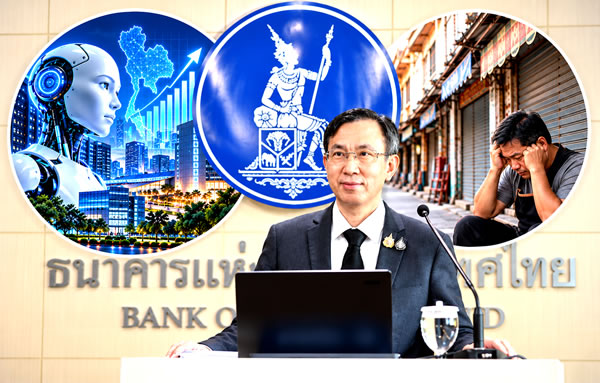
Monetary Policy Committee Secretary Don Nakornthap warns of Thailand’s divided economy: AI exports boom, but household debt and SME credit woes persist. Rates stay at 1% as oil threatens tourism. ( Source: Matichon )
Thailand’s economy is splitting into two sharply different worlds. Technology exports are surging, large corporations are expanding, and investment is rising. Yet households remain burdened by debt, smaller businesses face shrinking credit, and consumer spending remains weak.
Tourism faces another downturn as higher oil prices threaten foreign arrivals. On Wednesday, the Bank of Thailand confirmed this widening divide. Despite raising its growth forecasts, the central bank warned that the wider economy remains weak. Its Monetary Policy Committee unanimously held interest rates at 1%, with economic growth still below potential.
The decision followed Wednesday’s Monetary Policy Committee (MPC) meeting in Bangkok. All six members attending voted to maintain the benchmark rate, while one committee member was absent.
Bank of Thailand holds rates as stronger exports lift forecasts but leave domestic businesses struggling
It was the fourth consecutive meeting without an interest rate change. More significantly, the committee’s latest assessment exposed contrasting conditions across Thailand’s economy. Stronger exports are lifting national output, but domestic businesses and consumers remain under pressure.
MPC Secretary Don Nakornthap announced the decision on 28 October. He confirmed higher economic growth forecasts for both 2026 and 2027. The upgrades reflect stronger merchandise exports and investment linked to the global artificial intelligence boom.
However, the improved projections conceal substantial weakness across the domestic economy. Smaller businesses continue to lose access to credit, while households face high debt and fragile employment conditions.
The Bank of Thailand now expects gross domestic product (GDP) to expand by 2.4% in 2026. Previously, it forecast growth of 2.3%. Its projection for 2027 has also increased, from 1.8% to 2.1%. Nevertheless, the latest figures still point to subdued expansion. Thailand’s economy grew by 2.4% in 2025, and the central bank expects the same rate this year. Growth is then forecast to slow in 2027.
Artificial intelligence exports boost manufacturing while household debt keeps domestic demand weak
The main improvement comes from Thailand’s internationally connected manufacturing industries. Electronics producers are benefiting from rising demand for technology products and artificial intelligence-related equipment.
In parallel, private investment associated with these industries has exceeded earlier expectations. Companies involved in the technology cycle are expanding activity, while related industrial and service businesses are benefiting. The MPC identified these developments as principal reasons for upgrading its forecasts.
The benefits, however, remain concentrated among particular companies and workers. Large sections of Thailand’s economy are not experiencing the same expansion.
Indeed, the central bank confirmed that overall growth remains below the country’s economic potential. Private consumption is constrained by household debt, weak purchasing power and fragile employment. Smaller businesses face restricted credit, intense competition and structural obstacles.
The findings establish a striking contrast. Internationally connected manufacturers are benefiting from expanding global markets and stronger investment.
By comparison, businesses dependent on Thai consumers continue to face weak demand and financial pressure. The divergence extends across manufacturing, lending, employment and household spending. It was central to Wednesday’s decision to maintain accommodative monetary policy despite the stronger GDP forecasts.
Low interest rates fail to revive SME lending as large corporations secure most new bank credit growth
The benchmark interest rate remains at 1%, its lowest level since September 2022. Since October 2024, the Bank of Thailand has reduced borrowing costs by a combined 1.5 percentage points.
Nevertheless, these reductions have not produced a broad recovery in lending. Overall credit has expanded, but the improvement is concentrated among large corporations. Smaller businesses continue to face declining loan availability.
Large companies are borrowing to finance working capital, strengthen liquidity and meet higher operating expenses. Some lending also reflects investment in expanding industries. Separately, credit to small and medium-sized enterprises continues to contract across almost every economic sector.
Banks remain cautious about extending loans to borrowers considered financially vulnerable. Consequently, the improvement in overall lending figures conceals serious weakness among smaller companies.
The contrast is particularly significant because SMEs depend heavily on bank financing. Restricted credit limits their ability to fund operations, purchase equipment and manage rising costs.
Large corporations, meanwhile, are obtaining additional financing for investment and everyday business requirements. The Bank of Thailand’s assessment confirms that access to credit remains sharply divided despite historically low interest rates.
Banks restrict lending to vulnerable firms as household debt and fragile employment weigh on spending
The MPC reported that overall loan quality remained stable. Even so, it warned that the repayment capacity of SMEs and vulnerable households requires continued monitoring. Financial institutions remain reluctant to increase exposure to higher-risk borrowers.
These restrictions persist despite substantial monetary easing over the past two years. The central bank therefore stressed the importance of targeted financial measures alongside its accommodative interest rate policy.
Household finances present another difficult picture. High debt levels continue to restrict spending and borrowing capacity. At the same time, fragile employment conditions are placing additional pressure on incomes.
The MPC identified lower-income households as particularly vulnerable. Their purchasing power remains weak, while rising living costs reduce the money available for other expenditure.
The weakness is affecting private consumption, a major component of domestic economic activity. Consequently, stronger industrial production has not produced an equivalent increase in household spending.
Workers connected to expanding technology industries are benefiting from international demand. Outside those sectors, however, employment conditions remain fragile. The central bank identified this uneven distribution of economic gains as a continuing constraint on growth.
Rising living costs squeeze Thai households even as technology exports and industrial investment surge
Rising living costs are adding to the pressure. Lower-income households face weak purchasing power while essential expenses increase. Furthermore, high existing debt limits their ability to absorb additional costs.
The MPC’s assessment links these conditions directly to subdued private consumption. Stronger export earnings have therefore not translated into a comparable recovery across Thailand’s domestic market.
The revised GDP forecasts reinforce this distinction. Although the central bank expects stronger exports, overall growth remains below potential. The 2026 projection of 2.4% matches last year’s expansion. For 2027, the forecast falls to 2.1%. Notably, this slowdown is expected despite continued support from technology-related exports and investment.
Thailand’s international trade figures illustrate the strength of the export sector. Merchandise exports surged by 24% in September compared with the corresponding month last year. Imports increased even faster, jumping 50.4%. The rise reflected stronger demand for fuel and capital goods, including purchases associated with business investment.
These figures highlight the importance of international trade to Thailand’s current economic outlook. Electronics manufacturers are benefiting from stronger demand for components and technology products. In addition, investment linked to artificial intelligence is supporting related industries. The MPC cited this expansion as a major reason for its improved GDP projections.
Strong export figures mask structural weaknesses as tourism faces higher costs and fewer foreign visitors
The stronger trade figures do not, however, reflect conditions across the entire economy. The benefits remain concentrated among businesses directly involved in expanding industrial and service sectors.
Companies dependent on domestic consumers continue to face weaker conditions. Moreover, smaller firms face difficulties adapting to changing markets and intense competition.
The central bank specifically identified structural problems as another constraint on growth. These difficulties are contributing to weak domestic demand and limiting economic expansion.
Meanwhile, high household debt continues to restrict consumption. The combination leaves Thailand’s export industries performing better than large sections of its domestic economy.
Tourism presents a separate and increasingly difficult outlook. The Bank of Thailand expects foreign tourist arrivals to decline as higher international oil prices increase travel costs. The warning affects hotels, airlines, restaurants, retailers and transport operators. Numerous smaller businesses also depend on spending by overseas visitors.
Higher aviation fuel prices increase airline operating expenses. As a result, ticket prices could rise, placing additional pressure on international travel demand. The MPC expects higher travel costs to reduce foreign arrivals. This would weaken activity among tourism-dependent businesses already facing rising operating expenses.
Higher oil prices threaten winter tourism and fuel inflation despite stronger technology-led exports
The warning comes ahead of Thailand’s important winter tourism season. On another front, stronger technology exports are lifting the central bank’s growth forecasts.
The contrasting outlooks reinforce the divide identified by policymakers. International technology demand is supporting manufacturing, while tourism faces higher costs and weaker visitor numbers.
The tourism outlook also reflects developments beyond Thailand’s domestic economy. International oil prices remain sensitive to uncertainty surrounding the Middle East conflict. Higher fuel costs affect airlines and other transport businesses. In turn, more expensive travel can reduce demand from foreign visitors. The MPC identified these pressures as part of its latest economic assessment.
Energy prices are also creating wider inflation risks. The central bank expects consumer prices to increase temporarily during the remainder of 2026 and early 2027. Rising oil prices are a principal factor. Additionally, El Niño weather conditions could increase agricultural production costs and food prices.
The Bank of Thailand forecasts headline inflation averaging 2.1% in 2026. It then expects the rate to decline to 1.3% in 2027. Core inflation is projected at 1.2% this year and 1.3% next year. These figures reflect temporary supply-side pressures alongside continuing weakness in domestic demand.
Middle East oil risks and El Niño raise inflation concerns while weak demand limits underlying prices
September’s annual headline inflation reached 2.82%. This placed it close to the upper end of the central bank’s 1–3% target range. Core inflation stood at 1.50%. Nonetheless, policymakers expect underlying price pressures to remain relatively contained over the medium term.
The Middle East conflict remains an important source of uncertainty. Rising oil prices are increasing production and transport costs across several industries. In addition, El Niño could affect agricultural output and food prices. Both developments threaten to increase expenses for businesses and households already facing difficult economic conditions.
The MPC also identified limitations on government energy price support measures. Such restrictions could leave consumers and businesses more exposed to international price increases. Beyond that, policymakers are monitoring whether companies pass higher costs on to customers. The concern is whether temporary increases spread into underlying inflation.
The committee warned that inflation could exceed current estimates. Continued uncertainty surrounding the Middle East conflict remains a major risk. Restrictions on energy subsidies could also increase price pressures. Equally important, businesses passing higher costs to consumers could affect core inflation and medium-term expectations.
Despite these risks, the central bank expects inflation to ease during 2027. Temporary supply-side pressures are projected to diminish. At the same time, weak domestic demand is expected to restrain underlying price increases. The forecast decline to 1.3% reflects these conditions.
Weak consumer demand keeps inflation subdued as markets weigh the possibility of higher rates in 2027
The inflation outlook provides another indication of Thailand’s weak domestic economy. Technology-related exports and investment are expected to support growth. Yet subdued consumer demand is projected to keep medium-term inflation relatively low. The central bank also cited structural economic problems as a constraint on expansion.
These competing pressures shaped Wednesday’s interest rate decision. Weak household spending and restricted SME lending favour continued accommodative policy. Conversely, higher energy costs and inflation risks require close monitoring. The MPC therefore maintained the existing rate rather than introducing another reduction.
Financial markets had widely anticipated the decision. All 26 economists surveyed by Reuters expected the central bank to leave its benchmark rate unchanged. Most also expect interest rates to remain at 1% through the end of 2027. The committee’s next scheduled meeting is on 23 December.
Some international financial institutions, however, see a possibility of tighter monetary policy next year. Bloomberg reported changing expectations among JPMorgan Chase, OCBC and Bank of America. These institutions have identified a growing possibility of interest rate increases during 2027. Their assessments reflect uncertainty surrounding inflation and future economic conditions.
Bank of Thailand warns of prolonged low-rate risks as US policy expectations weaken the Thai baht
The Bank of Thailand also warned about potential financial stability risks associated with prolonged low interest rates. Nevertheless, policymakers consider the existing rate appropriate under current conditions.
The MPC believes accommodative monetary policy is supporting economic activity. Targeted financial measures remain important for vulnerable borrowers and businesses.
Currency developments formed another part of Wednesday’s assessment. The Thai baht has weakened against the US dollar following changes in expectations surrounding American monetary policy. Markets increasingly anticipate a more restrictive US interest rate environment. Consequently, the dollar has strengthened against the baht.
Rising international oil prices have added further pressure. The Middle East conflict remains an important factor behind uncertainty in energy markets. Thailand’s exposure to international fuel costs continues to affect its economic outlook. These developments are influencing financial conditions alongside changes in American interest rate expectations.
Thai government bond yields have increased slightly, broadly following movements in international financial markets. Private-sector borrowing costs, however, have remained relatively stable. The MPC reported that loan interest rates remain consistent with the unchanged policy rate. Bank loans continue to represent the principal financing channel for many Thai businesses.
Large corporations secure loans while smaller firms struggle and the baht faces continued pressure
Access to this financing remains sharply uneven. Large corporations are borrowing for working capital, liquidity and investment. Smaller enterprises, by contrast, continue to face contracting credit across almost every sector. Financial institutions remain cautious about lending to borrowers considered vulnerable.
The baht showed little immediate reaction to Wednesday’s announcement. Financial markets had already anticipated the interest rate decision. Its broader depreciation nevertheless remains part of the central bank’s assessment. US monetary policy expectations and international oil prices continue to influence Thailand’s financial conditions.
Taken together, the MPC’s findings expose substantial differences beneath the headline economic figures. Overall lending is increasing, but smaller businesses are obtaining less credit. GDP forecasts have improved, yet household purchasing power remains weak. Stronger exports are supporting national output without producing an equivalent domestic spending recovery.
The technology sector is benefiting from international investment and demand. Tourism, meanwhile, faces the prospect of declining foreign arrivals. Large corporations are expanding borrowing and investment. Smaller businesses continue to face restricted financing, intense competition and difficult trading conditions.
Household debt and shrinking SME credit expose the gap between export growth and domestic weakness
Households are experiencing another set of pressures. High debt, fragile employment conditions and rising living costs continue to constrain consumption. As a consequence, the benefits of stronger industrial activity remain concentrated among selected companies and workers. The wider domestic economy is not experiencing the same expansion.
The central bank’s latest figures make the division clear. Technology-related exports are lifting growth forecasts, while household debt suppresses spending. Large corporations are obtaining more credit, while SME lending contracts. Foreign tourism is expected to weaken despite stronger merchandise exports.
The revised forecasts also indicate continued economic weakness beyond 2026. Thailand’s GDP is expected to expand by 2.4% this year before slowing to 2.1% in 2027. Meanwhile, headline inflation is forecast to decline from 2.1% to 1.3%. The central bank expects weak domestic demand to remain an important factor.
The MPC’s assessment therefore distinguishes stronger international trade from the condition of Thailand’s domestic economy. Export-oriented manufacturers are benefiting from global demand. Smaller businesses and households remain constrained by debt, restricted financing and weak purchasing power. Tourism adds another area of vulnerability as international travel costs increase.
December policy meeting approaches with inflation risks rising and domestic demand still under pressure
The next monetary policy meeting will take place on 23 December. Policymakers will review economic growth, inflation and financial conditions. They will also monitor the repayment capacity of SMEs and vulnerable households. These borrowers remain exposed to weak domestic demand and restricted credit.
Inflation will remain another priority. The MPC is watching whether higher energy and food costs spread into underlying consumer prices. Separately, developments in the Middle East could affect oil prices and tourism. US monetary policy expectations will remain important for the baht and financial markets.
For now, the benchmark interest rate remains at 1%. The committee unanimously concluded that the existing policy remains appropriate. The decision follows substantial monetary easing since October 2024. Even after those reductions, however, the central bank’s assessment confirms that domestic economic weaknesses persist.
Thailand’s economy is expected to grow by 2.4% this year. The improved forecast reflects stronger technology exports and related investment. Yet the central bank expects growth to slow to 2.1% in 2027. The figures do not indicate a broad improvement across the domestic economy.
Central bank confirms Thailand’s divided economy as export industries thrive but households struggle
Wednesday’s findings establish two sharply different economic pictures. Large companies and export industries are benefiting from stronger international demand. In contrast, smaller businesses, indebted households and tourism operators face continuing financial and commercial pressures. The divide extends across manufacturing, lending, employment and consumer spending.
The Monetary Policy Committee’s decision reflects those contrasting conditions. Stronger exports have improved the national growth outlook, but domestic demand remains weak. SME credit continues to contract, while household debt restricts consumption. Rising oil prices are also threatening tourism and increasing inflation risks.
Thailand enters the final months of 2026 with technology-related exports supporting national output. Nevertheless, the Bank of Thailand expects overall economic growth to remain below potential.
Its latest assessment confirms a tale of two economies. One is expanding through international technology demand and corporate investment. The other remains constrained by debt, restricted credit, fragile employment and weak consumer spending.
Thailand’s GDP may get a bump up from the 3rd quarter after recent economic agency talks with PM Anutin
Prime Minister cock a hoop as IMF World Bank meet ends in Bangkok. Insists Thailand’s standing has risen
US Bangkok broadside to the IMF and the World Bank delivered by Scott Bessent who snubbed the meeting
Prime Minister Anutin talks of an economy driven by ‘quality growth’ at the Bangkok IMF World Bank forum
Protests at the IMF World Bank meetings turn violent but Bangkok police strongly deny being heavy handed
Police chief says Bangkok is ready for World Bank and IMF meetings with over 18,000 delegates visiting
Thailand struggles economically even with revised World Bank GDP growth for 2026 coming in at 2% for 2026
Vietnam’s economic growth races ahead of Thailand’s putting it on track to overtake its net GDP by 2029
Vietnam is taking Thailand’s quality tourists in huge numbers while Bangkok flails about with crackdowns
Thailand’s once mighty tourism industry is failing but now faces further damage from overvalued baht
Economists baffled by extraordinary and damaging rise of the baht in 2025 hitting tourism and exports
Top Thai banker launches blistering attack on present state of the economy calling for more inclusion
Joseph Anthony is an expat from Ireland who has lived in Thailand for the last decade. He has worked extensively in the media including editorial positions in Ireland and Thailand. He is focused on economic and business stories in Thailand as well as the expat lifestyle.
All posts by Joseph O' Connor
Prime Minister Anutin pushes a hard line on narcotics suppression which will jail even more yaba users October 22, 2026 Thailand’s drug crisis sees Anutin act with new
Departures tax to be axed as Thailand’s hotel sector reels from a debt crisis linked with the Covid era October 22, 2026 Revolt puts Thailand’s ฿1,000 departure tax in
12 properties raided, 85 people charged after Pattaya police raids linked to the illegal foreign ownership crackdown October 21, 2026 Police target ฿800 million in Pattaya property
Controversy on two wheels rages in Pattaya as city’s mototaxi drivers switch to blue vests from orange October 21, 2026 Blue replaces orange for 5,281 Pattaya motorcycle taxi
Queen Suthida meets the Emperor and Empress of Japan on a visit promoting international women’s ice hockey October 21, 2026 Queen Suthida meets Japan’s Emperor Naruhito and
Men accused of murdering Russian siblings in July plead guilty to all counts in Pattaya including rape October 20, 2026 Death penalty looms for two Thai men after guilty
Tourism industry shaken by the latest Chinese warning coming from its diplomatic missions in Thailand October 20, 2026 China warns its citizens of abductions and trafficking
PM orders hands off land and property by foreigners as enforcement to be moved ahead by December October 20, 2026 Anutin puts thousands of suspected foreign land
Chinese and Vietnamese links probed in police open files on nightlife activities in Bangkok and Rayong October 19, 2026 Police storm a karaoke bar at 4 am, arresting 13
Nigerian cocaine gang arrested after strict crackdown orders from the Immigration Bureau chief Big Nop October 18, 2026 Bangkok cocaine sting leads police from a dealer to a
Midnight raids in Rayong on karaoke clubs fronting for prostitution see local police chief sidelined pending enquiries October 17, 2026 Four unlicensed KTV clubs serving Chinese customers
American company director arrested in Bangkok Thursday for failing to over a million baht in wages October 17, 2026 Nearly four months after a court issued its first
Pheu Thai leadership assures PM of support in the No Conference debate and vote at the end of October October 17, 2026 Pheu Thai chiefs promise Anutin all 71 MPs to defeat a
Justice Ministry boss reveals ‘Black Research’ aimed at High School students. 3,000 sexual abuse images October 16, 2026 Schoolboys aged 15–17 were tricked into supplying
Man gunned down by motorcycle assassins outside a weed shop in Bangkok’s Laksi district early Friday October 16, 2026 Two motorcycle gunmen unleash more than ten shots
Police arrest South Korean after child reports mother being abused. Man found to have overstayed his visa October 16, 2026 A sudden call from a Thai woman’s child triggers
Base pipe bomb attack on Thursday in southern Yala province left five army officers with minor injuries October 16, 2026 Yala security forces come under bomb attack as
Pledges on investment are up but Foreign Direct Investment for the first six months is down nearly 5% October 22, 2026
Frenchman arrested by Immigration. Officer spotted him on Interpol wanted list for drug trafficking October 22, 2026
Drunk woman stripped naked on a Pattaya public street Tuesday night hurling abuse. Arrested by police October 21, 2026
Former top Democrat Party aide and MP met DSI over Bhumjaithai MP’s husband’s links to online gambling October 21, 2026
Row over handling of two online gambling cases related to MPs. Questions of jurisdiction and fair play October 21, 2026
German family members injured in Phuket after app based taxi driver lost control of car looking at GPS October 20, 2026
Bhumjaithai MP and her husband answer questions of the elite DSI police over links to online gambling October 20, 2026
Hellish battle with UK Home Office for Brit seeking to bring Burmese fiancée and son home for Christmas October 20, 2026
7kg heroin in drink sachets bound for Australia found in a Samut Prakan premises after police tip off October 19, 2026
Much loved Robocop, a popular figure in Nonthaburi near Bangkok dies in a tragic road traffic accident October 19, 2026
Thai star Nene Royal faces trademark headaches in Thailand and South Korea as she secures her fortune October 18, 2026
Six dead in deadly clashes in Southern Thailand including a policeman killed on National Police Day October 17, 2026
Underfire southern MP says Prime Minister Anutin telephoned her and urged her to post a selfie online October 17, 2026
Prime Minister cock a hoop as IMF World Bank meet ends in Bangkok. Insists Thailand’s standing has risen October 17, 2026
Departures tax pushed by the Ministry of Finance is the death kiss for the tourist sector say top execs October 16, 2026
US Bangkok broadside to the IMF and the World Bank delivered by Scott Bessent who snubbed the meeting October 16, 2026
Friday protests by anti IMF World Bank activists continue after overnight camp event in central Bangkok October 16, 2026
Air hostess linked to international trafficking ring smuggling Chinese nationals in and out of Thailand October 16, 2026
Protests at the IMF World Bank meetings turn violent but Bangkok police deny being heavy handed October 15, 2026
Bhumjaithai Party Southern MP facing political strain as questions grow about her husband’s online fortune October 15, 2026
Portuguese woman’s 5 year stay in Thailand without a valid visa ends at a Phuket cookery class on Tuesday October 15, 2026
Thai police get involved in Hong Kong prostitution ring smashed last weekend which yielded vast returns October 14, 2026
© 2026 Thai Examiner. All rights reserved.
2026年10月28日晚上11:19
在经济、生活、媒体、泰国
泰国央行周三证实,泰国经济呈现两极分化的局面。科技出口蓬勃发展,但家庭和小微企业仍面临巨大压力。尽管央行将2026年GDP增长预期上调至2.4%,但仍维持利率在1%不变。9月份出口额增长24%,但中小企业贷款持续萎缩,家庭债务严重抑制消费。与此同时,油价上涨威胁旅游业和通胀,预计外国游客数量将下降。货币政策委员会警告称,尽管人工智能蓬勃发展,但经济增长仍低于潜在水平。更糟糕的是,预计到2027年,经济增速将放缓至2.1%。
货币政策委员会秘书敦·纳空塔普警告称,泰国经济呈现分裂态势:人工智能出口蓬勃发展,但家庭债务和中小企业信贷困境依然存在。由于石油价格威胁旅游业,利率维持在1%不变。(来源:Matichon)
泰国经济正分裂成两个截然不同的世界。科技出口激增,大型企业不断扩张,投资也在增长。然而,家庭仍然背负着沉重的债务,小型企业面临信贷紧缩,消费支出依然疲软。
由于油价上涨威胁到外国游客数量,旅游业面临再次下滑。周三,泰国央行证实了这一日益扩大的差距。尽管上调了经济增长预期,但央行警告称,整体经济依然疲软。其货币政策委员会一致决定将利率维持在1%不变,因为经济增长仍低于潜在水平。
该决定是在周三于曼谷举行的货币政策委员会(MPC)会议后作出的。出席会议的六名委员全部投票决定维持基准利率不变,另有一名委员缺席。
泰国央行维持利率不变,出口走强提振了市场预期,但国内企业仍面临困境。
这是连续第四次会议未调整利率。更重要的是,委员会的最新评估揭示了泰国经济各领域存在的差异。出口强劲提振了国民产出,但国内企业和消费者仍然面临压力。
货币政策委员会秘书长敦·纳空塔普于10月28日宣布了这一决定。他确认了2026年和2027年经济增长预测的上调。此次上调反映了商品出口的强劲增长以及与全球人工智能热潮相关的投资。
然而,这些改善后的预测掩盖了国内经济各方面存在的严重疲软。小型企业持续面临信贷困境,而家庭则面临着高额债务和脆弱的就业形势。
泰国央行目前预计2026年国内生产总值(GDP)将增长2.4%。此前,该行预测增长率为2.3%。其对2027年的预测也从1.8%上调至2.1%。尽管如此,最新数据仍然表明经济增长较为温和。泰国经济在2025年增长了2.4%,央行预计今年也将保持这一增速。随后,预计2027年经济增长将放缓。
人工智能出口提振制造业,但家庭债务抑制国内需求疲软
主要改善源于泰国制造业与国际的紧密联系。电子产品生产商正受益于市场对科技产品和人工智能相关设备日益增长的需求。
与此同时,与这些行业相关的私人投资也超出了此前的预期。参与技术周期的企业正在扩大业务,相关的工业和服务企业也从中受益。货币政策委员会认为,这些发展是其上调预测的主要原因。
然而,这些好处仍然集中在少数公司和员工身上。泰国经济的大部分领域并未经历同样的扩张。
事实上,央行证实,整体经济增长仍低于该国的经济潜力。私人消费受到家庭债务、购买力疲软和就业形势不稳定的制约。小型企业面临信贷受限、竞争激烈和结构性障碍等问题。
研究结果呈现出鲜明的对比。与国际市场联系紧密的制造商正受益于不断扩大的全球市场和更强劲的投资。
相比之下,依赖泰国消费者的企业仍面临需求疲软和财务压力。这种差异体现在制造业、信贷、就业和家庭支出等各个方面。尽管GDP预期走强,但周三仍决定维持宽松货币政策,这正是造成这种差异的关键原因。
低利率未能提振中小企业贷款,因为大型企业获得了大部分新增银行信贷增长。
基准利率维持在1%,为2022年9月以来的最低水平。自2024年10月以来,泰国央行已累计将借贷成本降低了1.5个百分点。
然而,这些削减措施并未带来贷款的全面复苏。尽管整体信贷有所扩张,但这种改善主要集中在大型企业。小型企业仍然面临贷款获取渠道日益减少的困境。
大型企业通过借贷来筹集营运资金、增强流动性并应对不断上涨的运营费用。部分贷款也反映了对扩张型行业的投资。与此同时,几乎所有经济领域的中小企业信贷都在持续萎缩。
银行在向被认为财务状况脆弱的借款人发放贷款方面仍然保持谨慎。因此,整体贷款数据的改善掩盖了小型企业面临的严重困境。
这种对比尤为显著,因为中小企业严重依赖银行融资。信贷受限会限制它们为运营提供资金、购买设备和应对不断上涨的成本的能力。
与此同时,大型企业正在获得额外的融资,用于投资和日常业务运营。泰国银行的评估证实,尽管利率处于历史低位,但信贷获取仍然存在显著的不平等现象。
由于家庭债务和脆弱的就业形势抑制了支出,银行限制了对弱势企业的贷款。
货币政策委员会报告称,整体贷款质量保持稳定。尽管如此,该委员会仍警告称,中小企业和弱势家庭的还款能力需要持续监测。金融机构仍然不愿增加对高风险借款人的风险敞口。
尽管过去两年货币政策大幅宽松,但这些限制依然存在。因此,央行强调,在实施宽松利率政策的同时,采取有针对性的金融措施至关重要。
家庭财务状况则呈现出另一番严峻景象。高额债务持续限制着支出和借贷能力。与此同时,脆弱的就业形势也给收入带来了额外的压力。
货币政策委员会指出,低收入家庭尤其脆弱。他们的购买力依然薄弱,而不断上涨的生活成本又减少了他们可用于其他支出的资金。
这种疲软态势正在影响私人消费,而私人消费是国内经济活动的重要组成部分。因此,工业生产的强劲增长并未带来家庭支出的同等增长。
与蓬勃发展的科技产业相关的从业人员正受益于国际需求。然而,在这些行业之外,就业状况依然脆弱。央行指出,这种经济收益分配不均是制约经济增长的持续因素。
尽管科技出口和工业投资激增,但不断上涨的生活成本仍令泰国家庭捉襟见肘。
生活成本上涨加剧了他们的压力。低收入家庭购买力下降,而基本生活开支却在增加。此外,高额的现有债务也限制了他们承担额外支出的能力。
货币政策委员会的评估将这些状况与低迷的私人消费直接联系起来。因此,出口收入的强劲增长并未转化为泰国国内市场的相应复苏。
修订后的GDP预测进一步印证了这一区别。尽管央行预期出口将走强,但整体增长仍低于潜在水平。2026年的预测增速为2.4%,与去年的增速持平。而2027年的预测增速则降至2.1%。值得注意的是,尽管科技相关出口和投资持续支撑经济增长,但增速放缓的趋势依然存在。
泰国国际贸易数据显示,出口行业表现强劲。9月份商品出口额较去年同期增长24%,进口额增幅更为显著,高达50.4%。进口额的增长反映了市场对燃料和资本货物(包括与商业投资相关的采购)的需求强劲。
这些数据凸显了国际贸易对泰国当前经济前景的重要性。电子产品制造商受益于对零部件和技术产品更强劲的需求。此外,与人工智能相关的投资也带动了相关产业的发展。货币政策委员会(MPC)指出,这一增长是其上调GDP预测的主要原因。
强劲的出口数据掩盖了旅游业面临的结构性缺陷,因为旅游业正面临成本上升和外国游客减少的双重困境。
然而,贸易数据的走强并不能反映整个经济的状况。受益者仍然集中在直接参与工业和服务业扩张的企业。
依赖国内消费者的企业持续面临经营困境。此外,规模较小的企业也难以适应不断变化的市场和激烈的市场竞争。
央行特别指出,结构性问题是制约经济增长的另一大因素。这些困难导致国内需求疲软,限制了经济扩张。
与此同时,高企的家庭债务持续抑制消费。这两种因素共同导致泰国出口行业的表现优于其国内经济的大部分领域。
旅游业的前景则截然不同,而且日益艰难。泰国央行预计,随着国际油价上涨推高旅行成本,外国游客人数将会下降。这一预警影响到酒店、航空公司、餐厅、零售商和运输运营商。许多小型企业也依赖海外游客的消费。
航空燃油价格上涨会增加航空公司的运营成本。因此,机票价格可能会上涨,从而进一步抑制国际旅行需求。货币政策委员会预计,旅行成本上升将导致外国游客入境人数减少。这将削弱那些本已面临运营成本上涨的、依赖旅游业的企业的经营活动。
尽管通胀强劲,但油价上涨仍威胁冬季旅游业和燃料市场,而技术驱动型出口则有所增长。
泰国冬季旅游旺季即将到来,在此之前,央行发布了这一警告。另一方面,强劲的技术出口提振了央行的经济增长预期。
截然不同的前景进一步凸显了政策制定者所指出的分歧。国际技术需求支撑着制造业,而旅游业则面临成本上升和游客数量下降的困境。
旅游业前景也反映了泰国国内经济以外的发展趋势。国际油价仍然对中东冲突带来的不确定性十分敏感。燃油成本上涨会影响航空公司和其他运输企业。反过来,旅行成本上升可能会降低外国游客的需求。货币政策委员会在其最新的经济评估中已指出了这些压力。
能源价格上涨也加剧了通胀风险。央行预计,2026年剩余时间和2027年初消费者价格将暂时上涨。油价上涨是主要因素。此外,厄尔尼诺现象也可能导致农业生产成本和食品价格上涨。
泰国央行预测,2026年总体通胀率平均为2.1%,随后预计2027年将降至1.3%。核心通胀率预计今年为1.2%,明年为1.3%。这些数据反映了暂时的供给侧压力以及持续疲软的国内需求。
中东石油风险和厄尔尼诺现象加剧了通胀担忧,而疲软的需求则限制了潜在价格。
9月份的年度总体通胀率达到2.82%,接近央行1%至3%目标区间的上限。核心通胀率为1.50%。尽管如此,政策制定者预计中期内潜在价格压力将保持相对稳定。
中东冲突仍然是重要的不确定因素。油价上涨推高了多个行业的生产和运输成本。此外,厄尔尼诺现象也可能影响农业产量和食品价格。这两种情况都可能加剧本已面临严峻经济形势的企业和家庭的支出。
货币政策委员会还指出了政府能源价格支持措施的局限性。此类限制可能使消费者和企业更容易受到国际价格上涨的影响。此外,政策制定者正在密切关注企业是否会将更高的成本转嫁给消费者。他们担心的是,暂时的价格上涨是否会演变为潜在的通胀。
委员会警告称,通胀可能超过目前的预期。中东冲突持续带来的不确定性仍然是一个主要风险。能源补贴限制也可能加剧价格压力。同样重要的是,企业将更高的成本转嫁给消费者可能会影响核心通胀和中期预期。
尽管存在这些风险,央行预计2027年通胀率将有所回落。暂时的供给侧压力预计将会缓解。与此同时,疲软的国内需求预计将抑制潜在价格上涨。预测的1.3%的降幅反映了这些情况。
疲软的消费需求抑制了通胀,市场正在权衡2027年利率上升的可能性。
通胀前景进一步表明泰国国内经济疲软。科技相关的出口和投资预计将支撑经济增长,但疲软的消费需求预计将使中期通胀保持在相对较低的水平。泰国央行还指出,结构性经济问题是制约经济扩张的因素。
这些相互冲突的压力影响了周三的利率决定。疲软的家庭支出和中小企业贷款受限有利于维持宽松的货币政策。另一方面,能源成本上涨和通胀风险需要密切关注。因此,货币政策委员会决定维持现有利率不变,而不是再次降息。
金融市场普遍预期到这一决定。路透社调查的26位经济学家均预计央行将维持基准利率不变。大多数经济学家还预计,利率将在2027年底前保持在1%。该委员会的下一次会议定于12月23日举行。
然而,一些国际金融机构认为明年货币政策可能收紧。彭博社报道称,摩根大通、华侨银行和美国银行的预期有所改变。这些机构认为,2027年加息的可能性越来越大。他们的评估反映了通胀和未来经济状况的不确定性。
泰国央行警告称,由于美国政策预期疲软,泰铢走软,长期低利率风险加剧。
泰国央行也警告称,长期低利率可能带来金融稳定风险。尽管如此,政策制定者认为,在当前情况下,现行利率是合适的。
货币政策委员会认为,宽松的货币政策正在支持经济活动。有针对性的金融措施对弱势借款人和企业仍然至关重要。
货币走势是周三评估的另一部分。受美国货币政策预期变化的影响,泰铢兑美元走弱。市场越来越预期美国利率环境将收紧。因此,美元兑泰铢走强。
国际油价上涨加剧了市场压力。中东冲突仍然是能源市场不确定性的重要因素。泰国经济前景持续受到国际燃油成本的影响。这些因素与美国利率预期的变化共同影响着金融环境。
泰国政府债券收益率小幅上升,总体上与国际金融市场的走势一致。然而,私营部门的借贷成本保持相对稳定。货币政策委员会报告称,贷款利率与政策利率保持不变。银行贷款仍然是许多泰国企业的主要融资渠道。
大型企业获得贷款,而小型企业举步维艰,泰铢持续承压。
获得融资的渠道仍然极不均衡。大型企业借贷是为了获取营运资金、流动性和投资。相比之下,小型企业几乎在所有行业都面临信贷紧缩的困境。金融机构对被认为处境脆弱的借款人仍然保持谨慎态度。
泰铢对周三的公告反应平淡。金融市场此前已预期到利率决议。尽管如此,泰铢整体贬值仍是央行评估的一部分。美国货币政策预期和国际油价继续影响着泰国的金融状况。
综合来看,货币政策委员会的调查结果揭示了经济数据背后存在的诸多重大差异。总体而言,贷款总额有所增加,但小型企业获得的信贷却在减少。GDP预测有所改善,但家庭购买力依然疲软。出口强劲支撑了国民产出,但并未带动国内消费的相应复苏。
科技行业受益于国际投资和需求。与此同时,旅游业面临着外国游客数量下降的局面。大型企业正在扩大借贷和投资。小型企业则持续面临融资受限、竞争激烈和经营环境艰难等问题。
家庭债务和中小企业信贷萎缩暴露了出口增长与国内疲软之间的差距。
家庭正面临着另一系列压力。高额债务、脆弱的就业形势和不断上涨的生活成本持续抑制着消费。因此,工业活动增强带来的益处仍然集中在少数企业和工人身上,而更广泛的国内经济并未经历同样的扩张。
央行最新数据显示,经济分化趋势十分明显。科技出口提振了经济增长预期,而家庭债务则抑制了消费支出。大型企业信贷增多,而中小企业贷款减少。尽管商品出口走强,但预计外国旅游业仍将疲软。
修订后的预测还显示,2026年以后泰国经济将持续疲软。预计泰国今年GDP将增长2.4%,随后在2027年放缓至2.1%。与此同时,总体通胀率预计将从2.1%降至1.3%。泰国央行预计,国内需求疲软仍将是影响经济的重要因素。
因此,货币政策委员会的评估区分了国际贸易的走强与泰国国内经济状况。出口导向型制造商受益于全球需求。而小型企业和家庭仍然受到债务、融资受限和购买力疲弱的制约。随着国际旅行成本的增加,旅游业也成为另一个脆弱领域。
12月政策会议临近,通胀风险上升,国内需求依然承压。
下一次货币政策会议将于12月23日举行。政策制定者将审查经济增长、通胀和金融状况,并密切关注中小企业和弱势家庭的偿付能力。这些借款人仍然面临国内需求疲软和信贷受限的风险。
通胀仍将是另一项重点关注事项。货币政策委员会正在密切关注能源和食品价格上涨是否会传导至消费者基本价格。此外,中东局势的发展可能会影响油价和旅游业。美国货币政策预期对泰铢和金融市场仍至关重要。
目前,基准利率维持在1%。委员会一致认为,现行政策仍然适当。此前,自2024年10月以来,央行已大幅放松货币政策。然而,即便在这些降息措施之后,央行的评估仍然证实,国内经济疲软的局面依然存在。
泰国经济预计今年将增长2.4%。这一上调的预测反映了技术出口和相关投资的强劲增长。然而,泰国央行预计到2027年,经济增长将放缓至2.1%。这些数据并未表明国内经济出现全面改善。
泰国央行证实泰国经济分化严重,出口行业蓬勃发展,但家庭生活却举步维艰。央行指出,泰国经济呈现分裂态势,出口行业蓬勃发展,但家庭生活却步履维艰。
周三公布的调查结果揭示了截然不同的两种经济图景。大型企业和出口行业受益于强劲的国际需求。相比之下,小型企业、负债累累的家庭和旅游经营者则面临持续的财务和商业压力。这种差距体现在制造业、信贷、就业和消费支出等各个方面。
货币政策委员会的决定反映了这些相互矛盾的形势。出口走强改善了国家经济增长前景,但国内需求依然疲软。中小企业信贷持续萎缩,而家庭债务限制了消费。油价上涨也威胁着旅游业,并加剧了通胀风险。
泰国进入2026年最后几个月,科技相关出口将支撑国民产出。尽管如此,泰国央行预计整体经济增长仍将低于潜在水平。
其最新评估证实了两种经济体的分化。一种经济体正受益于国际技术需求和企业投资而不断扩张。另一种经济体则仍然受到债务、信贷紧缩、就业脆弱和消费支出疲软的制约。
泰国经济机构近期与总理阿努廷举行会谈后,泰国第三季度GDP或将有所增长。
泰国总理在曼谷举行的国际货币基金组织和世界银行峰会闭幕之际沾沾自喜,坚称泰国的地位已经提升。
美国驻曼谷代表斯科特·贝森特向国际货币基金组织和世界银行发表了措辞强硬的讲话,他本人却冷落了此次会议。
阿努廷总理在曼谷举行的国际货币基金组织和世界银行论坛上谈到,经济应以“高质量增长”为驱动。
国际货币基金组织和世界银行会议期间发生抗议活动,并演变为暴力事件,但曼谷警方强烈否认使用暴力手段。
曼谷警察局长表示,曼谷已做好迎接世界银行和国际货币基金组织会议的准备,预计将有超过18000名代表到访。
即使世界银行将泰国2026年的GDP增长率修正为2%,泰国的经济仍然面临困境。
越南经济增长速度超过泰国,有望在2029年实现净GDP超过泰国。
越南正大量吸引泰国的优质游客,而曼谷却在打击非法游客的行动中束手无策。
泰国曾经强大的旅游业正在衰落,如今又面临泰铢高估带来的进一步打击。
经济学家对泰铢在2025年出现异常且破坏性的上涨感到困惑,认为这将重创旅游业和出口。
泰国顶级银行家猛烈抨击当前经济状况,呼吁加强包容性经济。
约瑟夫·安东尼是一位来自爱尔兰的侨民,过去十年一直居住在泰国。他曾在爱尔兰和泰国的媒体行业担任过编辑职务,拥有丰富的媒体从业经验。他主要关注泰国的经济和商业新闻,以及侨民的生活方式。
约瑟夫·奥康纳的所有帖子
泰国总理阿努廷对毒品问题采取强硬立场,将有更多吸食冰毒者入狱 2026年10月22日 泰国毒品危机促使阿努廷采取新举措
泰国酒店业因新冠疫情引发的债务危机而遭受重创,离境税或将取消 2026年10月22日 民众抗议泰国1000泰铢的离境税
芭堤雅警方突击搜查12处房产,85人被控,此次行动与打击非法外资房产有关(2026年10月21日)。警方目标是芭堤雅价值8亿泰铢的房产。
芭堤雅两轮车争议:摩托出租车司机将背心颜色由橙色改为蓝色 2026年10月21日 芭堤雅5281辆摩托出租车司机将背心颜色由橙色改为蓝色
2026年10月21日,苏提达王后访问日本,旨在推广国际女子冰球运动,并会见了日本天皇和皇后。苏提达王后会见了日本天皇德仁。
两名被控于7月在芭堤雅谋杀俄罗斯兄妹的男子,于2026年10月20日认罪,承认所有指控,包括强奸罪。两名泰国男子因罪名成立,面临死刑。
泰国旅游业受到中国驻外使领馆最新警告的震动 2026年10月20日 中国警告其公民提防绑架和人口贩运
总理下令禁止外国人侵占土地和房产,执法行动将于2026年10月20日前推进。阿努廷将数千块疑似外国土地划为非法占地。
2026年10月19日,警方公开调查曼谷和罗勇夜生活场所的中国和越南关联,并展开调查。凌晨4点,警方突袭一家卡拉OK酒吧,逮捕13人。
2026年10月18日,在移民局局长“大诺普”(Big Nop)的严厉打击下,一个尼日利亚可卡因团伙在曼谷落网。此次缉毒行动将警方从一名毒贩引向了最终的犯罪团伙。
2026年10月17日午夜,罗勇府警方突击搜查以卖淫为幌子的卡拉OK俱乐部,当地警察局长因接受调查而被停职。四家无证KTV俱乐部为中国顾客提供服务。
一名美国公司董事周四在曼谷被捕,原因是拖欠超过一百万泰铢的工资(2026年10月17日)。此前近四个月,法院首次发出逮捕令。
为泰党领导层向总理保证,将在10月底的反对党大会辩论和投票中给予支持。2026年10月17日,为泰党领导人向阿努廷承诺,将动用全部71名议员的力量,击败反对党大会。
司法部部长揭露针对高中生的“黑名单”调查。2026年10月16日,3000张性虐待图片曝光。15至17岁的男学生被骗提供图片。
2026年10月16日星期五凌晨,一名男子在曼谷叻西区一家大麻店外遭摩托车枪手射杀。两名摩托车枪手开了十多枪。
警方逮捕一名韩国男子,此前一名儿童举报其母亲遭到虐待。该男子被发现签证过期滞留。2026年10月16日,一名泰国女子的孩子突然来电,引发了一系列事件。
2026年10月16日,亚拉省南部一处军事基地发生管状炸弹袭击,造成五名军官轻伤。亚拉安全部队遭到炸弹袭击。
投资承诺有所增加,但前六个月的外国直接投资下降了近5%(2026年10月22日)
一名法国男子因涉嫌贩毒被移民局逮捕。官员于2026年10月22日在国际刑警组织的通缉名单上发现了他的踪迹。
周二晚间,一名醉酒女子在芭堤雅街头被扒光衣服并辱骂他人。她于2026年10月21日被警方逮捕。
前民主党高级助手兼国会议员于2026年10月21日会见了泰国特别调查局,讨论泰自豪党议员的丈夫与网络赌博的关联。
围绕两起与议员有关的网络赌博案件处理方式的争议。管辖权和公平性问题 2026年10月21日
2026年10月20日,普吉岛发生一起车祸,一家德国人在乘坐网约车时因司机看GPS导航而失控受伤。
2026年10月20日,泰自豪党议员及其丈夫就网络赌博案接受泰国特警队(DSI)的质询。
一名英国男子试图将缅甸未婚妻和儿子带回家过圣诞节,却与英国内政部展开了一场艰苦卓绝的斗争(2026年10月20日)
2026年10月19日,警方根据线报在北榄府一处房屋内查获7公斤海洛因,这些海洛因藏在饮料袋中,原计划运往澳大利亚。
深受喜爱的“机械战警”(Robocop)是曼谷附近暖武里府的知名人物,于2026年10月19日因一场悲惨的交通事故去世。
泰国明星妮妮·罗亚尔(Nene Royal)在泰国和韩国面临商标纠纷,她正努力保住自己的财富。2026年10月18日
泰国南部发生致命冲突,造成六人死亡,其中包括一名在2026年10月17日国家警察日当天殉职的警察。
备受争议的南方议员称,总理阿努廷于2026年10月17日致电她,敦促她在网上发布一张自拍照。
泰国总理在曼谷举行的国际货币基金组织和世界银行会议闭幕之际沾沾自喜,坚称泰国的地位已经提升。(2026年10月17日)
财政部力推的离境税是旅游业的致命一击,高管们表示 2026年10月16日
美国驻曼谷大使斯科特·贝森特向国际货币基金组织和世界银行发出严厉警告,他缺席了2026年10月16日举行的会议。
2026年10月16日,在曼谷市中心举行通宵露营活动后,反对国际货币基金组织和世界银行的活动人士的抗议活动仍在继续。
2026年10月16日,一名空姐被曝与国际人口贩运团伙有关联,该团伙负责将中国公民偷渡出泰国。
国际货币基金组织和世界银行会议期间的抗议活动演变为暴力事件,但曼谷警方否认使用暴力手段 2026年10月15日
泰自豪党南部议员因其丈夫的网上财富受到质疑而面临政治压力 2026年10月15日
一名葡萄牙女子在没有有效签证的情况下在泰国滞留了五年,于2026年10月15日星期二在普吉岛的一堂烹饪课上结束了她的滞留。
泰国警方参与了上周末捣毁的香港卖淫团伙,并缴获了巨额赃物 2026年10月14日
© 2026 Thai Examiner。版权所有。