The US space industry will suffer for Ukraine’s Starlink outage, experts say专家称,乌克兰星链网络中断将对美国航天工业造成损失。
US allies aren’t happy: “We naturally insist that it works if we're paying for it."
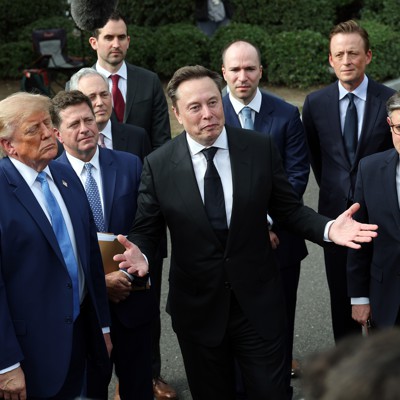
SpaceX CEO Elon Musk, center, stands with President Donald Trump, House Speaker Rep. Mike Johnson, R-LA., and others outside the White House on September 29, 2026. Kevin Dietsch/Getty Images
US allies aren’t happy: “We naturally insist that it works if we're paying for it."
Elon Musk’s decision to hobble satellite services to Ukraine’s military, and his shifting explanations for doing so, have undermined the U.S. space industry and the country’s diplomatic and intelligence partnerships, say lawmakers, foreign officials, and former senior members of the U.S. military.
“I'm an American. You're an American. We want American companies to be the most competitive,” said one former senior military official who worked in space policy, operations, and acquisitions. Episodes like the Starlink scandal “create an environment where you make more competitors.”
On Oct. 14, amid a Russian missile barrage, military operators across Ukraine found themselves unable to direct drones traveling faster than 100 mph, causing “the failure of several missions,” Ukrainian presidential adviser Serhii Beskrestnov wrote on Facebook. Without warning, Musk’s SpaceX had imposed limitations on Ukraine’s use of Starshield, the military-grade data network that runs on the company’s Starlink constellation. The service reduction, which lasted ten days, reduced Ukraine’s ability to fend off Russian missiles and jet-powered drones.
“People were killed because [there was] not enough destruction, not enough interceptors, including interceptors with Starlink, which didn't work, of course," Ukrainian President Volodymyr Zelenskyy said later on Oct. 14.
It’s not clear why SpaceX reduced service to Ukraine. Musk and President Donald Trump have been increasingly critical of Zelenskyy in recent weeks. Trump, who has reversed war-related sanctions on Russia and sought Moscow’s help to bring down domestic fuel prices, has complained about Ukrainian strikes on Russian energy plants. Musk, whose relationship with Kyiv has soured since the departure of former Defense Minister Mykhailo Fedorov, has asked for sympathy for Russian conscripts.
Musk, who promised last year that “Starlink will never turn off its terminals” in Ukraine, blamed Trump for the slowdown.
“Starshield systems are owned and controlled by the US government. Any limits on speed or usage are decided by the US military and ultimately POTUS,” he tweeted on Oct. 14.
That didn’t smell right to at least one former U.S. general.
“I honestly believe Musk thought he was acting in line with what the White House wanted. I can’t prove that, of course. But all the actions and everything people say tell me this was intentional,” said Ben Hodges, a retired general and former commander of U.S. Army Europe.
The inability to rely on SpaceX is sure to affect military decisionmaking, the former senior military official who worked in space policy said.
“From a planner perspective, obviously, you need to have confidence in your kill-chain capabilities, and so that introduces doubt, which must be incredibly difficult for the planners of the Ukrainian military.”
In letters to SpaceX and the Pentagon, U.S. lawmakers expressed several concerns about the interruption of service, including its effects on allies.
On Oct. 19, a group of senators reminded SpaceX officials of their “contract obligations with the Federal Republic of Germany, which funds Ukraine’s access to Starlink,” and asked: “When did you notify the German government of the decision to degrade Starlink capabilities?”
Representatives from their offices did not respond to questions regarding any answer they may have received.
In an Oct. 22 letter to Defense Secretary Pete Hegseth, another group of senators noted that Ukraine relies on Starlink for intelligence-sharing. They urged the Pentagon to “expand its existing Starshield contract to ensure Ukraine has the satellite communications capacity, coverage, and reliability necessary to sustain its military operations and renew Starshield’s unlimited-speed service.” Pentagon officials did not respond to questions about the letter.
Allied government officials also expressed alarm.
"I search for the right adjective to describe whoever took this decision or group of people took this decision against a country that is literally fighting for the lives of the citizens against naked aggression," Canadian Prime Minister Mark Carney said on Oct. 23.
German Foreign Minister Johann Wadephul on Oct. 16 put the issue plainly : "Germany is paying SpaceX and that's why we naturally insist that it works if we're paying for it."
Facing mounting pressure, Trump called Musk on Oct. 23 to ask him to lift the restrictions.
On Friday, Trump said, “If there’s a problem, I'll get it straightened out.”
That same day, Musk admitted that SpaceX had put a speed restriction in place but he blamed Ukraine, which he said had used the satellite network for offensive drone strikes and thereby “violated Starlink terms of service and [the military] used it for offensive drone strikes to kill people.” Ukrainian leaders have denied this .
But as the Oct. 19 letter points out, any real or imagined Starlink terms-of-service violation should not affect the Starshield service, which is under the control of the U.S. government. Like many, the senators were confused.
“SpaceX owns and operates the underlying Starlink network and infrastructure upon which certain Starshield services rely. These circumstances raise important questions...”
By Oct. 24, Ukrainian leaders said, full Starlink service had been restored.
For Ukrainian operators, the issue is resolved for now. But one former senior military official who worked in space systems acquisition told Defense One that the episode will undermine trust in U.S. satellite capabilities.
“Flipping the switches over a combat operation, it’s definitely a significant data point… The question is: Are we making the right decisions?”
U.S. dominance in space-based imaging and satellite communications, both military and commercial, is real. Europe does not have either a private or public satellite communications system capable of replacing Starlink overnight. Starlink’s importance in helping Ukraine achieve battlefield gains is also beyond dispute.
But Musk’s actions will accelerate the development of foreign alternatives to Starlink, said the formal official. More established, smaller competitors to Starlink, such as Eutelsat OneWeb, SES, Iridium and others, could also see increased government business or support.
It’s not the first time that a U.S. decision to withhold satellite services has convinced a security partner to reduce its reliance on Washington. In 1999, India was denied access to GPS during its Kargil conflict with Pakistan.
“The request that was denied to India drove them to build their own GNSS [global navigation satellite system] capability,” the former official said.
The European Union launched its own quest for a navigation system that same year, and the Galileo navigation system went operational in 2016.
From the perspective of U.S. space firms, “You risk your momentum by giving other competitors a reason to go build their own Galileo GPS system,” the former official said.
The urgent need for sovereign satellite capability led Kyiv to sign a development agreement with Denmark’s GomSpace in April and, on Oct. 22, a letter of intent with Finnish space technology company ICEYE and Nokia.
For U.S. military operations, that’s not all bad news, the official said, as it means a more resilient network with more providers of services such as global positioning and communications.
But the United States will never again enjoy a position of near-dominance in space, they said.
“Your Apple iPhone right now takes in GPS, Russian GNSS, and Chinese GNSS, yeah. So, in one way, it makes your system more resilient. In other ways your little phone is reliant on other things, systems that probably we would not have planned to be reliant on many years ago.”
NEXT STORY: Defense Business Brief: A little bit of MOSA; Netherlands-U.S. industry days, and more
2026年9月29日,SpaceX首席执行官埃隆·马斯克(中)与美国总统唐纳德·特朗普、众议院议长、路易斯安那州共和党众议员迈克·约翰逊等人在白宫外合影。图片来源:Kevin Dietsch/Getty Images
美国的盟友们并不满意:“如果我们付了钱,我们当然会坚持它必须有效。”
议员、外国官员和美国前高级军官表示,埃隆·马斯克决定限制向乌克兰军方提供卫星服务,以及他对此不断变化的解释,已经破坏了美国航天工业以及美国的外交和情报伙伴关系。
“我是美国人,你也是美国人。我们希望美国公司最具竞争力,”一位曾在太空政策、作战和采购部门工作的前高级军官说道。像星链丑闻这样的事件“会营造出更多竞争对手的环境”。
10月14日,在俄罗斯导弹猛烈攻击下,乌克兰各地的军事人员发现无法操控时速超过100英里的无人机,导致“多次任务失败”,乌克兰总统顾问谢尔盖·别斯克列斯特诺夫在脸书上写道。此前,马斯克的SpaceX公司在未发出任何警告的情况下,限制了乌克兰使用“星盾”(Starshield)服务。“星盾”是SpaceX公司“星链”(Starlink)卫星星座上运行的军用级数据网络。此次服务中断持续了十天,削弱了乌克兰抵御俄罗斯导弹和喷气式无人机的能力。
乌克兰总统泽连斯基在10月14日晚些时候表示:“人们丧生是因为(打击力度)不够,拦截器不够多,包括星链拦截器,当然,星链拦截器并没有发挥作用。”
目前尚不清楚SpaceX为何减少对乌克兰的服务。近几周来,马斯克和美国总统特朗普对泽连斯基的批评日益增多。特朗普曾取消对俄罗斯的战争相关制裁,并寻求莫斯科的帮助以降低国内燃料价格,他还抱怨乌克兰袭击俄罗斯的能源设施。马斯克与基辅的关系自前国防部长米哈伊洛·费多罗夫离职后恶化,他曾呼吁外界对俄罗斯应征入伍士兵表示同情。
马斯克去年曾承诺“星链永远不会关闭其在乌克兰的终端”,他将此次延误归咎于特朗普。
“星盾系统由美国政府拥有和控制。任何速度或使用限制都由美国军方决定,最终由美国总统决定。”他在10月14日发推文说。
至少有一位美国前将军觉得这事儿不太对劲。
“我真心相信马斯克认为他的行为符合白宫的意愿。当然,我无法证明这一点。但所有行动以及人们所说的一切都告诉我,这是有意为之,”退役将军、前美国陆军欧洲司令部司令本·霍奇斯说道。
一位曾在太空政策部门工作的前高级军官表示,无法依赖 SpaceX 势必会影响军事决策。
“从策划者的角度来看,显然你需要对自己的杀伤链能力充满信心,这就带来了疑虑,这对乌克兰军方的策划者来说一定非常困难。”
美国议员在致SpaceX和五角大楼的信中,对服务中断表达了多项担忧,包括其对盟友的影响。
10 月 19 日,一群参议员提醒 SpaceX 的官员们注意他们“与德意志联邦共和国签订的合同义务,该合同为乌克兰使用 Starlink 服务提供资金”,并问道:“你们何时通知德国政府降低 Starlink 服务能力的决定?”
他们办公室的代表没有回应有关他们可能收到的任何答复的问题。
10月22日,另一批参议员致信国防部长皮特·赫格塞斯,指出乌克兰依赖星链(Starlink)进行情报共享。他们敦促五角大楼“扩大现有的星盾(Starshield)合同,以确保乌克兰拥有维持其军事行动所需的卫星通信容量、覆盖范围和可靠性,并续签星盾的无限速服务”。五角大楼官员未对此信函作出回应。
盟军政府官员也对此表示担忧。
加拿大总理马克·卡尼于10月23日表示:“我正在寻找合适的形容词来描述做出这一决定的人或团体,他们反对一个正在为公民的生命而战,抵抗赤裸裸的侵略的国家。”
德国外交部长约翰·瓦德普尔于 10 月 16 日直言不讳地表示:“德国向 SpaceX 支付费用,所以我们当然坚持,既然我们付了钱,它就必须运转良好。”
面对越来越大的压力,特朗普于10月23日致电马斯克,要求他解除限制。
周五,特朗普说:“如果出了问题,我会解决的。”
当天,马斯克承认SpaceX确实设置了速度限制,但他将责任归咎于乌克兰,称乌克兰利用星链卫星网络进行无人机进攻,从而“违反了星链服务条款,并利用该网络进行无人机进攻以杀害民众”。乌克兰领导人否认了这一说法。
但正如10月19日的信函所指出的,任何实际的或臆想的星链服务条款违规行为都不应影响由美国政府控制的星盾服务。和许多人一样,参议员们对此感到困惑。
“SpaceX拥有并运营着Starlink网络和基础设施,而某些Starshield服务正是依赖于这些网络和基础设施。这些情况引发了一些重要问题……”
乌克兰领导人表示,截至10月24日,Starlink服务已全面恢复。
对乌克兰运营商而言,这个问题目前已经解决。但一位曾在航天系统采购部门工作的前高级军官告诉《防务一号》网站,这一事件将削弱人们对美国卫星能力的信任。
“在作战行动中切换开关,这绝对是一个重要的数据点……问题是:我们做出的决定是否正确?”
美国在天基成像和卫星通信领域(包括军事和商业领域)的绝对优势是毋庸置疑的。欧洲目前既没有私营卫星通信系统,也没有公共卫星通信系统能够一夜之间取代星链。星链在帮助乌克兰取得战场胜利方面的重要性也毋庸置疑。
但这位官方人士表示,马斯克的举措将加速开发星链的海外替代方案。一些规模较小、但已发展成熟的星链竞争对手,例如Eutelsat OneWeb、SES、Iridium等,也可能获得更多政府业务或支持。
这并非美国首次通过停止提供卫星服务来促使安全伙伴减少对华盛顿的依赖。1999年,在与巴基斯坦的卡吉尔冲突期间,印度就曾被禁止使用GPS。
这位前官员表示:“印度的请求被拒绝,促使他们建立了自己的全球导航卫星系统(GNSS)能力。”
同年,欧盟启动了自己的导航系统研发计划,伽利略导航系统于 2016 年投入使用。
这位前官员表示,从美国航天公司的角度来看,“如果你给了其他竞争对手一个理由去建造他们自己的伽利略GPS系统,你就有可能失去发展势头。”
由于迫切需要自主卫星能力,基辅在 4 月份与丹麦 GomSpace 公司签署了开发协议,并在 10 月 22 日与芬兰航天技术公司 ICEYE 和诺基亚签署了意向书。
这位官员表示,对于美国军事行动而言,这并非全是坏消息,因为这意味着一个更具弹性的网络,以及更多全球定位和通信等服务提供商。
但他们表示,美国将永远无法再次在太空领域占据近乎主导的地位。
“你的苹果iPhone现在同时接收GPS、俄罗斯GNSS和中国GNSS的信号。从某种程度上说,这增强了你系统的稳定性。但从另一方面来说,你的小手机也依赖于其他系统,而这些系统可能是我们多年前根本没想过要依赖的。”
下一篇报道:国防商业简报:MOSA概览;荷美产业日等