How US military funding propelled China’s robot dogs美国军费如何推动了中国机器狗的发展
Chinese company Unitree Robotics based the designs for its most successful robot dogs on innovations fueled by the U.S. military.
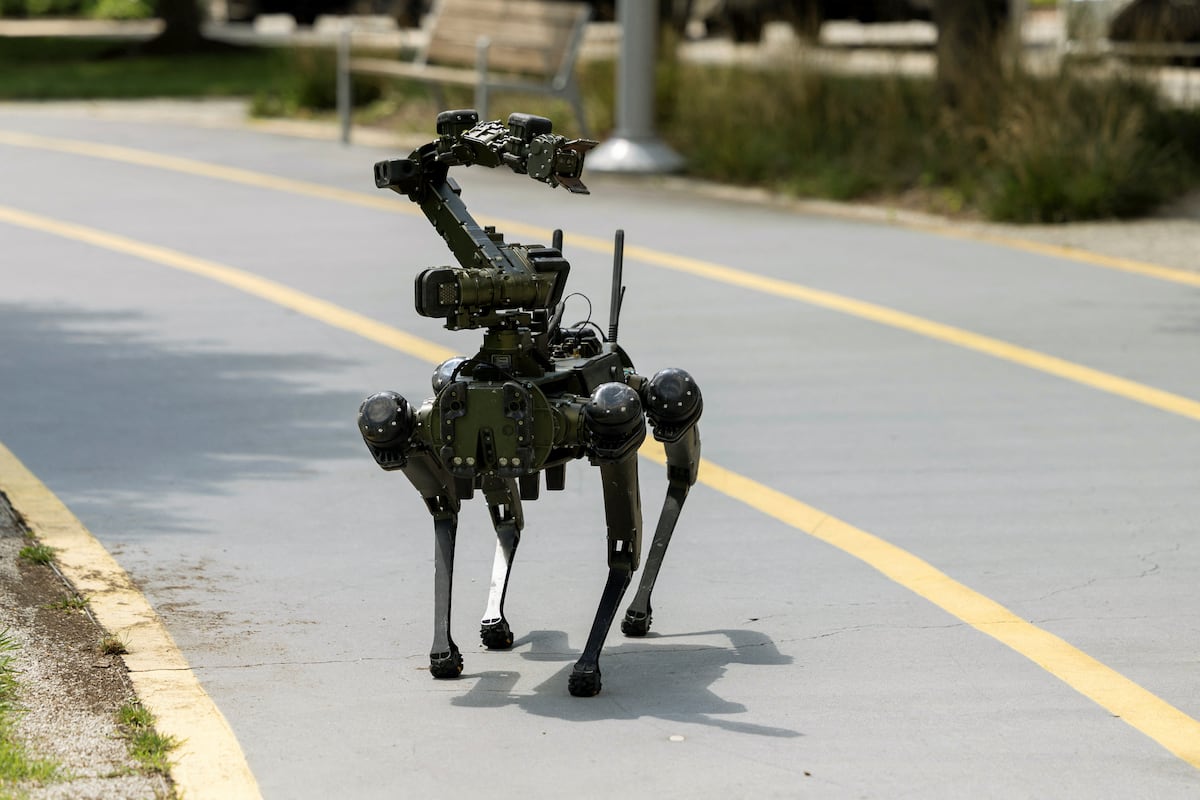
China’s Unitree Robotics — among the world’s biggest producers of humanoid and quadruped robots — based designs for its most successful robot dogs on innovations funded by the U.S. military, according to a former U.S. defense technology official and three top researchers involved in the project.
Unitree’s $1,600 Go2 model, launched in 2023, helped the company rapidly dominate the global quadruped robot market — its Shanghai IPO has drawn frenzied demand. Another Unitree robot has been shown on Chinese state television, armed and accompanying People’s Liberation Army (PLA) troops on an exercise.
These robots draw on breakthroughs in quadruped movement financed by the U.S. DEVCOM Army Research Laboratory (ARL) and other military programs, the researchers and the former official told Reuters.
The Army-funded project turned into, “basically, the first Unitree robot that had any kind of scale,” said Gavin Kenneally, a former University of Pennsylvania researcher involved in the program.
Ben Katz, who worked at Massachusetts Institute of Technology’s Biomimetic Robotics Lab, among a consortium of universities financed by the military programs, said the dimensions of Unitree’s popular Go series were “to the millimeter” almost identical to a groundbreaking robot he helped develop called Mini Cheetah.
Reuters is the first media outlet to detail connections between Unitree designs and the Army program.
The episode underscores broader problems with the United States’ ability to compete with China’s state-directed manufacturing sector in high-tech strategic industries, including those critical to national security.
Backed by subsidies, clusters of component factories, and a tolerance for heavy losses, Chinese companies have seized market share across industries such as solar panels, drones, EVs and quantum communications, many of which were first developed in the U.S. with government or military backing.
Kenneally commercialized the U.S. breakthroughs through his company Ghost Robotics, which supplies U.S. special forces with advanced, ruggedized robots. But compared to Unitree, its production is small and costly.
In June, the Pentagon added Unitree to a list of Chinese military companies, calling it a “contributor to the Chinese defense industrial base.” That designation falls short of a sanction but limits the U.S. military’s future use of Unitree’s technology. Unitree has said its robots are for civilian use.
Unitree, China’s State Council and China’s defense ministry did not respond to requests for comment.
Experts and robotics makers say China used Pentagon-funded work to design robot dogs and then proliferated them beyond U.S. capabilities to keep up.
Unitree did nothing underhanded in using the U.S. Army research. The program’s findings were published openly to stimulate progress in the field, a common practice.
ARL spokesperson Amanda Ligon said the research “strengthened the broader U.S. robotics ecosystem” and informed subsequent work across government and the private sector.
ARL referred questions about Unitree’s commercialization of the technology to the Pentagon, which declined to comment.
US companies versus China’s industrial policy
Unitree sold more than 5,500 humanoids and 18,000 quadrupeds last year, company filings show, and it’s now valued at about $9 billion ahead of its stock market debut on Wednesday.
By contrast, no U.S. company has mass-produced such robots, including Elon Musk’s Tesla, which has displayed prototypes of its Optimus humanoid for years. On a January earnings call, Musk called China “incredibly good” at scaling production.
Boston Dynamics, the U.S. company whose 2019 canine, Spot, used different technology, recently argued in a Congressional hearing that China’s low pricing would drive U.S. firms out of the market.
None of the U.S. robotics researchers who spoke with Reuters advocated for keeping such government-financed research secret. Instead, they said, U.S. policymakers should focus on enabling companies to quickly commercialize such advances to compete with China.
ARL also said publication was important to scientific and technological advancement.
The U.S. excels in innovation and software development but needs to ensure the capital, industrial base, highly skilled workforce and parts supply chains to scale up breakthroughs, said Vijay Kumar, dean at Penn Engineering.
For now, U.S. authorities often protect companies with trade restrictions on innovative Chinese products. In July, the Federal Communications Commission banned imports of future models of foreign-made humanoid and quadruped robots, including those from Unitree. China has threatened to retaliate against the FCC ban.
China’s Washington embassy said in a statement its companies are making new technologies affordable and accessible internationally. It accused the U.S. of abusing administrative power, and of “market distortion and unilateral bullying.”
Most of the experts who spoke to Reuters supported the U.S. ban but said the policy is not enough to build an industry to catch up with China.
“This isn’t just a competition between U.S. and Chinese robotics companies,” said Kenneally, the Ghost Robotics founder. “It’s between private U.S. companies and China’s coordinated national strategy.”
In 2015, Chinese President Xi Jinping set out a 10-year plan to lead industries including green energy, electric vehicles and robotics. Since then, China has channeled capital into risky bets on low-margin 21st-century advanced manufacturing.
Chinese robot manufacturers’ rapid reverse-engineering of products draws on the country’s dominance in refining critical minerals needed for magnets in robotics applications and the density of suppliers of motors, gears, ‘muscles’ known as actuators, and other components clustered near Unitree’s base in Hangzhou.
Reyk Knuhtsen, a robotics analyst at SemiAnalysis, called the United States’ failure to commercialize domestic research a “dropped ball,” citing U.S. venture capital’s preference for high-return software startups. It would take more than trade barriers on China to boost robotics manufacturing, he said.
“This is a very big hill for the U.S. to climb,” he said.
The White House did not respond to requests for comment about U.S. industrial policy. An FCC spokesperson said the commission was protecting Americans from foreign threats and preparing the country “to deliver on President Trump’s vision to lead the world on the next generation of technologies.”
Jaret Riddick, who as a former Army Research Laboratory director oversaw the Army-funded robotics project, said it did kick-start the U.S. quadruped industry. But in the end, without support for large-scale production, Unitree in China “just kind of consumed that space.”
Teaching robot dogs new tricks
The Army funded the Robotics Collaborative Technology Alliance (RCTA) between 2010 and 2020.
The RCTA gathered government, academic and industry researchers from UPenn, the Massachusetts Institute of Technology (MIT), Boston Dynamics, NASA’s Jet Propulsion Laboratory, and other research institutions. The alliance’s top commercial partner was General Dynamics Land Systems, the Michigan-based defense manufacturer that makes Abrams M1 tanks.
In 2016, UPenn researchers, including Kenneally, eliminated heavy central gearboxes and placed motors in robots’ legs, enhancing the ability to sense and respond to terrain. UPenn’s progress built on the MIT lab’s work funded by the Defense Advanced Research Projects Agency, DARPA.
In 2019, the MIT lab presented the Mini Cheetah, building on UPenn features with increased strength – and the ability to do backflips.
Months earlier, Katz published his MIT masters thesis, detailing Mini Cheetah’s actuators. Within six months, he found Chinese companies manufacturing actuator copies “you could buy on AliExpress,” he said, referring to the Chinese online retail giant.
Unitree had been founded three years before by Wang Xingxing, then 26 years old. In his 2016 master’s thesis from Shanghai University, which Reuters reviewed online, Wang cited the work done at MIT, including on earlier iterations of the Cheetah, and set out principles consistent with those developed at the U.S. lab. He acknowledged the lab’s “pioneering” contributions.
In his thesis, Wang explored design tweaks to speed up development, saying his findings could have future “defense, security, family and education” applications. He referenced Kenneally’s ARL-funded UPenn paper.
On its website, Unitree says the company “independently developed the motors, reducers, controllers, and even some sensors of the quadruped robot.”
A Unitree humanoid robot demonstrates kickboxing moves during the China International Supply Chain Expo in Beijing on June 22, 2026. (Florence Lo/Reuters)
Katz told Reuters he decided against taking his actuators into production, thinking there would be no market. He said China’s ability to move fast had broad benefits: Robotics “has advanced a lot because of the availability of actuators.”
Joao Ramos, who did research at the same time as Katz at the MIT lab, said Unitree copied the Mini Cheetah shape, structure and design. But he credited the company with doing “proper engineering” to perfect a mass-produced robot.
“The actual practical implementation, bringing it to real life, that’s all on them,” Ramos said.
Gun-totting robot dogs
Walking robots aren’t yet widely deployed on battlefields, but the United States and Chinese militaries have both explored the prospect. In October, another Chinese company’s “Robot Wolf” quadrupeds featured in Chinese media coverage of the PLA conducting mock beach landings.
Unitree has said in public statements that its products are intended for civilian use. In 2022, the company signed an open letter along with U.S. companies pledging not to weaponize robots, citing risks of harm and serious ethical issues.
But Chinese state television has featured Unitree’s Go2 model robots alongside Chinese troops and a modified version of the firm’s B1 series robot firing a mounted assault rifle.
In September 2023, the U.S. Army secured a federal waiver from laws requiring government agencies to prioritize American-made products, in order to purchase two Unitree Go2s, according to procurement records that described the devices as crucial tools in the absence of sufficient commercial quantities of U.S.-produced alternatives “of a satisfactory quality.” Reuters could not establish whether the purchases went ahead.
Later that month, U.S. Marines conducted an exercise attaching a rocket launcher to a Go1 to enable remote firing.
Kenneally’s Ghost Robotics has shipped about 1,000 of its Vision 60 robots, mostly to military and government customers for surveillance and search applications in harsh environments. The company’s first customer was Navy Special Warfare Command, which oversees Navy SEAL teams.
Some components for the Vision 60s, which sell for upwards of $165,000, are built in China, though the company has sought to move its supply chain. By comparison, Unitree lists its B series robot for below $100,000 in the U.S.
Ghost Robotics shifted its motor supply from China to South Korea two years ago, though it still finds it difficult to eliminate Chinese magnets and some metal components, Kenneally said.
The only way to escape China’s chokehold on the robotics supply chain, he said, is to secure supplies from other countries that have the manufacturing capacity that the United States lacks. In 2024, South Korea’s LIG Defense & Aerospace acquired a 60% stake in Ghost Robotics for $240 million. The company is exploring production in Taiwan, Kenneally said.
“We need to work closely with our allies,” he said. “There’s absolutely no path forward without them.”
据一位美国前国防技术官员和参与该项目的三位顶级研究人员透露,中国宇创机器人(全球最大的人形机器人和四足机器人生产商之一)最成功的机器狗的设计是基于美国军方资助的创新。
Unitree于2023年推出的售价1600美元的Go2机器人,帮助该公司迅速占据了全球四足机器人市场的主导地位——其在上海的IPO也引发了抢购热潮。另一款Unitree机器人曾在中国国家电视台亮相,它装备武器并伴随解放军部队参与演习。
研究人员和这位前官员告诉路透社,这些机器人利用了美国国防研究司令部陆军研究实验室 (ARL) 和其他军事项目资助的四足动物运动方面的突破。
参与该项目的宾夕法尼亚大学前研究员加文·肯纳利表示,陆军资助的这个项目“基本上成为了第一个具有一定规模的 Unitree 机器人”。
曾在麻省理工学院仿生机器人实验室工作的本·卡茨(Ben Katz)表示,Unitree公司广受欢迎的Go系列机器人的尺寸“精确到毫米”,几乎与他参与开发的突破性机器人Mini Cheetah完全相同。该实验室是由军事项目资助的大学联盟之一。
路透社是第一家详细报道 Unitree 设计与陆军计划之间联系的媒体。
这一事件凸显了美国在高科技战略产业(包括对国家安全至关重要的产业)与中国国有制造业竞争方面存在的更广泛的问题。
凭借补贴、零部件工厂集群以及对巨额亏损的容忍度,中国企业在太阳能电池板、无人机、电动汽车和量子通信等行业抢占了市场份额,而其中许多技术最初都是在美国政府或军方的支持下开发的。
肯纳利通过他的公司Ghost Robotics将美国的突破性技术商业化,该公司为美国特种部队提供先进、坚固耐用的机器人。但与Unitree相比,其产量较小且成本高昂。
今年6月,五角大楼将优尼特瑞(Unitree)列入中国军工企业名单,称其为“中国国防工业基础的贡献者”。这一认定虽不构成制裁,但限制了美军未来使用优尼特瑞的技术。优尼特瑞则表示,其机器人仅供民用。
Unitree、中国国务院和中国国防部均未回应置评请求。
专家和机器人制造商表示,中国利用五角大楼资助的研究成果设计了机器狗,然后迅速扩大生产规模,其规模超过了美国为追赶美国的能力。
Unitree在使用美国陆军的研究成果时并没有采取任何不正当手段。该项目的研究成果已公开发表,以促进该领域的发展,这是一种常见的做法。
ARL 发言人阿曼达·利贡表示,这项研究“加强了美国更广泛的机器人生态系统”,并为政府和私营部门的后续工作提供了信息。
ARL 将有关 Unitree 公司将该技术商业化的问题转给了五角大楼,但五角大楼拒绝置评。
美国公司与中国产业政策的对抗
公司文件显示,Unitree 去年售出了超过 5500 个类人机器人和 18000 个四足机器人,在周三上市之前,其估值约为 90 亿美元。
相比之下,没有一家美国公司能够大规模生产此类机器人,包括埃隆·马斯克的特斯拉公司。特斯拉多年来一直在展示其Optimus人形机器人的原型。在1月份的财报电话会议上,马斯克称中国在规模化生产方面“非常出色”。
美国波士顿动力公司(Boston Dynamics)于 2019 年推出了一款名为 Spot 的智能犬,该公司采用了不同的技术。该公司最近在国会听证会上辩称,中国的低价策略将把美国公司挤出市场。
接受路透社采访的美国机器人研究人员均未主张对这类政府资助的研究保密。他们表示,美国政策制定者应该着重帮助企业快速将这些技术成果商业化,以与中国展开竞争。
ARL还表示,发表论文对科学技术进步至关重要。
宾夕法尼亚大学工程学院院长维杰·库马尔表示,美国在创新和软件开发方面表现出色,但需要确保拥有足够的资金、工业基础、高技能劳动力和零部件供应链,才能扩大突破性成果的规模。
目前,美国当局通常通过对中国创新产品实施贸易限制来保护相关企业。今年7月,美国联邦通信委员会(FCC)禁止进口外国制造的未来型号人形机器人和四足机器人,其中包括优尼特瑞(Unitree)的产品。中国已威胁要对FCC的禁令进行报复。
中国驻华盛顿大使馆在一份声明中表示,中国企业正在使新技术在全球范围内价格合理且易于获取。声明指责美国滥用行政权力,并进行“市场扭曲和单边霸凌”。
接受路透社采访的大多数专家都支持美国的禁令,但他们表示,这项政策不足以建立一个能够赶上中国的产业。
“这不仅仅是中美机器人公司之间的竞争,”Ghost Robotics创始人肯纳利说,“这是美国私营企业与中国协调一致的国家战略之间的竞争。”
2015年,中国国家主席习近平制定了一项为期十年的产业发展规划,旨在引领绿色能源、电动汽车和机器人等产业的发展。自此,中国将大量资金投入到利润率较低、风险较高的21世纪先进制造业领域。
中国机器人制造商能够快速进行产品逆向工程,得益于中国在提炼机器人应用中磁铁所需的关键矿物方面的优势,以及电机、齿轮、被称为执行器的“肌肉”和其他组件供应商的密集分布,这些供应商都集中在杭州优尼特公司总部附近。
SemiAnalysis 的机器人分析师雷克·克努森 (Reyk Knuhtsen) 将美国未能将国内研究成果商业化称为“一大败笔”,并指出美国风险投资更倾向于高回报的软件初创公司。他表示,仅靠对华贸易壁垒不足以促进机器人制造业的发展。
他说:“这对美国来说是一个非常大的挑战。”
白宫未回应有关美国产业政策的置评请求。联邦通信委员会(FCC)发言人表示,该委员会正在保护美国民众免受外国威胁,并使美国“做好准备,以实现特朗普总统引领世界下一代技术的愿景”。
曾任陆军研究实验室主任、负责陆军资助机器人项目的贾雷特·里迪克表示,该项目确实启动了美国的四足机器人产业。但最终,由于缺乏大规模生产的支持,中国的优尼特公司“几乎完全占据了这一市场”。
教机器狗新把戏
2010 年至 2020 年间,美国陆军资助了机器人协作技术联盟 (RCTA)。
RCTA汇集了来自宾夕法尼亚大学、麻省理工学院(MIT)、波士顿动力公司、美国宇航局喷气推进实验室以及其他研究机构的政府、学术界和产业界研究人员。该联盟的主要商业合作伙伴是通用动力陆地系统公司,这家总部位于密歇根州的国防制造商生产艾布拉姆斯M1主战坦克。
2016年,包括肯纳利在内的宾夕法尼亚大学研究人员取消了笨重的中央齿轮箱,并将电机安装在机器人的腿部,从而增强了机器人感知和应对地形的能力。宾夕法尼亚大学的这项进展建立在麻省理工学院实验室由美国国防高级研究计划局(DARPA)资助的研究工作之上。
2019 年,麻省理工学院实验室推出了迷你猎豹机器人,该机器人以宾夕法尼亚大学的技术为基础,增强了力量,并具备了后空翻的能力。
几个月前,卡茨发表了他在麻省理工学院的硕士论文,详细介绍了迷你猎豹机器人的执行器。不到六个月,他就发现中国公司生产了仿制执行器的“产品,你可以在速卖通上买到”,他说道,这里指的是中国在线零售巨头速卖通。
Unitree由当时26岁的王星星于三年前创立。路透社在线审阅了王星星2016年在上海大学获得的硕士学位论文,他在论文中引用了麻省理工学院(MIT)的研究成果,包括早期版本的猎豹机器人,并阐述了与该实验室所制定的原则相一致的理念。他承认该实验室做出了“开创性”贡献。
王在他的论文中探讨了如何通过设计调整来加快开发速度,并表示他的研究成果未来可能应用于“国防、安全、家庭和教育”领域。他还引用了肯纳利在宾夕法尼亚大学发表的、由美国陆军研究实验室(ARL)资助的论文。
Unitree在其网站上表示,该公司“独立开发了四足机器人的电机、减速器、控制器,甚至一些传感器”。
2026年6月22日,在北京举行的中国国际供应链博览会上,优尼特瑞(Unitree)人形机器人展示了跆拳道动作。(Florence Lo/路透社)
卡茨告诉路透社,他决定不将他的执行器投入生产,因为他认为没有市场。他说,中国的快速发展带来了广泛的好处:机器人技术“由于执行器的普及而取得了长足的进步”。
与卡茨同时在麻省理工学院实验室进行研究的若昂·拉莫斯表示,优尼特里公司抄袭了迷你猎豹机器人的形状、结构和设计。但他赞扬该公司进行了“合理的工程设计”,从而完善了量产机器人。
拉莫斯说:“实际操作起来,把它变成现实,全靠他们了。”
持枪机器狗
步行机器人尚未在战场上广泛部署,但美国和中国军方都已探索过这种可能性。今年10月,另一家中国公司生产的“机器人狼”四足机器人出现在中国媒体对解放军模拟海滩登陆演习的报道中。
Unitree公司曾公开表示,其产品旨在用于民用领域。2022年,该公司与多家美国公司签署了一封公开信,承诺不会将机器人武器化,理由是这样做存在危害风险和严重的伦理问题。
但中国国家电视台曾播出过 Unitree 的 Go2 型机器人与中国军队并肩作战的画面,以及该公司 B1 系列机器人的改进型,该机器人还装备了一支突击步枪进行射击。
2023年9月,美国陆军获得联邦豁免,无需遵守政府机构必须优先采购美国制造产品的法律规定,以便采购两台Unitree Go2设备。采购记录显示,由于缺乏足够数量的“质量合格”的美国国产替代品,这些设备是至关重要的工具。路透社无法证实此次采购是否最终完成。
当月晚些时候,美国海军陆战队进行了一次演习,将火箭发射器安装到 Go1 上,以实现远程发射。
肯纳利的Ghost Robotics公司已交付约1000台Vision 60机器人,主要销往军方和政府客户,用于在恶劣环境下进行监视和搜索。该公司的首位客户是海军特种作战司令部,该司令部负责指挥海军海豹突击队。
Vision 60s 机器人的售价高达 16.5 万美元以上,其部分组件产自中国,尽管该公司一直在努力转移其供应链。相比之下,优利特(Unitree)在美国的 B 系列机器人售价低于 10 万美元。
肯纳利表示,Ghost Robotics 两年前将其电机供应从中国转移到了韩国,但该公司仍然发现很难摆脱中国产的磁铁和一些金属部件。
他表示,摆脱中国对机器人供应链的控制的唯一途径,是从其他拥有美国所缺乏的制造能力的国家获得供应。2024年,韩国LIG国防与航空航天公司以2.4亿美元收购了Ghost Robotics 60%的股份。肯纳利称,该公司正在探索在台湾生产的可能性。
他说:“我们需要与盟友密切合作。没有他们,我们根本无路可走。”