Trump orders Pentagon to cut back military exercises with South Korea特朗普下令五角大楼减少与韩国的联合军事演习
President Trump instructed the Pentagon to “substantially reduce” joint military exercises with long-term Asian ally South Korea.
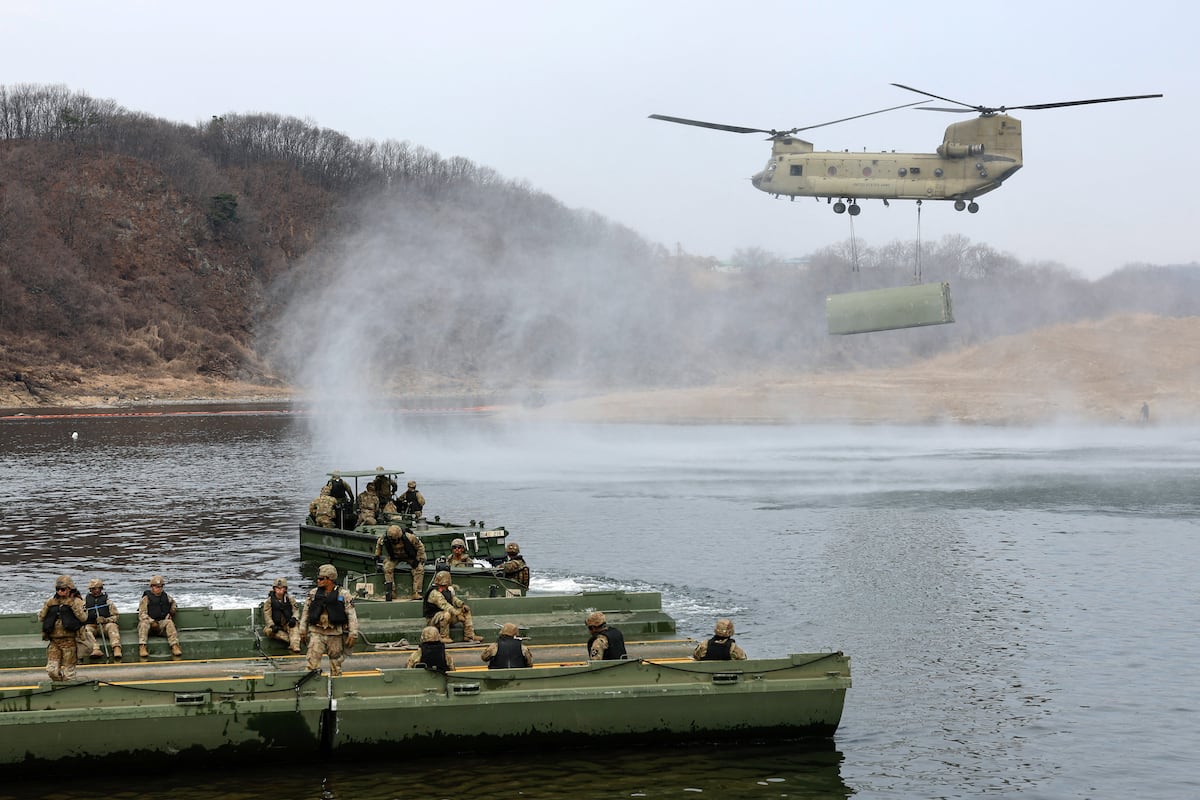
President Donald Trump on Sunday instructed the Pentagon to “substantially reduce” joint military exercises with long-term Asian ally South Korea, citing the cost of the drills and Seoul’s refusal to take part in actions against Iran.
Hours before exercises were scheduled to begin, Trump said on his Truth Social site he was “not happy” that the U.S. had agreed to participate and highlighted his “very good relationship” with Kim Jong Un, the leader of nuclear-armed and heavily sanctioned North Korea.
“These exercises are not only costly... but send a signal that is totally inappropriate and hostile, to a Country that, as long as Donald J. Trump has been President, has been unthreatening and respectful,” Trump wrote.
The annual Ulchi Freedom Shield joint military exercises are scheduled to run until August 27, with about 18,000 South Korean military personnel participating.
South Korea’s Joint Chiefs of Staff told Reuters the drills started on Monday as scheduled.
South Korea’s presidential Blue House said it was reviewing Trump’s post and “hopes that the friendly relationship between the U.S. and North Korean leaders will lead to meaningful dialogue between the two countries, opening discussions aimed at advancing peace and stability on the Korean Peninsula,” it said.
The allies would continue coordinating on their combined defense posture and military exercises, it said.
Responding to Trump’s claim that President Lee Jae Myung had refused to join U.S. efforts to denuclearise Iran, it said Seoul was discussing potential military contributions, while considering its defense readiness on the Korean Peninsula and domestic legal procedures.
A Pentagon spokesperson referred questions on the matter to the White House, which did not immediately respond to a request for details.
Up and down relationship
Trump has long sought to end or curtail military exercises with South Korea while clashing with Seoul over sharing the costs of stationing 28,500 U.S. troops in South Korea and their role in securing the broader region.
North Korea, still technically at war with the South, routinely denounces the U.S.-South Korean exercises as preparations for an invasion. Pyongyang last week fired a ballistic missile from its eastern coast towards the Sea of Japan, days after a similar North Korean short-range ballistic missile launch.
“This decision may be part of a larger effort to create a diplomatic opportunity with Pyongyang, as Trump has consistently wanted since coming back to office, although the haphazard nature of this move is unlikely to make much of an impression in Pyongyang,” Jenny Town, head of the Stimson Center think tank’s 38 North program, said in an email.
A TV broadcasts a news report on a possible summit between North Korean leader Kim Jong Un and President Donald Trump, at a railway station in Seoul, South Korea, on October 22, 2025. (Kim Hong-Ji/Reuters)
The relationship between Trump and Kim has been a roller coaster for years.
Trump once mocked the North Korean leader as “little rocket man” and threatened Pyongyang with “fire and fury,” while Kim boasted that he would “tame the mentally deranged U.S. dotard with fire.”
Yet they also took part in three summits, with Trump declaring, “we fell in love” after exchanging letters with Kim. None of these efforts led to changes in North Korea’s nuclear weapons or ballistic missile development.
Even as Trump on Sunday spoke warmly of North Korea, he pointed to South Korea’s stance on the U.S.-Israeli conflict with Iran.
“While somewhat unrelated (?), I recently asked the President of South Korea if they would like to join us in the Denuclearization of the Islamic Republic of Iran, and they said, ‘No thanks!’” Trump wrote.
Exercises shift to simulations
It’s unclear how the drills could be cut back, but in recent years, they have shifted away from live-fire exercises to computer-simulated missile and cyberattacks.
Victor Cha, head of the Korea program at Washington’s Center for Strategic and International Studies, said Trump may be seeking greater influence over North Korea as Pyongyang has been heavily engaged in support of Russia in Ukraine.
“The other way to look at this is that Trump wants to engage Kim as a way to impede the Russia-NK ties,” said Cha.
U.S. soldiers take part in the annual Freedom Shield joint military training in Yeoncheon, South Korea, on March 14, 2026. (Kim Soo-hyeon/Reuters)
U.S. military officials have said North Korean troops, who have fought alongside Russia in its invasion of Ukraine, have gained experience from the conflict, while Ukraine said last week that North Korean-made missiles were used in a Russian ballistic missile attack on a steel plant in Zaporizhzhia.
A high-ranking U.S. Northern Command official, Lieutenant General Joseph Jarrard, last week warned that North Korea had successfully tested intercontinental ballistic missiles with “enough boost to deliver a nuclear payload anywhere in North America.”
While Trump has repeatedly called for South Korea to shoulder a bigger burden of defense costs, a U.S. official this year called Seoul a “model ally” committed to increasing defense spending in line with U.S. regional strategy.
There are also broader economic tensions.
A former U.S. official who worked in the first Trump administration told Reuters he believed Trump is “frustrated with the intransigence” of the South Korean administration in addressing economic issues.
“The Lee government has repeatedly pursued policies antagonistic to American companies and shown little interest in following through on the historic investment deal with the United States,” the official said.
The countries signed a trade deal last year to lower Trump’s auto tariffs in exchange for Seoul’s commitment to invest $350 billion. South Korea has not announced details of its investment plan.
The allies have been at odds over a dispute involving U.S.-listed e-commerce company Coupang, which is being investigated by Seoul over a massive data leak.
周日,唐纳德·特朗普总统指示五角大楼“大幅减少”与长期亚洲盟友韩国的联合军事演习,理由是演习成本高昂以及首尔拒绝参与针对伊朗的行动。
在演习预定开始前几个小时,特朗普在他的“真相社交”网站上表示,他对美国同意参加演习感到“不高兴”,并强调了他与拥有核武器且受到严厉制裁的朝鲜领导人金正恩的“非常好的关系”。
“这些演习不仅耗资巨大……而且向一个自唐纳德·J·特朗普担任总统以来就一直对美国不构成威胁且尊重美国的国家发出了完全不恰当且充满敌意的信号,”特朗普写道。
一年一度的乙支自由之盾联合军事演习计划持续到8月27日,约有18000名韩国军人参加。
韩国联合参谋本部告诉路透社,演习已于周一按计划开始。
韩国总统府青瓦台表示,正在审查特朗普的任命,并“希望美朝领导人之间的友好关系能够促成两国之间有意义的对话,开启旨在促进朝鲜半岛和平与稳定的讨论”。
声明称,盟军将继续协调联合防御态势和军事演习。
针对特朗普声称韩国总统李在明拒绝加入美国为伊朗实现无核化所做的努力,韩国方面表示,首尔正在讨论潜在的军事贡献,同时也在考虑其在朝鲜半岛的防御准备情况和国内法律程序。
五角大楼发言人将有关此事的询问转给了白宫,白宫方面尚未立即回应有关细节的请求。
上下起伏的关系
特朗普长期以来一直试图结束或缩减与韩国的军事演习,同时与首尔就分担在韩国驻扎 28500 名美军的费用以及他们在维护更广泛地区安全方面的作用发生冲突。
朝鲜在技术上仍与韩国处于战争状态,并经常谴责美韩联合军演是入侵韩国的准备。上周,平壤从其东海岸向日本海发射了一枚弹道导弹,几天前,朝鲜也进行了类似的短程弹道导弹发射。
“这一决定可能是特朗普重返任以来一直希望与平壤建立外交关系的更大努力的一部分,尽管这一举动的随意性不太可能在平壤产生多大影响,”史汀生中心智库“38 North”项目负责人珍妮·汤恩在一封电子邮件中表示。
2025年10月22日,韩国首尔火车站,电视正在播放有关朝鲜领导人金正恩与美国总统唐纳德·特朗普可能举行峰会的新闻报道。(金洪基/路透社)
多年来,特朗普和金正恩的关系一直跌宕起伏。
特朗普曾嘲讽朝鲜领导人为“小火箭人”,并威胁要对平壤发动“烈火与怒火”,而金正恩则吹嘘说,他将“用烈火驯服这个精神错乱的美国老糊涂”。
然而,他们也举行了三次峰会,特朗普在与金正恩互通书信后宣称“我们坠入爱河”。但所有这些努力都没有促使朝鲜在核武器或弹道导弹研发方面做出任何改变。
尽管特朗普周日对朝鲜发表了热情洋溢的讲话,但他还是提到了韩国在美以冲突中对伊朗问题的立场。
“虽然这有点不相关(?),但我最近问韩国总统是否愿意加入我们,共同推动伊朗伊斯兰共和国无核化,他们回答说:‘不,谢谢!’”特朗普写道。
演习转向模拟
目前还不清楚如何缩减演习规模,但近年来,演习已从实弹演习转向计算机模拟的导弹和网络攻击。
华盛顿战略与国际研究中心韩国项目负责人维克多·查表示,由于平壤一直在乌克兰大力支持俄罗斯,特朗普可能正在寻求对朝鲜施加更大的影响力。
“换个角度来看,特朗普想通过与金正恩接触来阻碍俄罗斯与朝鲜的关系,”车说。
2026年3月14日,美军士兵在韩国涟川参加年度“自由之盾”联合军事演习。(金秀贤/路透社)
美国军方官员表示,曾与俄罗斯并肩作战入侵乌克兰的朝鲜军队从这场冲突中获得了经验;而乌克兰上周表示,俄罗斯对扎波罗热一家钢铁厂发动的弹道导弹袭击中使用了朝鲜制造的导弹。
美国北方司令部高级官员约瑟夫·贾拉德中将上周警告说,朝鲜已成功试射洲际弹道导弹,其“推进力足以将核弹头投送到北美任何地方”。
尽管特朗普一再呼吁韩国承担更大的国防开支,但今年一位美国官员称首尔是“模范盟友”,致力于根据美国地区战略增加国防开支。
此外,还存在更广泛的经济紧张局势。
一位曾在特朗普第一届政府任职的美国前官员告诉路透社,他认为特朗普对韩国政府在解决经济问题上的“顽固不化”感到“沮丧”。
这位官员表示:“李政府一再推行与美国公司敌对的政策,并且对履行与美国达成的历史性投资协议几乎没有表现出任何兴趣。”
两国去年签署了一项贸易协议,以降低特朗普对美国汽车加征的关税为条件,换取首尔承诺投资3500亿美元。韩国尚未公布其投资计划的细节。
盟友之间因涉及在美国上市的电子商务公司 Coupang 的纠纷而产生分歧,首尔方面正在对该公司进行大规模数据泄露调查。