The Soviet Union’s Railway-Based Intercontinental Ballistic Missile Had An Inflatable Nosecone苏联的铁路运输型洲际弹道导弹有一个充气式弹头。
The Soviet Union was the only country to field a fully operational rail-mobile ICBM and it had one highly unusual feature.
新闻视频
Updated Mar 9, 2021 7:41 PM EST
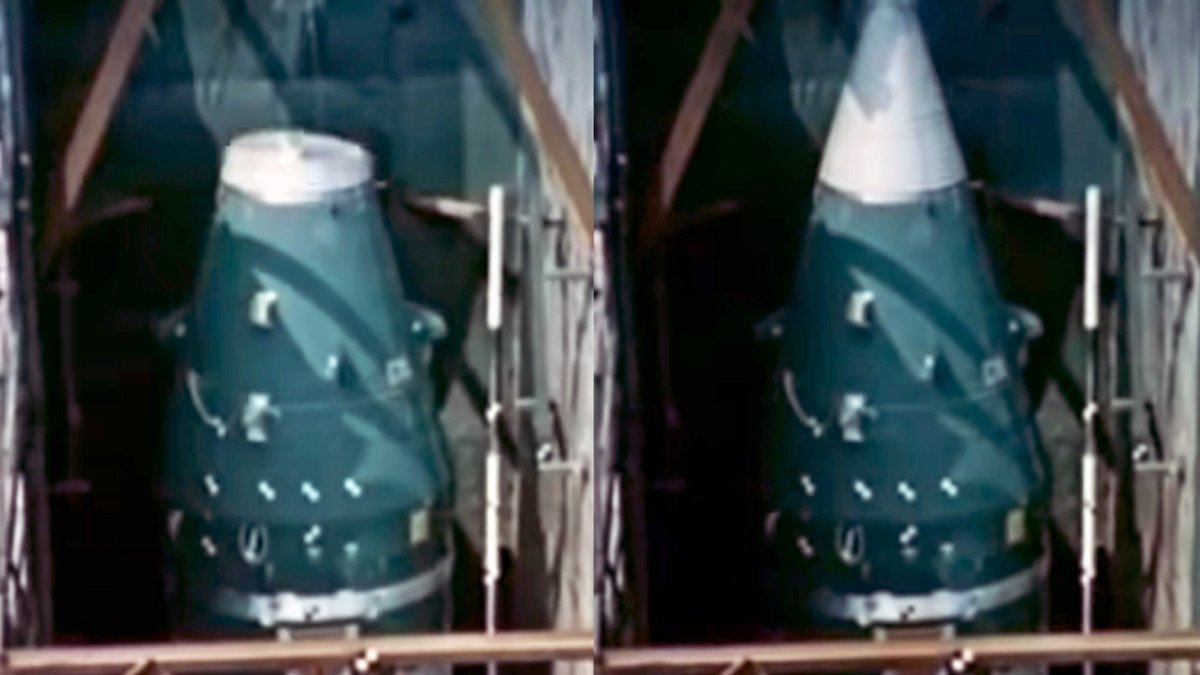
The Soviet Union’s Cold War-era Molodets intercontinental ballistic missile was unique for being fielded on a train, rather than in silos or on mobile launchers . But its novelty didn’t stop there — this weapon, known to NATO as the SS-24 Scalpel, also featured a bizarre inflatable nosecone.
What seems to be the only video available of the missile’s nosecone in action was brought to our attention by Twitter user Chase, whose feed is worth a follow for those interested in nuclear weapons and security, including some of its more unusual aspects. The same clip can be found within a longer video on YouTube, at around the 1:05 mark. That entire video is also posted later on in this article.
A Molodets missile train with RT-23UTTKh ICBM on display in a museum, with a more durable dummy nosecone fitted., Vitaly V. Kuzmin/Wikimedia Commons
The decision to incorporate an inflatable nosecone seems to have been driven by the very specific requirements of railway launch . Since the intercontinental ballistic missile (ICBM) itself was longer than a standard railroad car, this was a solution to accommodate it within the length restrictions of the launcher and retain aerodynamic properties once launched.
It seems the nosecone inflated soon after launch and it used a pressure accumulator to increase internal pressure, which in turn deployed a corrugated metal internal structure, forming the conical nose shape. This solution is used to reduce the overall length of the missile and its placement in the car. Meanwhile, inflatables continue to be used in spaceflight , if not missile technology, to this day.
The story of the SS-24 itself is an interesting one, part of a wider Soviet effort to make its land-based ICBMs more survivable. By the late 1960s, it was clear that the increasing accuracy of U.S. missiles would likely be enough to ensure the destruction of any Soviet ICBM silos, no matter how hardened. The Soviet response followed a two-pronged approach to enhance survivability: road-mobile missiles on tracked or wheeled launchers, and rail-mobile systems.
With 99,000 miles of railway lines able to accommodate disguised missile launchers, rail-mobile missiles would be almost impossible to find and consistently track. At the same time, it promised to allow heavier ICBMs to be fielded: Soviet road-mobile systems, at this point, were limited to missiles weighing around 40 tons. In addition, being tracked, the early road-mobile systems imparted potentially damaging vibrations on the missile itself.
In early 1969, two design bureaus, Chelomey and Yangel were tasked with developing rail-mobile ICBMs. The Chelomey offering was quickly abandoned since it used liquid-fuel propulsion that was too sensitive to the vibrations of the train and could potentially cause a catastrophic propellant leak.
A Pentagon artist’s impression of what then known as the SS-X-24 — indicating it was not yet fully operational., NATIONAL ARCHIVES
In the Ukrainian Soviet Socialist Republic, Yangel continued work on its design, based on the RT-23 missile for the Molodets system (translated to English, the name means something like ‘good boy’ or ‘well done’). However, this progressed only very slowly, and it wasn’t until 1980 that design work was finalized. As well as the formidable technical challenges involved in fielding a missile on a train, the Soviets were still perfecting solid-fuel rocket technology, and there was also lingering official resistance to mobile systems in general, on grounds of cost and complexity, as well as contravening arms treaty negotiations. There were also concerns about training crews to operate the systems and about the command-and-control issues surrounding a widely dispersed mobile ICBM force.
By the early 1980s, the Molodets had been overtaken by road-mobile developments, now that they could benefit from solid-fuel technology and wheeled launchers. Nevertheless, the rail-mobile system was still selected to form part of the Soviet fourth-generation ICBM force, alongside the road-mobile Topol ( SS-25 Sickle ). At the same time, silo-based missiles continued to be improved, focusing on more accurate warheads and better-protected silos. A silo-based RT-23 was also authorized, this trading the inflatable nosecone for a more robust folding one that similarly deployed after launch.
The two-part folding nosecone of a silo-launched SS-24 snaps closed on launch., YOUTUBE SCREENCAP
While the Topol was a ‘light’ ICBM with a single warhead, the Molodets used the ‘medium’ RT-23 missile. Testing of this missile began in 1982, but of the first 11 test flights, seven ended in failure. Ultimately, problems with the RT-23 were considered so serious that it was canceled in 1983, although the trains used in the Molodets system were handed over for crew training, while work continued on an alternative missile.
A contemporary diagram showing the missile stowed in the railcar, with the inflatable nosecone not yet deployed. Note also the three-stage missile configuration., YOUTUBE SCREENCAP
Finally, in 1985, test flights began of the improved RT-23UTTh missile, which carried 10 multiple independently targetable re-entry vehicles (MIRVs) each with a yield of 300 kilotons. Thought was briefly given to fielding this new ICBM on an enormous wheeled transport-erector-launcher (TEL), as well as in silos and as part of the Molodets. The Tselina-2 wheeled version was soon abandoned, but not before a 24 x 24 wheeled TEL prototype had been built.
Test launches of the RT-23UTTh missile as part of the rail-based Molodets were completed in December 1987 and the system was declared operational the same month. It was the last of the new-generation Soviet ICBMs to be deployed.
By 1988 there were around 10 Molodets trains operational, but it was an expensive system since it required tracks around the different operating hubs to be refurbished. Each Molodets division had four trains. Within each train , there were three cars for the launch module, including a single missile. There were also seven cars accommodating the command modules, one fuel and lubricants car, and two DM62 diesel locomotives that could move the whole thing at speeds of up to 75 miles per hour. All the railcars were disguised as refrigerated vans or as passenger cars.
An SS-24, complete with its launch tube, being removed from a train., Public Domain
By 1992 the Soviet Union had deployed 92 SS-24s, 36 of which were of the rail-based version. After the collapse of the Soviet Union, all the rail-based missiles were left on Russian territory, but as early as October 1991, Moscow announced they would from now on be stationed in garrisons. Continuing concerns about security were cited, but it’s likely the costs of the system also played a role. Furthermore, since the missiles had been built in what was now Ukraine, further production for Russia was impossible and the supply of spare parts dried up.
A Molodets train at the Russian Railway Museum in St. Petersburg., Andrey Filippov/Wikimedia Commons
The last rail-based SS-24 missiles had been removed from service in 2002 and the last base was liquidated in 2007 .
Surprisingly, perhaps, there were rumors that rail-mobile ICBMs might make a comeback in Russia. In 2014, reportedly with the support of the commander of the Strategic Rocket Forces , it was reported that a draft proposal for a modern version of the system was to be completed, named Barguzin, apparently as a counter to the U.S. Prompt Global Strike initiative. Work on the Barguzin was suspended in 2017 but since then, Russa has also unveiled a host of even more exotic strategic delivery systems .
But if the rail-mobile ICBM does ever return to the Russian inventory, it will very likely not feature an inflatable nosecone — the new-generation RS-24 Yars ICBM is already compact enough to fit within a standard-size railroad car, without any such ingenious modifications.
Contact the author: thomas@thedrive.com
Comments couldn’t be loaded. Please refresh the page.
更新于美国东部时间2021年3月9日晚上7:41。
苏联冷战时期研制的“青年”洲际弹道导弹的独特之处在于它不是部署在发射井或移动发射车上,而是部署在火车上。但它的新颖之处还不止于此——这种被北约称为SS-24“手术刀”的武器,还配备了一个奇特的充气式弹头。
这段导弹弹头锥体工作的视频似乎是目前唯一公开的,由推特用户Chase提供。Chase的推特账号值得关注,尤其适合对核武器和安全(包括一些较为罕见的方面)感兴趣的人士。同样的片段也出现在YouTube上一个较长的视频中,大约在1分05秒处。本文稍后也会附上该视频的完整版本。
博物馆展出了一列莫洛杰茨导弹运输机,机上搭载着RT-23UTTKh洲际弹道导弹,该导弹已安装了一个更耐用的模拟弹头。(图片来源:Vitaly V. Kuzmin/Wikimedia Commons)
采用充气式弹头似乎是为了满足铁路发射的特殊要求。由于洲际弹道导弹(ICBM)本身比标准铁路车厢长,因此这种解决方案既能使其符合发射装置的长度限制,又能保证发射后保持良好的空气动力学性能。
导弹发射后不久,弹头似乎便开始充气,它利用压力蓄能器增加内部压力,进而展开波纹状金属内结构,形成锥形弹头。这种设计旨在缩短导弹的整体长度,并方便其在运输车内放置。时至今日,充气式结构仍然应用于航天领域,尽管导弹技术已不再使用。
SS-24导弹本身的故事就很有意思,它是苏联为提高陆基洲际弹道导弹生存能力而做出的更广泛努力的一部分。到了20世纪60年代末,很明显,美国导弹日益提高的精度足以摧毁任何苏联洲际弹道导弹发射井,无论其加固程度如何。苏联采取了双管齐下的策略来提高生存能力:一是研发履带式或轮式发射车上的公路机动导弹,二是研发铁路机动系统。
拥有9.9万英里的铁路线,足以容纳伪装的导弹发射装置,铁路机动导弹几乎不可能被发现和持续追踪。同时,这也有望部署更重的洲际弹道导弹:当时苏联的公路机动系统仅限于重量在40吨左右的导弹。此外,早期的公路机动系统在被追踪时,会对导弹本身造成潜在的破坏性振动。
1969年初,切洛梅设计局和扬格尔设计局受命研发铁路机动洲际弹道导弹。切洛梅设计的方案很快被放弃,因为它采用的液体燃料推进系统对列车的震动过于敏感,可能导致灾难性的推进剂泄漏。
这是五角大楼艺术家绘制的当时被称为SS-X-24的飞机的示意图——表明它尚未完全投入使用。(国家档案馆)
在乌克兰苏维埃社会主义共和国,扬格尔继续推进其设计工作,该设计基于RT-23导弹,用于“青年”(Molodets)系统(其名称翻译成英语大致意为“好孩子”或“干得好”)。然而,这项工作进展极其缓慢,直到1980年才最终完成设计。除了将导弹部署到火车上所面临的巨大技术挑战外,苏联当时仍在完善固体燃料火箭技术,而且官方对移动式导弹系统普遍存在抵触情绪,理由是成本高昂、结构复杂,以及违反军控条约谈判。此外,人们还担心如何培训操作人员,以及分散部署的移动式洲际弹道导弹部队的指挥控制问题。
到了20世纪80年代初,由于公路机动导弹能够采用固体燃料技术和轮式发射装置,莫洛杰茨导弹的性能已被公路机动导弹超越。尽管如此,铁路机动导弹系统仍然被选中,与公路机动的“白杨”(SS-25“镰刀”)导弹一起,成为苏联第四代洲际弹道导弹部队的一部分。与此同时,井基导弹也在不断改进,重点在于提高弹头精度和增强发射井的防护能力。井基RT-23导弹也获得了批准,它用更坚固的折叠式弹头取代了充气式弹头,后者同样在发射后展开。
SS-24导弹采用井射方式发射,其两段式折叠鼻锥在发射时迅速闭合。(YouTube截图)
“白杨”导弹是一种轻型洲际弹道导弹,仅携带一个弹头;而“青年”导弹系统则使用中型RT-23导弹。该导弹的测试始于1982年,但在最初的11次试飞中,有7次以失败告终。最终,RT-23导弹的问题被认为非常严重,于1983年被取消。不过,“青年”导弹系统使用的列车被移交给相关部门用于乘员训练,同时,替代导弹的研发工作仍在继续。
一张当代示意图,显示了存放在铁路货车中的导弹,充气式弹头尚未展开。另请注意导弹的三级结构。(YouTube 截图)
最终,在1985年,改进型RT-23UTTh导弹开始试飞,该导弹携带10枚多弹头独立重返大气层载具(MIRV),每枚MIRV的当量为300千吨。人们曾短暂考虑过将这种新型洲际弹道导弹部署在巨型轮式运输起竖发射车(TEL)上,以及发射井和“青年”导弹系统上。Tselina-2轮式版本很快被放弃,但在此之前,已经制造了一辆24×24轮式TEL原型车。
作为“青年”铁路导弹系统的一部分,RT-23UTTh导弹的试射于1987年12月完成,该系统于同月宣布投入使用。它是苏联最后部署的新一代洲际弹道导弹。
到1988年,大约有10列“青年号”导弹发射车投入运营,但由于需要翻新各个运营枢纽周围的轨道,这套系统造价不菲。每个“青年号”分队拥有四列列车。每列列车上,有三节车厢用于装载发射模块,其中包括一枚导弹;七节车厢用于装载指令舱;一节燃料和润滑油车;以及两台DM62型柴油机车,它们能够以最高75英里/小时的速度牵引整套系统。所有车厢都伪装成冷藏车或客车。
一枚SS-24火箭及其发射管正从火车上卸下。(公共领域)
到1992年,苏联已部署了92枚SS-24导弹,其中36枚为铁路运输型。苏联解体后,所有铁路运输型导弹都留在了俄罗斯境内,但早在1991年10月,莫斯科就宣布这些导弹将从此部署在驻军营地。官方给出的理由是出于对安全的持续担忧,但该系统的成本很可能也是一个重要因素。此外,由于这些导弹是在当时的乌克兰境内制造的,俄罗斯无法继续生产,备件供应也随之中断。
圣彼得堡俄罗斯铁路博物馆内的一列青年号列车。(图片来源:Andrey Filippov/Wikimedia Commons)
最后一批铁路运输型 SS-24 导弹于 2002 年退役,最后一个基地于 2007 年被拆除。
或许令人惊讶的是,曾有传言称俄罗斯可能会重启铁路机动洲际弹道导弹项目。据报道,2014年,在战略火箭军司令的支持下,一份名为“巴尔古津”(Barguzin)的现代化系统方案草案即将完成,显然是为了应对美国的“全球快速打击”(PROMPG)计划。巴尔古津项目的研发工作于2017年暂停,但此后,俄罗斯还推出了一系列更为先进的战略运载系统。
但如果铁路机动洲际弹道导弹真的重返俄罗斯的装备库,它很可能不会配备充气式弹头——新一代 RS-24 Yars 洲际弹道导弹已经足够紧凑,可以装入标准尺寸的铁路车厢内,无需任何此类巧妙的改装。
联系作者:thomas@thedrive.com
评论加载失败,请刷新页面。