Check Out The Crazy Radar That Lies Beneath The MC-130H Combat Talon II’s Gonzo Nose来看看MC-130H“战斗利爪II”的“冈佐机头”下隐藏的疯狂雷达
This radar offers capabilities missing on the newer MC-130Js, which is why the H models remain in service years after their intended retirement date.
新闻视频
By Joseph Trevithick
Published Dec 30, 2019 8:57 PM EST
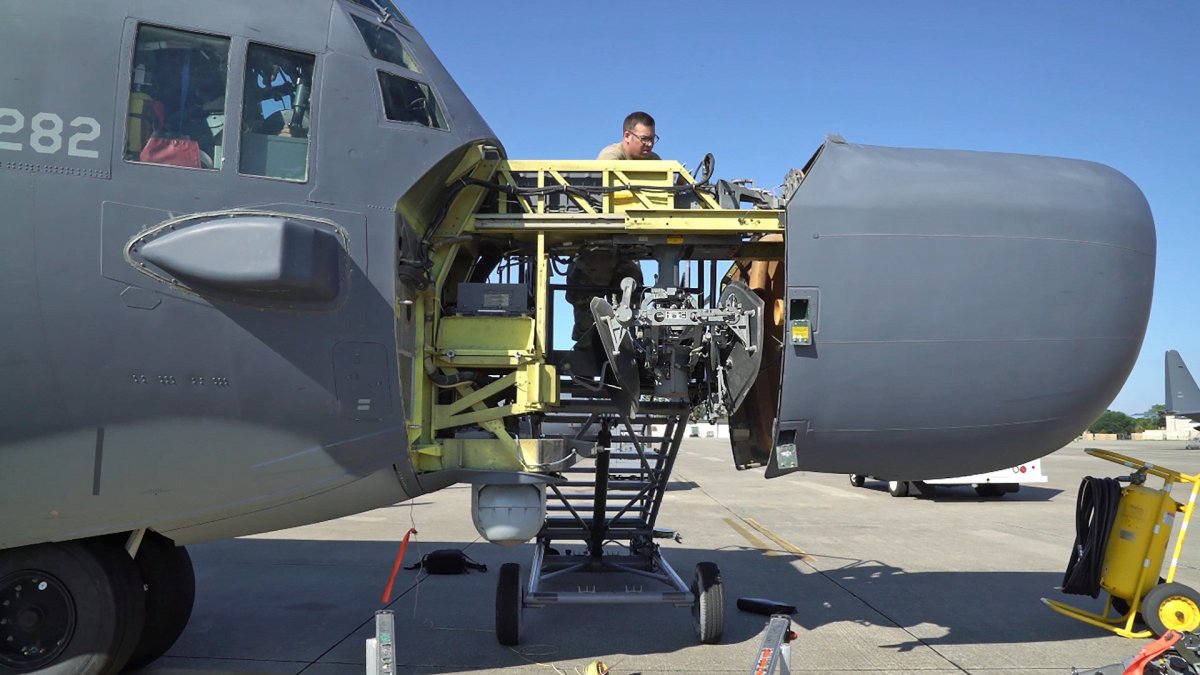
The U.S. Air Force’s 1st Special Operations Wing has released video footage of various routine maintenance tasks on an MC-130H Combat Talon II special operations transport that includes a look inside the aircraft’s giant nose at its powerful AN/APQ-170 radar. The AN/APQ-170 is the reason for the MC-130H’s unique snout, which makes it quickly distinguishable from other C-130 variants. It’s also offers robust terrain-following and terrain avoidance capabilities that all but two of the newer MC-130J Commando II ‘s lack, a glaring issue the War Zone
has reported on in detail in the past, which is why the Combat Talon IIs remains in service at all nearly a decade after the type’s original sunset date.
The video, which the 1st Special Operations Wing posted on the Defense Visual Information Distribution Service website on Dec. 30, 2019, shows members of the 901st Special Operations Maintenance Squadron working on the AN/APQ-170 radar, navigation system, and communications equipment on an MC-130H, serial number 89-0282, at Hurlburt Field in Florida. The 901st’s specific job is to train maintenance personnel to work on the Combat Talon IIs, 18 of which remain in service. Those aircraft are assigned to the 15th Special Operations Squadron, an operational unit, and the 19th Special Operations Squadron, which is responsible for training new aircrews for MC-130H and J models, as well as AC-130 gunship variants .
The highlight of the clip is definitely seeing MC-130H’s nose radome open, which is done by unhooking various latches and then sliding it forward along an integral rail assembly inside.
The entire nose assembly is massive compared to one found on a standard C-130H Hercules airlifter, or any other cargo-carrying C-130 variant for that matter, and is much bigger even than the one on its predecessor, the MC-130E Combat Talon . The Combat Talon was the Air Force’s first dedicated special operations transport variant of the venerable C-130.
Even with the extra room, the AN/APQ-170 fits snugly inside. The radar has seen a number of upgrades and modifications to improve its performance and reliability, but the general configuration remains largely the same. The system includes an X-band array mounted on top of two oscillating Ku-band arrays. As a mechanically scanned radar, the pair of dishes moving back and forth below helps the entire system scan faster than it would with just a single array. In the video clip, the personnel from the 901st are seen preparing to replace the X-band component.
A complete AN/APQ-170 radar undergoing maintenance. The X-band component on top and the Ku-band components below are clearly visible., USAF
The result is a multi-function radar suite than can provide traditional navigation and weather detection capabilities, as well as terrain following and mapping functionality. That latter of these modes, which allows for low-altitude penetration in any weather, are absolutely critical for the MC-130H’s core mission of providing a platform that is able to fly into denied areas in order to insert, extract, or resupply special operations forces.
The Air Force has been exploring the possibility of acquiring a more survivable platform, such as a stealth transport aircraft, to perform this mission in the face of increasingly dense and capable hostile air defenses. The service has also explored major modifications to its various MC-130 variants to ensure they remain as relevant as possible in the future. You can read about these developments in this past two-part
However, to remain as hidden from hostile air defenses as possible in the meantime, the Combat Talon IIs fly operational missions at night and at extremely low, nap of the earth altitudes, while following routes that exploit terrain features in order to further mask their approach. This requires a very capable and reliable radar with terrain-following and terrain-avoidance capabilities, such as the AN/APQ-170. The MC-130Hs also have a sensor turret with electro-optical and infrared cameras underneath the nose that provides additional situational awareness.
An MC-130H Combat Talon II. The aircraft’s sensor turret is visible under its large nose radome, which houses the AN/APQ-170 radar., Carlos Menendez San Juan via Wikimedia
As important as the AN/APQ-170 is to the Combat Talon II, it almost didn’t come to be. The Air Force had hoped to avoid the cost of internally developing a specialized terrain-following and terrain avoidance capable radar, as it had done with the MC-130E. It had gone so far as to stop production of the AN/APQ-122(V)8 found on the Combat Talon, which, by the 1980s, cost between $8 and $10 million apiece, or between $19 and nearly $24 million in 2019 dollars, according to The Praetorian STARShip : The untold story of the Combat Talon , an official Air Force historical monograph.
An MC-130E Combat Talon with its own distinct nose radome housing the AN/APQ-122(V)8 radar, which is still notably smaller than the one on the MC-130H. , Adrian Pingstone via Wikimedia
The Air Force wanted a cheaper radar and hired IBM to build it. IBM, in turn, subcontracted the work to Emerson Electric, who developed what became the AN/APQ-170. The radar program ran into so much trouble it almost scuttled the MC-130H project entirely. With no alternative immediately available, the service decided to push ahead with the Emerson Electric product, delaying the entry into service of the first Combat Talon II until 1991. At that time, each radar cost $20 million, equivalent to nearly $38 million today, according to The Praetorian STARShip . As such, the radar alone accounted for more than a tenth of the each MC-130H’s $160 million unit cost.
Difficulties in acquiring AN/APQ-170s and spare parts to go with them, together with continuing reliability issues, plagued the MC-130Hs in their early years. The Air Force initially took delivery of the Combat Talon II seen in the recent maintenance video, serial number 89-0282, in 1994 without a functioning X-band component installed. The radome also presented problems, particularly in not keeping everything warm enough to prevent icing in cold weather.
Despite updates and modifications, including a new radome heating and anti-icing system, by the mid-1990s, Praetorian STARShip says that the Air Force had completely given up on its requirement for the AN/APQ-170 to work for an average of 191 hours without a major failure. By the end of the decade, the service had initiated plans for yet another upgrade program, resulting in what was known as the AN/APQ-170(V)1-425 configuration, which had a so-called “mean time between failure” rate of 75 hours. By around 2000, all MC-130Hs had received this new version of the radar.
An MC-130H seen in 1999., Mike Freer via Wikimedia
Given this experience, it seems somewhat curious that the Air Force has ended going down a similar route , with similar results, when deciding on the radar for the new MC-130J Commando II. This new special operations transport version of the C-130 uses the same AN/APN-241 multi-function radar as the standard C-130J airlifter, which provides some nominal amount of terrain-following and terrain avoidance capability.
You can read more in detail about the MC-130J’s own radar saga in this past War Zone piece , but suffice to say, testing showed that the AN/APN-241 was unsafe to use for the kind of extreme low-level flying the Air Force Special Operations Command conducts with its MC-130Hs. There is now a program in the works to add a dedicated terrain-following and terrain avoidance capable radar, the AN/APQ-187 Silent Knight, to the Commando IIs. As of May 2019, there were only two MC-130Js in testing with the new radar fit.
An MC-130J Commando II with the AN/APQ-187 seen with its black radome mounted on top of the aircraft’s nose., Lockheed Martin capture
The Air Force had planned to retire the Combat Talon IIs entirely by 2012, but has significantly slowed this process in light of the limited capabilities of the Commando IIs. The plan now is to retain at least some MC-130Hs until the Silent Knight-equipped MC-130J proves it can match its capabilities and there are sufficient numbers of those aircraft to meet the demands of the U.S. special operations community.
As such, the MC-130Hs and their complex and expensive AN/APQ-170 radar, which have now been in service for nearly 30 years and are some of the oldest special operations aircraft in U.S. military service at present, look set to continue flying demanding, super-low-level, night-time special operations missions for at least a few more years.
Contact the author: joe@thedrive.com
Comments couldn’t be loaded. Please refresh the page.
作者:约瑟夫·特雷维西克
发布于2019年12月30日晚上8:57(美国东部时间)。
美国空军第一特种作战联队发布了一段视频,展示了一架MC-130H“战斗利爪II”特种作战运输机的各项例行维护工作,其中包括一窥飞机巨大的机头内部,可以看到其强大的AN/APQ-170雷达。正是AN/APQ-170雷达赋予了MC-130H独特的机头造型,使其能够迅速与其他C-130系列飞机区分开来。此外,它还具备强大的地形跟踪和地形规避能力,而除两架之外,其他所有新型MC-130J“突击队员II”运输机都缺乏这种能力,这在战区是一个显而易见的问题。
过去曾有详细报道,这也是为什么战斗爪 II 型飞机在最初的退役日期近十年后仍然服役的原因。
这段视频由第一特种作战联队于2019年12月30日发布在国防视觉信息分发服务网站上。视频显示,第901特种作战维护中队的成员正在佛罗里达州赫尔伯特机场对一架MC-130H型运输机(序列号89-0282)上的AN/APQ-170雷达、导航系统和通信设备进行维护。第901维护中队的具体任务是培训维护人员维护“战斗爪II”型运输机,目前仍有18架该型飞机在役。这些飞机分别隶属于第15特种作战中队(一个作战单位)和第19特种作战中队(负责MC-130H和J型以及AC-130炮艇机衍生型号的新机组人员培训)。
这段视频的亮点无疑是看到 MC-130H 的机头雷达罩打开,这是通过解开各种闩锁,然后沿着内部的集成导轨组件向前滑动来实现的。
与标准C-130H“大力神”运输机或其他任何C-130货运机型相比,整个机头组件都非常庞大,甚至比其前身MC-130E“战斗爪”的机头组件还要大得多。“战斗爪”是美国空军首款专为特种作战而设计的C-130特种作战运输机型。
即使空间更大,AN/APQ-170 雷达也能严丝合缝地安装在机舱内。该雷达经过多次升级和改进,以提高其性能和可靠性,但总体配置基本保持不变。该系统包括一个安装在两个往复运动的 Ku 波段天线阵列上方的 X 波段天线阵列。作为一种机械扫描雷达,下方两个往复运动的天线阵列有助于整个系统比仅使用单个天线阵列更快地进行扫描。在视频片段中,可以看到第 901 中队的官兵正在准备更换 X 波段组件。
一台完整的AN/APQ-170雷达正在进行维护。顶部的X波段组件和下方的Ku波段组件清晰可见。(美国空军)
最终成果是一套多功能雷达系统,它不仅具备传统的导航和气象探测能力,还能进行地形跟踪和测绘。其中,地形跟踪和测绘功能至关重要,因为它允许飞机在任何天气条件下进行低空突防,这对于MC-130H的核心任务——为特种作战部队提供进入敌方控制区域、执行部署、撤离或补给任务的平台——来说,无疑是一项极其关键的挑战。
面对日益密集且性能更强的敌方防空系统,空军一直在探索采购更具生存能力的平台(例如隐形运输机)来执行这项任务的可能性。空军还对其各种MC-130衍生机型进行了重大改进,以确保它们在未来尽可能保持其效用。您可以在之前的两篇报道中了解这些进展。
然而,为了尽可能躲避敌方防空系统的侦测,战斗爪II型飞机在夜间以极低的贴地飞行高度执行作战任务,并利用地形特征选择航线以进一步掩护其接近目标。这需要配备性能卓越且可靠的雷达,具备地形跟踪和地形规避能力,例如AN/APQ-170。MC-130H型飞机还在机头下方配备了一个装有光电和红外摄像机的传感器转塔,以提供额外的态势感知能力。
一架MC-130H“战斗利爪II”攻击机。飞机的传感器转塔在其巨大的机头雷达罩下方清晰可见,雷达罩内装有AN/APQ-170雷达。(图片来自Wikimedia,由Carlos Menendez San Juan提供)
尽管AN/APQ-170雷达对“战斗爪II”无人机至关重要,但它差点就没能问世。空军原本希望避免像MC-130E那样,自行研发一种具备地形跟踪和地形规避能力的专用雷达,从而节省成本。空军甚至停止了“战斗爪”无人机所搭载的AN/APQ-122(V)8雷达的生产。据空军官方历史专著《禁卫军星舰:战斗爪不为人知的故事》记载,到20世纪80年代,每台AN/APQ-122(V)8雷达的造价在800万至1000万美元之间,相当于2019年的1900万至近2400万美元。
一架MC-130E“战斗爪”攻击机,其独特的机头雷达罩内装有AN/APQ-122(V)8雷达,该雷达明显小于MC-130H上的雷达。(图片来自Wikimedia,Adrian Pingstone)
空军想要一款更便宜的雷达,于是委托IBM公司制造。IBM又将这项工作分包给了艾默生电气公司,后者最终研发出了后来的AN/APQ-170雷达。这款雷达项目遇到了诸多问题,几乎导致MC-130H项目彻底搁浅。由于当时没有其他替代方案,空军决定继续推进艾默生电气的产品,导致首架“战斗利爪II”的服役时间推迟到了1991年。据《普雷托里安星舰》一书所述,当时每部雷达的造价为2000万美元,相当于今天的近3800万美元。因此,仅雷达一项就占了MC-130H每架1.6亿美元单价的十分之一以上。
MC-130H早期服役期间,由于难以获得AN/APQ-170雷达及其配套备件,以及持续存在的可靠性问题,饱受困扰。空军最初于1994年接收的这架编号为89-0282的“战斗利爪II”型雷达(如近期维护视频中所示),其X波段组件尚未安装。雷达罩也存在问题,尤其是在寒冷天气下,无法保持足够的温度以防止结冰。
尽管经过多次升级和改进,包括加装新的雷达罩加热和防冰系统,但据 Praetorian STARShip 称,到 20 世纪 90 年代中期,空军已彻底放弃了 AN/APQ-170 雷达平均故障间隔时间达到 191 小时的要求。到 90 年代末,空军启动了另一项升级计划,最终推出了 AN/APQ-170(V)1-425 型雷达,其所谓的“平均故障间隔时间”为 75 小时。到 2000 年左右,所有 MC-130H 飞机都已换装了这款新雷达。
1999 年拍摄的一架 MC-130H,图片来自 Wikimedia,Mike Freer 提供。
鉴于此,令人有些费解的是,空军在为新型MC-130J“突击队员II”运输机选择雷达时,最终却走了类似的道路,并得到了类似的结果。这款新型C-130特种作战运输机与标准C-130J运输机一样,都使用了AN/APN-241多功能雷达,该雷达提供了一定程度的地形跟踪和地形规避能力。
您可以在之前《战区》杂志的一篇文章中详细了解MC-130J的雷达故事,但简而言之,测试表明,AN/APN-241雷达不适用于空军特种作战司令部使用MC-130H执行的那种极低空飞行任务。目前,一项旨在为“突击队员II”型飞机加装专用地形跟踪和地形规避雷达——AN/APQ-187“静默骑士”雷达的计划正在进行中。截至2019年5月,只有两架MC-130J正在进行新雷达的测试。
一架MC-130J“突击队员II”攻击机,机头上方安装有AN/APQ-187雷达罩,黑色雷达罩清晰可见。(洛克希德·马丁公司缴获)
空军原计划在2012年前全面退役“战斗爪II”型无人机,但鉴于“突击队员II”型无人机的性能有限,已大幅放缓这一进程。目前的计划是至少保留一部分MC-130H型无人机,直到配备“静默骑士”无人机的MC-130J型无人机证明其性能足以匹敌,并且拥有足够数量以满足美国特种作战部队的需求。
因此,MC-130H 及其复杂昂贵的 AN/APQ-170 雷达已经服役近 30 年,是目前美国军方服役最老的特种作战飞机之一,它们似乎注定要继续执行要求苛刻的超低空夜间特种作战任务至少几年。
联系作者:joe@thedrive.com
评论加载失败,请刷新页面。