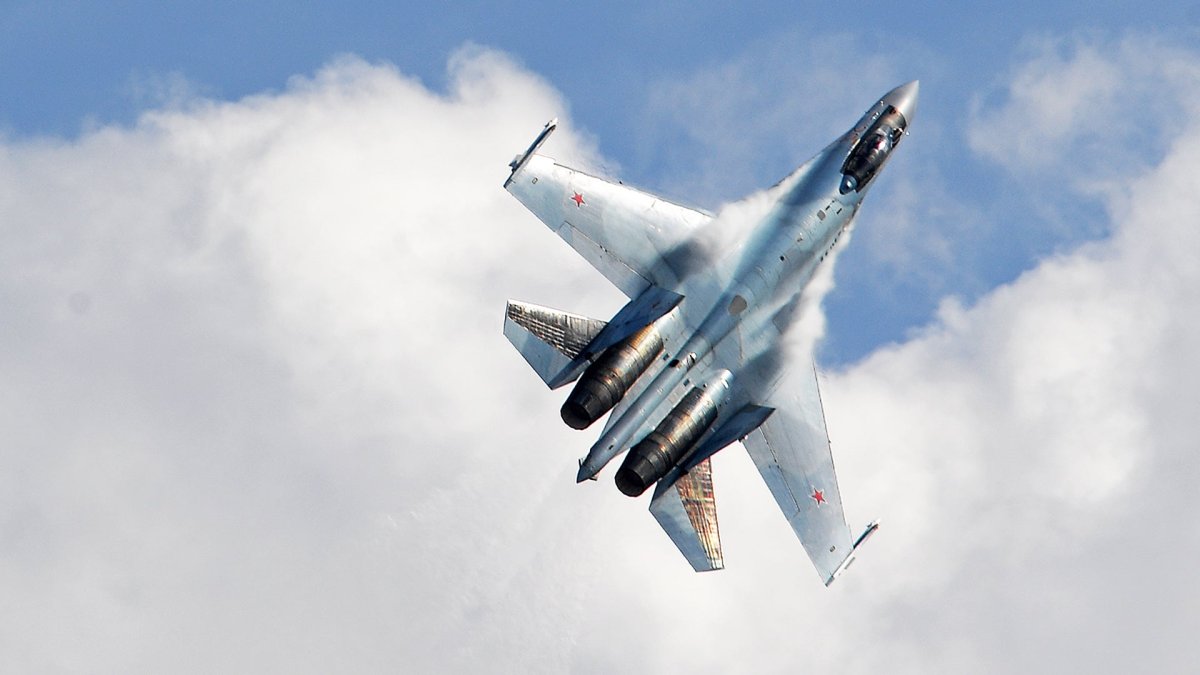
People Are Freaking Out Over Video Of Su-35 Practicing For Moscow Air Show一段苏-35战机为莫斯科航展进行训练的视频引发热议
The Su-35 may have a few new tricks to perform at MAKS 2017, but does the jet represent "peak fighter maneuverability" based on current air combat trends?
新闻视频
Updated Jul 5, 2020 7:15 PM EDT
Russia’s biannual marquee air show and weapons expo (referred to a MAKS) is about to kick off outside of Moscow and it never disappoints when it comes to aerial acts. In recent years, the star of the show has been the Su-35, Russia top-of-the-line Flanker derivative that features a digital fly-by-wire flight control system, three dimensional thrust vectoring nozzles and uprated AL-41F1S engines pumping out roughly 32,000 pounds of thrust each. All this adds up to an aircraft capable of astonishing aerial feats, regardless of their relevancy in most modern air combat scenarios.
In 2015, the Su-35S did some awesome maneuvers at MAKS as well. I posted on the jet’s unique flying abilities at the time and the gif I made went viral. People were just amazed a fighter aircraft could accomplish such maneuvers, and especially an operational one as big as the Su-35, which weighs over 40,000 pounds with its tanks empty and stores stations vacant.
Those are some amazing maneuvers that seem to defy the laws of physics at times, and you have to give it to the Russians, they make the best air show aircraft around bar none. But not that much of the Su-35’s acrobatic capability is relevant when it comes to modern air combat.
Being able to maneuver at the post-stall end of the envelope may be an attractive capability when taking on a single aerial opponent within visual range—one that is willing join in a dwindling speed, “groveling” knife fight. But many just won’t, as they are trained to engage in a “rate fight” not “radius fight” to maximize the positive attributes of their aircraft and minimize the negative ones. But either way, an advanced Flanker pulling off post-stall tricks turns into one big vulnerable target hanging out in a highly depleted energy state when other enemy fighters are present.
This type of extreme super-maneuverability holds less value than it did a decade or so ago when many western fighter aircraft still lacked a high-off boresight (HOBS) short-range air-to-air missiles and a helmet mounted sight for cueing those missile towards aerial targets far off the aircraft’s centerline.
Today most of these aircraft now have these systems, and the best HOBS missiles, like the latest iterations of the AIM-9X, are able to engage the enemy even when they are located over the pilot’s shoulder. The pilot turns their head, and the missile’s seeker turns too. When their eye is pointed at the target, the missile will lock on if it can and the pilot can then fire the missile and take evasive action. The latest variants don’t even require the missile’s seeker to be locked on before launch, instead a data-link guides the missile towards the target and then the seeker locks on once pointed at it. In other words, who wins and who loses during within visual range combat is no longer dictated by who can “point their nose” at the enemy first.
And of course, air show performances must be taken with the proverbial grain of salt. Once you add a practical fuel load and some weapons to any combat aircraft, its agility quickly erodes. Also, the routines performed are full of carefully tested and choreographed “edge of the envelope” sequences, many of which are flown by highly experienced pilots. So it’s not like the guy or gal up there has 200 hours in the jet and is chasing down another aircraft over a war zone and pulling these maneuvers off on the fly to make a kill.
An impressive lineup of Russian hardware at MAKS 2017., AP
Still, the Su-35, and many other Russian aircraft, are incredible crowd pleasers, but they are far from being just dancing bears. When paired with experienced aircrews and the right tactics , and considering that roughly 2.5 Su-35s can be bought for the price of a single F-35A, not to mention that they are already being actively exported, the type is a threat to be concerned with.
Video of the Su-30MKM, which uses a similar 3D thrust vectoring setup as the Su-35:
But regardless of what you see on youtube or on some Flanker obsessed websites, these aircraft stand little chance of surviving an encounter with similar numbers of F-22s or F-35s. And comparing them to 5th generation western fighters really isn’t fair to begin with. But rules of engagement in some scenarios, or when fighting over a tightly compacted battlefield, mean that there is no absolute guarantee that these types of aircraft will never make it to the merge with the F-35 or F-22.
Su-35S is currently the most advanced operational fighter in the Russia’s inventory. , AP
The F-35 in particular may be vulnerable. Considering the Lightning’s limited internal missile carriage capability, just four air-to-air missiles at this time , a formation of F-35s could become overwhelmed with targets, especially during long-range expeditionary operations against a near peer state foe. Running or standing their ground is not as good an option as it is for the F-22 as the F-35 lacks the rear-hemisphere low-observability that the F-22 possesses, nor its agility or ability to supercruise at high speed out of the combat arena.
When it comes to other 4th generation fighters, but less so for ones equipped with modern active electronically scanned array (AESA) radars, the Su-35S is a much larger threat even in the beyond visual range combat environment. Within visual range the jet should be feared, but once again, its super maneuverability is not highly relevant in a multi-aircraft engagement, and tactics are developed to degrade its slow-speed performance advantage.
Above all else, when any US or allied aircraft are operating in networked battlespace backed by various strategic intelligence, surveillance and reconnaissance (ISR) and command and control assets, as well as other “force multipliers,” their lethality and survivability improves exponentially no matter what opponents they face. But there are also vulnerabilities in relying too heavily on lumbering support assets or complex communications networks to win the day.
With this in mind, for current fighters, a good degree of maneuverability is still a good thing to have, but new designs would likely be better off with trading it for other key advantages. In fact, dropping the whole fighter moniker and mission set altogether seems like a good idea.
I have been a proponent of throwing maneuverability requirements out the door entirely for future manned assets. The ability to carry far more fuel and thus more range, have lower observability (better, wider-band stealth), larger and more capable internal electronic warfare systems, more expansive missile magazines (especially being able to carry missiles with far longer ranges than what is available today ) and in some cases enhanced supercruise capability would be far more advantageous than the ability to turn harder or to tumble around at zero forward airspeed. Additionally, the coming age of air-to-air lasers , which will be defensive in their application at first, is also likely to make slow-speed super maneuverability irrelevant and being able to avoid initial detection will have greater importance than ever.
The truth is, manned platforms, for many missions, including some counter air ones, are increasingly irrelevant for high-end combat environments. As many of our readers know, I would immediately take the pilot out of the equation totally for many mission sets and unleash a quantum leap in air combat capability altogether via fielding scores of advanced unmanned combat air vehicles. Agility and speed come very low on the list of capability priorities for such a system, with long-range, modular adaptability, affordability, broadband stealth and especially the ability to act as a networked and highly redundant autonomous swarm filing out the top of the list.
X-47B, Northrop Grumman
The great F-35 agility debate may also come to mind here. The F-35’s ability to maneuver as good (if not better) as a 4th generation fighter is an issue because it was something that was promised and repeatedly touted by the aircraft’s manufacturer throughout the aircraft’s development, and that goal impacted its design and overall capabilities. Considering its magazine size, stealth and speed limitations, it needs a certain degree of agility to survive in the within visual range environment for the missions that will be thrust upon it.
As for the F-35’s own performance at the Paris Air Show this year, something the aviation press seemed to swoon blindly over, I thought it looked about right for what we knew about the aircraft previously. Some claims from raving reviews seemed to be accurate and some claims from harsh critiques also seemed to be accurate. In the end the truth usually lies somewhere in the middle. And once again, this was a canned air show performance flown by a Lockheed test pilot, not a real-world combat simulation of any type.
What was certain of the F-35’s showing in Paris was that Lockheed’s PR blitz worked, with mainstream press quoting contractors’ soaring claims with unabated glee—never seeming to contemplate the fact that these were the same people who stand to make literally hundreds of billions in revenue from the aircraft. In the end I really wasn’t too disappointed with the jet from the videos I saw, it was clearly operating at the very edge of its capabilities and if anything else, it was a ballsy move by Lockheed. But I was let down many reporters who should have challenged contractors’ claims and unabashed hyperbole, or at least invited other voices to chime in with contradictory perspectives.
On a personal note, I have heard directly from crews from both branches that have flown against the F-35 in training maneuvers or are close (as in very) to the program. Their comments have ranged from “good enough I think” to “she’s a pig but who cares I don’t plan on seeing the enemy up close in it” to “we need new jets OK, and this is what they are giving us.” I have never heard a rave review directly from anyone about the F-35’s kinematic performance or agility. On the brighter side, by all accounts the pilots say the airplane is easy to fly generally speaking, which is great because it allows them to concentrate on the tactical aspects of the mission and not on aviating. The avionics are all also impressive, some more than others, when they operate properly.
Back to Russia and their super maneuverable jets. The Kremlin claims it is going to be designing and testing multiple new tactical fixed wing aircraft in the not so distant future. If this is fiscally even possible is a debate worth having, but regardless of this aspect of Russian officials’ claims, if they do indeed test even one new tactical jet in the foreseeable future, it will be interesting to see if they stick to their super maneuverability playbook or go for a much more balanced design approach.
The Su-35S and the T-50., AP
We have begun to see such a philosophy in the Sukhoi T-50, where some stealth elements and advanced sensors are mixed with thrust vectoring and high-maneuverability, but the aircraft cannot move around the sky like the Su-35. China has gone for range and low observability over raw agility as well with its J-20 stealth fighter/interceptor, and the country’s smaller J-31 doesn’t feature thrust vectoring or hyper agility either. If the US moves forward with a 6th generation fighter, by all accounts it will likely also put a major premium on range and low observability over nimbleness.
If these trends are any indication, it is likely that we have reached peak manned fighter low-speed agility with the Su-35.
Contact the author: Tyler@thedrive.com
Comments couldn’t be loaded. Please refresh the page.
更新于美国东部时间2020年7月5日晚上7:15
俄罗斯一年两度的旗舰航展暨武器展(简称MAKS)即将在莫斯科郊外拉开帷幕,其精彩的飞行表演向来不负众望。近年来,苏-35一直是展会的明星。这款俄罗斯最先进的侧卫战斗机衍生机型配备了数字电传飞行控制系统、三维推力矢量喷管以及推力高达约32000磅的升级版AL-41F1S发动机。所有这些配置使得苏-35能够完成令人惊叹的空中特技,尽管这些特技在大多数现代空战场景中可能并不实用。
2015年,苏-35S在莫斯科航展上也展现了一些令人惊叹的特技飞行。当时我发帖介绍了这架战机独特的飞行能力,我制作的GIF动图迅速走红。人们惊叹于一架战斗机竟然能够完成如此精彩的特技动作,尤其是像苏-35这样体型庞大的作战战机,即使油箱和挂架都空着,重量也超过4万磅。
这些特技动作令人叹为观止,有时甚至似乎违背了物理定律。不得不承认,俄罗斯人制造的特技飞机绝对是世界一流的。但就现代空战而言,苏-35的特技飞行能力并没有太大用处。
在失速后飞行包线末端进行机动的能力,在目视范围内与单个空中对手交战时可能极具吸引力——尤其是在对手愿意加入一场速度逐渐降低、如同“卑躬屈膝”般的近身肉搏战时。但许多对手并不愿意这样做,因为他们接受的是“速度战”而非“半径战”的训练,目的是最大限度地发挥飞机的优势,并最大限度地减少劣势。但无论如何,一架先进的侧卫战斗机如果进行失速后机动,一旦周围有其他敌机,就会变成一个巨大的、能量严重不足的活靶子。
这种极端的超机动性如今的价值远不如十年前,当时许多西方战斗机仍然缺乏高离轴瞄准线(HOBS)短程空空导弹和头盔瞄准器,无法引导这些导弹攻击远离飞机中心线的空中目标。
如今,大多数飞机都配备了这些系统,而像最新型AIM-9X这样的先进高空拦截导弹,即使敌机位于飞行员肩后方,也能有效攻击。飞行员转动头部,导弹的导引头也会随之转动。当飞行员的视线指向目标时,导弹会在条件允许的情况下锁定目标,飞行员随后即可发射导弹并采取规避动作。最新型号甚至无需在发射前锁定目标,而是由数据链引导导弹飞向目标,导引头在导弹指向目标后自动锁定。换句话说,在视距内空战中,胜负不再取决于谁能先“把机头对准”敌人。
当然,飞行表演的效果必须谨慎看待。任何战斗机一旦装载了实际的燃油和武器,其机动性都会迅速下降。此外,表演的套路都经过精心测试和编排,包含许多“极限飞行”动作,其中很多都是由经验丰富的飞行员完成的。所以,并不是说台上的飞行员只有200小时的飞行经验,然后在战区上空追击敌机,临场发挥这些特技来击落目标。
2017年莫斯科航展上,俄罗斯展出了一系列令人印象深刻的硬件设备。(美联社)
尽管如此,苏-35以及许多其他俄罗斯战机确实能吸引大量观众,但它们绝非徒有其表。如果搭配经验丰富的飞行员和正确的战术,再加上一架F-35A的价格大约可以买到2.5架苏-35,而且它们已经积极出口,那么这种战机就构成了不容忽视的威胁。
苏-30MKM的视频,它采用了与苏-35类似的3D推力矢量控制装置:
但无论你在YouTube或某些痴迷于侧卫战机的网站上看到什么,这些飞机在与数量相当的F-22或F-35交战时几乎没有生存的可能。而且,将它们与第五代西方战斗机相提并论本身就不公平。但在某些情况下,或者在战场面积狭小的情况下作战时,交战规则意味着,我们无法绝对保证这类飞机永远不会与F-35或F-22交战。
苏-35S是目前俄罗斯现役最先进的战斗机。(美联社)
F-35尤其可能比较脆弱。考虑到“闪电”战斗机有限的内部导弹挂载能力(目前仅能携带四枚空空导弹),F-35编队很容易被目标淹没,尤其是在与势均力敌的对手进行远程远征作战时。对于F-35来说,撤退或坚守阵地并非像F-22那样有效的选择,因为F-35缺乏F-22所拥有的后半球低可探测性,也不具备F-22那样的敏捷性和高速超音速巡航脱离战场的能力。
与其他第四代战斗机相比,苏-35S构成更大的威胁,即使在超视距作战环境中也是如此,但对于配备现代有源相控阵雷达(AESA)的战斗机而言,威胁则相对较小。在视距范围内,苏-35S同样不容小觑,但其超强的机动性在多机混战中并不十分突出,因此需要开发专门的战术来削弱其低速性能优势。
最重要的是,当美国或盟军的飞机在由各种战略情报、监视和侦察(ISR)以及指挥控制资产和其他“力量倍增器”支持的联网战场环境中作战时,无论面对何种对手,其杀伤力和生存能力都会呈指数级提升。但是,过度依赖笨重的支援资产或复杂的通信网络来赢得胜利也存在弱点。
考虑到这一点,对于现役战斗机而言,良好的机动性仍然非常重要,但新设计或许应该用机动性换取其他关键优势。事实上,彻底放弃“战斗机”这个名称和任务定位似乎才是明智之举。
我一直主张未来有人驾驶飞行器应彻底摒弃机动性要求。相比于更强大的转弯能力或零前向空速翻滚,更强大的机动性将更具优势。例如,携带更多燃料从而获得更远航程,更低的隐身性(更好、更宽频带的隐身性能),更大更先进的内部电子战系统,更丰富的导弹弹药库(尤其是能够携带射程远超现有导弹的能力),以及在某些情况下增强的超音速巡航能力。此外,即将到来的空空激光武器时代(初期应用主要为防御性武器)也可能使低速超机动性变得无关紧要,而避免被初始探测的能力将比以往任何时候都更加重要。
事实上,对于许多任务,包括一些反空战任务而言,有人驾驶平台在高端作战环境中的重要性日益降低。正如许多读者所知,我会立即在许多任务中完全移除飞行员,并通过部署大量先进的无人作战飞行器,实现空战能力的质的飞跃。对于此类系统而言,敏捷性和速度并非首要考虑因素,远程作战能力、模块化适应性、经济性、宽带隐身能力,尤其是作为网络化、高度冗余的自主集群作战的能力,才是最重要的。
X-47B,诺斯罗普·格鲁曼公司
这里或许还会提到关于F-35机动性的激烈争论。F-35能否达到(甚至超越)第四代战斗机的机动性是一个关键问题,因为这是飞机制造商在整个研发过程中反复承诺和宣传的目标,而这一目标也影响了其设计和整体性能。考虑到其弹匣容量、隐身性能和速度的限制,F-35需要一定的机动性才能在近距离作战环境中完成其即将执行的任务。
至于F-35在今年巴黎航展上的表现,航空媒体似乎对此赞不绝口,但我认为它的表现与我们之前对这架飞机的了解基本相符。一些热情洋溢的评论似乎准确无误,一些严厉批评的说法也似乎不无道理。最终,真相往往介于两者之间。而且,这毕竟只是由洛克希德公司的试飞员驾驶的一场预先录制好的航展表演,并非任何类型的实战模拟。
F-35在巴黎航展上的表现可以肯定的是,洛克希德·马丁公司的公关攻势奏效了。主流媒体兴高采烈地引用承包商们夸张的宣传,似乎从未想过,正是这些人将从这款战机中赚取数千亿美元的利润。最终,从我看到的视频来看,我对这架战机并没有感到太失望。它显然已经发挥出了自身性能的极限,而且无论如何,这都是洛克希德·马丁公司的一次大胆尝试。但我对许多记者感到失望,他们本应质疑承包商的说法和肆无忌惮的夸张之词,或者至少应该邀请其他声音提出不同的观点。
就我个人而言,我曾直接与来自美军和空军的机组人员交流过,他们要么在训练演习中与F-35进行过对抗,要么与该项目关系密切(非常密切)。他们的评价褒贬不一,从“我觉得还不错”到“这玩意儿真笨,不过谁在乎呢,反正我也不打算开着它近距离跟敌人交战”,再到“我们需要新战机,好吧,这就是他们给我们的”。我从未直接听到任何人对F-35的运动性能或敏捷性给予过高度评价。不过,好的一面是,据飞行员反映,这架飞机总体上比较容易驾驶,这很好,因为这让他们能够专注于任务的战术层面,而不是飞行操作本身。所有航电系统也都令人印象深刻,只是有些比其他的更出色,前提是它们能够正常运行。
回到俄罗斯及其超高机动性战机。克里姆林宫声称,将在不久的将来设计和测试多款新型战术固定翼飞机。这在财政上是否可行值得商榷,但无论俄罗斯官员的说法是否属实,如果他们真的在可预见的未来测试哪怕一款新型战术战机,那么他们是否会坚持超高机动性的设计理念,还是会采取更加平衡的设计方法,都将非常值得关注。
苏-35S和T-50。(美联社)
我们在苏霍伊T-50上已经开始看到这种理念的体现,它将一些隐身技术和先进传感器与推力矢量控制和高机动性相结合,但这款飞机的空中机动性却不如苏-35。中国在其歼-20隐形战斗机/截击机上也选择了航程和低可探测性而非纯粹的机动性,而其尺寸较小的歼-31也没有采用推力矢量控制或超高机动性。如果美国推进第六代战斗机的研发,根据各方预测,它很可能也会将航程和低可探测性置于灵活性之上。
如果这些趋势可以作为参考,那么苏-35很可能已经达到了有人驾驶战斗机低速敏捷性的巅峰。
联系作者:Tyler@thedrive.com
评论加载失败,请刷新页面。