The U.S. Air Force Almost Rented a Squadron of A-10 Warthogs to Colombia美国空军差点把一个中队的A-10“疣猪”攻击机租给哥伦比亚
The Colombian Air Force was very interested in turning the tank-busting jets on rebels and drug cartels.
新闻视频
By Joseph Trevithick
Updated Jul 5, 2020 7:08 PM EDT
When the A-10 Warthog first entered service, its primary job was standing ready to blow up hordes of tanks if the Soviet Union and its Warsaw Pact allies ever invaded Western Europe or if a similar major conflict erupted on the Korean Peninsula. Decades later, after years of flying the jets in a broader close air support role, the U.S. Air Force looked into what it would take to rent a fleet of the blunt-nosed attack jets to Colombia, where they would’ve blasted leftist guerrillas and drug smugglers.
In early November 2003, U.S. Air Force Lieutenant General Randall Schmidt, then the dual-hatted commander of U.S. Air Forces Southern and 12th Air Force, traveled to Bogota, Colombia to meet with the head of that country’s air force. During their meetings, the Colombian officer broached the subject of leasing 18 A-10s for a period of between three to five years.
The American flag officer relayed the message back to his superiors, who determined immediately that Colombia was not presently cleared to purchase A-10s, regardless of any other issues, according to a backgrounder on the issue the service crafted sometime in the next three months. Undeterred, he asked the Air Force’s International Affairs office to look into the feasibility of the request.
The bullet background paper on the matter made it into a packet of materials the Pentagon put together for U.S. Marine Corps General Peter Pace, then the Vice Chairman of the Joint Chiefs of Staff, before a trip in February 2004 that would take him first to U.S. Southern Command’s headquarters in Miami, Florida, then on to Colombia, and finally to Guantanamo Bay, Cuba on the way back. The Department of Defense released the full collection of documents, many of which it heavily redacted, in response to another individual’s Freedom of Information Act request. The records are now publicly available online.
At the time, Colombia was still heavily engaged in a long-running civil war with a collection of leftist rebels, most notably the Revolutionary Armed Forces of Colombia, better known by their Spanish acronym FARC. On top of that, the country’s security forces were battling drug cartels that had taken advantage of the conflict to establish their operations in areas with little or no government control.
In the early 2000s, to support government operations against both of these groups, the Colombian Air Force relied on American A-37 Dragonfly and OV-10 Bronco light strike aircraft, as well as Israeli Kfir fighter jets. Colombia had also upgraded a number of aging C-47 transports into turboprop gunships, which it called AC-47T Fantasmas , or “ghosts.” In 1993, the United States reportedly rejected a request to buy a number of larger and more capable AC-130 gunships . Armed helicopters provided additional firepower for mobile operations in the country’s remote jungles.
But FARC rebels had access to heavy weapons, including large caliber machine guns, and were finding ways to obtain man-portable shoulder-launched surface-to-air missiles . These weapons, combined with the rugged terrain and dense foliage, which helped hide insurgent and criminal movements and base camps, posed a significant threat to the country’s aircraft. Already combat proven over the skies of Kuwait and Iraq and able withstand an amazing amount of punishment and weave precision fire through dense jungle canopy, the venerable A-10 would have been a welcome addition. And after an American-led coalition invaded Iraq in March 2003 to unseat dictator Saddam Hussein, the Warthogs again became a star of a major U.S. military operation. Colombian Air Force officials would have undoubtedly seen the routinely glowing public reports about the aircraft’s performance in the Middle East.
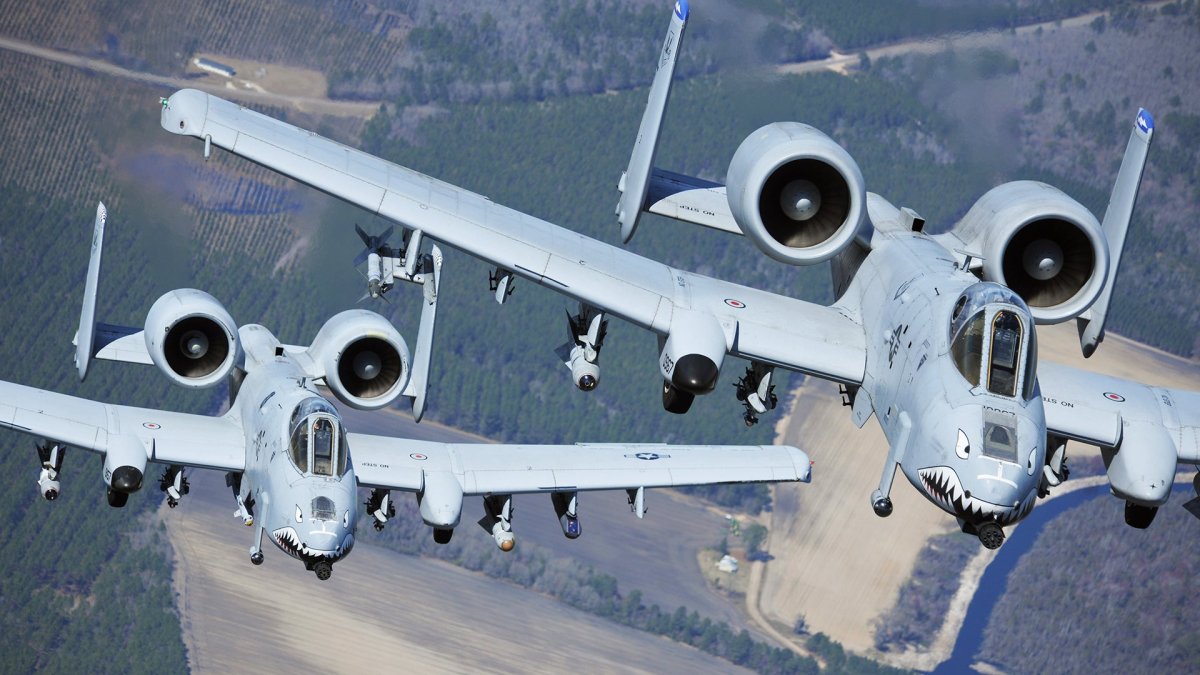
A heavily laden A-10., USAF
Schmidt found that there was tentative support for the rental idea from both the Air Force’s top leadership and the head of Air Combat Command (ACC), which controlled the bulk of the service’s combat-coded aircraft, including all of the active duty A-10s. “Regenerating a limited number of (about 12) A-10s for lease is feasible and does have benefits,” the bullet background paper noted. Unfortunately, there were significant bureaucratic hurdles in the way.
The most immediate issue was that ACC, perhaps surprisingly given its relationship with the low- and slow flying Warthogs, was not interested in giving up a squadron of its own aircraft to Colombia. With the straight-wing, twin-engine jets long out of production, Air Force officials asked about what was baking in the sun out at the famous boneyard at Davis-Monthan Air Force Base in Arizona.
What they heard back was that 198 A-10s were sitting the desert in various states of disrepair and none that were coded “XT” or “released for security assistance.” A total of 151 were set aside as parts sources to help sustain the Air Force and Air National Guard fleets, as well as any other project that might require Warthog parts. The other 47 were “XS” or in “inviolate storage.” Also known as Type 1000 storage, planes in this category are ready to return to duty with a minimum amount of effort. The Warthogs in this condition at the Boneyard were specifically on hand as a reserve in case there was a sudden need for replacement aircraft or a surge in demand for spare parts.
Still in relatively good shape and with most of their pieces still in place, they were also the best candidates for rehabilitation and transfer to Colombia. The Air Force’s top brass and ACC refused to commit to letting any of those aircraft out of storage until there was a clear understanding and commitment on the part of the Colombians with regards to “required configuration, timeline for modification]/delivery, sustainment and training requirements, funding mechanism, and guarantees the aircraft will be returned and placed back to XT status,” the backgrounder explained. The last stipulation appears to be a typo. The Air Force would almost undoubtedly have wanted the jets to go back into XS storage and not get a new XT status after coming back from their Latin American tour of duty.
In addition, the Air Force worried that the effort required to get these A-10s combat ready again would compete with separate upgrade work on its own Warthogs. At the time, the Aerospace Maintenance and Regeneration Center (AMARC) at Davis-Monthan – now known as the 309th Aerospace Maintenance and Regeneration Group (AMARG) – had the only facility with the necessary tooling to do depot-level maintenance on the jets.
The only way to adequately support both efforts would be to “incur exorbitant costs to set up new facility or expand AMARC capability,” the Air Force complained. It would already take between $7 and $8 million to just regenerate each aircraft bound for Colombia. In addition, someone would have to pay for other tasks such as training Colombian pilots to fly them and sustaining the planes in country.
An armored crop duster sprays herbicides in Colombia in 2003., DOS
On top of all that, there was one last impediment to the plan that no amount of money would have been able to solve. The Air Force was deathly worried about getting into a fight with the State Department, and not over export restrictions or human rights concerns – though American diplomats would certainly have needed to do a certain amount of finessing on both those issues.
No, the big problem was that in 2001, State had asked the Pentagon for 11 A-10s to support its own counter-narcotics programs in Latin America, including Colombia. Faced with many of the same dangers as the Colombian Air Force, the Department had similarly come to the conclusion that it needed more rugged planes to spray herbicides on illicit drug crops. The Bureau of International Narcotics and Law Enforcement Affairs, better known by its acronym INL, had already bought armored crop dusters and modified OV-10 Broncos that offered better protection against enemy fire. They had even considered purchasing armed versions to escort the spray aircraft. But the A-10 would have dramatically increased the capability of the Bureau’s Air Wing .
The Air Force balked at the idea, saying every one of the A-10s in the Boneyard was essential to maintaining its own fleet of aircraft. “Potential fight with DoS [Department of State] if A-10s are now released to Colombia as attack aircraft,” the background paper warned.
Ultimately, the service’s top leadership went back to Schmidt with at least two recommendations. The first one was that “regeneration and lease of about 12 A-10s is theoretically feasible but potentially comes with a high cost.” The other recommendation or recommendations are redacted. This is the only portion of the one-page document government censors blacked out.
A Colombian Air Force Super Tucano flies with two U.S. Air Force A-10s during Green Flag East in August 2016., USAF
We may never know what the other reasons were, or whether they argued for or against sending the A-10s to Colombia. We do know the lease plan never materialized. Instead, Colombia subsequently purchased a fleet of Embraer EMB 314 Super Tucano light attack aircraft. In 2013, The Washington Post reported that the Central Intelligence Agency and other members of the U.S. Intelligence Community were actively supporting Colombian targeted strikes against FARC leaders and other rebels. The project reportedly included integrating the GBU-12/B laser-guided bomb onto older Colombian A-37B Dragonfly light attack jets.
In general, these single-engine turboprops have become popular with small air forces around the world for surveillance and counterinsurgency missions, as well as basic training. The United States itself has facilitated their sale to Afghanistan and Lebanon and the Air Force is planning to include them in an experimental light attack fly-off later in 2017.
And in an interesting twist of fate, in August 2016, Colombian pilots brought some of their Super Tucanos to Barksdale Air Force Base in Louisiana to take part in a Green Flag East training exercise. During the practice sessions, they flew with Air Force A-10s from Moody Air Force Base. We don’t know if any of those Colombian aviators were aware of the discussions more than a decade earlier that might’ve had them flying the Warthogs themselves.
Contact the author: joe@thedrive.com
Comments couldn’t be loaded. Please refresh the page.
作者:约瑟夫·特雷维西克
更新于美国东部时间2020年7月5日晚上7:08
A-10“疣猪”攻击机最初服役时,其主要任务是随时准备摧毁成群的坦克,以应对苏联及其华沙条约盟国入侵西欧或朝鲜半岛爆发类似大规模冲突的情况。几十年后,在A-10执行了更广泛的近距离空中支援任务之后,美国空军开始研究向哥伦比亚租赁一批这种外形钝头的攻击机的可行性,这些战机原本计划用于打击哥伦比亚的左翼游击队和毒品走私分子。
2003年11月初,时任美国南方空军和第12航空队双职务的美国空军中将兰德尔·施密特前往哥伦比亚首都波哥大,会见了该国空军司令。会晤期间,哥伦比亚军官提出了租赁18架A-10攻击机,租期三至五年的事宜。
这位美国海军将领将信息转达给了他的上级。根据空军在接下来的三个月内就此问题撰写的一份背景资料,上级立即认定,无论其他任何因素如何,哥伦比亚目前都没有资格购买A-10攻击机。但他并未气馁,而是要求空军国际事务办公室调查这项请求的可行性。
关于此事的背景资料被五角大楼收录在一份资料包中,供时任参谋长联席会议副主席的美国海军陆战队上将彼得·佩斯在2004年2月出访前参考。佩斯此行将先前往位于佛罗里达州迈阿密的美国南方司令部总部,然后前往哥伦比亚,最后在返回途中抵达古巴关塔那摩湾。国防部应另一人根据《信息自由法》提出的申请,公布了全部文件,其中许多内容都经过了大量删减。这些记录现已在线公开。
当时,哥伦比亚仍深陷旷日持久的内战,交战双方是众多左翼叛军,其中最引人注目的是哥伦比亚革命武装力量(简称FARC)。此外,该国安全部队还要与趁乱在政府控制薄弱或无政府状态地区建立据点的贩毒集团作战。
21世纪初,为了支持政府打击这两个组织的行动,哥伦比亚空军主要依靠美国的A-37“蜻蜓”和OV-10“野马”轻型攻击机,以及以色列的“幼狮”战斗机。哥伦比亚还将一些老旧的C-47运输机升级为涡轮螺旋桨武装直升机,并将其命名为AC-47T“幽灵”(Fantasmas)。据报道,1993年,美国拒绝了哥伦比亚购买一批更大、性能更强的AC-130武装直升机的请求。这些武装直升机为哥伦比亚在偏远丛林地区的机动作战提供了额外的火力。
但哥伦比亚革命武装力量(FARC)叛军拥有包括大口径机枪在内的重型武器,并且正在想方设法获取单兵肩扛式地对空导弹。这些武器,加上崎岖的地形和茂密的植被(便于叛乱分子和犯罪分子的活动和营地藏匿),对哥伦比亚的飞机构成了重大威胁。久经沙场的A-10攻击机已经在科威特和伊拉克的上空久经考验,能够承受惊人的打击,并在茂密的丛林树冠中精准射击,因此对哥伦比亚来说无疑是一个受欢迎的补充。2003年3月,以美国为首的联军入侵伊拉克推翻萨达姆·侯赛因政权后,A-10再次成为美国重大军事行动中的明星。哥伦比亚空军官员无疑会看到关于A-10在中东地区表现的公开赞誉之词。
一架满载货物的A-10攻击机,美国空军
施密特发现,空军高层领导和空战司令部(ACC)司令都对租赁方案表示了初步支持。空战司令部控制着空军大部分作战飞机,包括所有现役的A-10攻击机。“租赁少量(约12架)A-10攻击机是可行的,而且确实有好处,”背景文件指出。然而,不幸的是,这一方案面临着诸多官僚障碍。
最紧迫的问题是,考虑到空军作战司令部(ACC)与低空慢速飞行的“疣猪”战机之间的密切关系,它似乎并不愿意将自己的一个中队飞机交给哥伦比亚。由于这种直翼双引擎喷气式飞机早已停产,空军官员开始询问位于亚利桑那州戴维斯-蒙森空军基地的著名飞机坟场里究竟有什么飞机在烈日下暴晒。
他们得到的答复是,有198架A-10攻击机停放在沙漠中,状况各异,没有一架被标记为“XT”或“已释放用于安全援助”。其中151架被预留作为零部件来源,用于维护空军和空中国民警卫队的机队,以及任何其他可能需要“疣猪”攻击机零部件的项目。其余47架被标记为“XS”或“处于不可破坏的存储状态”。这种存储方式也称为1000型存储,此类飞机只需极少的维护即可重新投入使用。停放在飞机坟场的这些处于这种状态的“疣猪”攻击机是专门作为后备力量准备的,以应对可能出现的飞机紧急更换或零部件需求激增的情况。
这些飞机状况相对良好,大部分部件也还在,因此也是最适合修复并移交给哥伦比亚的机型。背景资料解释说,空军高层和空军作战司令部拒绝承诺在哥伦比亚方面就“所需配置、改装/交付时间表、维护和训练要求、资金机制以及保证飞机归还并恢复XT状态”做出明确理解和承诺之前,将任何一架飞机从封存状态中释放出来。最后一项规定似乎是笔误。空军几乎肯定希望这些战机在结束拉丁美洲的任务后,能够恢复XS状态,而不是获得新的XT状态。
此外,空军还担心,让这些A-10战机重新投入作战所需的精力会与自身“疣猪”攻击机的升级工作产生冲突。当时,位于戴维斯-蒙森空军基地的航空航天维护与再生中心(AMARC,现为第309航空航天维护与再生大队AMARG)是唯一拥有必要工具进行A-10战机大修的机构。
空军抱怨说,要充分支持这两项工作,唯一的办法就是“投入巨资新建设施或扩建AMARC(飞机维护与修复中心)”。仅仅翻新每架飞往哥伦比亚的飞机就需要700万至800万美元。此外,还需要有人支付其他费用,例如培训哥伦比亚飞行员驾驶这些飞机以及在哥伦比亚境内维护这些飞机。
2003年,一架装甲农用飞机在哥伦比亚喷洒除草剂。(DOS)
除此之外,还有一个阻碍计划实施的最终障碍,无论投入多少资金都无法解决。空军极其担心与国务院发生冲突,而并非出于出口限制或人权方面的考虑——尽管美国外交官在这两个问题上肯定都需要进行一番周旋。
不,真正的问题在于,2001年,国务院曾向五角大楼申请11架A-10攻击机,以支持其在拉丁美洲(包括哥伦比亚)的禁毒项目。由于面临与哥伦比亚空军类似的诸多危险,国务院同样认为需要更坚固耐用的飞机来喷洒除草剂,以打击非法毒品作物。国际麻醉品和执法事务局(简称INL)此前已购置了装甲农用飞机和改装的OV-10“野马”攻击机,这些飞机能更好地抵御敌方火力。他们甚至考虑过购买武装版本来护航喷洒飞机。但A-10攻击机本可以极大地提升该局航空联队的作战能力。
空军对这一提议表示反对,称停放在飞机坟场的每一架A-10攻击机对于维持其自身机队至关重要。背景文件警告说:“如果现在将A-10交付给哥伦比亚用作攻击机,可能会与美国国务院发生冲突。”
最终,空军高层领导向施密特提出了至少两项建议。第一项建议是“理论上,更新和租赁大约12架A-10攻击机是可行的,但成本可能很高。”其他建议已被涂黑。这是这份仅有一页的文件中唯一被政府审查人员涂黑的部分。
2016年8月,在“绿旗东”军演期间,一架哥伦比亚空军的超级巨嘴鸟攻击机与两架美国空军的A-10攻击机一同飞行。
我们或许永远无法得知其他原因,也无法得知他们是否曾就向哥伦比亚派遣A-10攻击机进行过辩论。我们只知道租赁计划最终未能实现。哥伦比亚随后购买了一批巴西航空工业公司的EMB 314“超级巨嘴鸟”轻型攻击机。2013年,《华盛顿邮报》报道称,美国中央情报局和其他美国情报机构积极支持哥伦比亚对哥伦比亚革命武装力量(FARC)领导人和其他叛军成员进行定点打击。据报道,该项目包括将GBU-12/B激光制导炸弹集成到老旧的哥伦比亚A-37B“蜻蜓”轻型攻击机上。
总体而言,这些单引擎涡轮螺旋桨飞机因其在侦察、反叛乱任务以及基础训练方面的出色表现,已在全球小型空军中广受欢迎。美国自身也促成了向阿富汗和黎巴嫩出售此类飞机,并且美国空军计划在2017年晚些时候将其纳入轻型攻击机的试验性飞行测试中。
颇为巧合的是,2016年8月,哥伦比亚飞行员驾驶着他们的超级巨嘴鸟攻击机来到路易斯安那州的巴克斯代尔空军基地,参加“绿旗东部”联合军演。在训练期间,他们与来自穆迪空军基地的空军A-10攻击机进行了联合飞行。我们无从得知,这些哥伦比亚飞行员是否了解十多年前那些可能让他们有机会驾驶疣猪攻击机的讨论。
联系作者:joe@thedrive.com
评论加载失败,请刷新页面。