Pentagon will pick new US base location by June 2027, prioritizing 4 requirements五角大楼将于2027年6月前选定新的美国军事基地所在地,并优先考虑以下四项要求。
In an interview with Breaking Defense, Dale Marks, the assistant secretary of defense for Energy, Installations, and Environment, laid out new details on the effort.
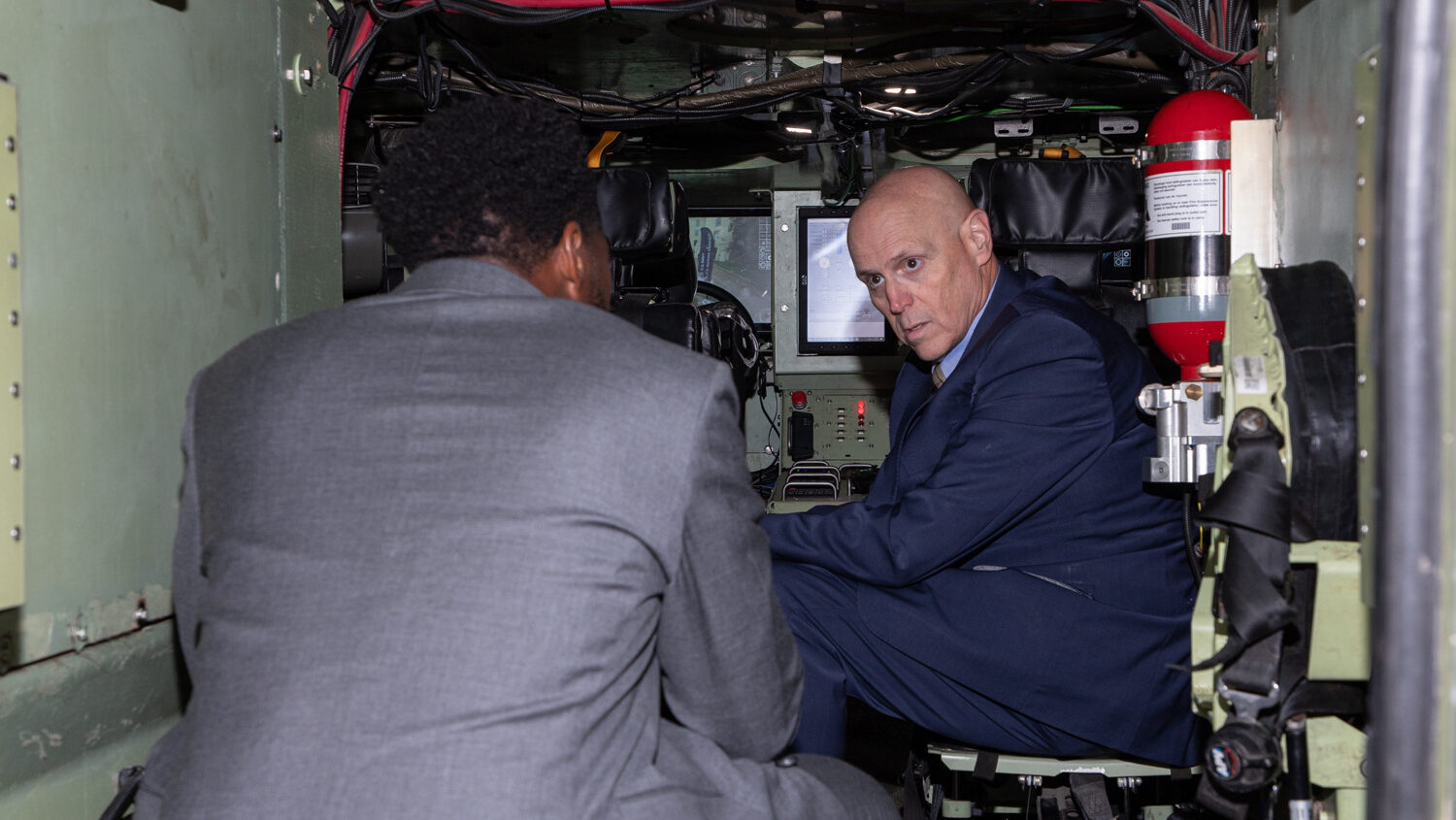
Assistant Secretary of Defense for Energy, Installations, and Environment Dale Marks reviews cutting-edge, operational energy innovations at OE-I's Energy Sentry - Pentagon expo. (Photo courtesy of DOD)
TAMPA, Fla. — The Pentagon wants to select a location for a new military base by June of next year based on four key metrics, and is asking states to submit their broad plans by Dec. 1, the senior official in charge of the effort told Breaking Defense this week.
“We talk about this as a base, but this is building a city,” Dale Marks, the assistant secretary of defense for Energy, Installations, and Environment, said during an interview on the sidelines of the Installation Innovation conference here this week.
His quest to find a home for this future base follows Defense Secretary Pete Hegseth’s late September announcement of a handful of new initiatives that involved tapping Marks to lead the effort to identify, evaluate, select, and prepare an “optimal site” for the installation.
“Rapid advancements in disruptive technologies, growing strategic alignment among peer adversaries, and persistent, sophisticated cyber intrusions against critical defense and homeland infrastructure necessitate a modernized, resilient posture,” Hegseth wrote in that initial memo kicking off the hunt. “To counter multi-domain threats and maintain strategic deterrence, the Department of War must rapidly establish a new, highly hardened joint military installation within the Homeland.”
Speaking from stage, Marks expanded on Hegseth’s remarks, pledging that the new base will focus on standing up “an entirely new operational formation … Think autonomous uncrewed strike wings, directed energy and counter drone brigades, hypersonic maneuvering units, and SI-driven joint operational task forces.”
The goal, Marks said in the interview, is make the bids and decision making process as public as possible to help alleviate any concerns that the Trump administration will favor a Republican-led state over one run by Democrats.
“There’s going to be a panel,” Marks said. “We’ve been told the president might be involved, but at this point, we’re just driving in a direction to get it to that selection criteria [in place].”
From requirements to readiness: Rethinking defense technology
As threats continue to evolve, speed will increasingly depend on what is already available when the need emerges.
So, what will go into that selection criteria? Based on comments Marks made during the interview, on stage and in an Oct. 22 letter sent out to the nation’s governors and adjutants general, there are four key factors that will matter the most.
First, the department is eyeing swaths of land within the 100,000 to 250,000 acre range, but that does not preclude consideration of “otherwise compelling offers” that may be smaller or larger, a detail he clarified in his letter to the state leaders.
Second, this new installation will need to be able to house and support 15,000 to 25,000 active service members and their families, or roughly 80,000 to 100,000 people. It will also need to support future formations with “autonomous mass” capabilities like those aforementioned drones and directed energy weapons.
Third, the future base is required to be self-sufficient with on-site, small modular nuclear reactors , hardened microgrids, and closed-loop water capture treatment and recycling systems that operate “indefinitely.”
“In our phased implementation roadmap, this base must demonstrate within its first 24 months that it can sustain 30 continuous days of full combat sorted generation, completely disconnected from the civilian grid and power supplies,” Marks told the audience. “If the continental United States experiences a catastrophic grid collapse, this installation will remain 100 percent operational, locked and loaded, ready to respond.”
Fourth, Marks wants states to pursue public-private partnerships in order to help with cost. Under that vision, the Defense Department could potentially fund things like the combat mission, power projection capabilities, subterranean command shelters, munitions bunkers, and tactical proving grounds, while commercial capital builds and operates the supporting digital infrastructure.
Marks did not offer a cost estimate for the program since a site has not been located, but he did tell Breaking Defense that the forthcoming 2028 budget request is expected to include a “wedge” to get the project up and running.
With these four broad pillars in place, state leaders have until Dec. 1 to submit site nominations. Marks and his team will then begin talking with the nominees about their concepts, helping flesh them out and examining the pros and cons of each location — down to small details.
“Some of these concepts, by the way… are ideas like where the fence lives. Maybe the fence is a fence. Maybe the fence isn’t a fence,” he told Breaking Defense. “Do I build houses or not build houses? Maybe the answer is the community, as part of their public-private partnership with us, says that they build the support infrastructure for us. Maybe they have hospitals that they want to use, or they’re going to build in the schools.”
Breaking Defense Video
How General Atomics views Europe’s unmanned future
A more flexible way to defend maneuver forces from drones that doesn’t tie them down [Sponsored]
What’s haunting the Pentagon this Halloween?
The new must-have capabilities for drones [Sponsored]
Army’s tech chief talks autonomy, acquisition and the future of drones
Drones take over AUSA, plus the Army’s plan to bring in new vendors
Hegseth talks autonomy at AUSA, a key show focus
Army doubles down on autonomy, stakes out Indo-Pacific role: AUSA Day 2
Telle talks ‘manufacturing rodeo,’ supply chain ‘weak links’: AUSA Day 1
New leaders, new drone command: What we expect from AUSA 2026
美国国防部负责能源、设施和环境事务的助理部长戴尔·马克斯在OE-I举办的“能源哨兵——五角大楼博览会”上检阅了尖端的能源创新技术。(图片由美国国防部提供)
佛罗里达州坦帕市——负责这项工作的高级官员本周告诉《防务新闻》,五角大楼希望在明年 6 月之前根据四项关键指标选定一个新的军事基地的地点,并要求各州在 12 月 1 日之前提交他们的总体计划。
“我们把它看作一个基地,但实际上这是在建设一座城市,”国防部负责能源、设施和环境的助理部长戴尔·马克斯本周在参加这里举行的设施创新会议期间接受采访时说。
在国防部长皮特·赫格塞斯 (Pete Hegseth) 于 9 月下旬宣布了一系列新举措之后,马克斯 (Marks) 开始寻求为这个未来的基地找到合适的地点。这些举措包括任命马克斯领导确定、评估、选择和准备该设施的“最佳地点”的工作。
“颠覆性技术的飞速发展、势均力敌的对手之间日益增强的战略联盟,以及针对关键国防和国土基础设施的持续而复杂的网络入侵,都要求我们建立现代化、高韧性的防御体系,”赫格塞斯在启动这项行动的最初备忘录中写道。“为了应对多域威胁并维持战略威慑,美国战争部必须在国土范围内迅速建立一个全新的、高度加固的联合军事设施。”
马克思在台上发表讲话,进一步阐述了赫格塞斯的讲话,承诺新基地将专注于组建“一个全新的作战编队……想想看,自主无人打击联队、定向能和反无人机旅、高超音速机动部队以及由智能系统驱动的联合作战特遣部队。”
马克思在采访中表示,目标是尽可能公开竞标和决策过程,以帮助消除人们对特朗普政府会偏袒共和党领导的州而不是民主党领导的州的任何担忧。
“将会成立一个评审小组,”马克思说。“我们听说总统可能会参与其中,但目前,我们只是朝着制定遴选标准的方向努力。”
从需求到战备:重新思考国防技术
随着威胁不断演变,速度将越来越取决于在需要出现时已有的资源。
那么,遴选标准会包含哪些内容呢?根据马克在面试、台上以及10月22日致全国各州州长和副州长的信中所作的评论,有四个关键因素最为重要。
首先,该部门正在关注面积在 10 万至 25 万英亩之间的大片土地,但这并不排除考虑面积更小或更大的“其他有吸引力报价”,他在给州领导人的信中澄清了这一细节。
其次,这座新设施需要能够容纳和支持15000至25000名现役军人及其家属,约合80000至100000人。它还需要支持未来具备“自主大规模”作战能力的部队,例如前文提到的无人机和定向能武器。
第三,未来的基地需要具备自给自足的能力,配备现场小型模块化核反应堆、加固型微电网以及闭环水收集处理和回收系统,这些系统能够“无限期”运行。
“根据我们的分阶段实施路线图,该基地必须在建成后的前24个月内证明,它能够在完全脱离民用电网和电力供应的情况下,持续30天维持完整的战时电力供应,”马克思告诉听众。“如果美国本土发生灾难性的电网崩溃,该基地将保持100%的运行状态,随时准备应对。”
第四,马克思希望各州推行公私合作模式,以帮助降低成本。按照这种设想,国防部可以资助作战任务、力量投送能力、地下指挥所、弹药库和战术试验场等项目,而商业资本则负责建设和运营配套的数字基础设施。
由于尚未找到合适的地点,马克斯没有提供该项目的成本估算,但他告诉《防务新闻》,即将提交的 2028 年预算申请预计将包含一笔“专项资金”,以使该项目得以启动和运行。
有了这四大支柱,各州领导人需要在12月1日前提交选址提名。之后,马克思和他的团队将开始与被提名者讨论他们的构想,帮助他们完善构想,并仔细审查每个地点的优缺点——甚至细致到小细节。
“顺便说一句,这些概念中有些……就像围栏的用途一样。也许围栏就是围栏,也许它不是围栏,”他告诉《防务新闻》。“我到底要不要建房子?也许答案在于社区,作为与我们公私合作的一部分,他们表示会为我们建设配套基础设施。也许他们想利用现有的医院,或者他们打算在学校里建房子。”
突破性防御视频
通用原子公司如何看待欧洲的无人化未来
一种更灵活的防御机动部队免受无人机攻击的方式,不会限制其行动[赞助]
今年万圣节,五角大楼究竟闹鬼?
无人机必备的新功能 [赞助内容]
陆军技术主管谈无人机的自主性、采购和未来
无人机主导了美国陆军协会(AUSA)的会议,此外,陆军还计划引入新的供应商。
Hegseth 在 AUSA 大会上谈到了自主性,这是本次大会的一个重点议题。
陆军加倍强调自主性,明确印太地区角色:AUSA第二天
特勒谈“制造业乱象”、供应链“薄弱环节”:AUSA第一天
新领导人,新无人机指挥部:我们对 AUSA 2026 的期待