After Vucic ouster, Serbia’s weapons-buying habits are under the microscope武契奇下台后,塞尔维亚的武器采购习惯正受到密切关注。
One of Europe’s key arms purchasers, Serbia, is likely to slow down procurement and investigate the probity of recent buys after a student-led protest movement ousted the country’s long-time strongman leader in a surprise election win on Sunday.
Share on Facebook (Opens in new window) Facebook
Share on X (Opens in new window) X
Share on Bluesky (Opens in new window) Bluesky
Share on Reddit (Opens in new window) Reddit
Share on LinkedIn (Opens in new window) LinkedIn
Share using Native tools Share Copied to clipboard
Share on Mail (Opens in new window) Mail
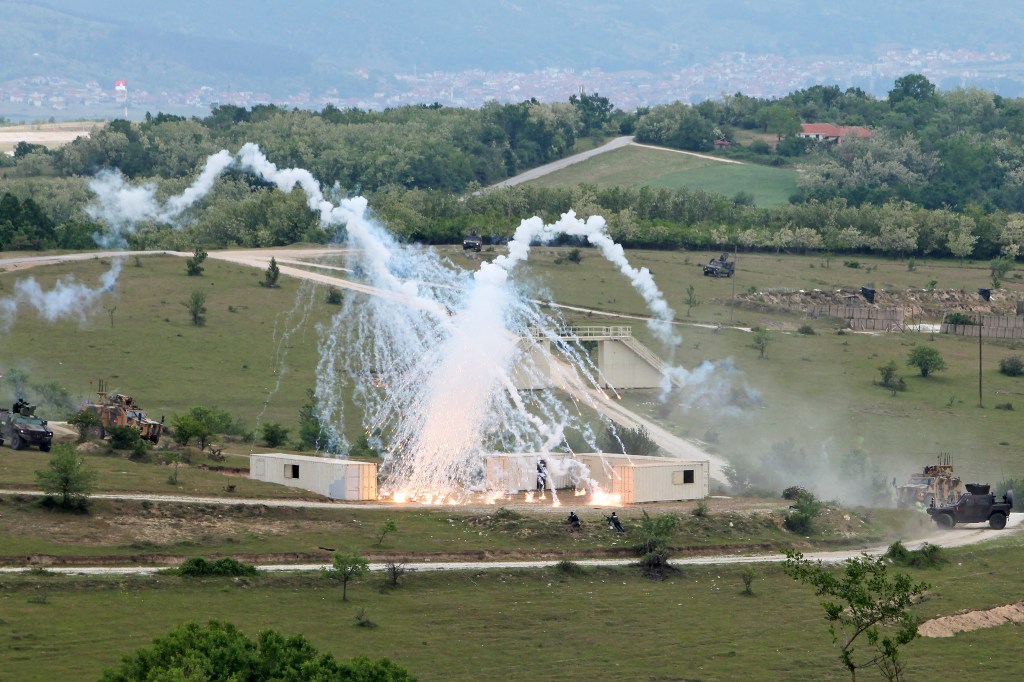
Smoke rises from a military device as soldiers take part in the joint “NATO-Serbia” military exercise at a training ground near Bujanovac in southern Serbia on May 22, 2026. (Sasa Djordjevic / AFP via Getty Images)
BELGRADE, Serbia — One of Europe’s key arms purchasers, Serbia, is likely to slow down procurement and investigate the probity of recent buys after a student-led protest movement ousted the country’s long-time strongman leader in a surprise election win on Sunday.
A group formed by students to battle alleged corruption in Serbia trounced Aleksandar Vucic at the polls by half a million votes, signaling exasperation with Vucic’s 12-year, increasingly authoritarian rule.
Vucic sought to punch above his weight on the international stage by playing Russia off against the European Union by seeking EU membership and supplying arms to Ukraine, but also refusing to apply sanctions against Russia.
He also acted as a bridgehead into the Balkans for China, signing major infrastructure deals with Chinese firms.
Vucic accompanied his outreach to Europe and China with large arms purchases, including buying 12 Rafale jets from France and FK-3 and HQ-17A air defense systems as well as CH-92 and CH-95 drones from Beijing .
Serbia also purchased Hermes drones from Israel and struck a deal with Elbit to assemble drones in Serbia.
According to SIPRI, Serbia spent around 1.12 billion euros on arms procurement in 2025 and nearly 3.65 billion euros in the period 2021-25.
Russian President Vladimir Putin (R) walks with Serbian President Aleksandar Vucic for a meeting at the Diaoyutai State Guesthouse in Beijing on Sept. 2, 2025. (Maxim Shemetov/POOL/AFP via Getty Images)
In January, Vucic announced he would double Serbia’s military capabilities within 18 months.
But on Sunday, he was voted out of office after students put up their university professors as candidates in a national election, forging a political party with huge support but no named leader.
Katarina Djokic, a researcher at SIPRI, told Defense News the new government would stay busy in the short term focusing on expunging Vucic’s firm grip on business and politics at home, with defense pushed further down the to-do list.
“The new government will have other priorities — prominently, delivering on anti-corruption policies and reestablishing functioning political institutions, which will be challenging enough. Under such conditions, there could be less resources and less political consensus for major defense projects,” she said.
“What could reasonably be expected is a slowdown in armament expenditures in the couple of years to come,” she added.
Djokic noted that the Student List’s manifesto talks of continuing to develop its layered air defense and modernizing Serbia’s air force, but she pointed to a stress on improving the lot of personnel, with a pay rise promised.
The manifesto talks of remedying a “scarcity of qualified personnel.”
The document also says an inquiry will be set up to pore over the paperwork of Vucic’s arms accords looking for corrupt deals.
“A new commission is being formed – an independent, interdepartmental government commission for irregularities, abuses and corruption in the production, procurement and export of weapons, as part of a general audit of the previous regime’s contracts,” it states.
The manifesto adds, “We will modernize defense industry factories and turn them into smart factories, establish a National Center for Military Electronics in cooperation with technical faculties, and launch a defense software program.”
The new government may not be so well disposed to defense deals with Israel. In the manifesto’s section on foreign policy it states, “We will not be complicit in the systematic attempt to destroy the Palestinian people that Israel is carrying out in the Gaza Strip.”
Vucic was adept at linking his arms build-up to tensions with neighboring Kosovo , which was formerly a part of Serbia and never acknowledged as an independent state by Serbia.
“Depending on the new government’s regional relations, there may be less incentive to use regional tensions and “arms races” as a pretext for ordering more arms, and more advanced arms,” said Djokic.
The Student List’s manifesto does however suggests the new government will keep up demands that Kosovo is reintegrated into Serbia.
“We will fight for the preservation of Kosovo … as part of Serbia,” it states.
Tom Kington is the Italy correspondent for Defense News.
分享至 Facebook(在新窗口中打开) Facebook
分享至 X(在新窗口中打开)X
在 Bluesky 上分享(在新窗口中打开)Bluesky
分享到 Reddit(在新窗口中打开)
在领英上分享(在新窗口中打开)领英
使用原生工具分享 已复制到剪贴板
分享至邮件(在新窗口中打开)邮件
2026年5月22日,在塞尔维亚南部布亚诺瓦茨附近的一个训练场,士兵们参加“北约-塞尔维亚”联合军事演习,一枚军用装置冒出浓烟。(Sasa Djordjevic / AFP via Getty Images)
塞尔维亚贝尔格莱德——塞尔维亚是欧洲主要的武器购买国之一,在学生领导的抗议运动于周日意外赢得选举,推翻了该国长期强人领导人之后,塞尔维亚可能会放慢采购速度,并调查最近购买武器的合法性。
一个由学生组成的、旨在对抗塞尔维亚腐败的团体在选举中以 50 万张选票的优势击败了亚历山大·武契奇,这表明人们对武契奇 12 年来日益专制的统治感到愤怒。
武契奇试图在国际舞台上发挥超出自身实力的作用,他通过寻求加入欧盟和向乌克兰提供武器来挑拨俄罗斯与欧盟之间的关系,但同时又拒绝对俄罗斯实施制裁。
他还充当了中国进入巴尔干地区的桥头堡,与中国企业签署了多项重大基础设施协议。
武契奇在与欧洲和中国接触的同时,还进行了大规模的武器采购,包括从法国购买 12 架阵风战斗机,以及从北京购买 FK-3 和 HQ-17A 防空系统以及 CH-92 和 CH-95 无人机。
塞尔维亚还从以色列购买了 Hermes 无人机,并与 Elbit 达成协议,在塞尔维亚组装无人机。
根据斯德哥尔摩国际和平研究所 (SIPRI) 的数据,塞尔维亚在 2025 年的武器采购支出约为 11.2 亿欧元,在 2021-2025 年期间的支出接近 36.5 亿欧元。
2025年9月2日,俄罗斯总统弗拉基米尔·普京(右)与塞尔维亚总统亚历山大·武契奇在北京钓鱼台国宾馆举行会晤。(图片来源:Maxim Shemetov/POOL/AFP via Getty Images)
今年1月,武契奇宣布他将在18个月内将塞尔维亚的军事能力提高一倍。
但周日,学生们推举他们的大学教授作为候选人参加全国选举,组建了一个拥有巨大支持但没有指定领导人的政党,他因此被选下台。
斯德哥尔摩国际和平研究所 (SIPRI) 的研究员 Katarina Djokic 告诉《防务新闻》,新政府短期内将忙于消除武契奇对国内商业和政治的牢固控制,而国防事务则被进一步推迟到待办事项清单的后面。
她表示:“新政府将有其他优先事项——其中最重要的是落实反腐败政策和重建运转良好的政治机构,这本身就极具挑战性。在这种情况下,用于重大国防项目的资源和政治共识可能会减少。”
她补充说:“可以合理预期的是,未来几年军备支出将会放缓。”
乔基奇指出,学生名单的宣言谈到要继续发展其多层次的防空体系,并使塞尔维亚空军现代化,但她也指出,宣言强调要改善人员待遇,并承诺加薪。
该宣言谈到要解决“合格人员短缺”的问题。
该文件还指出,将成立一个调查组,仔细审查武契奇的军火协议文件,以查找腐败交易。
“一个新的委员会正在组建——一个独立的、跨部门的政府委员会,负责调查武器生产、采购和出口过程中的违规行为、滥用职权行为和腐败行为,这是对前政权合同进行全面审计的一部分,”声明中写道。
该宣言还补充道:“我们将对国防工业工厂进行现代化改造,使其成为智能工厂,与各技术院系合作建立国家军事电子中心,并启动国防软件计划。”
新政府可能不太愿意与以色列达成防务协议。在其竞选宣言的外交政策部分,声明指出:“我们绝不会参与以色列在加沙地带实施的旨在系统性摧毁巴勒斯坦人民的行径。”
武契奇善于将他的军备竞赛与邻国科索沃的紧张局势联系起来,科索沃以前是塞尔维亚的一部分,但从未被塞尔维亚承认为独立国家。
乔基奇表示:“根据新政府的地区关系,可能会减少利用地区紧张局势和‘军备竞赛’作为借口来订购更多武器和更先进武器的动机。”
但学生名单的宣言确实表明,新政府将继续要求科索沃重新并入塞尔维亚。
“我们将为保全科索沃……作为塞尔维亚的一部分而战,”声明中写道。
汤姆·金顿是《防务新闻》驻意大利记者。