Army’s MV-75 production award could slip due to CR, raising program costs: Textron德事隆公司:由于持续拨款法案(CR),陆军MV-75的生产合同可能会被推迟,从而增加项目成本。
Bell Textron executives warned that a delay in the helicopter’s first low-rate production contract could increase the program’s expected financial hit to as much as $150 million.
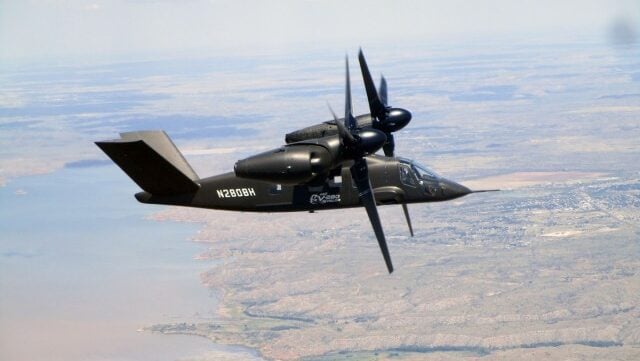
The U.S. Army announced today that its next-generation multi-role vertical lift aircraft, the MV-75 Future Long Range Assault Aircraft, will carry the Native American name “Cheyenne II”. (U.S. Army photo)
WASHINGTON — Uncertainty over federal funding could delay the Army’s first low-rate initial production (LRIP) contract for the MV-75 Cheyenne II helicopter, which would lead to an increase of as much as $150 million , Textron executives said today.
“With the start of the fiscal year in a [continuing resolution], we’d expect a possible push in the timing of the LRIP award. Previously, we were thinking Q4 into Q1 of next year,” Chief Financial Officer David Rosenberg told investors this morning during an earnings call.
A delay could exacerbate the financial hit Bell Textron already expects to take on the MV-75 program. In the previous quarter, the company estimated that funding delays would cost $60 million to $110 million. If the LRIP contract is pushed back even more, that figure could rise to $110 million to $150 million, Rosenberg said.
Bell was selected as the prime contractor for the MV-75 Cheyenne II helicopter in late 2022. Developed under the Arm’s Future Long Range Assault Aircraft (FLRAA) program, the Cheyenne is a tiltrotor aircraft expected to gradually replace the service’s UH-60 Black Hawk fleet once fielded in the 2030s.
The potential delay comes after the Army exhausted nearly all of its available fiscal 2026 funding for the MV-75 in July, according to Textron’s quarterly filing . The company continued work on the program while reducing spending to manage the funding shortfall.
In July, the Army requested to shift $350 million in funding to the MV-75 program to support Textron’s work building and testing eight prototype helicopters.
Congress approved that reprogramming request during the third quarter, Textron CEO Lisa Atherton said during the earnings call. About $300 million of that money was committed to the program in contract changes, covering costs Bell and its suppliers had already incurred.
Processor upgrades enable computing at the edge
Avoiding vendor lock and providing more room for sensors and upgrades are critical considerations.
“The $350 [million] was the request of the estimate of what the government expected that we would need throughout the third quarter,” Atherton told investors. “The government was able to quickly put on contract [modifications] the $300 [million] to cover the actuals that we and our suppliers had accrued. … As supplier invoices continue to trickle in through this month and next month, we will continue to obligate against that.”
Bell Textron recorded a financial hit on the MV-75 in the second quarter of FY26 due to funding delays that increased the program’s expected costs, Rosenberg said. Although Congress approved the Army’s reprogramming request, the company has not been able to recover that loss as it must wait for the government to officially add the funding to its contracts before it can reassess the earlier losses, he said.
“As timing continues to progress and the remaining contract [modifications] take place, we will then be able to take a look at previous charges,” Rosenberg added.
Federal budget uncertainty could continue to affect the program into 2027, as the government operates a CR while lawmakers work to approve a full-year defense spending bill.
Atherton said the proposed FY27 budget includes about $2.3 billion for the MV-75, though that funding still requires congressional approval.
Meanwhile, Bell Textron continues to work on the MV-75 aircraft ahead of flight testing next year. The company has so far completed three wings, received its first nacelles and built the first fuselage, while gearboxes have advanced into testing, Atherton said. The company expects to join the first fuselage with its wing assembly in the fourth quarter, she added.
Breaking Defense Video
How General Atomics views Europe’s unmanned future
A more flexible way to defend maneuver forces from drones that doesn’t tie them down [Sponsored]
What’s haunting the Pentagon this Halloween?
The new must-have capabilities for drones [Sponsored]
Army’s tech chief talks autonomy, acquisition and the future of drones
Drones take over AUSA, plus the Army’s plan to bring in new vendors
Hegseth talks autonomy at AUSA, a key show focus
Army doubles down on autonomy, stakes out Indo-Pacific role: AUSA Day 2
Telle talks ‘manufacturing rodeo,’ supply chain ‘weak links’: AUSA Day 1
New leaders, new drone command: What we expect from AUSA 2026
美国陆军今天宣布,其下一代多用途垂直起降飞机MV-75未来远程突击飞机将采用美洲原住民语言“夏延二号”(Cheyenne II)命名。(美国陆军照片)
华盛顿——德事隆公司高管今天表示,联邦资金的不确定性可能会推迟陆军首个MV-75“夏延II”直升机低速初始生产(LRIP)合同,这将导致成本增加高达1.5亿美元。
“由于本财年是在[持续拨款决议]中开始的,我们预计长期优先投资计划(LRIP)的授予时间可能会提前。此前,我们预计会在第四季度提前到明年第一季度,”首席财务官大卫·罗森伯格今天上午在财报电话会议上告诉投资者。
延期可能会加剧贝尔德事隆公司预计因MV-75项目而遭受的财务损失。该公司上一季度估计,资金延期将造成6000万至1.1亿美元的损失。罗森伯格表示,如果低速初始生产(LRIP)合同进一步延期,损失金额可能上升至1.1亿至1.5亿美元。
2022 年末,贝尔公司被选为 MV-75 Cheyenne II 直升机的主承包商。Cheyenne 是根据美国陆军未来远程突击飞机 (FLRAA) 计划开发的倾转旋翼机,预计将在 2030 年代部署后逐步取代美国陆军的 UH-60 黑鹰机队。
根据德事隆公司提交的季度报告,此次潜在的延期是由于陆军在7月份几乎耗尽了2026财年MV-75项目的全部可用资金。该公司在削减开支以应对资金缺口的同时,仍在继续推进该项目。
7 月,陆军请求将 3.5 亿美元的资金转移到 MV-75 项目,以支持德事隆公司建造和测试八架原型直升机的工作。
德事隆首席执行官丽莎·阿瑟顿在财报电话会议上表示,国会已于第三季度批准了这项重新编程请求。其中约3亿美元已通过合同变更投入该项目,用于支付贝尔及其供应商此前已产生的费用。
处理器升级使边缘计算成为可能
避免厂商锁定,并为传感器和升级留出更多空间是至关重要的考虑因素。
阿瑟顿告诉投资者:“这3.5亿美元是政府根据我们预计第三季度所需资金估算而提出的。政府迅速修改了合同,将这3亿美元用于支付我们和供应商实际产生的费用。……随着供应商的发票在本月和下个月陆续到账,我们将继续履行相应的付款义务。”
罗森伯格表示,由于资金延迟到位,MV-75项目预计成本增加,贝尔德事隆公司在2026财年第二季度因此遭受了财务损失。他指出,尽管国会已批准陆军的重新拨款请求,但该公司仍无法弥补这笔损失,因为必须等待政府正式将资金添加到合同中,才能重新评估之前的损失。
罗森伯格补充说:“随着时间推移和剩余合同(修改)的完成,我们将能够查看之前的指控。”
联邦预算的不确定性可能会持续影响该计划直至 2027 年,因为政府在立法者努力批准全年国防开支法案的同时,仍在运行一项持续拨款法案。
阿瑟顿表示,拟议的 2027 财年预算包括约 23 亿美元用于 MV-75 项目,但这笔资金仍需国会批准。
与此同时,贝尔德事隆公司正继续推进MV-75飞机的研发工作,为明年的飞行测试做准备。阿瑟顿表示,该公司目前已完成三架机翼的制造,接收了首批发动机短舱,并完成了首个机身的组装,变速箱的测试工作也已进入后期阶段。她补充说,该公司预计将在第四季度完成首个机身与机翼组件的组装。
突破性防御视频
通用原子公司如何看待欧洲的无人化未来
一种更灵活的防御机动部队免受无人机攻击的方式,不会限制其行动[赞助]
今年万圣节,五角大楼究竟被什么鬼魂萦绕?
无人机必备的新功能 [赞助内容]
陆军技术主管谈无人机的自主性、采购和未来
无人机主导了美国陆军协会(AUSA)的会议,此外,陆军还计划引入新的供应商。
Hegseth 在 AUSA 大会上谈到了自主性,这是本次大会的一个重点议题。
陆军加倍强调自主性,明确印太地区角色:AUSA第二天
特勒谈“制造业乱象”、供应链“薄弱环节”:AUSA第一天
新领导人,新无人机指挥部:我们对 AUSA 2026 的期待