At pivotal summit, Canadian-European security cooperation is a central focus在这次关键峰会上,加欧安全合作是中心议题。
The proposed measures would advance a broader strategic partnership that calls for Canada and Europe to assume greater responsibility for shared security while reinforcing NATO.
Share on Facebook (Opens in new window) Facebook
Share on X (Opens in new window) X
Share on Bluesky (Opens in new window) Bluesky
Share on Reddit (Opens in new window) Reddit
Share on LinkedIn (Opens in new window) LinkedIn
Share using Native tools Share Copied to clipboard
Share on Mail (Opens in new window) Mail
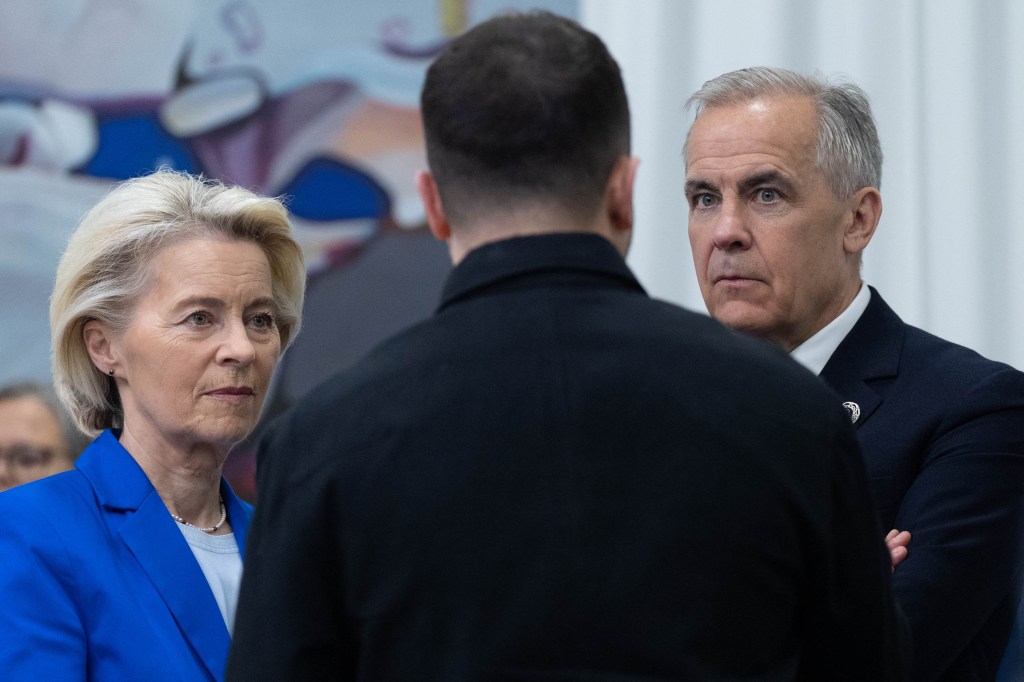
President of the European Commission Ursula von der Leyen (L) and Canadian Prime Minister Mark Carney (R) speak with Ukrainian President Volodymyr Zelensky during a Ukraine multi-lateral meeting in Yerevan, Armenia, on May 4, 2026. (Stefan Rousseau / POOL / AFP via Getty Images)
VIENNA — Canada and the European Union plan to deepen cooperation on satellite services, Arctic maritime capabilities and critical materials for defense industries at a two-day summit in Montreal that began on Thursday, according to a draft joint statement.
The proposed measures would advance a broader strategic partnership that calls for Canada and Europe to assume greater responsibility for shared security while reinforcing NATO. The draft , first reported by Politico, does not announce new troop deployments or weapons purchases.
Under the current wording, Canada is promised negotiations for access to services from Europe’s Galileo satellite constellation, as well as exploring Canadian participation in the European IRIS² satellite communications project.
Canada’s vast natural resources appear to be of particular interest to Brussels, with an entire section dedicated to energy and critical raw materials. The draft proposes exploring stockpiling of critical resources needed by civilian and defense industries to cushion supply chains against market fluctuations and geopolitical disruption.
There’s already some dissonance about some specific wording. In mid-September, European Commission President Ursula von der Leyen announced her plan to make Canada the EU’s first “associate member” – to the surprise of some European capitals. Now, the draft joint document for the ongoing summit has removed this language, speaking instead of an “ever-closer association of Canada to the EU, short of full membership itself.”
Canada is choosing not to get caught up in the war of terminology, with Politico quoting Carney as saying that “the good news is it doesn’t matter about specific names or nomenclature.”
Two key unifiers have driven Europe and Canada closer together: Russia’s war against Ukraine, and U.S. President Donald Trump. Canada launched Operation Reassurance in 2014 following Russia’s invasion of Ukraine and has led NATO’s multinational battle group in Latvia since 2017. Cooperation and coordination deepened further after Russia’s full-scale invasion of Ukraine in 2022.
Trump’s threats against NATO, Europe and Canadian sovereignty alike have accelerated the integration process. Particularly the Arctic has emerged as an area of interest. In February, Canada and Denmark signed a memorandum on defense cooperation amid Trump’s insistence that Greenland become a part of the United States, having threatened military force. Pointedly, the agreement with Ottawa was signed with Danish, Greenlandic and Faroese delegates present. It covered innovation, industrial cooperation, mutual logistics support, personnel, training and exercises.
And in March, Canada, Denmark, Finland, Iceland, Norway and Sweden held a summit in Oslo that laid the cornerstone for an Arctic-centric, security-focused format and concrete actions to secure an area that these countries increasingly perceive as a zone of joint security interests, especially vis-à-vis Russia and, to a lesser extent, China.
Finland and Norway also separately signed Arctic security-themed agreements with Canada in April and March, respectively, covering intelligence sharing, interoperability, logistics and maritime topics like the building of icebreakers, among other topics.
In July, Canada announced its intention to buy up to twelve new German-Norwegian submarines, preferring the European boats over a South Korean offer, just a few weeks after Ottawa singled out Sweden’s Saab as the preferred candidate to supply it with six new airborne early warning and control aircraft.
Around the same time, Canada secured preferential access to procurement under the EU’s Security Action for Europe (SAFE) defense-financing program, allowing Canadian-origin components to account for up to 80% of the procurement value of equipment purchased with its loans.
Linus Höller is Defense News’ Europe correspondent and OSINT investigator. He reports on the arms deals, sanctions, and geopolitics shaping Europe and the world. He holds master’s degrees in WMD nonproliferation, terrorism studies, and international relations, and works in four languages: English, German, Russian, and Spanish.
分享至 Facebook(在新窗口中打开) Facebook
分享至 X(在新窗口中打开)X
在 Bluesky 上分享(在新窗口中打开)Bluesky
分享到 Reddit(在新窗口中打开)
在领英上分享(在新窗口中打开)领英
使用原生工具分享 已复制到剪贴板
分享至邮件(在新窗口中打开)邮件
2026年5月4日,在亚美尼亚首都埃里温举行的乌克兰多边会议上,欧盟委员会主席乌尔苏拉·冯德莱恩(左)和加拿大总理马克·卡尼(右)与乌克兰总统弗拉基米尔·泽连斯基交谈。(图片来源:Stefan Rousseau / POOL / AFP via Getty Images)
维也纳——根据一份联合声明草案,加拿大和欧盟计划在周四于蒙特利尔举行的为期两天的峰会上,深化在卫星服务、北极海上能力和国防工业关键材料方面的合作。
拟议措施旨在推进更广泛的战略伙伴关系,呼吁加拿大和欧洲承担更多维护共同安全的责任,同时加强北约。据Politico网站率先报道,该草案并未宣布新的部队部署或武器采购计划。
根据目前的措辞,加拿大将获得与欧洲伽利略卫星星座就接入服务进行谈判的机会,并探索加拿大参与欧洲 IRIS² 卫星通信项目的可能性。
加拿大丰富的自然资源似乎引起了布鲁塞尔的特别关注,草案专门用一个章节讨论了能源和关键原材料。草案提议探讨储备民用和国防工业所需的关键资源,以缓冲供应链免受市场波动和地缘政治动荡的影响。
一些措辞已经引发了一些争议。9月中旬,欧盟委员会主席乌尔苏拉·冯德莱恩宣布了她让加拿大成为欧盟首个“联系成员国”的计划——这令一些欧洲国家的首都感到惊讶。如今,正在举行的峰会的联合文件草案删除了这一措辞,取而代之的是“加拿大与欧盟建立日益紧密的联系,但尚未成为正式成员国”。
加拿大选择不卷入这场术语之争,《政治报》援引卡尼的话说,“好消息是,具体的名称或术语并不重要。”
促使欧洲和加拿大走得更近的两个关键因素是:俄罗斯对乌克兰的战争以及美国总统唐纳德·特朗普。2014年俄罗斯入侵乌克兰后,加拿大发起了“安心行动”,并自2017年起领导北约驻拉脱维亚多国战斗群。2022年俄罗斯全面入侵乌克兰后,双方的合作与协调进一步深化。
特朗普对北约、欧洲和加拿大主权的威胁加速了一体化进程。北极地区尤其成为各方关注的焦点。今年2月,在特朗普坚持要求格陵兰岛并入美国、甚至威胁动用武力之际,加拿大和丹麦签署了一份防务合作备忘录。值得注意的是,这份与渥太华签署的协议有丹麦、格陵兰和法罗群岛的代表在场。协议内容涵盖创新、产业合作、相互后勤支持、人员配备、培训和演习等领域。
今年 3 月,加拿大、丹麦、芬兰、冰岛、挪威和瑞典在奥斯陆举行峰会,为以北极为中心、以安全为重点的模式奠定了基础,并制定了具体行动来确保该地区的安全。这些国家越来越将该地区视为共同安全利益区,特别是针对俄罗斯,以及在较小程度上针对中国。
芬兰和挪威也分别于 4 月和 3 月与加拿大签署了以北极安全为主题的协议,涵盖情报共享、互操作性、后勤和海事主题(如建造破冰船等)。
7 月,加拿大宣布计划购买多达 12 艘新的德挪联合研制的潜艇,比起韩国的报价,更倾向于欧洲潜艇。而就在几周前,渥太华还选定瑞典萨博公司作为为其提供 6 架新型空中预警和控制飞机的首选供应商。
大约在同一时期,加拿大获得了欧盟“欧洲安全行动”(SAFE)国防融资计划下的优先采购权,允许加拿大制造的零部件占使用其贷款购买的设备采购价值的 80%。
林努斯·霍勒是《防务新闻》的欧洲记者和开源情报调查员。他报道影响欧洲乃至全球的军火交易、制裁和地缘政治。他拥有大规模杀伤性武器不扩散、恐怖主义研究和国际关系三个硕士学位,并精通英语、德语、俄语和西班牙语四种语言。