Army pilots are trying virtual reality to stay more alert in flight陆军飞行员正在尝试利用虚拟现实技术来提高飞行中的警觉性。
The 101st Combat Aviation Brigade is testing the NeuroTrainer as a possible readiness tool for their aviators.
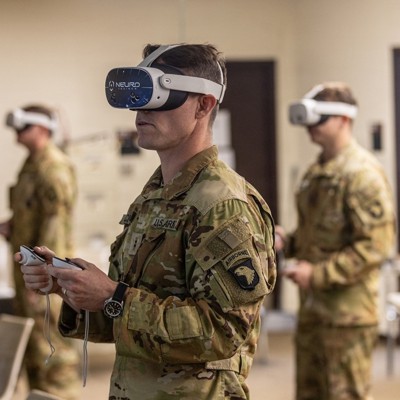
A U.S. soldier uses the NeuroTrainer virtual reality training system during the 101st Combat Aviation Brigade’s 32-week pilot test at Fort Campbell, Kentucky, on Oct. 20, 2026. U.S. Army / Capt. Andrew Lightsey IV
The 101st Combat Aviation Brigade is testing the NeuroTrainer as a possible readiness tool for their aviators.
The 101st Combat Aviation Brigade is testing a virtual-reality headset to see if it can make helicopter pilots more alert.
For the next eight months, the unit will incorporate the Oculus -based NeuroTrainer into their flight-training regimen, to measure whether pilots’ reaction times improve.
“In the 101st Combat Aviation Brigade, our pilots operate in unpredictable environments where split-second decisions dictate mission success,” Col. Anthony Marston, the unit’s commander, told Defense One. “By putting our aviators through the targeted exercises using the NeuroTrainer, we want to see if it can measurably improve their processing abilities.”
Pilots will do three headset sessions a week, playing two games for at least six minutes. One game requires them to catch orange balls while dodging projectiles, and the other challenges them to identify a robot teammate outside of their immediate field of view, then swat a ball in that teammate’s direction.
“All the VR-based exercises are designed to challenge and improve reaction time, situational awareness, and quick-decision making,” said Capt. Drew Lightsey, a spokesman for the 101st CAB.
During the initial phase of the program, unit pilots will do a round on the NeuroTrainer and then get in a helicopter simulator to measure their cognition, a news release said.
“It had a little bit of a learning curve to start,” said Chief Warrant Officer 2 Eric Low, a CH-47 Chinook maintenance test pilot. “Once you start to get the hang of it, it felt like a video game. I like how it challenged different aspects of hand-eye coordination and the ability to track multiple objects at the same time.”
The second phase begins at week 15, when 70 pilots will be evaluated on their long-term results.
“Evaluators will consider the speed at which aircrews perform emergency procedures in the simulator and a qualitative assessment asking open-ended survey questions on how participants felt they improved after using the system over time,” Lightsey said.
Down the line, the NeuroTrainer could become a tool for pilots to use on days when they aren’t flying, or for staff pilots who don’t fly frequently but need to keep their skills sharp.
“I think this device could bring awareness to some of the underlying issues affecting our pilots,” said Victor Rodriguez, cognitive performance specialist for the 101st CAB’s Holistic Health and Fitness program. “The performance results could help us recognize when to discuss stress, oversaturation, or emotional regulation with them to help them improve.”
The press release said that similar headset tests are taking place at Navy Fighter Weapons School, Air Force Special Operations Command, and the 75th Ranger Regiment.
NEXT STORY: At last, Army seeing progress in Pacific network
2026年10月20日,在肯塔基州坎贝尔堡,一名美国士兵正在使用NeuroTrainer虚拟现实训练系统,参与第101战斗航空旅为期32周的试点测试。(美国陆军/安德鲁·莱特西四世上尉)
第101战斗航空旅正在测试NeuroTrainer,将其作为飞行员可能的战备工具。
第101战斗航空旅正在测试一款虚拟现实头盔,以检验它是否能提高直升机飞行员的警觉性。
在接下来的八个月里,该部队将把基于 Oculus 的 NeuroTrainer 纳入其飞行训练计划中,以衡量飞行员的反应时间是否有所改善。
“在第101战斗航空旅,我们的飞行员在变幻莫测的环境中作战,瞬息万变的决策决定着任务的成败,”该部队指挥官安东尼·马斯顿上校告诉Defense One网站。“通过使用NeuroTrainer对我们的飞行员进行针对性训练,我们希望看看它是否能显著提高他们的处理能力。”
飞行员每周将进行三次头戴式设备训练,每次至少进行六分钟的游戏,共玩两款游戏。其中一款游戏要求他们在躲避抛射物的同时接住橙色球,另一款游戏则要求他们识别视野范围之外的机器人队友,然后将球击向该队友。
“所有基于 VR 的训练都是为了挑战和提高反应时间、情境意识和快速决策能力,”第 101 战斗航空旅发言人德鲁·莱特西上尉说。
新闻稿称,在该计划的初始阶段,部队飞行员将先在神经训练器上进行一轮训练,然后进入直升机模拟器来测量他们的认知能力。
“刚开始上手确实需要一点时间,”CH-47“支奴干”直升机维护试飞员、二级准尉埃里克·洛说道,“一旦掌握了要领,感觉就像在玩电子游戏。我喜欢它对不同方面手眼协调能力以及同时追踪多个物体能力的挑战。”
第二阶段从第 15 周开始,届时将对 70 名飞行员的长期结果进行评估。
“评估人员将考虑机组人员在模拟器中执行紧急程序的速度,并通过定性评估,向参与者提出开放式调查问题,询问他们在使用该系统一段时间后感觉自己有哪些进步,”莱特西说。
从长远来看,NeuroTrainer 可以成为飞行员在非飞行日使用的工具,或者供不经常飞行但需要保持技能熟练的飞行员使用。
“我认为这款设备可以帮助我们更好地了解影响飞行员的一些潜在问题,”第101战斗航空旅整体健康与体能项目认知能力专家维克多·罗德里格斯说道。“测试结果可以帮助我们判断何时需要与他们讨论压力、过度疲劳或情绪调节等问题,从而帮助他们提升能力。”
新闻稿称,海军战斗机武器学校、空军特种作战司令部和第 75 游骑兵团也在进行类似的耳机测试。
下一篇报道:陆军终于在太平洋网络建设中取得进展