Japan To Assemble AMRAAM Missiles As U.S. Moves To Dramatically Boost AIM-120 Production日本将组装AMRAAM导弹,与此同时,美国正大幅提升AIM-120导弹的产量。
As part of a multibillion-dollar missile-production expansion, Washington and Tokyo also seek to accelerate production of the SM-3 Block IIA interceptor. As part of a multibillion-dollar missile-production expansion, Washington and Tokyo also seek to accelerate production of the SM-3 Block IIA interceptor.
新闻视频
Published Oct 29, 2026 5:59 PM EDT
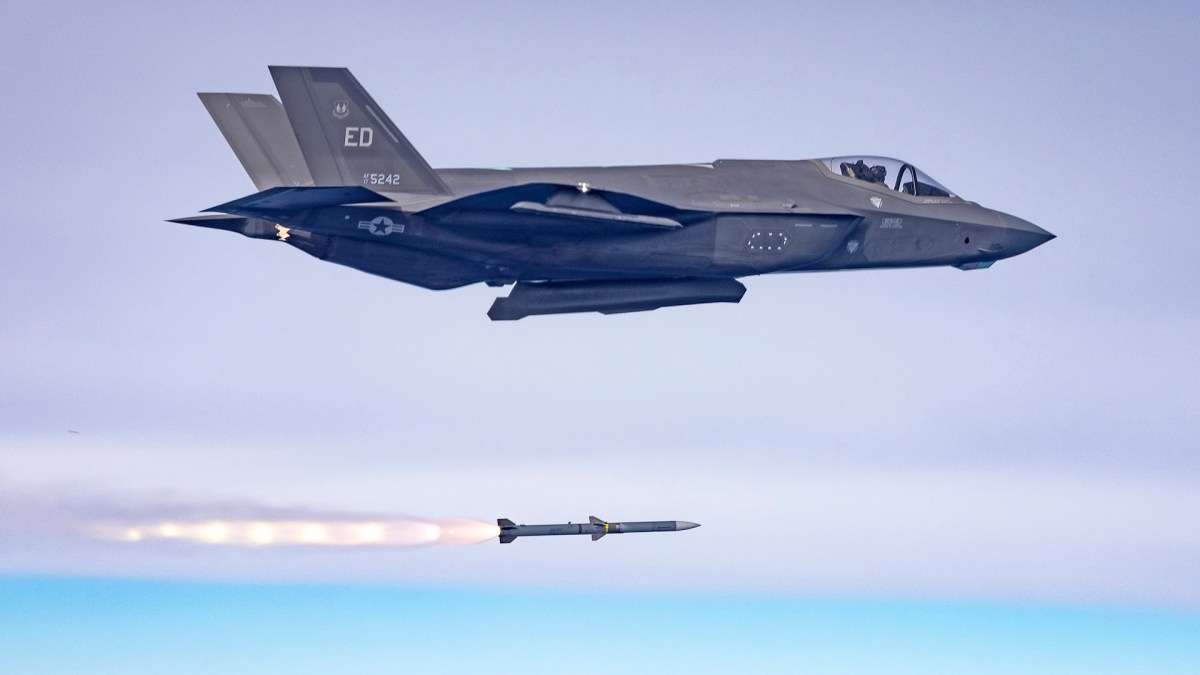
U.S. Air Force/Ethan Wagner
The United States and Japan will establish a facility in Japan for the final assembly and inspection of AIM-120 Advanced Medium-Range Air-to-Air Missiles (AMRAAMs), advancing a bilateral effort to expand munitions production as demand rises across the U.S. and allied military forces.
Japanese Defense Minister Shinjiro Koizumi announced the agreement following discussions with U.S. Secretary of War Pete Hegseth on the sidelines of the ASEAN Defense Ministers’ Meeting-Plus in Cebu, Philippines. The facility will operate under the broader Operation Supercharge initiative, which seeks to accelerate cooperation between the two countries on defense equipment and technology.
Secretary of War Pete Hegseth shakes hands with Japanese Minister of Defense Shinjirō Koizumi at the 13th ASEAN Defense Ministers’ Meeting-Plus in Cebu, Philippines, on October 28, 2026. DOW photo by U.S. Air Force Master Sgt. Brycen Guerrero
“We finally reached an agreement on the establishment of a final assembly and inspection facility in Japan for the AMRAAM air-to-air missile, which is essential for the F-35 ,” Koizumi said, according to a translation of his remarks published by Air & Space Forces Magazine .
Koizumi described the agreement as a means of ensuring access to equipment required by both countries while strengthening Japan’s domestic defense industrial base. At this point, the facility’s location, construction timeline, anticipated production capacity, and Japanese industrial partner are yet to be disclosed.
U.S. Air Force weapons load crew secure an AMRAAM onto a bomb lift truck at Nellis Air Force Base, Nevada, June 23, 2025. U.S. Air Force photo by William R. Lewis
The announcement follows a September award to RTX subsidiary Raytheon for a five-year AMRAAM production contract , with options for two additional years, valued at up to $20.7 billion. Under a framework agreement announced in February, Raytheon is working toward annual production of at least 1,900 missiles. That figure represents the overall production target, of which the future Japanese facility will account for a share. AIM-120s can cost over $1 million per unit, depending on variant .
The new arrangement also comes after more than two years of discussions over Japanese participation in AMRAAM manufacturing. The initiative emerged in 2024, followed by a feasibility study supported by Mitsubishi Electric and Raytheon. By April 2026, discussions had expanded to include possible Japanese production of circuit card assemblies in addition to final assembly and inspection.
New Production Node For A High-Demand Missile
The AIM-120 beyond-visual-range air-to-air missile is used by a wide range of U.S. and allied combat aircraft, including the F-35. Examples of the stealth fighter are operated by U.S. Air Force and Marine Corps units stationed in Japan , as well as by the Japan Air Self-Defense Force (JASDF). Both the U.S. Air Force and JASDF also operate F-15 variants in Japan , for which AMRAAM is similarly a primary weapon.
A first F-15EX Eagle II designated for Kadena Air Base, Japan, takes off at Boeing’s St. Louis facility. U.S. Air Force photo by Senior Airman Melany Bermudez
AMRAAM is also employed by ground-based air-defense systems, including the National Advanced Surface-to-Air Missile System (NASAMS). This system protects the U.S. Capital Region and over a dozen countries around the globe . It has been extensively battle-proven in Ukraine over nearly three years of operations.
Raytheon says the weapon is fielded by 44 countries and operates across 14 platforms. Its continued importance to fighter operations and air defense has made expanding manufacturing capacity a priority as the United States seeks to replenish inventories and meet soaring international demand. This is in stark contrast to the situation only a few years ago, when global AMRAAM stockpiles were viewed as plentiful.
Since then, AMRAAMs have been used extensively in the U.S. and allied campaign against Houthi drones , as well as in engagements over Syria and Iraq during efforts to defend Israel against multiple Iranian attacks . Ukraine has also expended substantial numbers of these missiles to counter Russian drones and cruise missiles, employing them through NASAMS air defense systems and, more recently, its F-16 fighters . These munitions have been supplied by the United States and NATO allies.
The wreckage of an AIM-120C-8 missile, apparently found in the aftermath of a Russian air attack on Dnipro in Ukraine. via Dnipro Main News/Telegram
The new U.S. production contract covers Lots 41 through 47 and includes advanced AIM-120D-3 variants featuring modernized processors and software-based electronic-warfare countermeasures.
With a scramble now on to find new ways to increase the global AMRAAM supply, RTX has said it invested in manufacturing equipment, workforce expansion, and supplier capacity to support the production increase. The company also identified new U.S. solid-rocket-motor production lines expected to come online in 2027 as part of its effort to address manufacturing bottlenecks.
Maintainers prepare AIM-120D AMRAAMs for carriage by F-15s during a mass aircraft generation exercise at Kadena Air Base, Japan. U.S. Air Force/Senior Airman Peter Reft
The contract is intended to provide greater production stability than the shorter procurement agreements that previously characterized the program. Its multiyear structure gives Raytheon greater visibility into future demand and supports investment in manufacturing capacity and the missile’s component supply chain.
Japan’s participation could add another assembly location to an expanding industrial base. This should be made easier by the fact that AMRAAM is also less technologically sensitive now that the new AIM-260 is in the works . However, the extent to which the facility will increase total output will depend on its eventual capacity and the division of manufacturing responsibilities between Japanese and U.S. industry.
Technology Transfer And Industrial Safeguards
The agreement is the latest step in a process that has required extensive negotiations over industrial participation and technology protection.
Japan’s longstanding restrictions on arms exports and defense-industrial cooperation have complicated arrangements involving weapons considered offensive in nature. AMRAAM also incorporates classified guidance technology and proprietary intellectual property, requiring safeguards governing the transfer and handling of sensitive information.
The planned facility therefore stops short of a commitment to manufacture the entire missile domestically. Instead, a final assembly and inspection model allows Japan to complete and check missiles using components produced through an industrial arrangement.
For Tokyo, domestic assembly could help support replenishment of its own AMRAAM stocks and strengthen its defense-industrial capabilities. For Washington, an additional qualified production location will diversify the manufacturing network serving U.S. forces and international customers.
SM-3 Production Also In Focus
AMRAAM is not the only missile addressed under Operation Supercharge. Koizumi also confirmed that the United States and Japan had agreed to share technical information intended to increase production of the Standard Missile-3 Block IIA interceptor.
SM-3 Block IIA is designed to intercept ballistic missiles during the midcourse phase of flight and is principally employed by ship-based Aegis missile-defense systems . The interceptor is the product of a joint U.S.-Japanese development program and has also been acquired by Japan, including as the primary effectors for its two new cruiser-sized Aegis System Equipped Vessels (ASEV).
Neither government has disclosed how much the latest agreement is expected to increase SM-3 production or when additional output might become available.
The two initiatives reflect a wider effort to strengthen allied munitions supply chains as regional security concerns intensify. Japan has been expanding its defense capabilities amid increased Chinese military activity around the Japanese archipelago and continuing disputes across the East and South China Seas .
An SM-3 Block IIA interceptor in a production facility. Raytheon
It should also be noted that European countries are also currently pursuing initiatives to strengthen domestic missile manufacturing output, including systems such as the Patriot interceptor and other air-defense munitions. Earlier this week, for example, Lockheed Martin announced plans to establish a dedicated PAC-3 Missile Maintenance Facility (MMF) in Poland.
A Patriot crew member assigned to B Battery, 5th Battalion, 7th Air Defense Artillery Regiment, guides a PAC-3 interceptor for loadout at Miesau Army Depot, Germany, on May 22, 2018. U.S. Army photo by Capt. Robert Durr Capt. Robert Durr
In its readout of the meeting, the U.S. Department of War said Hegseth welcomed Japan’s efforts to strengthen its defense-industrial capacity. The two leaders also committed to continued coordination on critical munitions production , although the readout did not specifically mention the AMRAAM facility.
The agreements establish a framework for closer industrial cooperation, but their eventual operational impact remains uncertain. At this point, details about the Japanese facility’s location, opening date, annual output, and its precise manufacturing responsibilities remain unclear. Meanwhile, the SM-3 initiative lacks a published production-growth target.
Regardless, the move to establish a Japanese AMRAAM assembly and inspection capability makes a good deal of sense alongside a major expansion of U.S. manufacturing. Whether that arrangement materially improves missile availability during a prolonged Indo-Pacific crisis will depend on how quickly the new capacity comes online and whether the wider production network can deliver the components and completed weapons required by both countries.
Contact the author: thomas@thewarzone.com
Comments couldn’t be loaded. Please refresh the page.
发布于美国东部时间2026年10月29日下午5:59
美国空军/伊桑·瓦格纳
美国和日本将在日本建立一个设施,用于AIM-120先进中程空空导弹(AMRAAM)的最终组装和检验,以推进两国扩大弹药生产的双边努力,满足美国及其盟军日益增长的需求。
日本防卫大臣小泉进次郎在菲律宾宿务举行的东盟防长扩大会议期间,与美国战争部长皮特·赫格塞斯会谈后宣布了这项协议。该设施将在“超级增压行动”(Operation Supercharge)框架下运作,该行动旨在加速两国在国防装备和技术方面的合作。
2026年10月28日,美国陆军部长皮特·赫格塞斯在菲律宾宿务举行的第十三届东盟防长扩大会议上与日本防卫大臣小泉进次郎握手。照片由美国空军一级军士长布莱森·格雷罗拍摄。
据《空军与太空部队杂志》刊登的小泉表示:“我们最终就在日本建立AMRAAM空空导弹的最终组装和检验设施达成了协议,这对F-35至关重要。”
小泉表示,该协议旨在确保两国都能获得所需装备,同时增强日本国内的国防工业基础。目前,该设施的选址、建设时间表、预计产能以及日本的工业合作伙伴尚未公布。
2025年6月23日,美国空军武器装载小组在内华达州内利斯空军基地将一枚先进中程空空导弹(AMRAAM)固定到炸弹吊车上。美国空军照片,摄影:威廉·R·刘易斯
此前,RTX子公司雷神公司于9月获得了一份为期五年、价值高达207亿美元的AMRAAM导弹生产合同,并可选择续签两年。根据2月份公布的框架协议,雷神公司的目标是年产至少1900枚导弹。该数字代表了总产量目标,其中未来在日本的工厂将占一部分。AIM-120导弹的单价可能超过100万美元,具体取决于型号。
这项新安排是在就日本参与AMRAAM导弹制造进行两年多的磋商后达成的。该倡议于2024年提出,随后由三菱电机和雷神公司支持开展了一项可行性研究。到2026年4月,磋商范围扩大到包括在日本生产电路板组件,以及最终组装和检验。
为高需求导弹打造的新型生产节点
AIM-120超视距空空导弹被美国及其盟国的多种作战飞机使用,包括F-35战斗机。驻日美军空军和海军陆战队以及日本航空自卫队均装备了F-35隐形战斗机。此外,美军空军和日本航空自卫队在日本也装备了F-15系列战斗机,AMRAAM导弹同样是其主要武器之一。
首架交付日本嘉手纳空军基地的F-15EX“鹰II”战斗机在波音公司位于圣路易斯的工厂起飞。美国空军高级飞行员梅拉尼·贝尔穆德斯摄
AMRAAM导弹也被地面防空系统采用,包括美国国家先进地对空导弹系统(NASAMS)。该系统负责保护美国首都地区以及全球十几个国家。在乌克兰近三年的实战中,该系统已久经考验。
雷神公司表示,该武器已在44个国家部署,并可在14种平台上使用。由于其对战斗机作战和防空的重要性持续存在,美国正努力补充库存并满足不断增长的国际需求,因此扩大产能已成为当务之急。这与几年前的情况截然不同,当时全球AMRAAM导弹库存被认为十分充足。
此后,美国及其盟国在打击胡塞武装无人机的行动中广泛使用了先进中程空空导弹(AMRAAM),并在叙利亚和伊拉克上空的战斗中也使用了AMRAAM,以保卫以色列免受伊朗多次袭击。乌克兰也消耗了大量此类导弹来对抗俄罗斯的无人机和巡航导弹,并通过NASAMS防空系统以及最近的F-16战斗机进行部署。这些弹药由美国及其北约盟国提供。
一枚AIM-120C-8导弹残骸,显然是在俄罗斯空袭乌克兰第聂伯罗后发现的。(图片来源:第聂伯罗主新闻/Telegram)
美国新的生产合同涵盖第 41 至 47 批次,其中包括采用现代化处理器和基于软件的电子战对抗措施的先进 AIM-120D-3 型号。
为了尽快找到增加全球先进中程空天导弹(AMRAAM)供应的新途径,RTX公司表示已投资于生产设备、扩大员工队伍并提升供应商产能,以支持产量增长。该公司还确定了预计将于2027年投产的美国新型固体火箭发动机生产线,作为其解决生产瓶颈措施的一部分。
在日本嘉手纳空军基地,维护人员正在为F-15战斗机准备AIM-120D先进中程空空导弹,以备在一次大规模飞机编队演习中携带。美国空军/高级空军兵彼得·雷夫特
该合同旨在提供比此前该项目常用的短期采购协议更高的生产稳定性。其多年期结构使雷神公司能够更好地预测未来需求,并支持对制造能力和导弹零部件供应链的投资。
日本的参与可能会为不断扩大的工业基地增添一个组装地点。由于新型AIM-260导弹正在研发中,AMRAAM导弹的技术敏感性有所降低,这将使组装工作更加容易。然而,该设施最终能将总产量提高多少,将取决于其最终产能以及日美两国工业界在制造责任上的分工。
技术转让和产业保障
该协议是经过广泛谈判,就产业参与和技术保护等问题达成的最新进展。
日本长期以来对武器出口和国防工业合作的限制,使得涉及被视为进攻性武器的安排变得复杂。AMRAAM导弹还包含机密制导技术和专有知识产权,因此需要采取措施来规范敏感信息的传输和处理。
因此,该规划中的设施并未承诺完全在国内生产导弹。相反,它采用的是最终组装和检验模式,允许日本使用通过工业合作生产的零部件完成导弹的组装和检验。
对东京而言,国内组装有助于补充其自身先进中程空天导弹(AMRAAM)的库存,并增强其国防工业能力。对华盛顿而言,新增一个合格的生产基地将使服务于美军和国际客户的制造网络更加多元化。
SM-3的生产也备受关注。
AMRAAM并非“超级增压行动”中唯一涉及的导弹。小泉还证实,美国和日本已同意共享技术信息,旨在提高标准-3 Block IIA拦截导弹的产量。
SM-3 Block IIA 拦截弹设计用于在弹道导弹飞行中段进行拦截,主要用于舰载宙斯盾导弹防御系统。该拦截弹是美日联合研发的成果,日本也已采购,并将其作为两艘新型巡洋舰级宙斯盾系统装备舰(ASEV)的主要拦截器。
两国政府均未透露最新协议预计能将SM-3的产量提高多少,也未透露何时能有额外的产量。
这两项举措体现了在地区安全形势日益严峻的情况下,加强盟国军需品供应链的更广泛努力。随着中国在日本列岛周边军事活动日益频繁,以及东海和南海争端持续不断,日本一直在增强其防御能力。
生产车间内的SM-3 Block IIA拦截弹。雷神公司
还应注意的是,欧洲各国目前也在采取措施加强本国导弹制造能力,包括爱国者拦截导弹和其他防空弹药等系统。例如,本周早些时候,洛克希德·马丁公司宣布计划在波兰建立一个专门的PAC-3导弹维护设施(MMF)。
2018年5月22日,在德国米绍陆军基地,隶属于美国陆军第7防空炮兵团第5营B连的“爱国者”导弹系统机组人员正在引导一架PAC-3拦截机进行装载。美国陆军上尉罗伯特·杜尔摄。
美国战争部在会晤纪要中表示,赫格塞斯对日本加强国防工业能力的努力表示欢迎。两国领导人还承诺继续在关键弹药生产方面进行协调,但纪要中并未具体提及先进中程空天导弹(AMRAAM)的生产设施。
这些协议为更紧密的产业合作奠定了框架,但其最终的实际影响仍不明朗。目前,日本工厂的选址、投产日期、年产量及其具体的生产职责等细节仍不清楚。与此同时,SM-3计划也未公布具体的产量增长目标。
无论如何,在日本建立AMRAAM导弹组装和检测能力,与美国大幅扩张制造业相结合,无疑是明智之举。这一安排能否在印太危机持续期间显著提升导弹可用性,将取决于新产能上线的速度,以及更广泛的生产网络能否为两国提供所需的零部件和成品武器。
联系作者:thomas@thewarzone.com
评论加载失败,请刷新页面。