Small drones will soon lose combat advantage, French Army chief says法国陆军参谋长称,小型无人机很快将失去作战优势。
He cited the example of the Bayraktar drone, “the king of the war” at the start of the conflict in Ukraine, that is no longer being used.
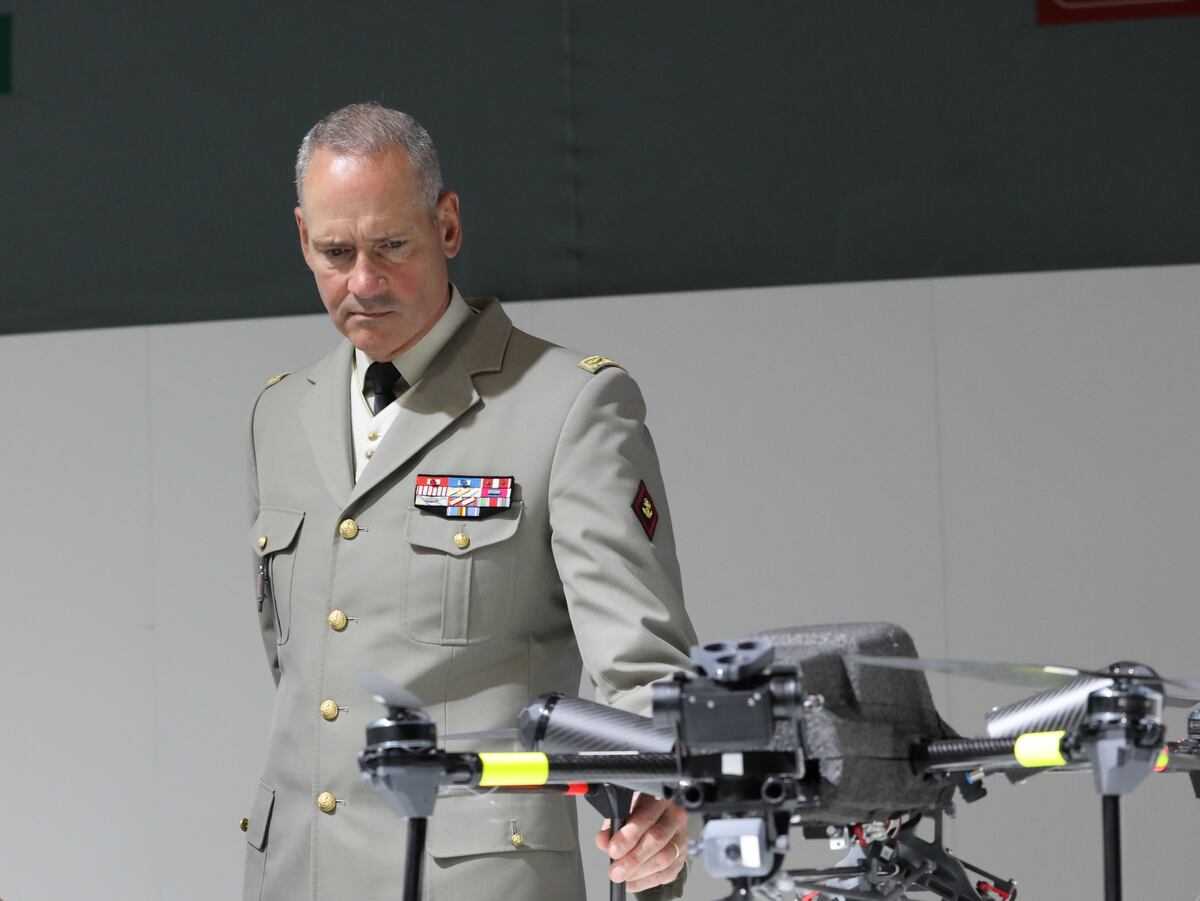
PARIS — The advantage now enjoyed by small aerial drones on battlefields including in Ukraine is but “a moment in history,” French Army Chief of Staff Gen. Pierre Schill said at the Eurosatory defense show in Paris.
While anti-drone systems are lagging and “leave the sky open to things that are cobbled together but which are extremely fragile,” countermeasures are being developed, Schill told reporters during a tour of the French Army stand at the show June 19. Already today, 75% of drones on the battlefield in Ukraine are lost to electronic warfare, the general said.
”The life of impunity of small, very simple drones over the battlefield is a snapshot in time,” Schill said. “Right now it’s being exploited, that’s clear, and we have to protect ourselves. Today, the sword, in the sense of the aerial drone, is powerful, more powerful than the shield. The shield is going to grow.”
This year’s edition of Eurosatory featured dozens of anti-drone systems, including shotguns, cannons and missiles, while companies including Safran, Thales and Hensoldt presented soft-kill solutions to eliminate drones by electronic means. Schill said vehicles in France’s Scorpion collaborative combat program will all be anti-drone systems in two years time, linking their detection capability with turrets that can fire a missile or a 40mm airburst grenade.
First-person view drones currently carry out about 80% of the destruction on the front line in Ukraine, when eight months ago those systems weren’t present, according to Schill. The general said that situation won’t exist 10 years from now, and the question could be asked whether that might already end in one or two years. Schill cited the example of the Bayraktar drone, “the king of the war” at the start of the conflict in Ukraine but no longer being used because it’s too easy to scramble.
The general said he doesn’t consider that the war in Ukraine calls into question the French choice of a maneuvering army built around medium armor, with a focus on speed and mobility. The vehicles that the Army is introducing as part of the Scorpion program -- the Griffon, Serval and Jaguar – can be equipped with either active or passive protection, even if a strong emphasis of mine protection means they’re “quite massive.”
The French Army is receiving around 120 Griffons and 120 Servals every year as part of Scorpion, as well as more than 20 Jaguars. The vehicles are equipped with “extremely powerful” information systems, and a vehicle such as the Griffon may contain more lines of code than a Rafale fighter jet, according to Schill.
Vehicles developed before the Scorpion program, such as the Leclerc main battle tank, are being reconfigured to become part of the collaborative combat system, which for example allows a target detected by one vehicle to be attacked by another. Scorpion was “extremely ambitious,” works, and has met expectations, according to Schill.
“Everything we had planned is perfectly in place, but it’s just a question of cost effectiveness on certain capabilities,” the general said.Something not considered five years ago is the rapid development of microprocessors, which means the gathered data can now be analyzed within the vehicle rather than externally. In combination with on-board artificial intelligence, that will allow for capabilities such as immediate threat detection, including of drones.
When looking to draw lessons from Ukraine, there needs to be a distinction between what is situational and related the type of terrain and battles being fought, and what is structural, the general said. The war in eastern Europe doesn’t mean the issues of the past 30 years around risk and crisis management will disappear. “We must remain a versatile army.”
The French choice has been to not separate the army into distinct parts suited for different theaters, for example an intervention army that is agile and mobile and a mechanized armor army prepared to fight a war like the one in Ukraine today, with “perhaps more rugged, lowered vehicles, but which, when they hit a mine will kill crews.”
Schill said he wants to preserve the “warrior aspect” of the French army, in which every soldier is aware they can be deployed in operation, rather than a soldier in a territorial defense army “who will never do anything.”
The pace of military drone development means that Army can’t commit to large buying programs, because an acquired capability can become obsolete in five months, according to the general. Schill said today’s drones fly better than those two or three years ago, with more computing power onboard that is capable of terrain-based navigation or switching frequencies to escape jamming.
Drones can’t be compared to 155mm shells, which can be stocked and will remain relevant in 10 years time, and the Army needs to find “the right system in this fast-moving world of new technology,” Schill said. The challenge is creating an industrial model that can produce in mass if necessary, and sufficiently standardized.
Future buying of electronic gear such as drones but also small radios and smart phones may be done in batches to allow for technology evolution, for example renewing equipment at the brigade level rather than multiple-year programs to equip the entire Army with a new piece of equipment, Schill said.
The general also commented on the future French-German Main Ground Combat System, which will consist of several vehicles, some of them manned and others automated, combining anti-drone weapons, close-defense anti-aircraft capabilities, missiles and a canon. Putting all of that on a single tank would create a vehicle weighing 80 metric tons, which “is just not possible.”
Development of the system is going to 10 to 15 years because the land-based robotics are “not completely mature yet,” according to Schill.Schill said he doesn’t know whether the right main gun for the future tank system will be 120mm, 130mm or 140mm, saying that will depend on issues such as stealth and mobility requirements, as well as what the gun bore would add in terms of penetration. KNDS, which is involved in the MGCS program, presented a gun that can swap its barrel to fire either 120mm or 140mm shells.
The French Leclerc tank probably won’t get a second upgrade beyond the current XLR version being rolled out, according to the general. He said the French-German agreement is for the next-generation system in 2040, making the Leclerc question a secondary issue.
It’ll be in France’s interest to piggyback on any capability additions made by the United Arab Emirates, another Leclerc user, between now and 2040 as a way to finance intermediate innovations, Schill said. The introduction of the MGCS won’t immediately mean the end of the Leclerc, which the general expects to be in service in the French Army until 2045.
Rudy Ruitenberg is a Europe correspondent for Defense News. He started his career at Bloomberg News and has experience reporting on technology, commodity markets and politics.
巴黎——法国陆军总参谋长皮埃尔·希尔将军在巴黎举行的欧洲防务展上表示,小型无人机目前在包括乌克兰在内的战场上所享有的优势只是“历史上的一个瞬间”。
席尔在6月19日参观法国陆军展台时告诉记者,虽然反无人机系统发展滞后,“让天空对那些拼凑起来但极其脆弱的武器敞开了大门”,但应对措施正在研发中。这位将军说,目前在乌克兰战场上,已有75%的无人机因电子战而损失。
“小型简易无人机在战场上肆意妄为的现状只是暂时的,”希尔说。“现在这种局面显然正在被利用,我们必须保护自己。如今,就空中无人机而言,这把剑威力强大,远胜于盾牌。而盾牌的力量终将增强。”
今年的欧洲防务展展出了数十种反无人机系统,包括霰弹枪、火炮和导弹。同时,赛峰集团、泰雷兹集团和亨索尔特公司等企业也展示了利用电子手段摧毁无人机的软杀伤解决方案。席尔表示,法国“蝎子”协同作战项目中的车辆将在两年内全部具备反无人机系统的功能,其探测能力将与可发射导弹或40毫米空爆榴弹的炮塔连接起来。
据希尔将军称,目前乌克兰前线约80%的破坏活动是由第一人称视角无人机造成的,而八个月前这些系统还不存在。这位将军表示,这种情况十年后将不复存在,甚至有人质疑,这种情况是否会在一两年内结束。希尔以拜拉克塔尔无人机为例,这款无人机在乌克兰冲突初期曾是“战争之王”,但由于太容易被拦截,现在已经不再使用。
这位将军表示,他不认为乌克兰战争会质疑法国选择以中型装甲部队为基础、注重速度和机动性的机动性军队的战略。陆军正在“蝎子”计划中引入的车辆——“狮鹫”、“薮猫”和“美洲虎”——可以配备主动或被动防护系统,尽管由于高度重视防雷性能,它们的体积“相当庞大”。
法国陆军每年都会接收约120辆“狮鹫”装甲车和120辆“薮猫”装甲车,作为“蝎子”联合军演的一部分,此外还有20多辆“美洲虎”装甲车。这些车辆配备了“极其强大”的信息系统,据希尔称,像“狮鹫”这样的车辆所包含的代码行数可能比“阵风”战斗机还要多。
在“蝎子”计划之前开发的车辆,例如勒克莱尔主战坦克,正在进行重新配置,以成为协同作战系统的一部分。该系统允许一辆车辆探测到的目标由另一辆车辆进行攻击。希尔表示,“蝎子”计划“雄心勃勃”,运作良好,并且达到了预期目标。
“我们所有的计划都已就绪,现在的问题只是某些功能的成本效益,”这位将军说道。五年前人们并未考虑到微处理器的快速发展,这意味着现在可以在车辆内部分析收集到的数据,而无需外部分析。结合车载人工智能,这将实现诸如即时威胁探测(包括无人机威胁探测)等功能。
这位将军表示,在从乌克兰吸取教训时,必须区分情境因素(例如地形和战斗类型)和结构性因素。东欧战争并不意味着过去30年来围绕风险和危机管理的问题会消失。“我们必须保持军队的多功能性。”
法国的选择是不将军队分成适合不同战区的不同部分,例如一支灵活机动的干预部队和一支准备打赢像今天乌克兰战争那样的战争的机械化装甲部队,后者“或许拥有更坚固、更低矮的车辆,但一旦触雷就会杀死乘员”。
希尔表示,他希望保留法国军队的“战士精神”,让每一位士兵都意识到自己随时可能被部署到作战行动中,而不是成为一支“永远不会有所作为”的领土防御部队中的士兵。
据这位将军称,军用无人机的发展速度意味着陆军无法投入大量资金进行采购,因为一项新能力可能在五个月内就会过时。希尔表示,如今的无人机比两三年前的无人机飞行性能更好,机载计算能力更强,能够进行基于地形的导航或切换频率以躲避干扰。
希尔表示,无人机不能与155毫米炮弹相提并论,后者可以储备,而且在未来十年内仍然适用。陆军需要在“这个瞬息万变的新技术世界中找到合适的系统”。挑战在于如何建立一个必要时能够大规模生产且足够标准化的工业模式。
希尔表示,未来采购无人机、小型收音机和智能手机等电子设备可能会分批进行,以便适应技术发展,例如在旅级单位更新设备,而不是通过多年计划为整个陆军配备新设备。
这位将军还谈到了未来法德联合研制的主力地面作战系统,该系统将由多种车辆组成,其中一些是有人驾驶的,另一些是自动驾驶的,它将结合反无人机武器、近程防空能力、导弹和一门火炮。把所有这些装备都放在一辆坦克上,会使这辆坦克的重量达到80吨,“这根本不可能”。
据希尔称,该系统的研发将持续10到15年,因为陆基机器人技术“尚未完全成熟”。希尔表示,他目前尚不清楚未来坦克系统的主炮口径是120毫米、130毫米还是140毫米,因为这取决于隐蔽性和机动性等因素,以及炮管口径对穿透力的提升。参与MGCS项目的KNDS公司展示了一款可以更换炮管以发射120毫米或140毫米炮弹的火炮。
这位将军表示,法国勒克莱尔坦克可能不会在目前正在服役的XLR版本之后进行第二次升级。他说,法德协议的目标是2040年推出下一代系统,因此勒克莱尔坦克的问题只是次要的。
希尔表示,法国可以借助阿联酋(勒克莱尔坦克的另一个用户)在2040年前的任何能力提升,以此来资助中期创新,这符合法国的利益。MGCS的引入并不意味着勒克莱尔坦克的退役,这位将军预计该坦克将在法国陆军服役至2045年。
鲁迪·鲁伊滕贝格是《防务新闻》的欧洲记者。他的职业生涯始于彭博新闻社,拥有报道科技、大宗商品市场和政治方面的经验。