US approves loitering munitions sale for Taiwan’s ‘porcupine strategy’美国批准向台湾出售巡飞弹,以支持其“豪猪战略”。
The Defense Security Cooperation Agency approvals include 291 Altius 600M-V loitering munitions from Anduril, plus 720 Switchblade 300s from AeroVironment.
CHRISTCHURCH, New Zealand — Taiwan won approval from main benefactor the U.S. to buy hundreds of loitering munitions, as part of a “porcupine strategy” to use such attritable weapons to help defend the country from a potential Chinese military invasion.
The Defense Security Cooperation Agency’s June 18 approvals included 291 Altius 600M-V loitering munitions from Anduril, plus 720 Switchblade 300s from AeroVironment. The former is valued at $300 million and the latter at $60.2 million.
The Altius 600M-V package includes warheads and electro-optic/infrared cameras, pneumatic launchers, transport trailers and ground control stations. The 47lb (12kg) aircraft has a 276-mile (440km) flight range and 4-hour endurance.
As for the Switchblade 300, it comes with both anti-personnel and anti-armor warheads. It is smaller, with a 3.69lb (1.68kg) weight and just a 20-minute endurance.
Chen Kuo-ming, a Taipei-based defense analyst, told Defense News the Switchblades are suitable for anti-personnel use, and the Altius against armor.
The weapons should be delivered in 2024-2025.
“In the face of the Chinese Communist Party’s frequent military operations around Taiwan, the U.S. side in this case agreed to sell arms items that will have reconnaissance and immediate strike capabilities and can respond quickly to enemy threats,” Taiwan’s Ministry of National Defense said in a statement.
The U.S.-Taiwan Business Council also applauded the potential sales. Council President Rupert Hammond-Chambers noted they “add substantially to Taiwan’s inventory of mobile smart munitions, which can be used during on-island fighting all the way through to attacking People’s Liberation Army assets off Taiwan’s coastline”.
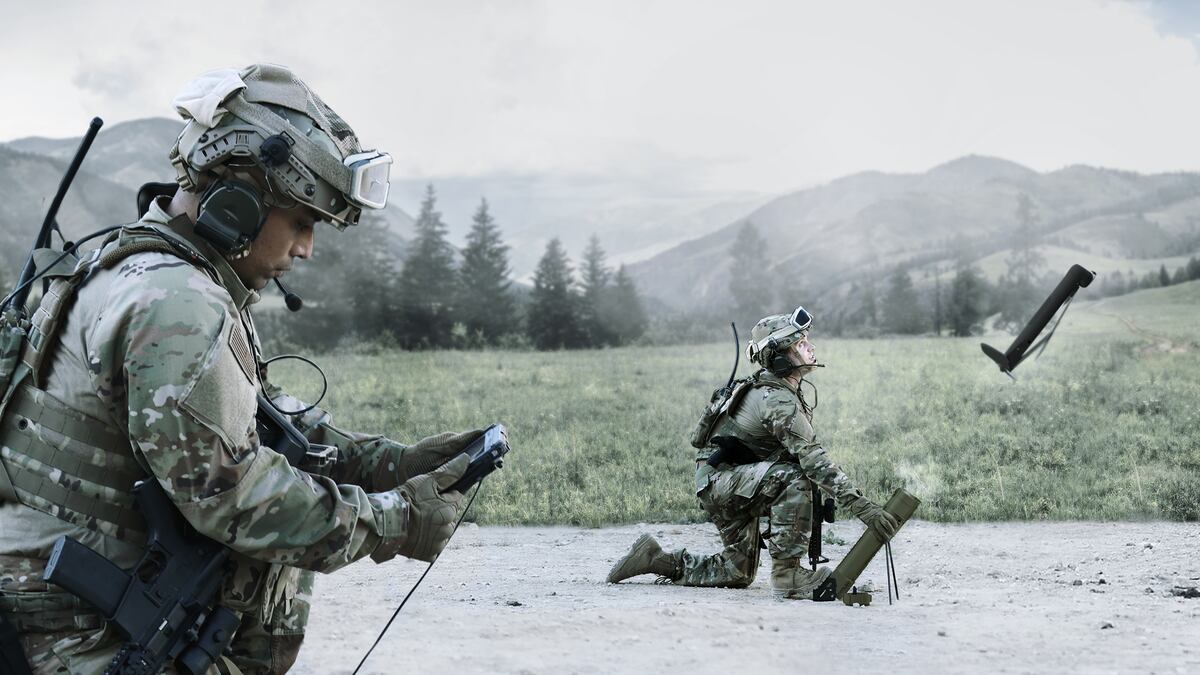
The Altius 600 has been delivered to Ukraine, but Taiwan will be the first customer for the warhead-armed Altius 600M-V. (U.S. Army)
Chen said he believes these loitering munitions are good for Taiwan, since they can be used by independent units, even if the country’s navy and air force have been defeated.
However, he expressed concerns about their price compared to the cost of antitank missiles, for example. He also questioned the ability of Taiwanese frontline units to see and therefore target enemies beyond visual range.
Chen said the National Chung-Shan Institute of Science and Technology – Taiwan’s defense research and development agency – had displayed various drones, including a loitering munition – at a 2023 Taipei defense exhibition. However, “Until now, we have no real loitering munition for the army to use. So after about nine months, the U.S. government decided to sell these to Taiwan.”
Hammond-Chambers also noted, “Taiwan currently has domestic companies who are working with foreign partners to develop their own indigenous mobile smart munitions. In conjunction with Foreign Military Sales cases such as these, we should expect the Ministry of National Defense to also start procuring locally to meet their defensive requirements.”
At last month’s Shangri-Li Dialogue in Singapore, Adm. Samuel Paparo, head of the U.S. Indo-Pacific Command, outlined a plan to strike back if China attacks Taiwan. “I want to turn the Taiwan Strait into an unmanned hellscape using a number of classified capabilities … so that I can make their lives utterly miserable for a month, which buys me the time for the rest of everything.”
Editor’s note: This story was updated to reflect that the per-unit cost of an Altius loitering munition, which the manufacturer has declined to name on the record, cannot be reliably inferred from the overall price tag of the foreign military sale.
Gordon Arthur is an Asia correspondent for Defense News. After a 20-year stint working in Hong Kong, he now resides in New Zealand. He has attended military exercises and defense exhibitions in about 20 countries around the Asia-Pacific region.
新西兰基督城——台湾获得了主要援助国美国的批准,可以购买数百枚巡飞弹,这是台湾“豪猪战略”的一部分,该战略旨在利用这种消耗性武器帮助台湾抵御中国潜在的军事入侵。
美国国防安全合作局6月18日批准的采购项目包括从安杜里尔公司采购291枚Altius 600M-V巡飞弹,以及从AeroVironment公司采购720枚Switchblade 300巡飞弹。前者价值3亿美元,后者价值6020万美元。
Altius 600M-V 套件包括弹头、光电/红外摄像机、气动发射器、运输拖车和地面控制站。该无人机重 47 磅(12 公斤),飞行范围 276 英里(440 公里),续航时间为 4 小时。
至于Switchblade 300,它配备了反人员和反装甲弹头。它的体积更小,重量为3.69磅(1.68公斤),续航时间只有20分钟。
台北国防分析师陈国明告诉《防务新闻》,Switchblade 适合用于对付人员,而 Altius 适合用于对付装甲。
这些武器应该在2024-2025年交付。
台湾国防部在一份声明中表示:“面对中国共产党在台湾周边频繁的军事行动,美方同意出售具备侦察和即时打击能力,能够快速应对敌方威胁的武器装备。”
美台商业协会也对潜在的销售表示赞赏。协会主席鲁珀特·哈蒙德-钱伯斯指出,这些武器“大幅增加了台湾的移动智能弹药储备,这些弹药可用于岛内作战,甚至可用于攻击台湾海岸线附近的解放军目标”。
Altius 600导弹已交付乌克兰,但台湾将成为配备核弹头的Altius 600M-V导弹的首个客户。(美国陆军)
陈先生表示,他认为这些巡飞弹对台湾有好处,因为即使台湾的海军和空军战败,独立部队也可以使用它们。
然而,他对这些武器的价格表示担忧,例如与反坦克导弹相比。他还质疑台湾前线部队能否在视距外发现并打击敌人。
陈先生表示,台湾国防研究与发展机构——国立中山科学研究院——曾在2023年台北防务展上展出过多种无人机,其中包括巡飞弹。然而,“直到现在,我们军队还没有真正可用的巡飞弹。因此,大约九个月后,美国政府决定向台湾出售这些弹药。”
哈蒙德-钱伯斯还指出:“台湾目前有一些本土企业正与外国合作伙伴共同研发自主研发的移动智能弹药。随着此类对外军售案例的出现,我们应该预期国防部也会开始在本地采购,以满足其防御需求。”
在上个月于新加坡举行的香格里拉对话会上,美国印太司令部司令塞缪尔·帕帕罗海军上将概述了一项反击计划,以防中国攻击台湾。“我想利用一系列机密能力,将台湾海峡变成一片无人控制的地狱……这样我就可以让他们在一个月内过得极其痛苦,从而为我争取时间去做其他事情。”
编者按:本文已更新,以反映 Altius 巡飞弹的单价(制造商拒绝公开透露该弹药的名称)无法从对外军售的总价中可靠地推断出来。
戈登·阿瑟是《防务新闻》的亚洲特派记者。在香港工作20年后,他现居新西兰。他曾到访亚太地区约20个国家,参加过军事演习和防务展览。