Ground robots hauling drones into battle is a trend at Paris arms fair在巴黎武器展上,地面机器人牵引无人机投入战斗成为一种趋势。
Teledyne Flir and Rheinmetall have proposed combos of robots on land and in the air.
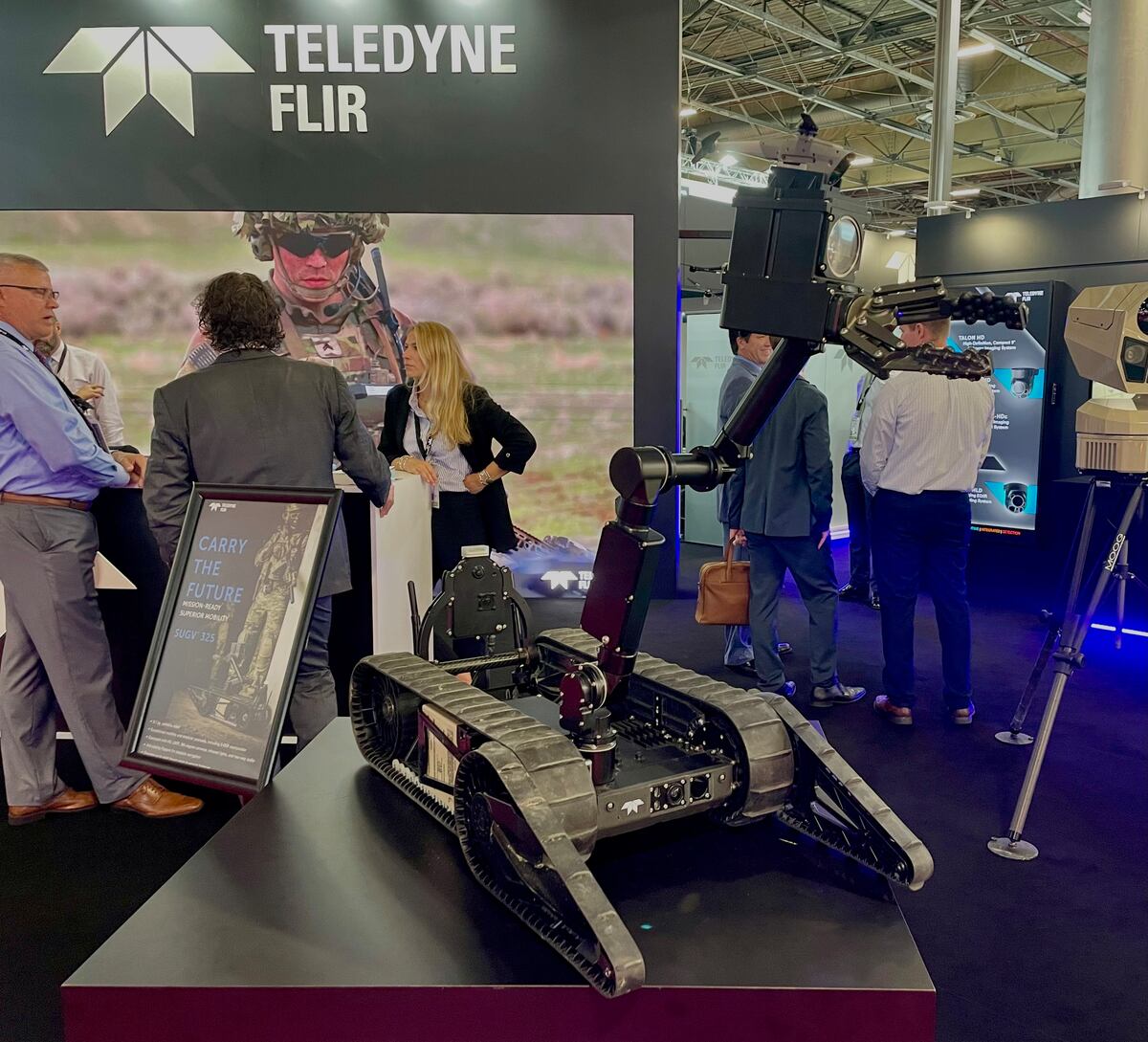
PARIS — The next-generation of robot warfare is unfolding with the teaming of ground and air robots propelling each other forward.
At the Eurosatory trade show here, the U.S.-based company Teledyne Flir debuted a new unmanned ground vehicle, or UGV, mounted with its nano aerial drone, the Black Hornet 4, on top.
Dubbed the SUGV 325, the ground robot is light enough to be carried by a single person and is fitted with an arm-like structure for grabbing objects.
“We see robots as being good unmanned partners for unmanned aerial systems, you can lean into the good things of the robot – eight hours of runtime, capability to carry heavier payloads, and persistence – and pair it with the drone’s agility and speed,” Nate Winn, director of product management for unmanned systems at Teledyne told Defense News.
Both assets can be used to extend each other’s range, where if something is detected by the high-definition cameras onboard the UGV, the drone can be launched from the robot using the same controller to go investigate potential danger further away.
The unmanned duo also enables it to increase the standoff distance between a threat and military personnel on the battlefield, Winn added.
“Any action in the battle space begins with gathering information, so you want the robot and or the unmanned aerial system to be the first point of contact with any potentially threatening situation,” he said.
Rheinmetall Canada's Mission Master unmanned ground vehicle, pictured at the Eurosatory trade show in Paris on June 18, 2024, can release an aerial drone and have it follow along overhead. (Elisabeth Gosselin-Malo/staff photo)
The integration of aerial drones and combat robots into fighting units is something that the U.S. Army appears to be experimenting with.
Last month, footage branded with the U.S. Army’s Sandhills Project logo emerged on social media , in which more than a dozen drones are seen launched from a UGV in less than 15 seconds.
Another robot-on-robot combo at the trade show here was Rheinmetall Canada’s Mission Master CXT, which was armed with a tethered drone from the French company Elistair.
“We have already integrated it into our Mission Master command and control software, meaning that with the same control tablet, a single operator can control the UGV and the connected drone,” Etienne Rancourt, director of international business development at Rheinmetall Canada said.
The Elistair drone is able to follow the UGV at 30 kph (19 mph), at a 60-meter altitude autonomously.
Correction: A previous version of this story included erroneous information provided by Rheinmetall Canada regarding Elistair’s interaction with an unmanned ground vehicle. The company has clarified that the aerial drone can operate at a 60-meter altitude autonomously.
Elisabeth Gosselin-Malo was a Europe correspondent for Defense News. She covers a wide range of topics related to military procurement and international security, and specializes in reporting on the aviation sector. She is based in Milan, Italy.
巴黎——下一代机器人战争正在展开,地面机器人和空中机器人协同作战,相互推动,共同前进。
在本次欧洲防务展上,总部位于美国的 Teledyne Flir 公司首次推出了一款新型无人地面车辆(UGV),其顶部搭载了该公司的纳米级空中无人机“黑黄蜂 4”。
这款名为 SUGV 325 的地面机器人重量轻,一个人即可携带,并配有类似手臂的结构,用于抓取物体。
“我们认为机器人是无人机系统的优秀无人伙伴,你可以充分利用机器人的优势——八小时的运行时间、携带更重有效载荷的能力以及持久性——并将其与无人机的敏捷性和速度相结合,”泰莱达因公司无人系统产品管理总监内特·温恩告诉《防务新闻》。
这两个资产可以互相扩展对方的活动范围,如果 UGV 上的高清摄像头检测到什么,就可以使用同一个控制器从机器人上发射无人机,去更远的地方调查潜在的危险。
温恩补充说,这架无人双机还可以增加战场上威胁目标与军事人员之间的安全距离。
他说:“战场上的任何行动都始于信息收集,因此你希望机器人或无人机系统成为与任何潜在威胁情况接触的第一点。”
莱茵金属加拿大公司(Rheinmetall Canada)的“任务大师”(Mission Master)无人地面车辆(如图所示,摄于2024年6月18日巴黎举行的欧洲防务展)可以释放一架无人机并使其在空中跟随行驶。(伊丽莎白·戈斯林-马洛/工作人员照片)
美国陆军似乎正在尝试将无人机和作战机器人整合到作战部队中。
上个月,一段带有美国陆军沙丘计划标志的视频在社交媒体上流传开来,视频中可以看到十几架无人机在不到 15 秒的时间内从无人地面车辆 (UGV) 上发射出去。
在本次贸易展上,另一款机器人对机器人的组合是莱茵金属加拿大公司的 Mission Master CXT,它配备了法国公司 Elistair 的系留无人机。
“我们已经将其集成到我们的 Mission Master 指挥控制软件中,这意味着使用同一个控制平板电脑,单个操作员可以控制无人地面车辆和连接的无人机,”莱茵金属加拿大公司国际业务发展总监 Etienne Rancourt 表示。
Elistair 无人机能够以 30 公里/小时(19 英里/小时)的速度,在 60 米的高度自主跟随 UGV。
更正:此前报道中包含莱茵金属加拿大公司提供的关于Elistair无人机与无人地面车辆交互的错误信息。该公司已澄清,该无人机可在60米高度自主飞行。
伊丽莎白·戈斯林-马洛曾任《防务新闻》欧洲通讯员。她的报道涵盖军事采购和国际安全等广泛领域,尤其擅长航空领域的报道。她常驻意大利米兰。