Marines Corps’ landing ship taking longer, costing more than planned海军陆战队的登陆舰耗时更长,成本也超出预期。
A key vessel Marines need to move around in a potential island shootout with China is two years behind schedule.
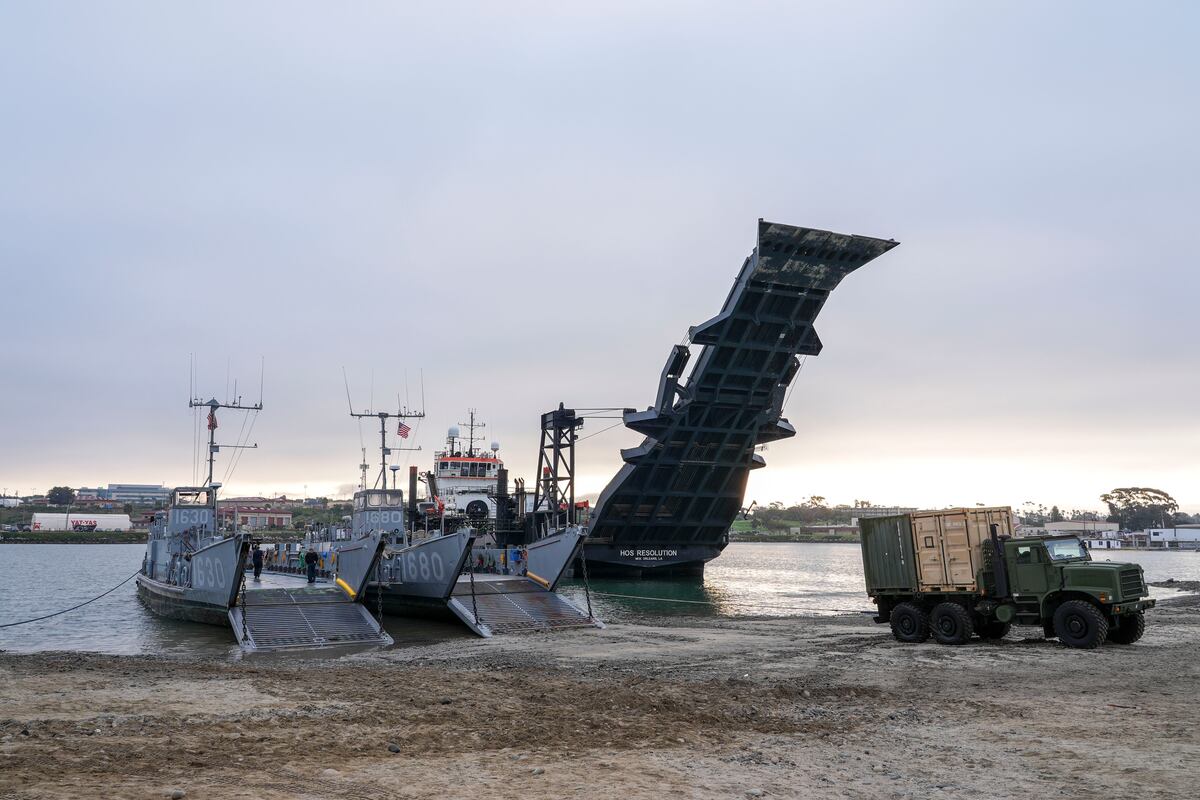
A key vessel Marines need to move around in a potential island shootout with China is two years behind schedule, could cost nearly triple its original estimate and the short-term fix isn’t cheap.
The Navy’s landing ship medium program expects to award its design and construction contract in fiscal year 2025, two years later than originally planned, according to the Government Accountability Office’s Annual Weapons Systems Assessment , released Monday.
The concept, formerly called the light amphibious warship, was launched in 2020 to procure 35 such stern landing vessels.
The ship would hew closely to commercial designs to lower its signature and provide the recently formed Marine littoral regiments with options for maneuvering in areas close to shore and within island chains, especially in the Pacific.
The current ship being used for testing is the stern landing vessel, a modified commercial watercraft that allows users to offload and onload directly from the beach.
“It is a shore-to-shore logistics connect to get heavy things that we can’t put on airplanes or don’t want to have a big ship coming in to bring, get it from Point A to Point B to move; maneuver it from Point B to a more advantageous position at Point C; and then sustain that position,” Assistant Commandant Gen. Christopher Mahoney said in March.
Original design features for the landing ship medium concept include:
A length of 200 to 400 feet.
A draft, or depth of the vessel beneath the waterline, of 12 feet.
A crew of about 70 sailors.
The capacity for carrying 50 Marines and 648 short tons of equipment.
8,000 square feet of deck cargo space
Transit speed of 14 knots and a cruising range of 3,500 nautical miles.
Roll-on/roll-off beaching capability for beaches with a 1:40 grade.
A helicopter landing pad.
Two 30 mm guns and six .50-caliber guns for self-defense.
A 20-year service life.
Source: Congressional Research Services
The first of three planned regiments became operational in 2023. The Navy is developing a bridging strategy, according to the report. Marine Corps Times has reported on ongoing experimentation with commercial vessels modified to meet the service’s landing needs throughout the past two years.
But those solutions require “significant modifications,” according to the report , costing upward of $115 million per modified vessel.
A 2020 report by Congressional Research Services that was updated in April noted that Congress could consider adapting the existing fleet of Army logistics support vessels for at least some of the Marines’ requirements.
The Army has more than 100 such vessels in its fleet, according to that report . Dozens of those vessels have similar capabilities to the landing ships the Corps is seeking.
At the time the Army had sought to divest some of its watercraft fleet. But since then, the service has shifted its logistics needs to the Pacific and now wants to expand the fleet, Defense News reported .
Army logistics support vessel USAV SP/4 James A. Loux prepares to conduct a stern gate transfer with amphibious dock landing ship Carter Hall. (Petty Officer 3rd Class Kristin L. Grover/Navy)
Under the current timeline, the Navy expects to award the construction contract for the ships in March 2025 and have the first ship delivered by January 2029. On that schedule, the Navy expects to conclude operational testing by July 2030 and hit initial capability by December 2034, according to the Government Accountability Office report .
Another report released in April shows a much higher overall cost for the program than officials originally planned.
The Congressional Budget Office estimated the initial 18-ship program could cost between $6.2 billion and $7.8 billion in 2024 inflation-adjusted dollars, Marine Corps Times’ sister publication Defense News reported in April.
That translates to $340 million to $430 million per hull.
That’s three times more than the original estimate of $2.6 billion for the program ― or $150 million per ship.
If the Navy gets the green light to buy the full fleet of 35 landing ships, as the Marine Corps has requested, the program will cost between $11.9 billion and $15 billion, according to the Congressional Budget Office report .
Todd South has written about crime, courts, government and the military for multiple publications since 2004 and was named a 2014 Pulitzer finalist for a co-written project on witness intimidation. Todd is a Marine veteran of the Iraq War.
海军陆战队在与中国可能发生的岛屿冲突中需要调动的一艘关键舰艇,其建造进度比原计划落后了两年,成本可能接近原先估计的三倍,而且短期解决方案也不便宜。
根据美国政府问责局周一发布的年度武器系统评估报告,海军中型登陆舰项目预计将在 2025 财年授予其设计和建造合同,比原计划晚两年。
该概念以前被称为轻型两栖战舰,于 2020 年启动,旨在采购 35 艘此类舰尾登陆舰。
该舰将严格按照商业设计建造,以降低其特征信号,并为新成立的海军陆战队近岸团提供在近岸区域和岛链内(尤其是在太平洋地区)进行机动的选择。
目前用于测试的船只为船尾登陆船,这是一种经过改装的商用船只,允许用户直接从海滩卸载和装载货物。
“这是一条从海岸到海岸的后勤连接线,用来运送我们无法用飞机运输或不想用大型船只运送的重型物品,将其从 A 点运送到 B 点;再将其从 B 点机动到 C 点更有利的位置;然后维持该位置,”助理司令克里斯托弗·马奥尼将军在 3 月份表示。
中型登陆舰概念的原始设计特点包括:
长度为200至400英尺。
吃水深度(即船舶水线以下的深度)为 12 英尺。
船员约70人。
可搭载 50 名海军陆战队员和 648 短吨装备。
8,000平方英尺的甲板货物空间
航速14节,巡航范围3500海里。
适用于坡度为 1:40 的海滩的滚装/滚卸式沙滩作业能力。
直升机停机坪。
用于自卫的两门 30 毫米炮和六门 .50 口径机枪。
使用寿命为20年。
资料来源:国会研究服务处
据报道,计划组建的三个团中的第一个已于2023年投入使用。海军正在制定一项过渡战略。《海军陆战队时报》曾报道,过去两年里,海军一直在进行试验,利用改装后的商用船只来满足其登陆需求。
但报告指出,这些解决方案需要进行“重大修改”,每艘改装后的船舶成本高达 1.15 亿美元。
国会研究服务处在 2020 年发布的一份报告(该报告于 4 月更新)指出,国会可以考虑改造现有的陆军后勤支援船队,以满足海军陆战队的部分需求。
报告显示,陆军舰队拥有100多艘此类舰艇。其中数十艘舰艇具备与海军陆战队正在寻求的登陆舰类似的能力。
据《防务新闻》报道,当时陆军曾试图出售部分水上舰艇。但此后,陆军已将其后勤需求转移到太平洋地区,现在希望扩大舰艇规模。
陆军后勤支援舰“詹姆斯·A·卢克斯”号(USAV SP/4 James A. Loux)准备与两栖船坞登陆舰“卡特·霍尔”号(Carter Hall)进行舰尾舱门交接作业。(海军三级军士克里斯汀·L·格罗弗/海军)
根据目前的进度安排,海军预计将于 2025 年 3 月授予舰艇建造合同,并于 2029 年 1 月交付首艘舰艇。根据美国政府问责局的报告,按照该进度,海军预计将于 2030 年 7 月完成作战测试,并于 2034 年 12 月达到初始作战能力。
四月份发布的另一份报告显示,该项目的总成本远高于官员们最初的计划。
据《海军陆战队时报》的姊妹刊物《防务新闻》4 月份报道,国会预算办公室估计,最初的 18 艘舰艇计划按 2024 年通货膨胀调整后的美元计算,成本可能在 62 亿美元至 78 亿美元之间。
这意味着每艘船的成本在 3.4 亿美元到 4.3 亿美元之间。
这比该项目最初估计的 26 亿美元高出三倍——也就是每艘船 1.5 亿美元。
根据国会预算办公室的报告,如果海军获得批准购买海军陆战队要求的全部 35 艘登陆舰,该计划将耗资 119 亿美元至 150 亿美元。
自2004年以来,托德·索斯为多家出版物撰写有关犯罪、法院、政府和军事方面的文章,并因与人合著的关于恐吓证人的文章入围2014年普利策奖决赛。托德是参加过伊拉克战争的海军陆战队老兵。