Rubio ratchets up pressure on NATO at key summit卢比奥在关键峰会上加大对北约的压力
Secretary of State Marco Rubio is casting new doubt on NATO's relevance after key allies recoiled from backing Washington’s “Operation Epic Fury.”
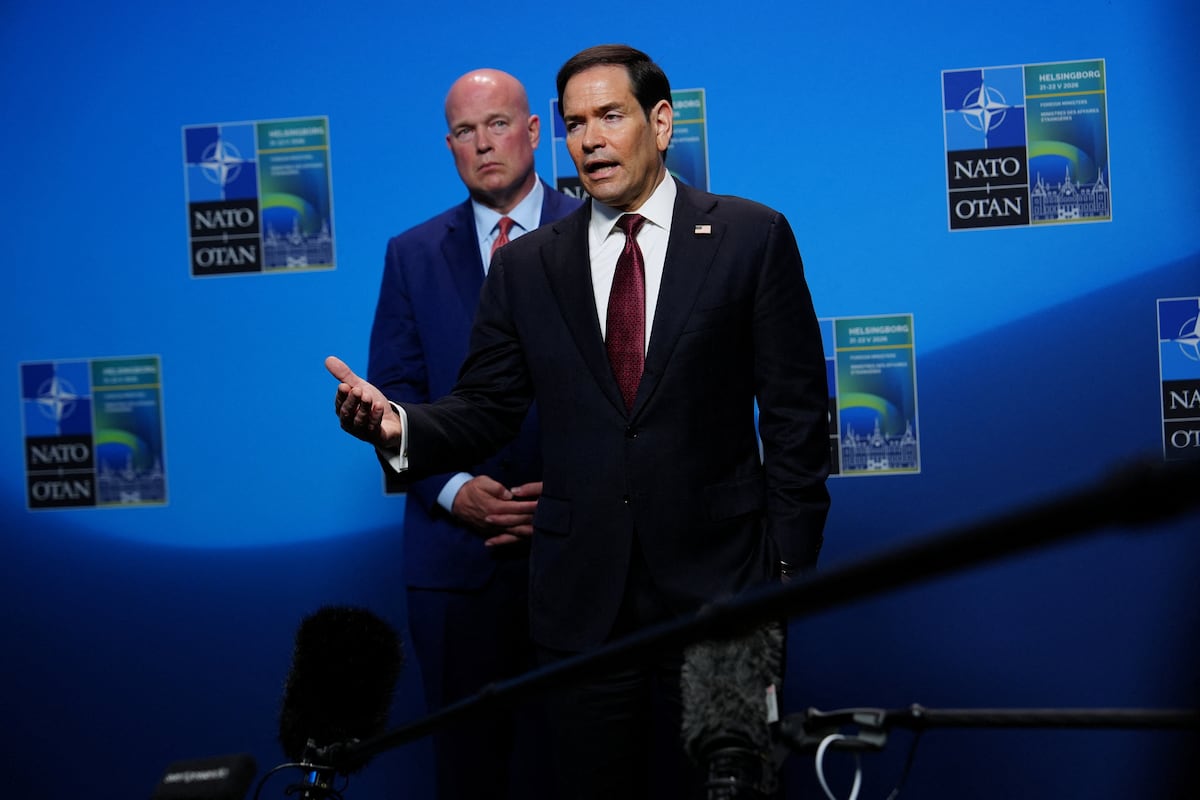
Secretary of State Marco Rubio is casting new doubt on the North Atlantic Treaty Organization’s relevance to the United States after key allies recoiled from backing Washington’s “Operation Epic Fury.”
Rubio, speaking to reporters following a meeting with foreign ministers in Sweden on Friday, contended that the raison d’etre of NATO was undermined when allies refused to allow the U.S. to use installations on their soil during a war.
“One of the arguments I always made was that these bases in the region provided us logistical options that we wouldn’t otherwise have,” Rubio said. “And when some of those bases are denied to you — during a conflict that we’re involved in — then you question whether that value is still there.”
The U.S.-NATO relationship has been increasingly strained in the wake of the war in Iran, which began on Feb. 28. President Donald Trump believes that NATO allies should have offered much more assistance, especially with regard to reopening the Strait of Hormuz. In basic terms, several of those nations say the war, started by Trump and Israeli Prime Minister Benjamin Netanyahu without their consultation, is not their problem.
“I was never swayed by NATO,” Trump said in an interview in April. “I always knew they were a paper tiger.”
In recent weeks, the Trump administration has moved to scale back its military footprint across Europe, a shift Rubio emphasized predated tensions over Iran.
But some contradictory signals have been sent. On Thursday, Trump announced that the United States would deploy 5,000 additional troops to Poland — the same number of troops the Pentagon said earlier this month would be withdrawn from Germany.
Poland’s Foreign Minister Radoslaw Sikorski welcomed Thursday’s reversal, while his Swedish counterpart, Maria Malmer Stenegard, told reporters the U.S. position “is confusing indeed, and not always easy to navigate.”
Rubio, for his part, asserted that the United States military has global commitments in the Indo-Pacific, Middle East and Western Hemisphere that it has to meet — and that this requires a constant reevaluation of force posture.
“It’s well understood in the alliance that the United States’ troop presence in Europe is going to be adjusted,” Rubio said, underscoring that the process is already ongoing. “I’m not saying they’re going to be thrilled about it, but they are certainly aware of it.”
“This is not a punitive thing,” he insisted.
Regardless, Rubio said that Trump’s “disappointment” with the alliance’s response to U.S. operations in Iran will “have to be addressed” at the next NATO leaders’ summit, set for Turkey in July. He suggested that the gathering in Ankara will rank among the most consequential in NATO’s history.
Tanya Noury is a reporter for Military Times and Defense News, with coverage focusing on the White House and Pentagon.
在主要盟友纷纷撤回对华盛顿“史诗狂怒行动”的支持后,国务卿马可·卢比奥对北大西洋公约组织与美国的关系提出了新的质疑。
鲁比奥周五在瑞典与各国外长会晤后对记者表示,北约存在的理由在盟国拒绝允许美国在战争期间使用其领土上的设施时受到了破坏。
鲁比奥说:“我一直强调的一个论点是,这些位于该地区的基地为我们提供了原本无法获得的后勤保障。而当我们卷入冲突,却无法使用其中一些基地时,你就会质疑这些基地的价值是否依然存在。”
自2月28日伊朗战争爆发以来,美国与北约的关系日益紧张。美国总统唐纳德·特朗普认为,北约盟国本应提供更多援助,尤其是在重新开放霍尔木兹海峡方面。简而言之,一些盟国表示,这场由特朗普和以色列总理本雅明·内塔尼亚胡在未与他们协商的情况下发动的战争,与他们无关。
“我从未被北约所动摇,”特朗普在四月份的一次采访中说。“我一直都知道他们是纸老虎。”
最近几周,特朗普政府开始缩减其在欧洲的军事存在,卢比奥强调,这一转变早于伊朗问题上的紧张局势。
但一些相互矛盾的信号也随之发出。周四,特朗普宣布美国将向波兰增派5000名士兵——这与五角大楼本月早些时候宣布将从德国撤出的兵力数量相同。
波兰外交部长拉多斯瓦夫·西科尔斯基对周四的政策逆转表示欢迎,而瑞典外长玛丽亚·马尔默·斯滕内加德则告诉记者,美国的立场“确实令人困惑,而且并不总是容易理解”。
鲁比奥则断言,美国军方在印太地区、中东和西半球负有必须履行的全球承诺——这就需要不断重新评估兵力部署。
鲁比奥表示:“联盟内部都清楚,美国在欧洲的驻军规模将会调整。”他强调,调整进程已经在进行中。“我不是说他们会对此感到高兴,但他们肯定意识到了这一点。”
“这不是惩罚性措施,”他坚持说。
尽管如此,鲁比奥表示,特朗普对北约应对美国在伊朗军事行动的回应感到“失望”,这个问题“必须在7月于土耳其举行的下届北约领导人峰会上得到解决”。他暗示,安卡拉峰会将是北约历史上最重要的峰会之一。
Tanya Noury 是《军事时报》和《防务新闻》的记者,她的报道主要集中在白宫和五角大楼。