France’s drone production shifts from policy ambition to factory floor法国无人机生产从政策愿景转向工厂生产
France’s push to enlist its car industry to produce military drones is moving to industrial implementation.
France’s push to enlist its car industry to produce military drones is moving to industrial implementation, as partnerships between automakers, car-part suppliers and defense firms turn lessons from the war in Ukraine into working assembly lines.
Since the start of the year, at least six defense-automotive tie-ups have been announced, as President Emmanuel Macron’s government seeks to combine the scale, automation and cost discipline of France’s car sector with one of the fastest-growing segments of military technology.
Ukraine and Russia’s use of drones has reshaped warfare, and that has prompted France and its European allies to prioritise drone production, as pressure from Washington on Europe to boost its military capabilities has added urgency.
The projects indicate France is building an industrial base capable of producing tens of thousands of drones a year — a scale difficult for defense startups to achieve alone, albeit one still dwarfed by Ukrainian and Russian efforts.
“Why now? Because the need is now, drones are now,” Christophe Périllat, chief executive of auto parts supplier Valeo, told reporters at the end of July. “And why in France? Because we’re being asked to guarantee our sovereignty.”
French defense officials do not anticipate a near-term need to deploy a large number of drones in the skies above France, but say it must be prepared for conflict.
The goal is to give France the ability to produce drones quickly and ramp up output should a crisis arise, they say. A July report by the French Senate’s defense committee described France’s stock of just a few thousand drones as “insufficient to achieve a critical mass.”
Valeo has said it will manufacture electric drone motors in France for defense technology firm Harmattan AI. Meanwhile, Forvia unveiled a partnership last week with a European defense company specialising in AI-powered counter-drone systems and is weighing plans to build capacity in France to manufacture 1,000 interceptor drones each month.
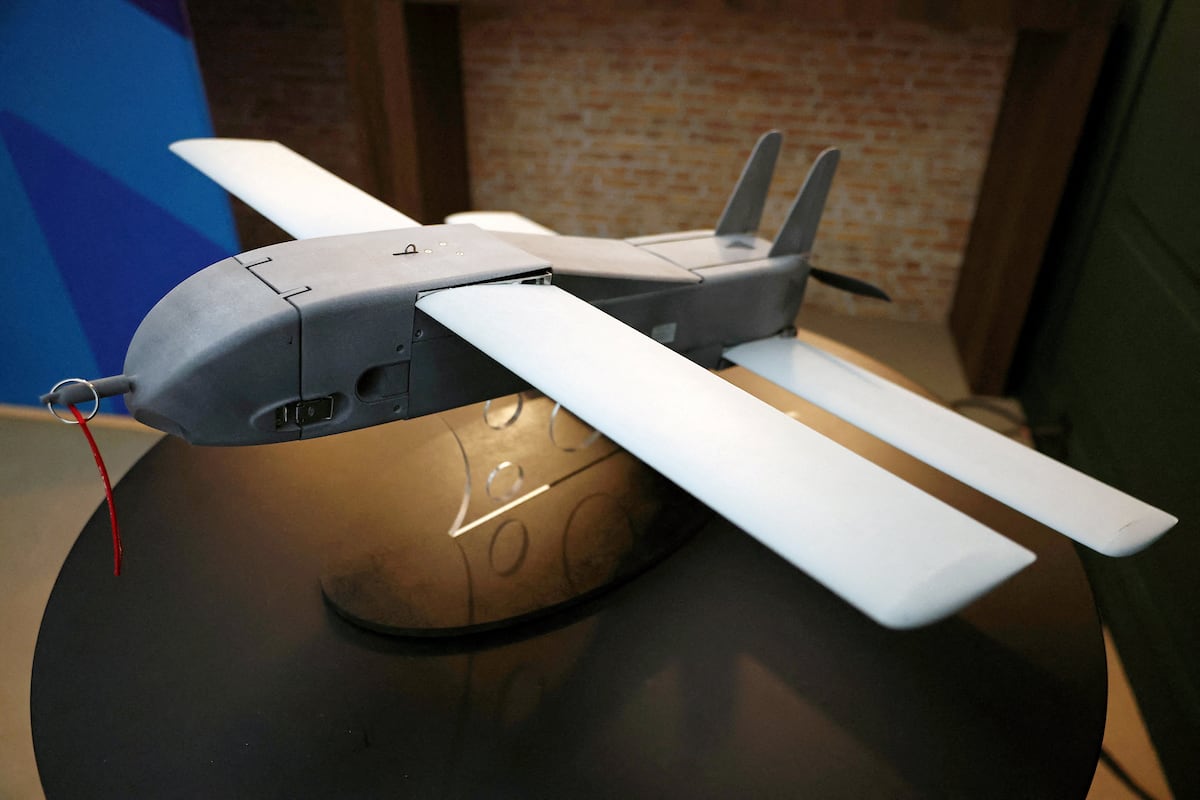
Renault, already working with Turgis & Gaillard to develop a long-range drone, partnered with Thales in June to industrialise production of the Toutatis kamikaze drone, targeting up to 1,000 units per month from 2027.
French drone maker Delair teamed up with German automotive supplier Schaeffler the same month to establish a French production line capable of producing around 100 drones per day by November.
If the plans announced by Renault, Schaeffler and Forvia are realized, combined output could reach 60,000 units per year. In a conflict, many more would be needed.
Drones have been used in warfare for decades, but the war in Ukraine has seen an explosion in scale.
Drones now dictate the flow of the battlefield, notching up the vast majority of kills. The front line has turned into a “kill zone,” with soldiers hiding underground from the constant aerial threat.
After Russia’s full-scale invasion in 2022, Ukraine quickly accelerated its use of drones for reconnaissance, battlefield combat and long-range strikes. President Volodymyr Zelenskiy said in July that it will produce 10 million in 2026.
Ukraine now has hundreds of drone makers, big and small. Some even produce more than Ukraine’s military can buy, and the government has cautiously moved towards allowing them to export some excess production.
Patrick Pailloux, head of France’s defense procurement agency, said he was working in particular with auto subcontractors to design drones that France will be able to produce in large quantities.
“It’s not the same: producing a drone in a defense start-up and making something that can be reproduced in very large volumes using production-line robots,” he said.
Renault CEO François Provost said in June the Toutatis kamikaze drone was being redesigned with fewer components and from injection-moulded plastic, enabling cheaper, higher-volume production than the current 3D-printed model.
Defense officials say the challenge is scaling up production capacity while not building stockpiles that could soon become obsolete.
Patrice Caine, CEO of French defense technology group Thales, said this summer that drones were “objects that evolve quickly” under the impetus of technological advances.
Pailloux said France needed “enough so that we can train, and (the production capacity) to be able to withstand a shock”.
Prime Minister Sebastien Lecornu pledged a €150 million ($175 million) investment to develop a dedicated drone sector last December.
But Antoine Level, head of France’s drone industry association, said Germany was ahead of France in funding short-range drones, and that there were still “not enough orders to truly stimulate the industry.”
法国正努力让其汽车工业参与生产军用无人机,这一努力正在逐步走向工业化实施。汽车制造商、汽车零部件供应商和国防公司之间的合作,将从乌克兰战争中吸取的经验教训转化为实际的装配线。
今年年初以来,至少有六项国防与汽车行业的合作项目宣布启动,法国总统埃马纽埃尔·马克龙的政府希望将法国汽车行业的规模、自动化和成本控制与增长最快的军事技术领域之一相结合。
乌克兰和俄罗斯使用无人机改变了战争格局,这促使法国及其欧洲盟友优先发展无人机生产,而华盛顿向欧洲施压,要求其提升军事能力,更使这一趋势变得紧迫起来。
这些项目表明,法国正在建立一个每年能够生产数万架无人机的工业基地——这是国防初创企业独自难以实现的规模,尽管与乌克兰和俄罗斯的努力相比仍然相形见绌。
“为什么是现在?因为现在有这个需求,无人机现在就应该投入使用,”汽车零部件供应商法雷奥首席执行官克里斯托夫·佩里拉特在7月底告诉记者。“为什么是在法国?因为我们被要求保障我们的主权。”
法国国防官员预计近期内不需要在法国上空部署大量无人机,但表示必须做好应对冲突的准备。
他们表示,此举旨在使法国具备快速生产无人机的能力,并在危机发生时迅速提高产量。法国参议院国防委员会7月份的一份报告指出,法国目前仅有的几千架无人机“不足以达到临界规模”。
法雷奥公司表示,将在法国为国防科技公司Harmattan AI生产电动无人机电机。与此同时,福维亚公司上周宣布与一家专注于人工智能反无人机系统的欧洲国防公司建立合作关系,并正在考虑在法国建厂,每月生产1000架拦截无人机。
雷诺此前已与 Turgis & Gaillard 合作开发远程无人机,并于 6 月与泰雷兹公司合作,实现 Toutatis 神风特攻队无人机的工业化生产,目标是从 2027 年起每月生产多达 1000 架。
同月,法国无人机制造商 Delair 与德国汽车供应商舍弗勒合作,建立了一条法国生产线,到 11 月,该生产线每天能够生产约 100 架无人机。
如果雷诺、舍弗勒和福维亚公布的计划得以实现,三家公司的联合产量可达每年6万辆。但在冲突中,所需的产量将远不止于此。
无人机在战争中已经使用了几十年,但乌克兰战争使其规模呈爆炸式增长。
无人机如今主导着战场局势,夺得了绝大多数的战果。前线已变成“杀戮区”,士兵们躲在地下以躲避持续不断的空中威胁。
2022年俄罗斯全面入侵后,乌克兰迅速加快了无人机在侦察、战场作战和远程打击方面的应用。总统泽连斯基7月表示,乌克兰计划在2026年生产1000万架无人机。
乌克兰现在有数百家无人机制造商,规模大小不一。有些制造商的产量甚至超过了乌克兰军方的采购量,政府已谨慎地开始允许他们出口部分过剩产品。
法国国防采购局局长帕特里克·帕尤表示,他正在与汽车分包商密切合作,设计法国能够大规模生产的无人机。
“这不一样:在国防初创公司生产无人机和使用生产线机器人大规模复制产品是两回事,”他说。
雷诺首席执行官弗朗索瓦·普罗沃斯特在 6 月份表示,Toutatis 神风特攻队无人机正在重新设计,采用更少的组件和注塑成型的塑料,与目前的 3D 打印模型相比,可以实现更便宜、更高产量的生产。
国防官员表示,挑战在于如何在扩大生产能力的同时,避免建立可能很快过时的库存。
法国国防技术集团泰雷兹首席执行官帕特里斯·凯恩今年夏天表示,在技术进步的推动下,无人机是“快速发展的物体”。
帕尤克斯表示,法国需要“足够的资源来进行培训,以及(生产能力)来抵御冲击”。
去年 12 月,总理塞巴斯蒂安·勒科尔努承诺投资 1.5 亿欧元(1.75 亿美元)发展专门的无人机产业。
但法国无人机行业协会负责人安托万·莱维尔表示,德国在短程无人机的资金投入方面领先于法国,而且目前“订单量仍然不足以真正刺激该行业的发展”。