CNA Explains: Will new loan limits for private-hire cars mean less COE demand or higher ride-hailing prices?CNA解读:新的私召车贷款限额会导致拥车证需求减少还是网约车价格上涨?
Individuals buying vehicles registered as private-hire cars can now only borrow up to 70 per cent of the car’s purchase price, compared with 100 per cent previously, but experts say it remains unclear whether this will lead to lower demand for COEs.
Individuals buying vehicles registered as private-hire cars can now only borrow up to 70 per cent of the car’s purchase price, compared with 100 per cent previously, but experts say it remains unclear whether this will lead to lower demand for COEs.
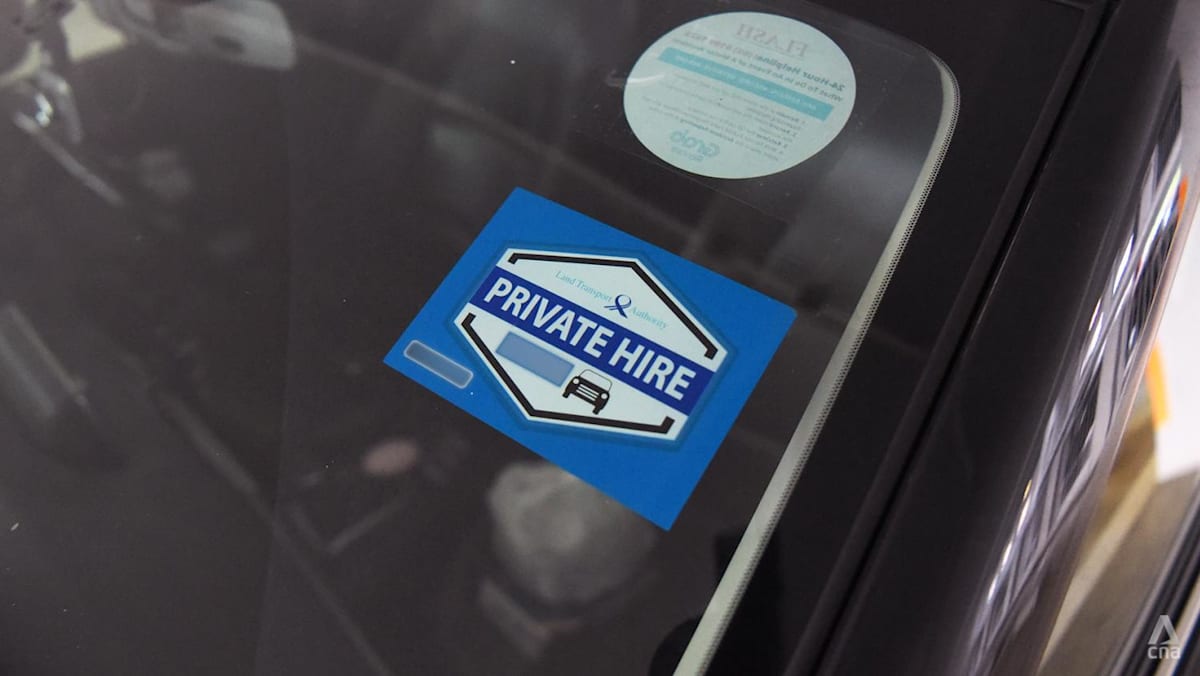
A car in Singapore with a private hire vehicle decal (Photo: CNA/Gaya Chandramohan)
This audio is generated by an AI tool.
SINGAPORE: The Singapore government took action this week to close a potential loophole that some car buyers may have used to access a bigger and longer loan.
From Friday (Oct 30), individuals buying vehicles registered as private-hire cars can only borrow up to 60 per cent or 70 per cent of the car's purchase price, depending on the open market value. The loan tenures will also be capped at seven years.
Previously, individual owners of private-hire cars could potentially take a loan on 100 per cent of the purchase price, meaning they would not need to pay a lump sum upfront.
The authorities said on Thursday that some buyers may have been registering their vehicles as private-hire cars "primarily to access more permissive financing terms" without intending to provide ride-hailing services.
They pointed to a recent surge in registrations of self-drive private-hire cars owned by individuals, which had reached around 500 vehicle registrations per month.
CNA explains what the tighter loan limits mean for Certificate of Entitlement (COE) premiums and ride-hailing fares.
Who is affected by the new rules?
The tighter loan limits directly affect buyers who register their individually owned cars as private-hire vehicles (PHVs), whether they intend to provide the services or not.
NTUC Assistant Secretary-General Yeo Wan Ling said the changes to financing will affect genuine private-hire drivers' ability to earn a living.
Ms Yeo, who is also adviser to the National Private Hire Vehicles Association, said the association will need to monitor whether the change unintentionally makes sustainable vehicle ownership inaccessible to genuine drivers, increase their dependence on rental fleets or raise their operating costs.
Carro's Singapore country head Kyran Wong said the vast majority of the firm’s customers take on normal loans or pay in cash.
"It is not common for car buyers to register their car as a PHV just to take on a 100 per cent loan," he said.
As of September this year, there were 98,621 private-hire cars in Singapore, according to the Land Transport Authority.
Mr Vincent Ng, business consultant at Vincar Group, said his company has customers who own their vehicles and use them to provide ride-hailing services part-time, but the numbers are not significant.
However, in other segments of the market such as for parallel imported cars, he said some car dealers actively tout and promote the 100 per cent loan, meaning some customers may have made use of the loophole.
Will demand for COEs fall?
However, it remains unclear whether the changes will lead to lower demand for COEs.
On one hand, removing the financing advantage should reduce demand from buyers who were primarily using private-hire car registration to access larger or longer loans, said Assistant Professor Lee Kwok Hao of the National University of Singapore's (NUS) Business School.
"However, some affected buyers may still purchase private cars under the conventional financing rules, while others may consider company ownership or alternative financing arrangements," he said.
The net reduction in COE demand depends on how many buyers leave the car market rather than change their registration or ownership arrangement, he added.
The Singapore University of Social Sciences' Walter Theseira made a similar point: "It depends on the marginal decision taken by the prospective buyer."
Some buyers can still afford the same vehicle with a regular loan, said the associate professor of economics, noting that the lowered interest rate would mean lower overall cost.
They may have registered the car as a private-hire vehicle mainly to maximise cashflow, and may still purchase the car.
Others may buy a car, but choose a cheaper vehicle so they can afford the downpayment, said Assoc Prof Theseira.
Lastly, some may now find themselves priced out of the market now that the option of a 100 per cent loan has been removed.
At the same time, he believes the market is currently driven by more premium buyers who are able to afford buying cars under normal financing arrangements.
CNA Games Guess Word Crack the word, one row at a time Buzzword Create words using the given letters Mini Sudoku Tiny puzzle, mighty brain teaser Mini Crossword Small grid, big challenge Word Search Spot as many words as you can Show More Show Less
How will COE premiums be affected?
Assoc Prof Theseira said movements in COE premiums will depend on what shifts prospective buyers make.
"It is unlikely that all of them will get priced out of the market. Hence, this move is not equivalent to just removing 10 per cent of demand," he said, referring to the 500 registrations of self-drive private-hire cars owned by individuals in recent months.
He noted that recent COE auctions have had around 5,000 car quotas per month.
Even if 10 per cent of demand is removed, there would be little impact on price if other buyers that have yet to secure a COE are willing to pay similar premiums, he said.
NUS' Asst Prof Lee said he would be reluctant to estimate a particular reduction in premiums on account of the 500 private-hire car registrations.
He said they represent a group that could potentially be affected, rather than 500 purchases that will definitely disappear.
"We do not know how many of these buyers relied on financing exceeding the new limits, nor how many will switch to other purchasing arrangements," he reiterated.
Overall, he said he expected some downward pressure on COE premiums, but the magnitude is uncertain.
Will fares for ride-hailing services be affected?
With tighter loan limits making it difficult for genuine private-hire vehicle drivers to purchase new cars, one might wonder if the supply of drivers may decrease, or if their operating costs may increase.
Assoc Prof Theseira does not expect ride-hailing to be affected in a big way, given that the loan limits target buyers who were registering their vehicles as private-hire cars without intending to provide private-hire services.
Asked if fares could rise, he said: "The move is not intended to affect PHV supply due to these vehicles not being used for PHV service in the first place, so this is less likely."
He added that using a new car to provide private-hire services would be a bad financial decision because the value of the car depreciates significantly especially when it is new.
Asst Prof Lee similarly expects the effect on ride-hailing fares to be minimal – unless the new limits materially reduce the number of active drivers or raise their operating costs.
He pointed to other factors affecting ride-hailing fares, such as passenger demand and the platforms' pricing decisions.
"Higher vehicle costs do not necessarily translate one-for-one into higher fares. Some costs may be absorbed through lower driver earnings or platform margins," he said.
Get our pick of top stories and thought-provoking articles in your inbox
Stay updated with notifications for breaking news and our best stories
Join our channel for the top reads for the day on your preferred chat app
现在,购买注册为私召车的车辆的个人只能借贷车辆购买价格的 70%,而以前可以借贷 100%,但专家表示,这是否会导致拥车证需求下降仍不清楚。
新加坡一辆贴有私人出租车标志的汽车(图片:CNA/Gaya Chandramohan)
这段音频是由人工智能工具生成的。
新加坡:新加坡政府本周采取行动,堵上了一个潜在的漏洞,一些购车者可能利用该漏洞获得更大额、更长期限的贷款。
自周五(10月30日)起,购买注册为网约车的个人,根据车辆的公开市场价值,最多只能贷款购车价格的60%或70%。贷款期限也将被限制在七年以内。
以前,私人出租车的个人车主可以申请购车款100%的贷款,这意味着他们不需要预先支付一大笔钱。
当局周四表示,一些购车者可能将车辆注册为私人出租车,“主要是为了获得更宽松的融资条件”,而并非打算提供网约车服务。
他们指出,最近个人拥有的自驾私人出租车的注册量激增,每月注册量已达到约 500 辆。
CNA解释了更严格的贷款限额对拥车证(COE)保费和网约车费用意味着什么。
新规会影响哪些人?
更严格的贷款限额直接影响那些将自己的私家车注册为私人出租车 (PHV) 的购车者,无论他们是否打算提供服务。
全国职工总会助理秘书长杨婉玲表示,融资方式的改变将影响真正的私召车司机谋生的能力。
同时担任全国私召车协会顾问的叶女士表示,该协会需要密切关注这一变化是否会无意中使真正的驾驶员无法拥有可持续的车辆所有权,增加他们对租赁车队的依赖,或提高他们的运营成本。
Carro 新加坡区负责人 Kyran Wong 表示,该公司绝大多数客户都选择普通贷款或现金支付。
他说:“购车者为了获得100%贷款而将汽车注册为PHV(插电式混合动力汽车)的情况并不常见。”
根据新加坡陆路交通管理局的数据,截至今年9月,新加坡共有98621辆私召车。
Vincar Group 的商业顾问 Vincent Ng 先生表示,他的公司有一些客户拥有自己的车辆,并利用这些车辆兼职提供网约车服务,但数量并不多。
然而,他表示,在其他细分市场,例如平行进口汽车市场,一些汽车经销商积极宣传和推广 100% 贷款,这意味着一些客户可能已经利用了这个漏洞。
对拥车证的需求会下降吗?
然而,这些变化是否会导致拥车证需求下降,目前尚不清楚。
新加坡国立大学商学院助理教授李国豪表示,一方面,取消融资优势应该会减少那些主要利用私召车登记来获得更大额或更长期限贷款的买家的需求。
“然而,一些受影响的买家可能仍然会按照传统的融资规则购买私家车,而其他人可能会考虑公司所有权或其他融资安排,”他说。
他补充说,拥车证需求的净减少取决于有多少买家退出汽车市场,而不是改变他们的登记或所有权安排。
新加坡社会科学大学的沃尔特·特塞拉也提出了类似的观点:“这取决于潜在买家做出的边际决策。”
这位经济学副教授表示,一些买家仍然可以通过普通贷款购买同样的车辆,并指出利率降低意味着总成本降低。
他们可能将这辆车登记为私人出租车,主要是为了最大限度地提高现金流,并且可能仍然会购买这辆车。
副教授塞西拉表示,有些人可能会买车,但会选择价格较低的车型,以便支付首付。
最后,由于100%贷款的选择被取消,一些人可能会发现自己买不起房了。
与此同时,他认为目前市场是由更多能够通过正常融资方式购买汽车的高端买家驱动的。
CNA游戏 猜词游戏 逐行破解单词 流行词游戏 用给定的字母组成单词 迷你数独 小小谜题,挑战你的大脑 迷你填字游戏 小方格,大挑战 单词搜索 尽可能多地找出单词 显示更多 显示更少
拥车证溢价将受到怎样的影响?
副教授塞西拉表示,拥车证溢价的变动将取决于潜在买家的购买意愿变化。
“不太可能所有车辆都会因为价格过高而被挤出市场。因此,此举并不等同于仅仅减少 10% 的需求,”他说道,指的是近几个月来个人拥有的 500 辆自驾出租车的注册量。
他指出,最近的拥车证拍卖每月配额约为 5000 辆汽车。
他表示,即使需求减少 10%,如果其他尚未获得拥车证的买家愿意支付类似的溢价,价格也不会受到太大影响。
新加坡国立大学助理教授李表示,他不愿估计500辆私召车登记会带来多少保费下降。
他说,他们代表的是可能受到影响的群体,而不是肯定会消失的 500 笔交易。
他重申:“我们不知道有多少买家依赖的融资超过了新的限额,也不知道有多少买家会转而采用其他购买方式。”
他表示,总体而言,他预计拥车证溢价会面临一定的下行压力,但下行幅度尚不确定。
网约车服务的费用会受到影响吗?
由于贷款限额收紧,真正的私家车司机难以购买新车,人们可能会想,司机数量是否会减少,或者他们的运营成本是否会增加。
副教授塞西拉预计网约车不会受到太大影响,因为贷款限额针对的是那些将车辆注册为私人出租车但并不打算提供私人出租车服务的买家。
当被问及票价是否会上涨时,他表示:“此举并非旨在影响私家车供应,因为这些车辆本来就不是用于私家车服务的,所以这种情况不太可能发生。”
他还补充说,用新车提供私人出租车服务是一个糟糕的财务决定,因为汽车的价值会大幅贬值,尤其是新车。
李助理教授同样预计,除非新的限制措施大幅减少活跃司机的数量或增加他们的运营成本,否则对网约车费用的影响将微乎其微。
他还指出,影响网约车票价的其他因素包括乘客需求和平台的定价决策。
他说:“车辆成本上涨并不一定会直接转化为车费上涨。部分成本可能会通过降低司机收入或平台利润来抵消。”
订阅我们的邮件,即可获取精选热点新闻和引人深思的文章。
订阅通知,第一时间获取突发新闻和精彩报道。
加入我们的频道,即可在您常用的聊天应用上获取当日热门文章。