Nearly half of S’pore employers who use AI in HR do so for recruitment: SNEF survey新加坡雇主联合会(SNEF)调查显示,近半数在人力资源领域使用人工智能的雇主将其用于招聘:
Nearly half of Singapore employers use AI in hiring, with SNEF survey highlighting oversight, fairness and HR adoption trends. Read more at straitstimes.com.
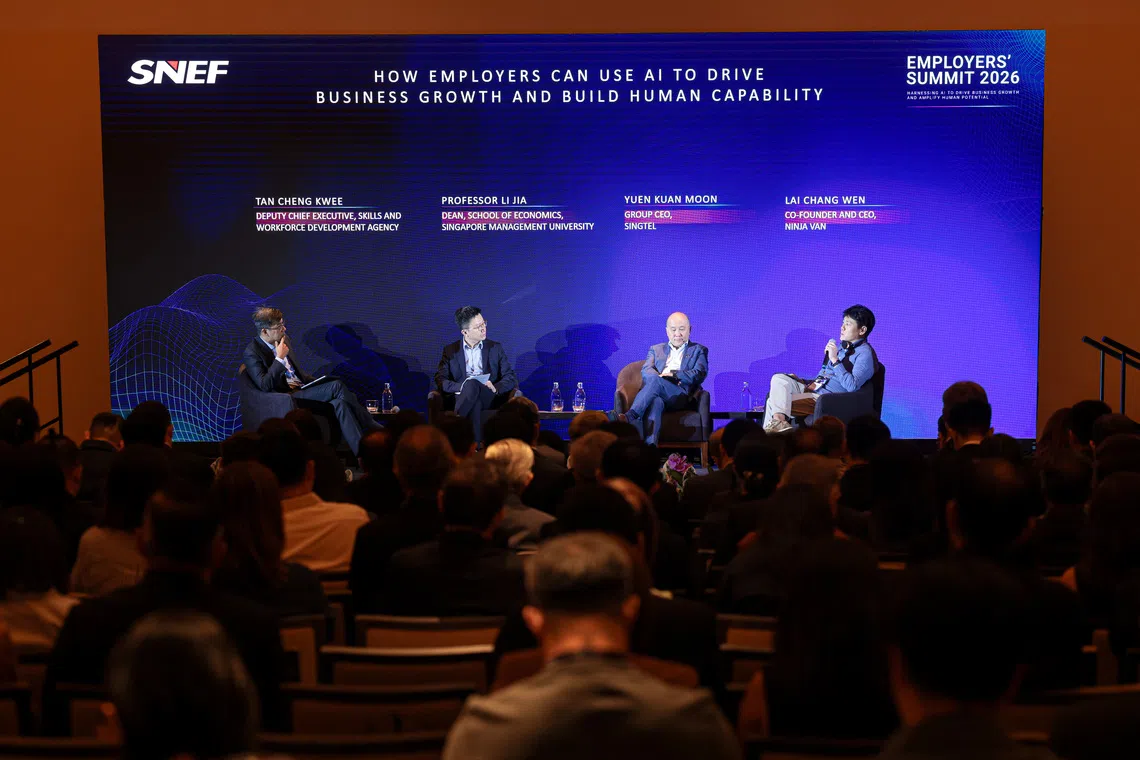
(From left) Skills and Workforce Development Agency deputy chief executive Tan Cheng Kwee; Dean of School of Economics at SMU Li Jia; Singtel group CEO Yuen Kuan Moon; and SNEF council member and Ninja Van CEO Lai Chang Wen at the SNEF Employers’ Summit 2026.
PHOTO: LIANHE ZAOBAO
Published Oct 30, 2026, 03:00 PM
Updated Oct 30, 2026, 08:47 PM
Nearly half of Singapore employers use AI in HR, especially for recruitment and performance. Larger firms use specialist tools, while smaller firms prefer general tools like ChatGPT.
SNEF said human oversight stays central. Most AI HR cases still need human sign-off, and employers worry about over-reliance, trust and accountability when AI makes errors.
SNEF launched an “AI-HR pre-scoped solution” and pilot consultants to support adoption. It also urged firms to keep AI decisions legal under workplace fairness rules and labour laws.
SINGAPORE – Almost three-quarters of Singapore employers use artificial intelligence in human resources processes, according to a new Singapore National Employers Federation (SNEF) survey.
The poll of 1,000 employers conducted in June and July found that 740 respondents use AI in HR, with the technology more widely used in the early stages of HR processes, such as recruitment (49%) and managing employee performance (45%), and less so in deciding compensation (26%) and managing employee exits (15%).
Larger firms employing more than 200 employees are more likely to adopt AI-powered HR tools such as Workday and SAP SuccessFactors, according to the survey. Workday, for instance, offers HR professionals work solutions involving the help of a co-pilot – like that of an AI agent – such as a “recruiting agent” and “performance agent” .
Meanwhile, small and medium-sized enterprises tend to rely more on all-purpose tools like ChatGPT and Microsoft Copilot.
The survey findings were unveiled at the inaugural SNEF Employers’ Summit on Oct 30 at Grand Hyatt Singapore, where eight organisations, including Singtel, Huawei Singapore and Nanyang Polytechnic, showcased AI solutions in an exhibition.
Singtel group chief executive Yuen Kuan Moon said in his keynote address that all AI-related projects in the company are being put through three lenses that look at measuring investment returns: customers, employees and future growth.
“Start with the value from the customer and employee (standpoints), and not from technology. Redesign the flow of work before selecting the tools, and the change is continuous,” he said, encouraging employers to move together as an organisation.
More than 300 people including business leaders, senior HR practitioners and trade association leaders were in attendance.
At the summit, Acting Manpower Minister Jasmin Lau highlighted a recently launched HR playbook that brings together “AI starter kits” for selected HR uses and training to build AI fluency among HR professionals. This is also meant to help SMEs access HR expertise more flexibly.
Lau also urged employers to include their unions and employees when redesigning jobs. “People are more likely to contribute to change when they have helped shape it.”
Maintaining human oversight
For firms that have adopted AI in their HR processes, human judgment remains central, said SNEF in a press statement on Oct 30. Out of nearly 3,000 HR use cases reported by 655 employers surveyed, 85% still require human confirmation or sign-off for AI-automated processes.
For example, while AI can be used to provide data or filter options, a person’s judgment to accept, reject or override decisions will still be needed.
Meanwhile, in cases where AI executes decisions without human intervention, findings showed that the majority of these tend to be high-volume or routine tasks like resume-screening and skills assessment.
Even so, nearly all employers (97%) have designated someone with authority, such as a supervisor or hiring manager, to intervene and change decisions if needed.
The top three concerns among employers using AI were an over-reliance that could erode HR capabilities over time, the challenge of knowing when to trust AI over professional judgment, and accountability when AI makes errors.
In his welcome remarks at the summit, SNEF president Kuah Boon Wee said: “The level of oversight should match the stakes: lighter for routine tasks, closer for decisions that affect people’s livelihoods. That is what responsible use should look like in practice.
“AI should enable our people to contribute at a higher level, not weaken the capability that our businesses depend on.”
The survey also found that the level of support employers want in adopting AI varies according to their stage of AI adoption. For example, those who are exploring AI are particularly interested in guidance on identifying AI tools that have been assessed for fairness, while employers already using AI want more clarity on responsible use, governance and liability considerations.
SNEF said it is important for employers to ensure that their HR decisions – including AI-enabled ones – are compliant with employment legislation and other pertinent guidance.
The survey found that 84% of employers surveyed who use AI in HR indicated they were very or extremely familiar with at least one of the frameworks covered in the poll, including the Workplace Fairness Act and Tripartite Guidelines on Fair Employment Practices.
At the summit, Acting Minister for Manpower Jasmin Lau highlighted a recently launched HR playbook which brings together “AI starter kits” for selected HR uses and training to build AI fluency among HR professionals. PHOTO: LIANHE ZAOBAO
At the summit, Acting Minister for Manpower Jasmin Lau highlighted a recently launched HR playbook which brings together “AI starter kits” for selected HR uses and training to build AI fluency among HR professionals.
Under the Workplace Fairness Act, workers will have stronger protections against discrimination at work under the new Workplace Fairness Legislation, which is being introduced through two Bills.
The first Bill, introduced in November 2024, specifies that employment decisions, such as in hiring, firing and appraisals, based on five groups of characteristics are unlawful. These are: age; nationality; sex, marital status, pregnancy status and caregiving responsibilities; race, religion and language; and disability and mental health conditions.
The second Bill is expected to be passed in 2026 or 2027.
At the summit, Kuah also launched an “AI-HR pre-scoped solution” for employers to get a paid package comprising workplace planning advisory support, workforce diagnostics and skills analytics, and AI solutions. Instead of a standalone tool, the package aims to encourage employers to look at AI-driven transformation holistically.
“The package is pre-scoped so you have a clearer sense of cost before you commit to it,” he said, adding that SNEF is starting with a pilot and preliminary group of consultants supported under the Workforce Development Grant (Job Redesign+).
The specialist consultants appointed based on their experience with AI-related HR projects include accounting firm BDO Singapore and manpower consultancy firm Elitez Group.
Under the grant, eligible employers can access funding of up to $150,000 for each company’s job redesign projects, including consultancy fees and worker reskilling costs.
“If you are exploring AI in HR, I encourage you to speak to (SNEF),” said Kuah.
Sharon Salim is a business correspondent at The Straits Times, with a focus on jobs, workplace culture and trends.
AI/artificial intelligence
(从左至右)技能与劳动力发展局副局长陈成贵;新加坡管理大学经济学院院长李佳;新加坡电信集团首席执行官袁冠文;以及新加坡全国雇主联合会理事会成员兼Ninja Van首席执行官赖昌文出席2026年新加坡全国雇主联合会雇主峰会。
图片来源:联合早报
发布于2026年10月30日下午3:00
更新于2026年10月30日晚上8:47
近半数新加坡雇主在人力资源管理中使用人工智能,尤其是在招聘和绩效管理方面。大型企业使用专业工具,而小型企业则更倾向于使用像 ChatGPT 这样的通用工具。
SNEF表示,人工监督仍然至关重要。大多数人工智能人力资源案例仍需人工签字确认,而雇主担心过度依赖人工智能会导致信任危机,并在人工智能出错时难以追究责任。
SNEF推出了一项“人工智能人力资源预定义解决方案”,并派遣试点顾问支持该方案的实施。同时,SNEF也敦促各公司确保人工智能决策符合工作场所公平规则和劳动法。
新加坡——新加坡全国雇主联合会 (SNEF) 的一项最新调查显示,近四分之三的新加坡雇主在人力资源流程中使用人工智能。
6 月和 7 月对 1000 位雇主进行的调查发现,740 位受访者在人力资源中使用人工智能,该技术在人力资源流程的早期阶段应用更为广泛,例如招聘 (49%) 和员工绩效管理 (45%),而在决定薪酬 (26%) 和员工离职管理 (15%) 方面应用较少。
调查显示,员工人数超过200人的大型企业更有可能采用Workday和SAP SuccessFactors等人工智能驱动的人力资源工具。例如,Workday为人力资源专业人员提供借助人工智能助手(例如“招聘助手”和“绩效助手”)的工作解决方案。
与此同时,中小企业往往更依赖于 ChatGPT 和 Microsoft Copilot 等通用工具。
调查结果于 10 月 30 日在新加坡君悦酒店举行的首届 SNEF 雇主峰会上公布。峰会上,包括新加坡电信、华为新加坡和南洋理工学院在内的八家机构在展览中展示了人工智能解决方案。
新加坡电信集团首席执行官袁冠文在主题演讲中表示,公司所有与人工智能相关的项目都从三个角度来衡量投资回报:客户、员工和未来增长。
他表示:“要从客户和员工的角度出发,而不是从技术的角度出发。在选择工具之前,先重新设计工作流程,而且变革是持续不断的。”他鼓励雇主作为一个组织共同前进。
包括企业领导人、高级人力资源从业人员和行业协会领导人在内的 300 多人出席了会议。
在峰会上,人力部代理部长刘嘉敏重点介绍了近期推出的人力资源指导手册,该手册汇集了针对特定人力资源应用的“人工智能入门工具包”以及旨在提升人力资源专业人员人工智能素养的培训。此举也旨在帮助中小企业更灵活地获取人力资源专业知识。
刘先生还敦促雇主在重新设计工作岗位时要让工会和员工参与进来。“当人们参与塑造变革时,他们更有可能为变革做出贡献。”
保持人工监督
SNEF在10月30日的一份新闻稿中表示,对于已在人力资源流程中采用人工智能的公司而言,人的判断仍然至关重要。在接受调查的655家雇主报告的近3000个人力资源用例中,85%的案例仍然需要人工确认或签字才能完成人工智能自动化流程。
例如,虽然人工智能可以用来提供数据或筛选选项,但仍然需要人来判断是否接受、拒绝或推翻这些决定。
同时,研究结果表明,在人工智能无需人工干预即可执行决策的情况下,大多数决策往往是大量或例行性任务,例如简历筛选和技能评估。
即便如此,几乎所有雇主(97%)都指定了有权力的人,例如主管或招聘经理,以便在必要时进行干预并改变决定。
使用人工智能的雇主最担心的三个问题是:过度依赖人工智能可能会随着时间的推移削弱人力资源能力;何时应该信任人工智能而不是专业判断的挑战;以及人工智能出错时的责任追究。
在峰会的欢迎致辞中,新加坡国家能源论坛(SNEF)主席郭文伟表示:“监管力度应该与利害关系相匹配:日常任务监管力度要轻一些,而影响人们生计的决策则需要更严格的监管。这才是负责任使用在实践中应有的样子。”
“人工智能应该使我们的人们能够做出更高水平的贡献,而不是削弱我们企业赖以生存的能力。”
调查还发现,雇主在采用人工智能方面所需的支持程度因其人工智能应用阶段而异。例如,正在探索人工智能的雇主尤其希望获得关于如何识别经过公平性评估的人工智能工具的指导,而已经在使用人工智能的雇主则希望更清楚地了解负责任使用、治理和责任方面的注意事项。
SNEF表示,雇主必须确保其人力资源决策(包括人工智能辅助决策)符合劳动法规和其他相关指导方针。
调查发现,在人力资源中使用人工智能的受访雇主中,84% 的人表示他们非常熟悉或极其熟悉调查中涵盖的至少一个框架,包括《工作场所公平法案》和《公平就业实践三方指南》。
在峰会上,人力部代部长刘嘉玲重点介绍了近期推出的人力资源手册,该手册汇集了针对特定人力资源应用的“人工智能入门工具包”以及旨在提升人力资源专业人士人工智能素养的培训。图片来源:联合早报
在峰会上,人力部代理部长刘嘉敏重点介绍了最近推出的人力资源手册,该手册汇集了用于特定人力资源用途的“人工智能入门套件”和培训,旨在提高人力资源专业人员的人工智能素养。
根据《工作场所公平法》,劳动者将在新的《工作场所公平立法》下获得更强有力的保护,免受工作场所歧视。该立法通过两项法案提出。
第一项法案于2024年11月提出,明确规定基于五类特征做出的雇佣决定(例如招聘、解雇和绩效评估)属于非法行为。这五类特征分别是:年龄;国籍;性别、婚姻状况、怀孕状况和照护责任;种族、宗教和语言;以及残疾和精神健康状况。
第二项法案预计将于 2026 年或 2027 年获得通过。
在峰会上,Kuah 还推出了一项“AI-HR 预定义解决方案”,为雇主提供包含工作场所规划咨询支持、劳动力诊断和技能分析以及人工智能解决方案的付费服务包。该服务包并非单一工具,而是旨在鼓励雇主以整体视角看待人工智能驱动的转型。
“该方案已预先确定范围,因此您在做出决定之前可以更清楚地了解成本,”他说道,并补充说,SNEF 正在启动一个试点项目,并组建了一批初步的顾问,这些顾问由劳动力发展补助金(工作重新设计+)提供支持。
根据其在人工智能相关人力资源项目方面的经验,委任的专业顾问包括会计事务所 BDO 新加坡和人力资源咨询公司 Elitez Group。
根据这项拨款,符合条件的雇主可以获得高达 15 万美元的资金,用于每个公司的工作岗位重新设计项目,包括咨询费和员工技能再培训费用。
Kuah表示:“如果您正在探索人工智能在人力资源领域的应用,我鼓励您与(SNEF)联系。”
Sharon Salim 是《海峡时报》的商业记者,主要关注就业、职场文化和趋势。
人工智能