Swastikas on some Finland air force flags to be phased out芬兰空军部分旗帜上的纳粹标志将被逐步移除。
Swastikas have remained on some Finnish air force flags, raising eyebrows among NATO allies, tourists and others who spot them at military events.
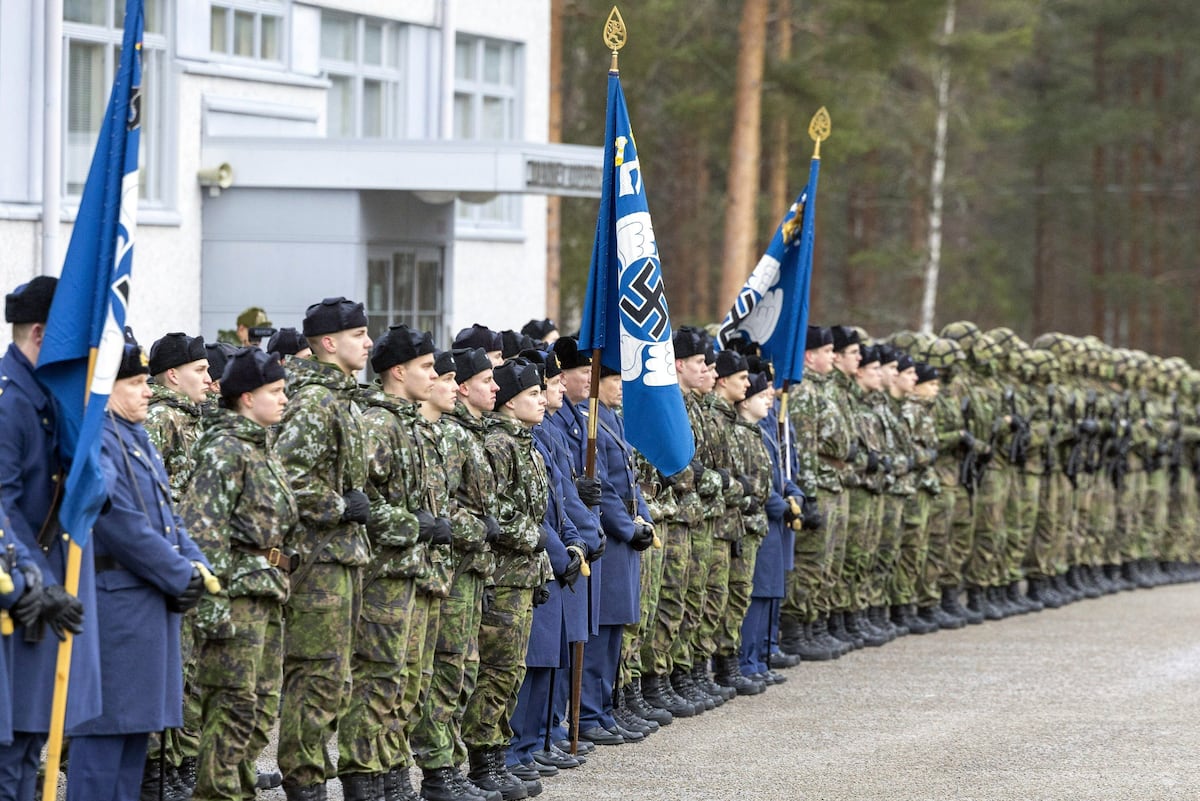
Finland’s Air Force, now part of NATO, still flies swastikas on a handful of unit flags — but is preparing to phase them out, largely to avoid awkwardness with its Western allies.
The history of the Finnish air force’s use of the swastika, which since the 20th century has largely been associated with Nazi tyranny and hate groups, is more complex than at first appearance. It is an ancient symbol and Finland’s air force began using it many years before the birth of Nazi Germany.
Change has been underway for years. A swastika logo was quietly pulled off the Air Force Command’s unit emblem a few years ago. But swastikas have remained on some Finnish air force flags, raising eyebrows among NATO allies, tourists and other foreigners who spot them at military events.
“We could have continued with this flag, but sometimes awkward situations can arise with foreign visitors. It may be wise to live with the times, Col. Tomi Böhm, the new head of Karelia Air Wing air defense force, was quoted as saying in a report Thursday by the public broadcaster YLE.
The Defense Forces, in an email to The Associated Press on Friday, said a plan to renew the air force unit flags was launched in 2023, the year Finland joined NATO, but said it was not linked to joining the alliance. The aim, it said, was “to update the symbolism and emblems of the flags to better reflect the current identity of the Air Force.”
It referred to an article in daily Helsingin Sanomat on Friday, which said the reason for the removal was a perception that the swastika has been an “embarrassing symbol in international contexts.”
Finland, which shares a long border with Russia, joined NATO in April 2023 over concerns related to Russia’s full-scale invasion of Ukraine.
Teivo Teivanen, a professor of world politics at the University of Helsinki, said the flags in question were introduced in the 1950s and today are flown by four Air Force units.
The Air Force and the Finnish public generally had for years insisted the swastikas used in Finland’s air force “have nothing to do with the Nazi swastika,” said Teivanen, who this month had a book published whose Finnish title translates as “History of the Swastika.”
But now, following Finland’s integration with NATO, policymakers have decided “there’s now a need to get more integrated with the forces of countries like Germany, the Netherlands, and France — countries where the swastika is clearly a negative symbol," he said.
Teivanen said that in 2021, German air force units bowed out of a final ceremony following exercises at a military base in Finland’s Lapland region after learning that the Finnish swastikas would be on display.
Finland’s air force adopted the swastika emblem in 1918 soon after country gained its independence after more than a century of Imperial Russian rule.
Count Eric von Rosen of neighboring Sweden donated Finland’s first military plane in 1918, which bore his personal symbol, the swastika.
The Finnish air force soon after adopted a blue swastika on a white background as the national insignia on all its planes from 1918 to 1945. After the war, the imagery remained for decades on some Air Force unit flags and decorations as well as on the insignia of the Air Force Academy.
But that doesn’t mean there is no Nazi connection at all.
Von Rosen, an aristocratic explorer and ethnographer, was the brother-in-law of Hermann Goering, a decorated World War I German fighter pilot who became an early Nazi Party member. Goering went on to lead Germany’s Luftwaffe during World War II under Hitler.
The Finnish air force stressed that its use of the symbol had no connection to Nazi Germany, although Finland entered into a reluctant alliance with the Third Reich during World War II.
New flags — featuring an eagle — will be published when the work has been completed and the flags are introduced into use for events like parades and local ceremonies, the Defense Forces said, without saying when that would happen.
“The traditional Von Rosen swastika emblem, in use since 1918, has already been removed from most other Air Force emblems during earlier reforms, so its removal from the unit flags is a logical continuation of this work,” the emailed statement said.
芬兰空军现在是北约的一部分,但仍有一些部队的旗帜上带有纳粹标志——不过,芬兰空军正准备逐步淘汰这些标志,主要是为了避免与西方盟友产生尴尬关系。
芬兰空军使用卐字的历史远比表面看起来复杂。自20世纪以来,卐字大多与纳粹暴政和仇恨团体联系在一起。它是一个古老的符号,芬兰空军早在纳粹德国成立之前就已经开始使用它了。
变革已持续多年。几年前,芬兰空军司令部悄然移除了部队徽章上的纳粹标志。但一些芬兰空军旗帜上仍然保留着纳粹标志,这引起了北约盟国、游客和其他外国人在军事活动中的关注。
“我们本来可以继续使用这面旗帜,但有时与外国访客相处会遇到尴尬的情况。顺应时代潮流或许才是明智之举。”卡累利阿空军联队新任防空部队司令托米·伯姆上校在周四芬兰国家广播公司YLE的报道中如是说。
芬兰国防军周五在一封发给美联社的电子邮件中表示,一项更新空军部队旗帜的计划于2023年启动,即芬兰加入北约的那一年,但该计划与加入北约无关。芬兰国防军称,此举旨在“更新旗帜的象征意义和标志,以更好地反映芬兰空军的当前形象”。
它提到了《赫尔辛基日报》周五发表的一篇文章,该文章称移除纳粹标志的原因是人们认为纳粹标志在国际语境中是一个“令人尴尬的符号”。
芬兰与俄罗斯接壤,由于担心俄罗斯全面入侵乌克兰,于 2023 年 4 月加入北约。
赫尔辛基大学世界政治学教授泰沃·泰瓦宁表示,这些旗帜是在 20 世纪 50 年代引入的,如今由四个空军单位悬挂。
芬兰空军和芬兰公众多年来一直坚称,芬兰空军使用的卐字标志“与纳粹卐字标志没有任何关系”,泰瓦宁说道。他本月出版了一本书,芬兰语书名翻译过来是《卐字标志的历史》。
但他表示,现在,随着芬兰加入北约,决策者们认为“现在有必要与德国、荷兰和法国等国的军队更加紧密地融合——在这些国家,纳粹标志显然是一个负面的象征。”
泰瓦宁表示,2021 年,德国空军部队在芬兰拉普兰地区的一个军事基地进行演习后的最后一次仪式上得知芬兰的纳粹标志将被展示后,便退出了仪式。
芬兰空军在 1918 年采用了卐字标志,当时芬兰刚刚结束了一个多世纪的沙皇俄国统治,获得了独立。
邻国瑞典的埃里克·冯·罗森伯爵于 1918 年向芬兰捐赠了第一架军用飞机,飞机上印有他的个人标志——卐字。
芬兰空军随后很快采用白底蓝卐字作为其所有飞机的国徽,从 1918 年到 1945 年一直沿用。战后,这一图案在一些空军部队的旗帜和勋章以及空军学院的徽章上保留了几十年。
但这并不意味着两者之间完全没有纳粹联系。
冯·罗森是一位贵族出身的探险家和民族学家,他是赫尔曼·戈林的妹夫。戈林是一位功勋卓著的第一次世界大战德国战斗机飞行员,后来成为纳粹党的早期成员。二战期间,戈林在希特勒的领导下,领导了德国空军。
芬兰空军强调,芬兰使用该标志与纳粹德国没有任何关系,尽管芬兰在二战期间被迫与第三帝国结盟。
国防部表示,新旗帜(以鹰为图案)将在制作完成后发布,并投入游行和地方仪式等活动中使用,但并未说明具体时间。
“自 1918 年以来一直使用的传统冯·罗森卐字徽章,在之前的改革中已经从大多数其他空军徽章中移除,因此将其从部队旗帜中移除是这项工作的合乎逻辑的延续,”电子邮件声明中写道。