From Singapore’s heartlands to luxury footwear: How Mashizan Masjum built a business on his own terms从新加坡的腹地到奢侈鞋履:马希赞·马斯朱姆如何按照自己的方式打造商业帝国
Once a television producer, the Singaporean now creates limited-edition shoes handmade in Florence for an international clientele. But building his luxury footwear label has meant learning when to adapt, rethink his designs and listen to his customers.
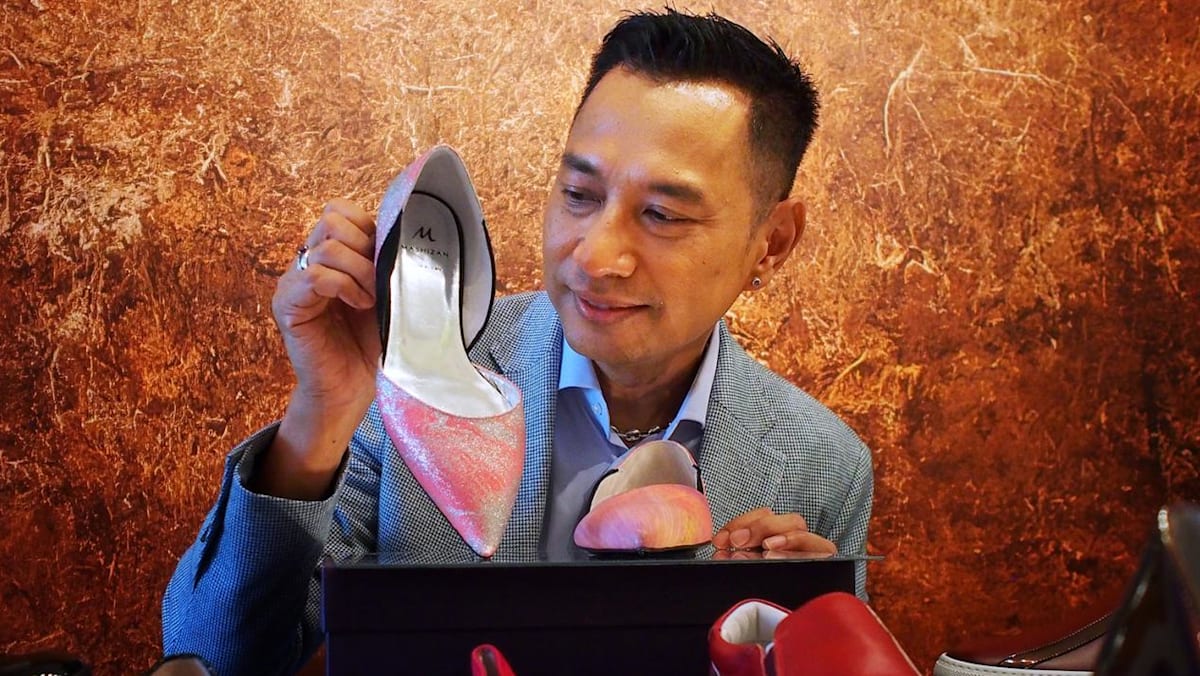
Once a television producer, the Singaporean now creates limited-edition shoes handmade in Florence for an international clientele. But building his luxury footwear label has meant learning when to adapt, rethink his designs and listen to his customers.
Singapore shoe designer Mashizan Masjum launched his namesake luxury footwear label in 2015, following nearly two decades in television. (Photo: Alfie Lee)
This audio is generated by an AI tool.
Mashizan Masjum’s first women’s shoe collection had all the elements of an escapist bling fantasy. There were heels towering up to 11cm, bold colours, iridescent leather and enough Swarovski crystals to send a magpie into a frenzy. After nearly two decades in television, the Singaporean had gone to Florence to learn how to make shoes and returned with a new creative itch that the media industry could no longer scratch.
The collection, launched in 2015, got fashion tongues wagging. Press coverage came hard and fast, and soon department stores started knocking. But women trying on his shoes kept telling Mashizan the same thing: The heels were simply too high.
“I listened to my customers,” said Mashizan, now 53. “You have to understand what’s practical and what they want.”
So he lowered the heels. By the time he presented his next collection at Singapore Fashion Week in 2016, the vertiginous heels had largely given way to lower styles. Today, some of the label’s most popular shoes are flats, kitten heels and sneakers, while even its higher heels tend to stop at around 5cm to 7cm.
Mashizan’s collections feature a range of footwear, from flats and kitten heels to higher heels, with an emphasis on both style and comfort. (Photo: Jude P)
It was the first of many course corrections. More than 10 years after launching his namesake label, Mashizan is still designing shoes – an achievement that belies how precarious those years have sometimes been. Twice, first in 2017 and again during the pandemic, he wondered whether the business would survive. What kept it going was not simply designing better shoes, but learning when to abandon his assumptions about luxury, how fashion should be sold and, ultimately, what his job as a designer actually entailed.
Mashizan was not exactly fleeing an unsuccessful first career.
“I’ve always felt that in a professional life, you don’t have to stick to one path,” he said. “There are many ways to go about developing your career and growing professionally.”
A graduate of the pioneer batch of NTU’s School of Communication Studies, he worked in current affairs and documentary production, including a stint with CNA. By the early 2000s, he was producing programmes independently across Asia.
International networks such as National Geographic and Discovery were beginning to commission more work out of Asia, but Mashizan felt many of the opportunities were still going to Western producers. If getting those commissions from Singapore was difficult, he reasoned, he would go to the US and prove himself there instead. In 2005, he moved to New York.
For someone who describes his younger self as a reticent “Singaporean boy” from the heartlands, New York required him to square his shoulders and make himself impossible to ignore. “You’ve got to be aggressive, right? You’ve got to be bold and fearless,” he recalled. “I had to transform.”
New York became his proving ground. Over the next six years, Mashizan broke into the American television industry, producing, writing and directing for production companies. He had gone there determined to prove that a Singaporean producer could compete internationally; when he returned to Singapore in 2011, he had the credentials to show for it.
As head of content at a production company, he was overseeing multiple producers and had reached a level of seniority many people spend their careers working towards. Yet something had gone missing.
“The higher the corporate ladder you go, the less creative you become,” he said.
Mashizan initially juggled his television career with designing shoes before deciding to devote himself fully to his namesake footwear label. (Photo: Alfie Lee)
In 2013, he took a six-month sabbatical in Florence to study footwear design and shoemaking. The intention was not to abandon television. He simply liked shoes, regarded them as small, wearable works of art and wanted to understand how they were constructed, right down to making a pair with his own hands. “I thought it was just going to be for fun,” he admitted.
He returned to television and initially ran both lives in parallel, designing shoes when he had the time and mental space. But after his first footwear collection began attracting attention, his boss asked him what he really wanted: To continue on the path he already knew, or see where the new one might lead.
Mashizan was already in his early 40s. “I thought long and hard about it,” he recalled. “If I don’t do it now, when am I going to do it?”
WHEN DESIGN MEETS REALITY
He took the plunge and realised that leaving television was one reinvention. Learning how to run a luxury footwear business was another.
The early attention did not automatically translate into a sustainable business. Mashizan was not a celebrity designer with an existing audience to draw upon, nor did he have the scale and marketing machinery of an established luxury house. Finding buyers meant slowly building a clientele from scratch.
“You really have to pound the pavement and try to build a cult following,” he said. “It took me many, many years, and those years were difficult.”
View this post on Instagram A post shared by MASHIZAN (@mashizanofficial)
A post shared by MASHIZAN (@mashizanofficial)
From the outside, at least, the label appeared to be gathering momentum. By 2016, Mashizan shoes were stocked at retailers including Public Factory in New York and Tiramisu in Milan, alongside department stores such as Tangs and Takashimaya back home. Mashizan was also taking his collections directly to customers through trunk shows in cities including New York, Paris, Dubai and Kuala Lumpur.
Yet by 2017, barely two years after launching the label, Mashizan was already questioning whether he could sustain the business on his own. It forced him to confront a less glamorous reality: Being a shoe designer involved surprisingly little time actually designing shoes.
He might devote a few concentrated weeks twice a year to creating a collection, but the rest of his time is spent taming the beast that is the business: Marketing, selling, speaking to clients, handling logistics and deciding what should – or should not – go into production.
Even during the creative process, several versions of Mashizan have to argue with one another as he reviews his sketches. There is the designer drawn to a particular silhouette or material, and the merchandiser asking who will buy it and in which market.
Mashizan, shoes are small, wearable works of art, a philosophy reflected in the sculptural shape of these metallic heels. (Photo: Jude P)
“I almost have to go through the process as though I am a big conglomerate, which I’m not,” he said with a chuckle.
Then there are the pattern makers and factories in Italy, who ultimately determine whether what exists on paper can become a properly constructed shoe.
Samples are then produced and shown at trunk shows, where Mashizan gauges customers’ reactions before deciding which designs to take into production. Of perhaps eight or 10 samples, only half might eventually be manufactured.
Over time, the label also stopped trying to operate like much larger fashion companies. Mashizan no longer rigidly follows the traditional seasonal calendar, preferring to release collections when they are ready. The business has also moved away from selling through retailers to dealing directly with customers through trunk shows, pop-ups and private appointments.
Some clients now own 10 or 12 pairs of his shoes. “When you show loyalty to people, people show loyalty back to you,” he said.
SURVIVING BY STAYING CLOSE
Rather than relying on department stores, Mashizan has increasingly focused on selling directly to customers through trunk shows, pop-ups and private appointments. (Photo: Alfie Lee)
Nowhere was that relationship tested more than in 2020, when the pandemic struck. Unable to hold face-to-face trunk shows, Mashizan wondered if his company would survive. As the world went into lockdown, new pairs of luxury shoes were hardly a priority – after all, there was nowhere to go and no occasion to trot around in a glamorous pair of heels.
Mashizan began holding private sessions over Zoom with customers in Singapore, including virtual fittings. To his relief, sales did not dry up entirely. Some clients continued buying shoes, even if they had to wait until the world reopened to wear them.
“Everyone was stuck at home, but then they had all this money to spend,” he recalled with a laugh. “So what do they do? They buy more shoes.”
By then, his decision to build the business around direct relationships rather than depend heavily on department stores had become an advantage. Mashizan could reach out to customers who already knew the label instead of waiting for a wholesale buyer to place another season’s order.
“A lot of my clients are actually MDs, CEOs. They’re really C-suite level,” he said. His customers also include school vice-principals, teachers and other professionals who spend much of the day on their feet and want something both comfortable and distinctive.
Prices on his website currently range from around S$650 (US$508) for slip-on sneakers and flats to about S$720 for heeled styles. Mashizan believes what unites his customers is not so much their income as a preference for something less widely available, rather than the familiar labels and monograms of major luxury brands.
His own modus operandi is deliberately small-scale. The shoes are handmade in Florence in limited quantities. This allows him to pay closer attention to materials, construction and the response of the people who wear them, rather than chase volume for its own sake. It also gives him room to experiment and source exclusive materials from artisans, often available only in small quantities.
A length of vintage kimono fabric he sourced, for instance, might yield just 12 pairs of shoes; another piece of leather might be sufficient for only four pairs of sneakers. Sometimes he offers these materials to long-standing customers before production even begins, giving them first dibs on a pair that may never be repeated.
“If you wanted a particular model in that pair, that size, there might only be two pairs,” he explained. “If you buy in Singapore, someone else buys in Paris. That’s it. In the whole world, only two of you will be having it.”
A LONG WAY FROM THE HEARTLANDS
The geography of those customers now mirrors Mashizan’s own life. Despite keeping the operation small and production strictly artisanal, he works with collaborators across several cities, including a partner in Paris and publicists in Los Angeles. His shoes are made in Italy, Paris is what he calls his “creative playground”, and New York is home.
Not every design makes it into production. Mashizan may develop eight to 10 samples, with only about half eventually manufactured. (Photo: Jude P)
“New York is home because we have a home here. My cats are here, my partner’s here as well,” he explained. “But Singapore has always been and will always be my anchor.”
It is perhaps the clearest measure of the distance travelled. In 2005, New York was where a reticent boy from Singapore’s heartlands arrived determined to prove that he could hold his own. Two decades later, he no longer talks about the city as a proving ground – it has simply become home.
A single handpicked story that we think you shouldn't miss. Just one a day.
这位新加坡人曾是一名电视制片人,如今在佛罗伦萨为国际客户手工制作限量版鞋履。但打造他的奢侈鞋履品牌意味着他必须学会何时调整、重新思考设计并倾听客户的意见。
新加坡鞋履设计师马什赞·马斯朱姆 (Mashizan Masjum) 在电视行业工作近二十年后,于 2015 年创立了以自己名字命名的奢侈鞋履品牌。(图片:Alfie Lee)
这段音频是由人工智能工具生成的。
玛希赞·马斯朱姆的首个女鞋系列完美诠释了奢华与幻想的融合。高达11厘米的鞋跟、大胆的色彩、闪亮的皮革,以及足以让喜鹊疯狂的施华洛世奇水晶,无不令人目眩神迷。这位新加坡设计师在电视行业摸爬滚打了近二十年后,前往佛罗伦萨学习制鞋技艺,归来后却发现自己对制鞋产生了新的创作热情,而媒体行业已无法满足她的需求。
这个系列于2015年推出,立刻引起了时尚界的广泛关注。媒体报道铺天盖地而来,百货公司也纷纷找上门来。但试穿他设计的鞋子的女性都向马希赞表达了同样的感受:鞋跟实在太高了。
“我倾听顾客的意见,”现年 53 岁的马希赞说。“你必须了解什么是实际的,以及他们想要什么。”
于是他降低了鞋跟高度。到了2016年他在新加坡时装周发布下一季作品时,恨天高已经基本被低跟鞋取代。如今,该品牌最受欢迎的鞋款包括平底鞋、猫跟鞋和运动鞋,即使是高跟鞋,鞋跟高度也通常在5到7厘米左右。
Mashizan的鞋履系列涵盖各种款式,从平底鞋、猫跟鞋到高跟鞋,兼顾时尚与舒适。(图片:Jude P)
这是众多调整中的第一次。创立同名品牌十多年后,马希赞依然在设计鞋履——这一成就掩盖了这些年来他所经历的种种挑战。他曾两次怀疑公司能否生存下去,第一次是在2017年,第二次是在疫情期间。支撑公司继续运营的,不仅仅是设计出更好的鞋履,更是学会了何时应该放弃对奢侈品、时尚销售方式以及最终作为一名设计师的真正职责的固有认知。
马希赞并非完全是为了逃避失败的第一份职业。
“我一直觉得,在职业生涯中,你不必拘泥于一条路,”他说。“有很多方法可以发展你的事业,实现专业成长。”
他毕业于南洋理工大学传播学院首届毕业生,曾从事时事和纪录片制作工作,包括在亚洲新闻台(CNA)工作过一段时间。到2000年代初期,他已开始独立制作亚洲各地的节目。
像国家地理频道和探索频道这样的国际电视网开始委托亚洲制作更多节目,但马希赞觉得很多机会仍然流向了西方制片人。他心想,既然在新加坡拿不到这些委托,不如去美国证明自己。2005年,他搬到了纽约。
他形容自己年轻时是个内向的“新加坡男孩”,来自新加坡的腹地。而纽约则要求他挺直腰杆,让自己引人注目。“你必须积极主动,对吧?你必须大胆无畏,”他回忆道,“我必须改变自己。”
纽约成了他的试炼场。在接下来的六年里,马希赞打入了美国电视行业,为多家制作公司担任制片人、编剧和导演。他此行的决心是证明新加坡制片人也能在国际舞台上竞争;2011年回到新加坡时,他已用实力证明了自己的努力。
作为一家制作公司的内容主管,他管理着多位制片人,并达到了许多人毕生追求的资历高度。然而,总觉得少了点什么。
他说:“你在企业里爬得越高,你的创造力就越低。”
马希赞最初一边从事电视事业,一边设计鞋子,之后才决定全身心投入到以自己名字命名的鞋履品牌中。(图片:阿尔菲·李)
2013年,他休假六个月前往佛罗伦萨,学习鞋履设计和制作。他并非有意放弃电视事业,只是单纯地喜欢鞋子,认为它们是小巧精致、可以穿戴的艺术品,想要了解它们的构造,甚至想亲手制作一双。“我当时只是想找点乐子,”他坦言。
他重返电视圈,起初两份工作并行,有空的时候就设计鞋子。但当他的第一个鞋履系列开始受到关注后,他的老板问他真正想要的是什么:是继续走他熟悉的路,还是看看新的道路会把他带向何方。
马希赞当时已经四十出头了。“我反复思考了很久,”他回忆说,“如果我现在不做,那我什么时候做呢?”
当设计遇上现实
他毅然决然地投身其中,意识到离开电视行业是一次自我重塑,而学习如何经营一家奢侈鞋履企业则是另一次。
早期的关注度并未自动转化为可持续的商业模式。马希赞并非拥有现成粉丝群的明星设计师,也没有成熟奢侈品牌所具备的规模和营销体系。寻找买家意味着他需要从零开始,慢慢建立起客户群。
“你真的需要脚踏实地,努力建立起一批忠实的追随者,”他说。“我花了很长时间,而且那些年非常艰难。”
在 Instagram 上查看此帖子 MASHIZAN (@mashizanofficial) 分享的帖子
MASHIZAN (@mashizanofficial) 分享的帖子
至少从表面上看,这个品牌似乎正在蓬勃发展。到2016年,Mashizan的鞋履已入驻纽约的Public Factory和米兰的Tiramisu等零售商,以及日本本土的Tangs和Takashimaya等百货公司。Mashizan还通过在纽约、巴黎、迪拜和吉隆坡等城市的巡回展销会,直接将他的系列产品带给顾客。
然而到了2017年,也就是品牌创立仅仅两年后,马希赞就开始质疑自己能否独自维持这项事业。这迫使他面对一个不那么光鲜的现实:作为一名鞋履设计师,真正花在设计鞋子上的时间远比想象中少得多。
他每年可能会抽出两周时间集中精力创作一个系列,但其余时间都用来驯服商业这头猛兽:营销、销售、与客户交谈、处理物流以及决定哪些产品应该投入生产,哪些产品不应该投入生产。
即使在创作过程中,马希赞在审阅草图时,脑海中也会同时浮现出几个不同的“马希赞”的形象。一方面,设计师会被某种特定的廓形或面料所吸引;另一方面,销售人员则会质疑谁会买,以及会在哪个市场销售。
Mashizan认为,鞋子是小巧精致、可穿戴的艺术品,这种理念体现在这双金属高跟鞋的雕塑造型上。(图片:Jude P)
“我几乎不得不像一个大型企业集团那样去完成这个过程,但我并不是,”他笑着说。
然后还有意大利的制版师和工厂,他们最终决定纸上的图案能否变成一双制作精良的鞋子。
随后制作样品并在巡回展上展示,Mashizan 会在展上收集顾客反馈,然后再决定哪些设计投入生产。大约八到十个样品中,最终可能只有一半会量产。
随着时间的推移,Mashizan 也不再试图像规模更大的时尚公司那样运营。它不再严格遵循传统的季节性发布计划,而是倾向于在设计完成后再发布系列。此外,Mashizan 的销售模式也从通过零售商转向通过巡回展、快闪店和私人预约等方式直接与顾客沟通。
有些客户现在拥有他设计的10双或12双鞋。“当你对别人忠诚时,别人也会对你忠诚,”他说。
生存之道在于保持亲密
Mashizan不再依赖百货公司,而是越来越注重通过巡回展、快闪店和私人预约等方式直接向顾客销售产品。(图片:Alfie Lee)
2020年疫情爆发时,这段关系经受了前所未有的考验。由于无法举办线下鞋履展示会,马希赞开始担忧公司能否生存下去。随着世界各地进入封锁状态,添置新鞋不再是人们的首要任务——毕竟,人们无处可去,也没有任何场合可以穿着华丽的高跟鞋招摇过市。
马希赞开始通过Zoom与新加坡的顾客进行一对一的线上咨询,包括虚拟试鞋。令他欣慰的是,销量并没有完全停滞。一些顾客仍然继续购买鞋子,即使他们不得不等到世界恢复正常后才能穿上它们。
“大家都困在家里,但他们却有很多钱可以花,”他笑着回忆道。“所以他们干了什么?他们买了更多的鞋子。”
那时,他决定围绕直接客户关系而非过度依赖百货公司来构建业务,这一策略已成为一项优势。马希赞可以主动联系那些已经了解该品牌的顾客,而无需等待批发商下下一季的订单。
“我的很多客户实际上都是总经理、首席执行官,他们都是真正的高管层,”他说。他的客户还包括学校副校长、教师和其他需要长时间站立的专业人士,他们希望鞋子既舒适又别具一格。
他网站上的鞋款价格目前从约650新元(508美元)的平底休闲鞋到约720新元的高跟鞋不等。马希赞认为,顾客的共同点与其说是收入,不如说是他们更偏爱一些不太常见的款式,而不是那些耳熟能详的大牌奢侈品牌的标签和标志。
他刻意采用小规模经营模式。鞋子在佛罗伦萨手工制作,产量有限。这使他能够更加关注材料、结构以及穿着者的反馈,而不是为了追求产量而盲目扩张。同时,这也让他有空间去尝试和采购工匠们提供的独家材料,这些材料往往数量稀少。
例如,他找到的一块复古和服面料,可能只能做出12双鞋;另一块皮革,可能只够做4双运动鞋。有时,他会在生产开始前就把这些材料提供给老客户,让他们优先获得可能绝版的鞋款。
“如果你想要特定款式、特定尺码的鞋子,可能只有两双,”他解释说。“如果你在新加坡买,另一个人会在巴黎买。就是这样。全世界可能只有你们两个人会拥有它。”
离中心地带很远
如今,这些顾客的分布地域与马希赞的生活轨迹不谋而合。尽管他坚持小规模运营和纯手工制作,但他与多个城市的合作伙伴保持着密切联系,包括一位巴黎的合伙人和洛杉矶的公关人员。他的鞋子产自意大利,巴黎是他所谓的“创意乐园”,而纽约则是他的家。
并非所有设计最终都能投入生产。Mashizan可能会开发8到10个样品,但最终只有大约一半会被制造出来。(图片:Jude P)
“纽约是我的家,因为我们在这里有房子。我的猫在这里,我的伴侣也在这里,”他解释说。“但新加坡一直并将永远是我的精神家园。”
这或许是衡量一路走来最清晰的指标。2005年,一个来自新加坡腹地、性格内向的男孩来到纽约,决心证明自己能够立足。二十年后,他不再把这座城市视为试炼场——它早已成为他的家。
每天一篇,我们精心挑选一篇您不容错过的精彩故事。