End of an era: Tracing Lee Biscuits' 92-year journey from Singapore to Johor一个时代的终结:追溯李氏饼干从新加坡到柔佛的92年历程
From Marie biscuits and cream crackers to colourful iced gems, Lee Biscuits' snacks were household staples for generations of Singaporeans and Malaysians. After 92 years, production is coming to an end.
From Marie biscuits and cream crackers to colourful iced gems, Lee Biscuits' snacks were household staples for generations of Singaporeans and Malaysians. After 92 years, production is coming to an end.
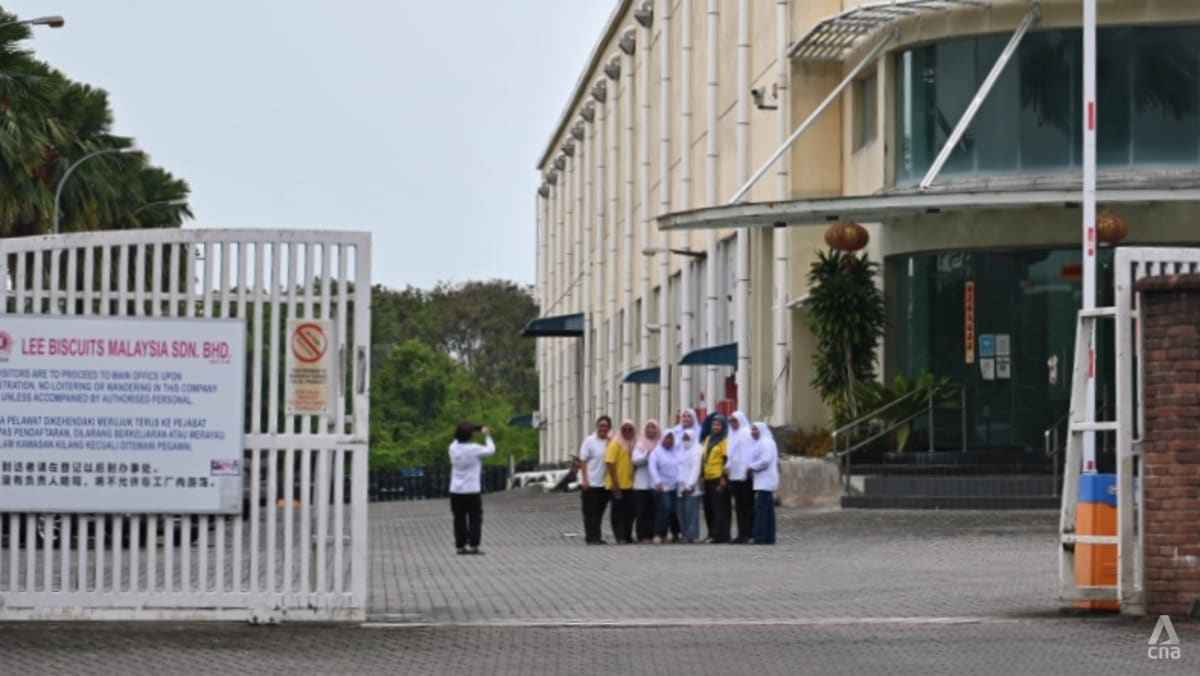
Workers taking photos outside the Lee Biscuits factory in Pontian, Johor on Oct 29, 2026. (Photo: CNA/Zamzahuri Abas)
This audio is generated by an AI tool.
JOHOR BAHRU/SINGAPORE: For generations of Malaysians and Singaporeans, Lee Biscuits' Marie biscuits, saltine crackers, banana puffs and colourful iced gems were familiar snacks.
Now, after 92 years, the biscuit maker, also known as Nam Lee, is preparing to cease production at its factory in Pontian, Johor at the end of October.
Founded in Singapore in 1934 by prominent businessman and philanthropist Lee Kong Chian, the company moved its manufacturing operations to Johor in 1955, first to Tampoi and later to Pontian.
When CNA visited the factory on Thursday (Oct 29), workers declined to comment on the impending closure. Some were seen taking photographs outside the factory as its final days approached.
For those whose lives have become intertwined with the factory, however, the closure is a personal loss.
Rogayah Othman, 62, has run a food stall just outside its gates since 2012, with workers stopping by regularly for breakfast and lunch.
“I am sad as I’ve grown close to some of the workers. They are like my own kids,” she told CNA.
Some Lee Biscuits products were still listed for sale on supermarket chain FairPrice’s website as of Thursday.
CNA looks back at the biscuit maker’s journey from Singapore to Johor.
CNA Games Guess Word Crack the word, one row at a time Buzzword Create words using the given letters Mini Sudoku Tiny puzzle, mighty brain teaser Mini Crossword Small grid, big challenge Word Search Spot as many words as you can Show More Show Less
Lee Biscuits' factory in Pontian, Johor on Oct 29, 2026. (Photo: CNA/Zamzahuri Abas)
1934-1955: From rubber empire to biscuit manufacturing
Lee Biscuits’ origins can be traced to 1934, when it was established in Singapore by Lee Kong Chian, one of Southeast Asia’s most prominent businessmen of his time.
Also known as the “Rubber King” and “Pineapple King”, Lee built a vast business empire spanning rubber plantations, pineapple cultivation, manufacturing and other industries.
According to Singapore’s National Library Board, Lee amassed much of his wealth through the rubber trade before diversifying into businesses such as Lee Pineapple, Lee Biscuits and Lee Sawmills.
He was also the son-in-law of rubber tycoon and philanthropist Tan Kah Kee, who introduced him to the rubber industry.
Beyond his business ventures, Lee was known for his philanthropic contributions, particularly in education. He contributed extensively to numerous schools and universities across Malaysia and Singapore.
A selection of biscuits produced by Lee Biscuits. (Photo: Facebook/Heritage SG Food)
Established while Singapore was still under colonial rule, Lee Biscuits set out to produce affordable biscuits for consumers in the region.
Its early offerings included cream crackers, banana puffs and Marie biscuits, products that would go on to become familiar snacks in households across Singapore and Malaysia.
The company also developed brands such as Shield, Turkey and Bell.
1955: Crossing the Causeway to Johor Bahru
After 21 years in Singapore, Lee Biscuits moved its manufacturing operations across the Causeway to Tampoi in Johor Bahru in 1955.
The relocation was aimed at giving the company greater access to Malaysia’s agricultural supply chains and industrial space, according to The Rakyat Post.
According to Lee Biscuits' website, the move was accompanied by acquisitions that allowed it to expand its operations and range of products.
A worker seen outside the Lee Biscuits factory in Pontian, Johor on Oct 29, 2026. (Photo: CNA/Zamzahuri Abas)
1965 onwards: More biscuits, more variety
As its manufacturing capabilities grew, so did its selection of biscuits.
From 1965, Lee Biscuits expanded its range to include lemon puffs, iced gems biscuits, animal cookies and chocolate and butter cream biscuits.
2000s: Another move in Johor
In 2000, Lee Biscuits fully upgraded its production facility into a modernised plant.
It also began researching and developing products to cater to increasingly health-conscious consumers, according to the company’s website.
Five years later, the company relocated its manufacturing operations from Tampoi to Pontian, also in Johor, to accommodate further expansion.
The former Tampoi site subsequently made way for a Giant hypermarket, according to The Edge Malaysia.
In 2008, the company obtained ISO and Hazard Analysis and Critical Control Points (HACCP) certifications, as part of efforts to improve manufacturing standards and food safety.
An aerial view of the Lee Biscuits factory in Pontian, Johor. (Photo: CNA/Zamzahuri Abas)
2023-2026: Winding down
Lee Biscuits' impending closure follows the shutdown of another longstanding food manufacturer under the Lee Group.
In November 2023, the group closed its decades-old Lee Pineapple cannery in Skudai, Johor, as it shifted focus towards oil palm cultivation. That closure prompted its own wave of nostalgia, with large crowds of people queuing to snap up its pineapple water before production ended.
Nearly three years later, it is Lee Biscuits’ turn.
Malaysian media reported this month that the Pontian factory would cease production at the end of October. Tan Eng Meng, the assemblyman for Pekan Nanas in Pontian, confirmed the closure to Malaysian Chinese news outlet China Press.
The shutdown is part of a restructuring by the parent group, which is reportedly moving away from snack manufacturing to consolidate its assets and focus on core businesses including rubber and palm oil operations, according to the New Straits Times.
Rogayah Othman, 62, runs a food stall just outside the Lee Biscuits factory in Pontian. (Photo: CNA/Zamzahuri Abas)
Suppliers and customers began receiving notices about the production halt in September, while the factory is also reportedly laying off workers.
About 300 employees were expected to remain until the end of October, mainly to carry out cleaning and other work at the factory, China Press reported.
Additional reporting by Zamzahuri Abas.
An automated curation of our top stories to start your day.
Get our pick of top stories and thought-provoking articles in your inbox
Stay updated with notifications for breaking news and our best stories
Join our channel for the top reads for the day on your preferred chat app
从玛丽饼干、奶油脆饼到色彩缤纷的糖霜巧克力,利氏饼干的零食曾是几代新加坡人和马来西亚人的家庭必备。92年后,利氏饼干的生产即将结束。
2026年10月29日,工人们在柔佛州笨珍的李氏饼干厂外拍照。(图片:CNA/Zamzahuri Abas)
这段音频是由人工智能工具生成的。
新山/新加坡:对于几代马来西亚人和新加坡人来说,李氏饼干的玛丽饼干、苏打饼干、香蕉泡芙和色彩缤纷的糖霜巧克力都是熟悉的零食。
如今,这家拥有 92 年历史的饼干制造商(又名南利)正准备在 10 月底停止其位于柔佛州笨珍的工厂的生产。
该公司由著名商人兼慈善家李光前于 1934 年在新加坡创立,1955 年将其生产业务迁至柔佛州,先是迁至淡杯,后来迁至笨珍。
周四(10月29日),中央社记者走访了这家工厂,工人们拒绝就即将关闭一事发表评论。随着工厂倒闭日期的临近,一些工人在工厂外拍照留念。
但对于那些生活与工厂紧密相连的人来说,工厂的关闭是一种个人损失。
62 岁的罗加亚·奥斯曼自 2012 年以来一直在大门外经营一个食品摊位,工人们经常来这里吃早餐和午餐。
“我很伤心,因为我和一些工人关系很亲密。他们就像我的孩子一样,”她告诉亚洲新闻台。
截至周四,部分 Lee Biscuits 产品仍在超市连锁店 FairPrice 的网站上出售。
CNA回顾了这家饼干制造商从新加坡到柔佛的历程。
CNA游戏 猜词游戏 逐行破解单词 流行词游戏 用给定的字母组成单词 迷你数独 小小谜题,挑战你的大脑 迷你填字游戏 小方格,大挑战 单词搜索 尽可能多地找出单词 显示更多 显示更少
2026 年 10 月 29 日,Lee Biscuits 位于柔佛笨珍的工厂。(照片:CNA/Zamzahuri Abas)
1934-1955年:从橡胶帝国到饼干制造
李氏饼干的历史可以追溯到 1934 年,当时由东南亚最杰出的商人之一李光前在新加坡创立。
李光耀也被称为“橡胶大王”和“菠萝大王”,他建立了一个庞大的商业帝国,业务涵盖橡胶种植园、菠萝种植、制造业和其他行业。
据新加坡国家图书馆管理局称,李光耀通过橡胶贸易积累了大量财富,之后又将业务拓展到李氏菠萝、李氏饼干和李氏锯木厂等行业。
他还是橡胶大亨兼慈善家陈嘉庚的女婿,陈嘉庚将他引入了橡胶行业。
除了商业成就之外,李光耀还以其慈善贡献而闻名,尤其是在教育领域。他为马来西亚和新加坡的众多中小学和大学慷慨解囊。
李氏饼干出品的一系列饼干。(图片来源:Facebook/Heritage SG Food)
李氏饼干创立于新加坡仍处于殖民统治时期,旨在为该地区的消费者生产价格实惠的饼干。
其早期产品包括奶油饼干、香蕉泡芙和玛丽饼干,这些产品后来成为新加坡和马来西亚家庭熟悉的零食。
该公司还开发了 Shield、Turkey 和 Bell 等品牌。
1955年:跨越堤道前往新山
在新加坡经营 21 年后,李氏饼干于 1955 年将其生产业务迁至柔佛州新山淡杯。
据《人民邮报》报道,此次搬迁旨在让该公司更好地进入马来西亚的农业供应链和工业领域。
据 Lee Biscuits 网站称,此举伴随着一系列收购,使其能够扩大业务范围和产品种类。
2026 年 10 月 29 日,柔佛州笨珍 Lee Biscuits 工厂外的一名工人。(照片:CNA/Zamzahuri Abas)
1965年至今:更多种类的饼干
随着其生产能力的提升,其饼干种类也随之增加。
从 1965 年起,李氏饼干扩大了产品范围,包括柠檬泡芙、糖霜宝石饼干、动物饼干以及巧克力奶油饼干。
2000年代:在柔佛州的又一次搬迁
2000年,李氏饼干公司将其生产设施全面升级为现代化工厂。
据该公司网站介绍,该公司还开始研发产品,以迎合日益注重健康的消费者。
五年后,为了进一步扩张,该公司将其生产业务从柔佛州的淡杯迁至笨珍。
据《马来西亚边缘报》报道,原淡杯地块后来被改建成了Giant大型超市。
2008 年,该公司获得了 ISO 和危害分析与关键控制点 (HACCP) 认证,这是为提高生产标准和食品安全所做的努力的一部分。
柔佛笨珍李饼干工厂的鸟瞰图。 (照片:CNA/Zamzahuri Abas)
2023-2026年:接近尾声
李氏饼干即将倒闭,此前李氏集团旗下的另一家老牌食品制造商也已关门歇业。
2023年11月,该集团关闭了位于柔佛州士古来、经营数十年的李氏菠萝罐头厂,转而将业务重心转向油棕种植。此次关闭引发了一波怀旧热潮,大批民众排队抢购停产前的菠萝水。
将近三年后,轮到李氏饼干了。
马来西亚媒体本月报道称,笨珍工厂将于10月底停产。笨珍北干那那州议员陈永明向马来西亚中文媒体《中国报》证实了这一消息。
据《新海峡时报》报道,此次停产是母公司重组的一部分,据称该母公司正在逐步退出零食制造领域,以整合资产并专注于橡胶和棕榈油等核心业务。
62岁的罗加亚·奥斯曼在笨珍李氏饼干厂外经营着一个食品摊位。(图片:CNA/Zamzahuri Abas)
供应商和客户从9月份开始陆续收到停产通知,据报道,该工厂也在裁员。
据《中国报》报道,约有300名员工预计将留任至10月底,主要负责工厂的清洁和其他工作。
Zamzahuri Abas 的补充报道。
每天清晨,我们都会自动为您推送最热门的新闻资讯,助您开启美好的一天。
订阅我们的邮件,即可获取精选热点新闻和引人深思的文章。
订阅通知,第一时间获取突发新闻和精彩报道。
加入我们的频道,即可在您常用的聊天应用上获取当日热门文章。