From boats to buildings: Sembawang Shipyard’s final voyage从船舶到建筑:三巴旺船厂的最后航程
As operations wind down at Seatrium’s Admiralty Yard, CNA speaks to two long-time employees about the site’s rich maritime history and their hopes for the redevelopment.
新闻视频
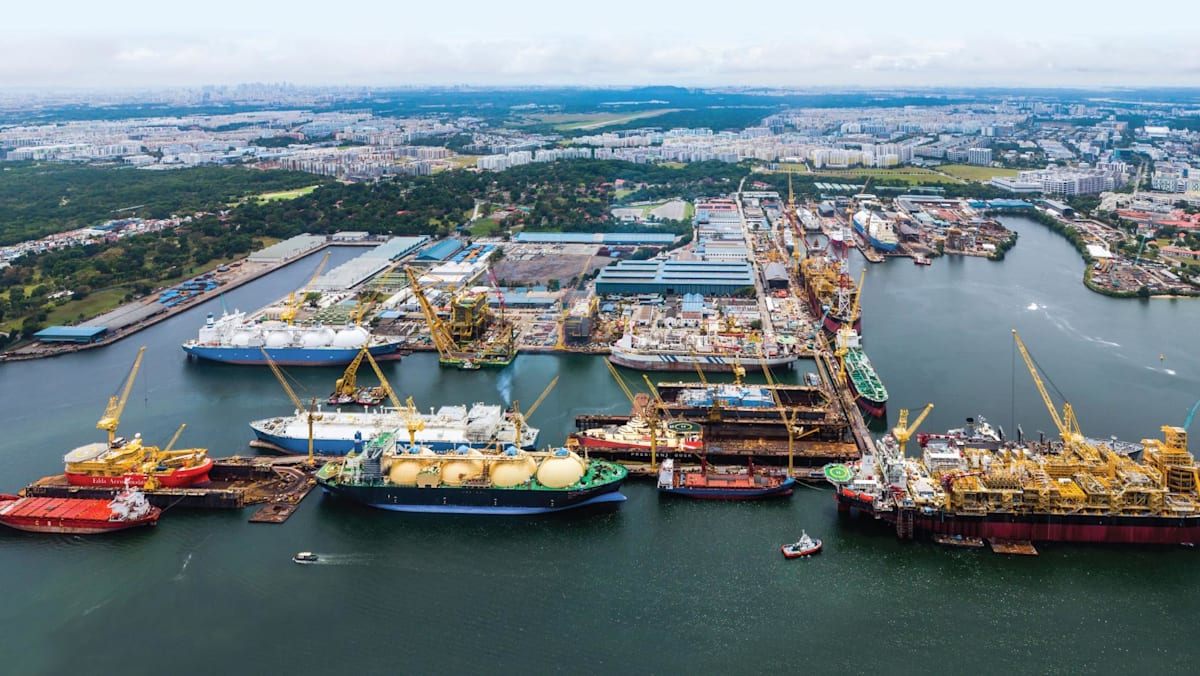
As operations wind down at Seatrium’s Admiralty Yard, CNA speaks to two long-time employees about the site’s rich maritime history and their hopes for the redevelopment.
Seatrium Admiralty Yard, formerly known as Sembawang Shipyard. (Photo: Seatrium)
This audio is generated by an AI tool.
SINGAPORE: About once a week, Ms Wang Huiping makes her way to Admiralty Yard when she has meetings or projects to attend to.
It has been over a decade since the shipyard was renamed. But whenever she takes a taxi there, drivers still ask: "Going to Sembawang Shipyard?"
For many like Ms Wang, 56, who has worked at the shipyard since she was a fresh graduate in 1993, it is a name that is embedded in memory.
The shipyard is still operational under offshore, marine and energy company Seatrium. But it has begun to wind down ahead of 2028, when the land will be returned to the government for redevelopment.
CNA Games Guess Word Crack the word, one row at a time Buzzword Create words using the given letters Mini Sudoku Tiny puzzle, mighty brain teaser Mini Crossword Small grid, big challenge Word Search Spot as many words as you can Show More Show Less
Workers at Seatrium Admiralty Yard, on Jul 28, 2026. (Photo: CNA/Ili Mansor)
These days, the flurry of workers in coveralls cycling to their posts in the morning, and the grumble of machines that once filled the naval workshops have given way to a slower rhythm.
“Then you look around, it's really a very nostalgic feeling. Not many people, not many ships. It’s like counting the days,” said Ms Wang, Seatrium’s vice-president of marketing for repairs and upgrades.
“So that's why it can also be quite sad, because it used to be full house and full of vibe.”
The 86ha site – almost the size of Jurong Lake Gardens – is planned for redevelopment into a mixed-use waterfront precinct , Prime Minister Lawrence Wong said at the 2025 National Day Rally.
The area’s maritime heritage will be preserved, including the King George VI Dock, which was once the world’s largest dry dock. Ideas being considered for the space include community spaces for concerts, sports and performances.
The government is also exploring waterfront homes, dining, shopping and recreation along the coastline.
“When you put it all together, this can become a new vibrant waterfront destination in the north – rich in heritage, yet reimagined for the future,” Mr Wong said at the time.
An artist’s impression of housing blocks by the coast at the redeveloped Sembawang Shipyard area. (Image: Singapore Institute of Planners)
For the many employees who have spent decades of their lives at the shipyard, the redevelopment plans come with a sense of bittersweetness.
“We just hope that in doing that, some of the things very unique about this location, they can consider preserving,” said Ms Wang.
“And I mean, they cannot preserve us, the people, but (they can preserve) the buildings.”
Sembawang Shipyard’s roots date back to 1938, when it was built by the British as a naval base to service British warships.
At the time, it was comparable to the best naval bases in the world, boasting the King George VI Dock. The dock spans 4.55 million cubic ft – roughly equivalent to 51 Olympic-sized swimming pools – and could fit the biggest ships at the time.
During World War II, the base was occupied by Japanese forces, who enlisted civilian dockyard workers under harsh conditions, according to historical accounts. In 1945, it reverted to British control.
When the British handed over the base to Singapore in 1968, it was for a token sum of S$1.
The naval docks were commercialised and converted into Sembawang Shipyard. In 1971, it was officially declared open by then-President Benjamin Sheares.
A plaque dated December 1968 commemorating the British handover of the shipyard to the Singapore government. (Photo: CNA/Ili Mansor)
Then-Prime Minister Lee Kuan Yew at the opening of the Premier Dock in 1975. (Photo: Seatrium)
In its early days, the shipyard employed "thousands of people", many of whom made the surrounding Sembawang area home.
“So many people have done so much work (and) contributed. Last time they even tell me, ‘My father used to work here, my brother used to work here.’ Sometimes there are also couples who work together,” said Ms Wang, who also met her husband at work.
Employees were often willing to go the extra mile because they felt a strong sense of belonging to the place, she added.
“There’s a lot of kampung spirit. Long ago, we even had an in-house barber shop for the workers to cut their hair,” she said.
“At that time, we probably called it the Sembawang spirit … of course we have evolved over the years, and now we are part of a bigger Seatrium family,” she added, referring to Sembcorp Marine’s rebrand to Seatrium in 2023, following a merger with Keppel Offshore & Marine.
For more than 30 years, Ms Wang saw the shipyard grow and she will also be here to see its eventual end.
Ms Wang Huiping, vice-president of marketing at Seatrium repairs and upgrades, in Seatrium Admiralty Yard on Jul 28, 2026. (Photo: CNA/Ili Mansor)
In its early years, the shipyard carried out standard repairs on simple tankers, bulk carriers and container ships.
Over time, through upgrades and long-term partnerships, more high-value ships began docking at the yard.
For example, the shipyard focused on retrofitting and converting liquefied natural gas (LNG) carriers into specialised vessels, such as floating storage and regasification units and floating liquefied natural gas vessels. Seatrium also developed its capabilities in cruise ship upgrades, refurbishment and life-extension.
“We always forecast and build our facilities to cater to what we think is coming,” said Ms Wang.
“The ships don't just come by chance. You need to target and build and court that particular customer.”
The King George VI dockside crane at Seatrium Admiralty Yard, on Jul 28, 2026. The crane, marked with the year 1937, is used to hoist materials and equipment into and out of the dock, as well as to and from ships in the dock. (Photo: CNA/Ili Mansor)
With the shipyard calling time, many of her colleagues hope the redeveloped space will retain the memories of the site's rich maritime history.
According to the Urban Redevelopment Authority (URA), the Singapore Institute of Architects and the Singapore Institute of Planners have each developed ideas for what the future Sembawang Shipyard site could look like.
One idea is to turn the King George VI Dock into a sunken public plaza for community sports and recreation.
An artist's impression of the redevelopment of Sembawang Shipyard. (Image: Urban Redevelopment Authority)
“I hope they don’t convert it into a swimming pool,” said Ms Wang jokingly.
“I hope it's still recognisable as a dock because imagine you develop this place, then if people shift in, they can see a semblance of the history behind this place. Not just Sembawang – the entire Sembawang, Chong Pang area is all part of a big naval base.”
An art-deco modern fire station, which was conserved in 2007, can be transformed into a community and lifestyle hub.
Former naval workshops could be reimagined as spaces for media production, start-ups and artists, alongside a mall with cafes and co-working spaces, URA said.
A former fire station at Seatrium Admiralty Yard, on Jul 28, 2026. (Photo: CNA/Ili Mansor)
One of the machinery workshops at Seatrium Admiralty Yard, on Jul 28, 2026. (Photo: CNA/Ili Mansor)
For assistant vice president of operations Choo Xin Jian, the machinery workshop has a special place in his heart.
Even after moving on from the machinery department to yard and project management, the 43-year-old still “holds a lot of feelings” for the building and drops by the workshop from time to time to say hello to the people there.
Mr Choo, who spent 16 years of his 20-year career at the workshop, said one of his favourite memories is working through the night on demanding projects.
“For cruise vessels, they don't have buffer time to extend the schedule because the customers, the passengers, are waiting. So, for some of the projects, what we do is that we work around the clock.
“Then, in order for better coordination … we actually spend time in the shop overnight to ensure that during the night the productivity and the safety are not slacking off; it's the same as what we did during the daytime,” he said.
Mr Choo Xin Jian, assistant vice-president of operations at Seatrium, in the machinery workshop at Seatrium Admiralty Yard on Jul 28, 2026. (Photo: CNA/Ili Mansor)
It is painstaking work, but the effort is worth it.
“That blood, tears, sweat, but when you see the end product – high satisfaction. That satisfaction you can never take away. It is always part of your memory,” he said.
Mr Choo hopes the machines that have chugged alongside workers for decades – some of the oldest cranes date back to 1934 – can be preserved as part of the site's heritage for future generations.
When the British left the shipyard to Singapore, there were no operating instructions or manuals for the machines, said Mr Choo. Employees had to figure out how to use them through observation and on-the-job training.
The machines are still being used for their original functions, such as lifting heavy items or creating parts for ship repair. Today, Seatrium uses a combination of legacy machines and modern equipment.
Dr Tony Tan, then-Minister for Finance, visited the naval workshop in July 1979. (Photo: Seatrium)
The long lathe machine in the machinery workshop at Seatrium Admiralty Yard on Jul 28, 2026. (Photo: CNA/Ili Mansor)
“So if we can use the machine, which is currently still operational up to the standards that we require, then there's no need to actually buy any machines,” said Mr Choo, adding that it is not cost-effective to replace them.
“Once you have feelings towards a particular piece of equipment, you want to keep it running. That is the pride that people have.”
Older machines that have been maintained over the years and remain in use at the machinery workshop at Seatrium Admiralty Yard, on Jul 28, 2026. (Photo: CNA/Ili Mansor)
NOT JUST ANOTHER PIECE OF LAND
For now, the focus is on transitioning the workforce and projects to Seatrium’s Tuas Boulevard Shipyard, an integrated mega-shipyard in south-west Singapore about three times the land area of the Sembawang site.
According to Seatrium, the Sembawang site will continue to support ongoing work, while areas no longer required for project execution are progressively being prepared for handover.
The process is being managed in phases to maintain safe and efficient operations while ensuring continuity for projects and customers.
The interior of the machinery workshop at Seatrium Admiralty Yard, on Jul 28, 2026. (Photo: CNA/Ili Mansor)
After spending the bulk of two decades at Sembawang, Mr Choo said he feels sad to leave.
“But again, in all aspects of life, evolution and transition are unavoidable,” he said.
“But I can say that I'm proud to be part of the history in Admiralty Yard, and to see its development from then-Sembawang Shipyard to Sembcorp Marine, and finally to Seatrium Admiralty Yard.”
To him, the yard signifies the resilience of Singapore – in transforming from a naval dockyard to a commercially viable yard.
“It proves the resilience, the dedication, and the innovativeness of people coming together, the spirit that actually emboldens the growth of this yard.
“Similarly, it reflects how Singapore actually grows in times of crisis, in times of economic uncertainty, but we managed to pull it through.”
For Ms Wang, her hope for the future generations that will come to live in the new development is a simple one.
The shipyard is historically significant, as part of Singapore's early development as a maritime hub, she said.
“I hope that they know that this is not just another piece of land.”
Get our pick of top stories and thought-provoking articles in your inbox
Stay updated with notifications for breaking news and our best stories
Join our channel for the top reads for the day on your preferred chat app
随着 Seatrium 的 Admiralty Yard 的运营逐渐结束,CNA 采访了两位在该地工作多年的员工,了解该地丰富的航海历史以及他们对重建的期望。
Seatrium Admiralty Yard,前身为 Sembawang Shipyard。(图片:Seatrium)
这段音频由人工智能工具生成。
新加坡:王慧萍女士大约每周一次会前往海军部码头,处理会议或项目。
船厂更名已经十多年了。但每当她乘出租车去那里时,司机仍然会问:“去三巴旺船厂吗?”
对于像 56 岁的王女士这样的人来说,这个名字早已深深烙印在她的记忆中。王女士自 1993 年大学毕业后就一直在这家造船厂工作。
该造船厂目前仍在海上、海洋和能源公司Seatrium的运营下。但随着土地在2028年归还政府用于重新开发,造船厂已开始逐步关闭。
CNA游戏 猜词游戏 逐行破解单词 流行词游戏 用给定的字母组成单词 迷你数独 小小谜题,挑战你的大脑 迷你填字游戏 小方格,大挑战 单词搜索 尽可能多地找出单词 显示更多 显示更少
2026年7月28日,Seatrium Admiralty Yard的工人们。(图片:CNA/Ili Mansor)
如今,早上穿着工作服的工人们骑着自行车匆匆赶往工作岗位的景象,以及曾经充斥着海军车间的机器轰鸣声,都已被更慢的节奏所取代。
“环顾四周,真的会有一种很怀旧的感觉。人不多,船也不多。感觉就像在数日子一样,”Seatrium公司负责维修和升级营销的副总裁王女士说道。
“所以这也让人感到很伤感,因为这里以前总是座无虚席,气氛非常活跃。”
总理黄循财在2025年国庆群众大会上表示,这块占地86公顷(几乎与裕廊湖花园面积相当)的地块计划重新开发为一个多功能滨水区。
该地区的航海遗产将得到保护,其中包括曾是世界上最大的干船坞——乔治六世国王船坞。目前正在考虑的方案包括将该区域改造成用于举办音乐会、体育赛事和表演的社区空间。
政府还在探索沿海地区的滨水住宅、餐饮、购物和休闲娱乐设施。
“综合所有因素,这里可以成为北部一个充满活力的新兴海滨目的地——既拥有丰富的历史底蕴,又面向未来进行了重新构想,”黄先生当时说道。
这是艺术家绘制的位于三巴旺船厂重建区沿海住宅楼的效果图。(图片:新加坡规划师协会)
对于许多在造船厂工作了几十年的员工来说,重建计划让他们感到既欣慰又难过。
王女士说:“我们只是希望,通过这样做,他们能够考虑保留这个地方的一些非常独特的东西。”
“我的意思是,他们无法保护我们这些人,但他们可以保护建筑物。”
三巴旺造船厂的历史可以追溯到 1938 年,当时英国人建造了这座造船厂,作为海军基地为英国军舰提供服务。
当时,它堪比世界上最好的海军基地,拥有乔治六世国王船坞。该船坞占地455万立方英尺——大约相当于51个奥运会标准游泳池——可以容纳当时最大的舰船。
据历史记载,二战期间,该基地被日军占领,日军强征码头工人从事艰苦的劳动。1945年,该基地重归英国控制。
1968 年英国将该基地移交给新加坡时,只象征性地支付了 1 新元。
海军船坞被商业化并改建为三巴旺造船厂。1971年,时任总统本杰明·希尔斯正式宣布其开业。
一块日期为1968年12月的牌匾,纪念英国将造船厂移交给新加坡政府。(图片:CNA/Ili Mansor)
1975年,时任总理李光耀出席总理码头开幕仪式。(图片:Seatrium)
造船厂早期雇佣了“数千人”,其中许多人居住在附近的森巴旺地区。
“很多人都做了很多工作,做出了很多贡献。上次他们甚至告诉我,‘我父亲以前在这里工作,我哥哥以前在这里工作。’有时候还有夫妻一起工作,”王女士说道,她也是在工作中认识了她的丈夫。
她补充说,员工们往往愿意付出额外的努力,因为他们对这个地方有强烈的归属感。
“这里很有乡村精神。很久以前,我们甚至还设有自己的理发店,供工人们理发,”她说。
“当时,我们可能称之为三巴旺精神……当然,这些年来我们不断发展,现在我们已成为更大的 Seatrium 大家庭的一部分,”她补充道,指的是胜科海事在 2023 年与吉宝岸外与海事合并后更名为 Seatrium。
30多年来,王女士见证了造船厂的发展壮大,她也将亲眼见证它的最终落幕。
2026年7月28日,Seatrium维修升级公司市场营销副总裁王慧萍女士在Seatrium海军部船厂。(图片:中央社/伊利·曼索尔)
造船厂成立初期,主要对简单的油轮、散货船和集装箱船进行标准维修。
随着时间的推移,通过升级改造和长期合作,越来越多的高价值船舶开始停靠在该船厂。
例如,该船厂专注于对液化天然气(LNG)运输船进行改造,将其改装成专用船舶,例如浮式储存再气化装置和浮式液化天然气船。Seatrium 还发展了其在邮轮升级、翻新和延寿方面的能力。
王女士说:“我们总是会预测未来趋势,并根据我们认为未来会出现的情况来建设我们的设施。”
“船只不会凭空出现。你需要锁定目标客户,精心打造并争取他们。”
2026年7月28日,位于Seatrium海军造船厂的乔治六世国王码头起重机。这台起重机标有1937年的字样,用于将材料和设备吊装进出船坞,以及将货物吊装到停泊在船坞内的船舶上。(图片:CNA/Ili Mansor)
随着造船厂的关闭,她的许多同事希望重新开发的空间能够保留该地丰富的航海历史记忆。
据市区重建局 (URA) 称,新加坡建筑师协会和新加坡规划师协会都对未来三巴旺造船厂的样貌提出了各自的设想。
其中一个想法是将乔治六世国王码头改造成一个下沉式公共广场,供社区进行体育和娱乐活动。
这是艺术家绘制的三巴旺船厂重建效果图。(图片来源:市区重建局)
王女士开玩笑地说:“我希望他们不要把它改建成游泳池。”
“我希望它还能被认作一个码头,因为想象一下,如果你开发这个地方,那么如果有人搬进来,他们就能感受到这个地方的历史气息。不仅仅是三巴旺——整个三巴旺、崇邦地区都是一个大型海军基地的一部分。”
这座于 2007 年被保护起来的装饰艺术风格的现代消防站,可以改造成社区和生活方式中心。
市区重建局表示,可以将以前的海军工坊改造成媒体制作、创业和艺术家的工作室,旁边还可以建一个带有咖啡馆和联合办公空间的购物中心。
2026年7月28日,位于Seatrium Admiralty Yard的一座前消防站。(图片:CNA/Ili Mansor)
2026年7月28日,位于Seatrium Admiralty Yard的其中一间机械车间。(图片:CNA/Ili Mansor)
对于运营副总裁助理朱新健来说,机械车间在他心中有着特殊的地位。
即使从机械部门调到场地和项目管理部门,这位 43 岁的男子仍然对这座建筑“怀有很深的感情”,并且时不时会去车间和那里的人们打个招呼。
在车间工作了 16 年(占他 20 年职业生涯的 16 年)的朱先生说,他最美好的回忆之一就是熬夜完成那些要求很高的项目。
“对于邮轮来说,他们没有缓冲时间来延长航程,因为乘客都在等待。所以,对于某些项目,我们只能昼夜不停地工作。”
“然后,为了更好地协调……我们实际上会在夜间待在车间,以确保夜间生产效率和安全不会下降;这和我们白天所做的一样,”他说。
2026年7月28日,Seatrium运营副总裁助理朱新健先生在Seatrium海军部船厂的机械车间。(图片:中央社/伊利·曼索尔)
这是一项艰巨的工作,但付出是值得的。
“那份心血、泪水和汗水,当你看到最终成果时——那种满足感是无法磨灭的。它永远是你记忆的一部分,”他说。
Choo 先生希望这些陪伴工人们工作了几十年的机器——其中一些最古老的起重机可以追溯到 1934 年——能够作为该遗址遗产的一部分被保存下来,留给子孙后代。
朱先生说,英国人离开造船厂迁往新加坡时,机器没有任何操作说明或手册。员工们只能通过观察和在职培训来摸索如何使用这些机器。
这些机器至今仍用于其最初的功能,例如吊装重物或制造船舶维修零件。如今,Seatrium 公司采用传统机器与现代设备相结合的方式运营。
时任财政部长陈庆炎博士于1979年7月参观了海军工坊。(图片:Seatrium)
2026年7月28日,位于Seatrium Admiralty Yard机械车间的长车床。(图片:CNA/Ili Mansor)
“所以,如果我们能继续使用目前仍能达到我们要求标准的机器,那么实际上就没有必要购买任何机器了,”朱先生说,并补充说,更换机器并不划算。
“一旦你对某件设备产生了感情,你就会想让它继续运转下去。这就是人们的自豪感。”
2026年7月28日,在Seatrium Admiralty Yard的机械车间里,一些经过多年维护仍在使用的老式机器。(图片:CNA/Ili Mansor)
不仅仅是另一块土地
目前,重点是将员工和项目转移到 Seatrium 的 Tuas Boulevard 造船厂,这是一个位于新加坡西南部的综合性巨型造船厂,其占地面积约为三巴旺造船厂的三倍。
据 Seatrium 称,三巴旺工地将继续支持正在进行的工作,而不再需要用于项目执行的区域正在逐步准备移交。
该流程分阶段进行管理,以维持安全高效的运营,同时确保项目和客户的连续性。
2026年7月28日,位于海军部造船厂的Seatrium机械车间内部。(图片:中央社/伊利·曼索尔)
在三巴旺工作了近二十年后,朱先生表示离开让他感到难过。
“但是,在生活的各个方面,进化和转变都是不可避免的,”他说。
“但我可以说,我很自豪能成为海军部船厂历史的一部分,并见证它从当时的胜宝旺船厂发展成为胜科海事,最终成为西特瑞姆海军部船厂。”
对他而言,该船厂象征着新加坡的韧性——从一个海军船坞转型为一个具有商业可行性的船厂。
“这证明了人们团结起来所展现出的韧性、奉献精神和创新精神,这种精神实际上鼓舞了这片土地的发展。”
“同样,这也反映了新加坡在危机时期、经济不确定时期是如何发展的,但我们最终还是挺过来了。”
王女士对未来将居住在这个新开发区里的几代人的期望很简单。
她表示,该造船厂具有重要的历史意义,是新加坡早期发展成为海事中心的一部分。
“我希望他们明白,这不仅仅是另一块土地。”
订阅我们的邮件,即可获取精选热门新闻和引人深思的文章。
订阅通知,第一时间获取突发新闻和精彩报道。
加入我们的频道,即可在您常用的聊天应用上获取当日热门文章。